Tacna to Arequipa

As is so often the case, it is the people you meet that you remember when thinking back to a place. Tacna is one of those places. The manager of the little hotel I booked greets us with genuine warmth. The room he takes us too only has a window to a central well, no outside window, but it feels clean so for one night, it will do. He tells us of a restaurant nearby which closes in 30′ at 4pm so we rush over for a late lunch. We had one of the most delicious seafood risottos, full of fresh prawns and scallops. And it was cheap!!!

Back to our hotel for a nana nap for Anthony while I set out exploring the town. I spend a lovely couple hours just wondering through this lovely town and bring a couple of tiny pastries to have with a cup of tea back at the room which will do as dinner as we had such a late lunch.
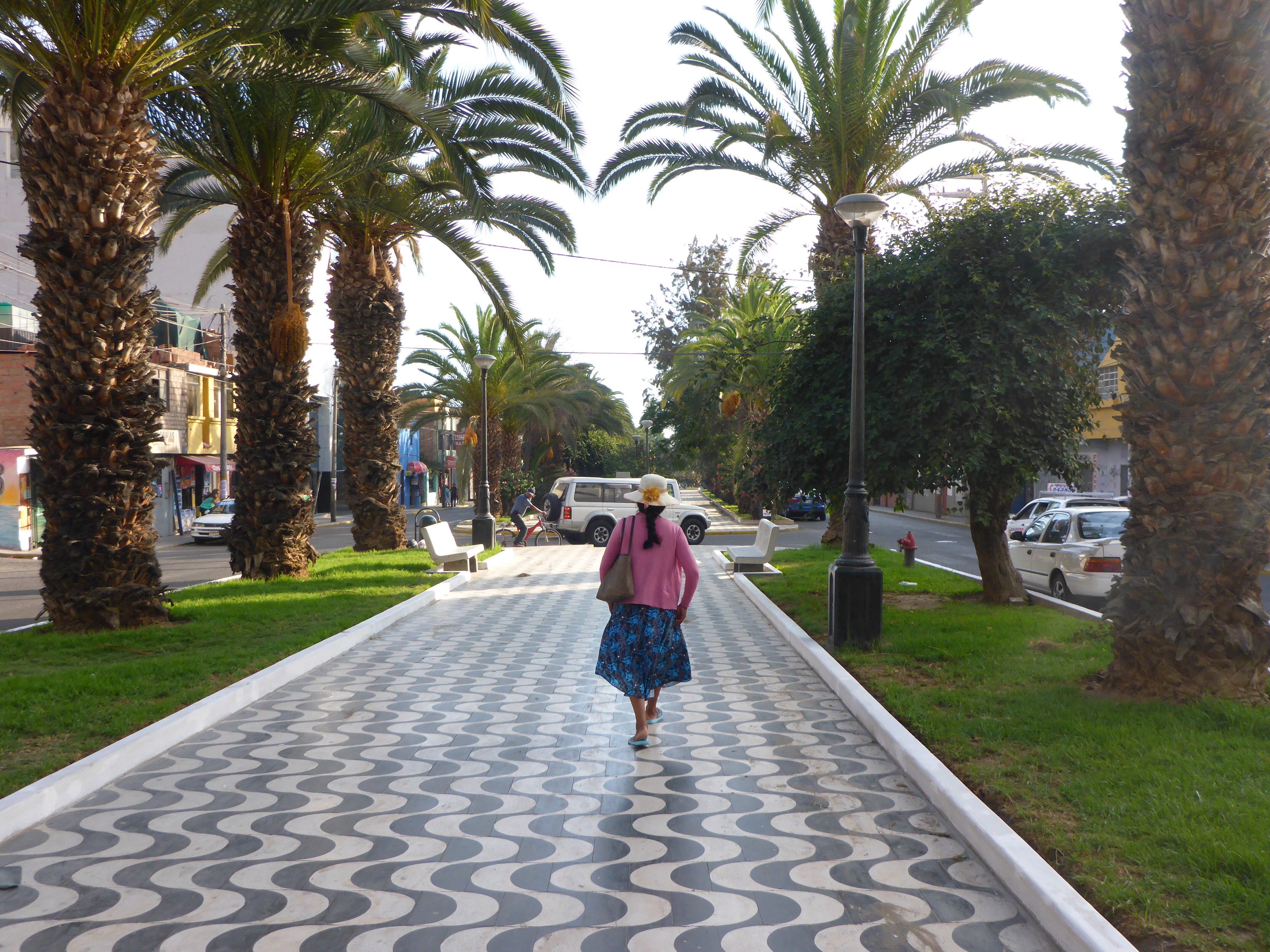
Alameda Bolognesi walkway in Tacna

Alameda Bolognesi walkway in Tacna

Tacna Paseo Civico
Tacna Paseo Civico

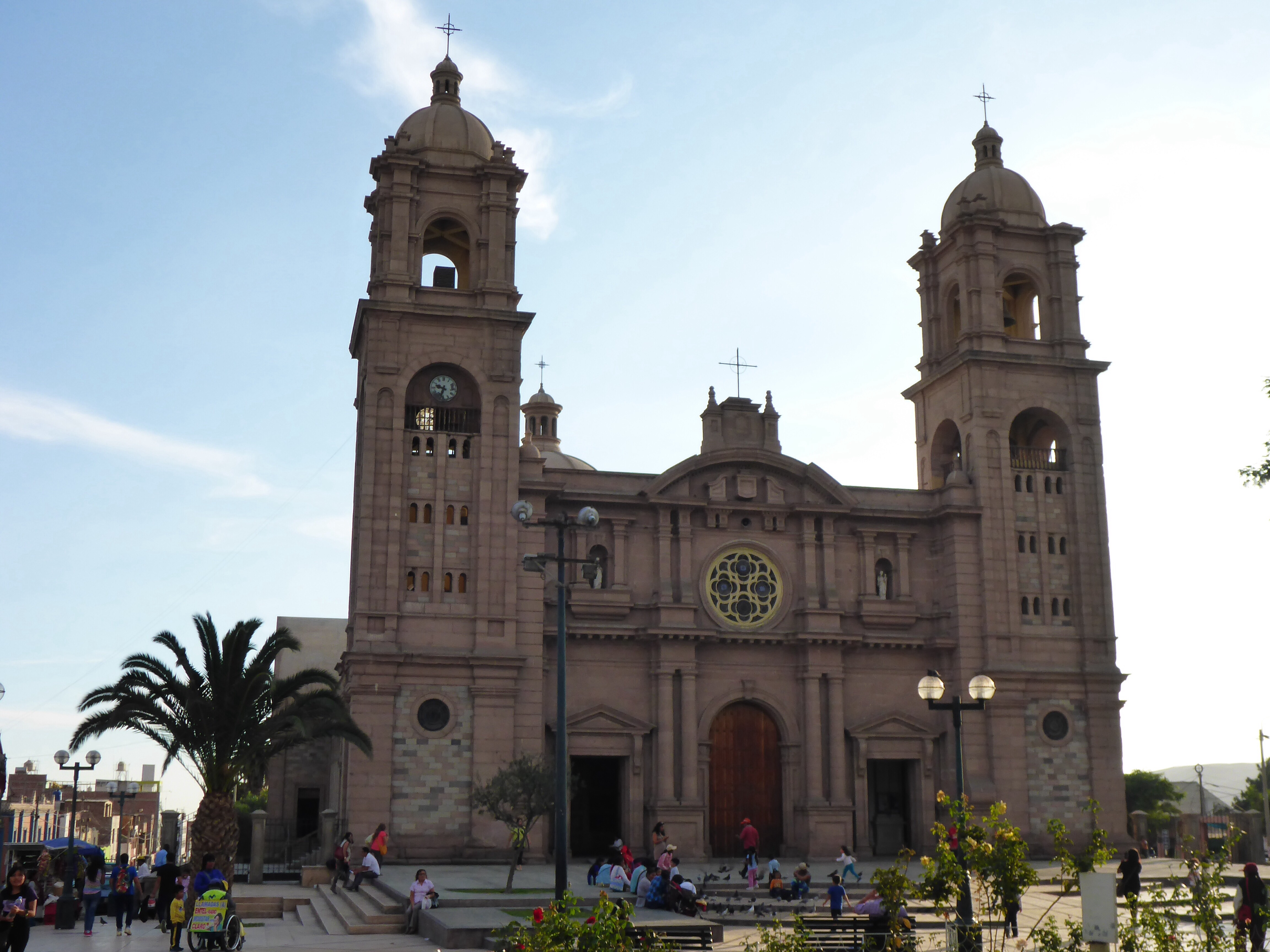
Tacna neo-renaissance cathedral
Tacna neo-renaissance cathedral

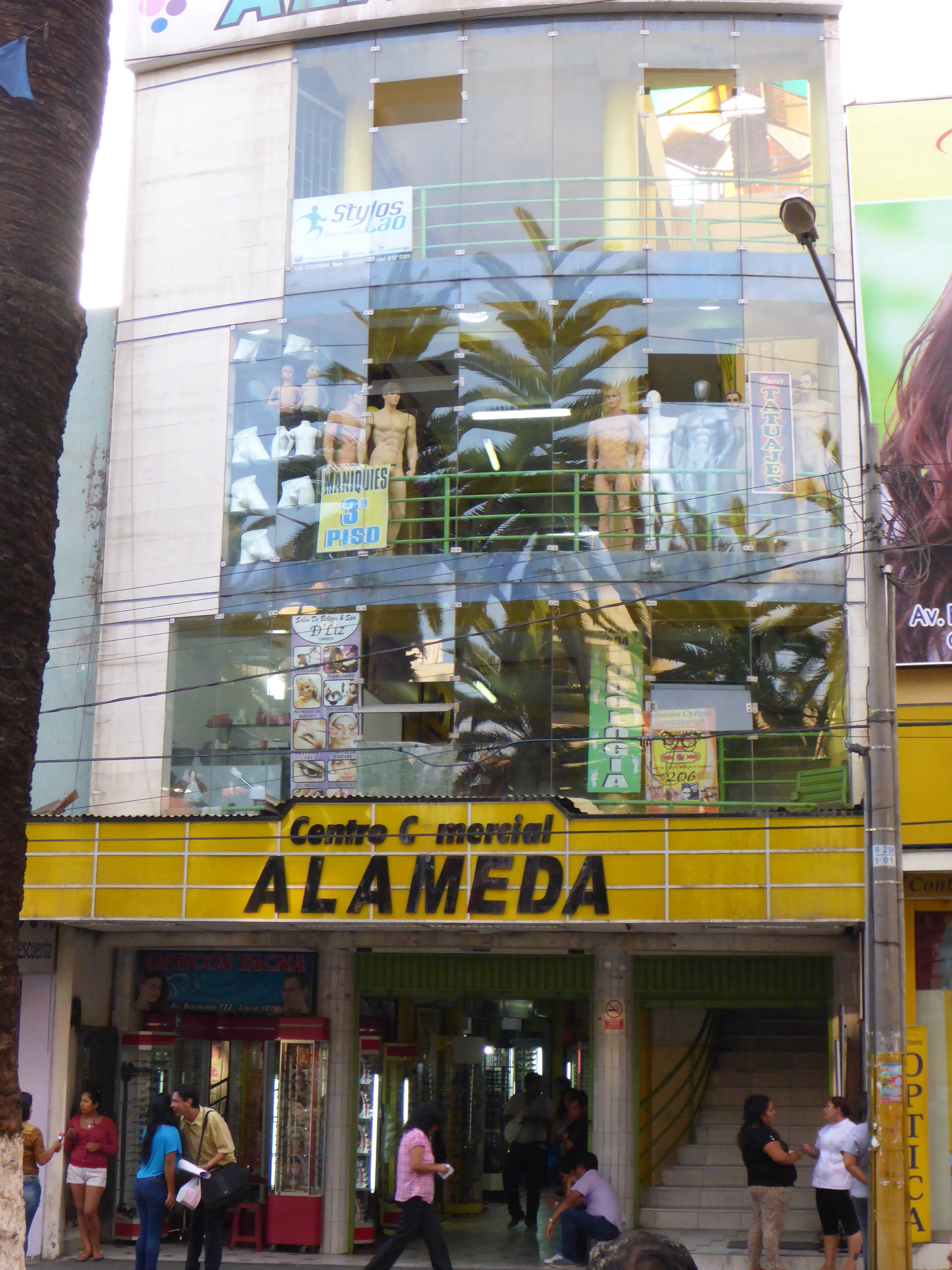
Unusual store in Tacna

Unusual store in Tacna


Espiritus Santo church in  Tacna

Espiritus Santo church in Tacna

We get up at 6am this morning, 28th March, as we have a long ride to Arequipa, 400kms is not that far, but we don’t know what the road condition or traffic will be like. Our lovely hotel managers have agreed to have our breakfast ready a little earlier than usual for our early departure. The bread rolls arrive fresh from the bakery. It is a simple little hotel but the service and personal touch are wonderful. This is one of those times I really wish I could speak Spanish. It is more than good service, I feel a personal connection. The gentle touch of our shoulders meant so much more, it came from the heart, warm hearts. In my frustration at myself having realised at the time of paying for the night that I was missing my Visa card, I didn’t think of taking a photo of them or get their names. Yet, their warmth will remain with me. We now have to return to the border where we purchased our road insurance yesterday as this is where I am sure I forgot to collect it back. We really didn’t need this extra mileage today… Lucky it is not too far… And Anthony in his usual supportive way is very calm about it. In situations like this, we usually beat ourselves up enough that the other one feels more sorry than annoyed. We’re a good team.

So off we head back to the border. I walk into the SOAT building and the lady who processed Anthony’s paperwork yesterday immediately notices and recognised me, opens her drawer and hands me my Visa card. Phew…..

Back to Tacna, in time for local rush hour now after a wasted 1.5 hours and we are finally on our way to Arequipa.
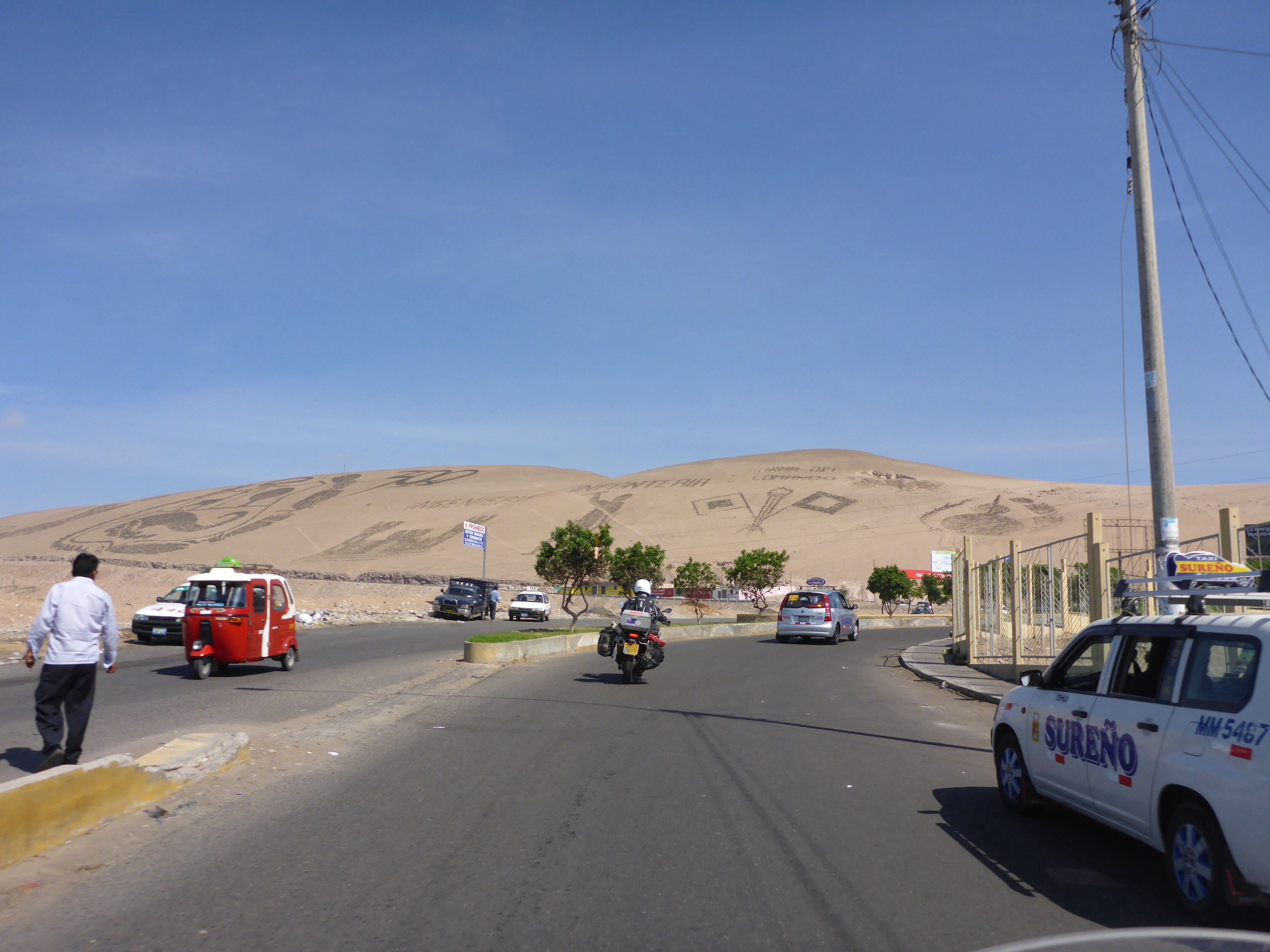
Finally leaving Tacna after a quick trip back to the border to collect Anne's credit card

Finally leaving Tacna after a quick trip back to the border to collect Anne’s credit card

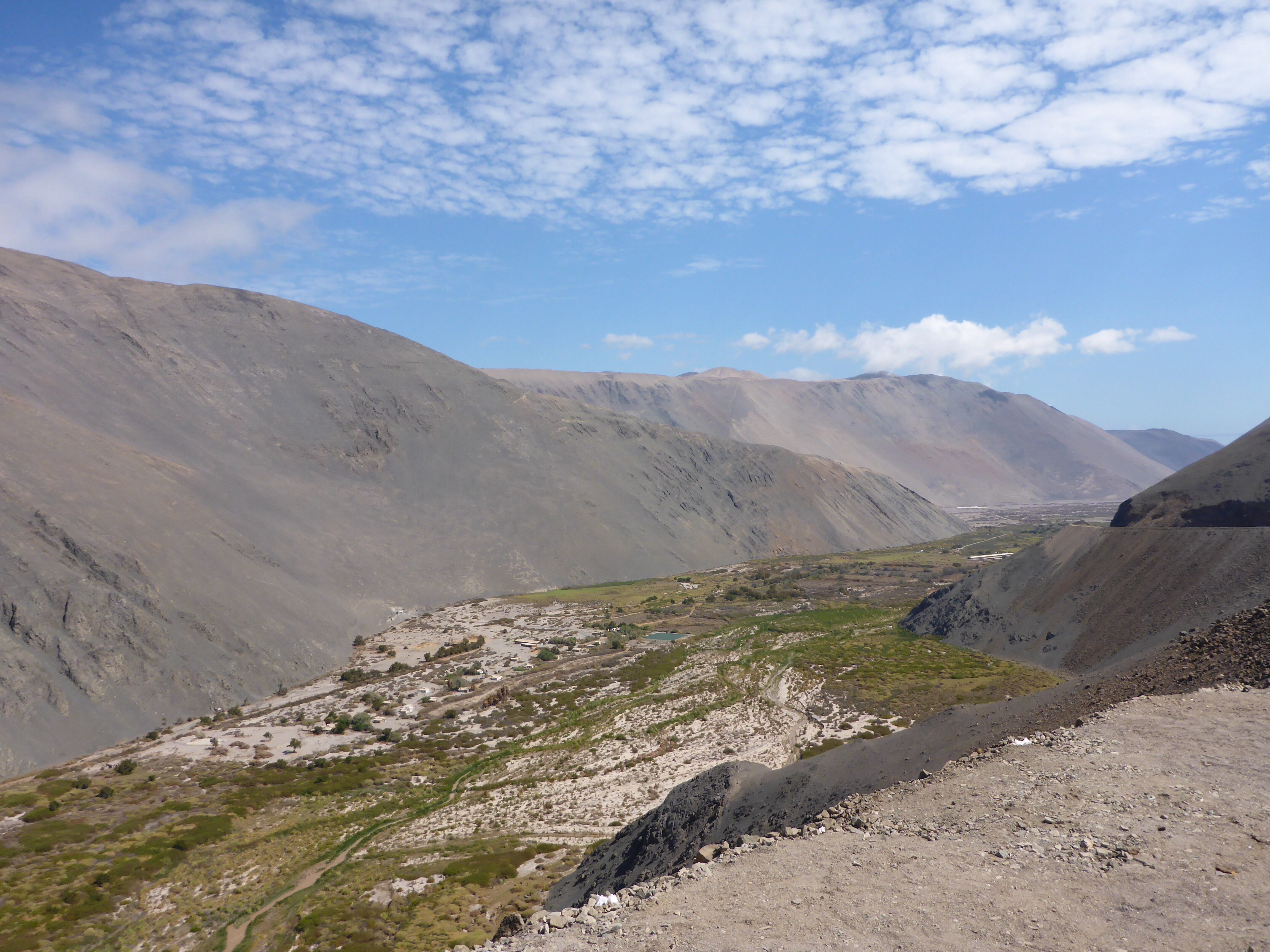
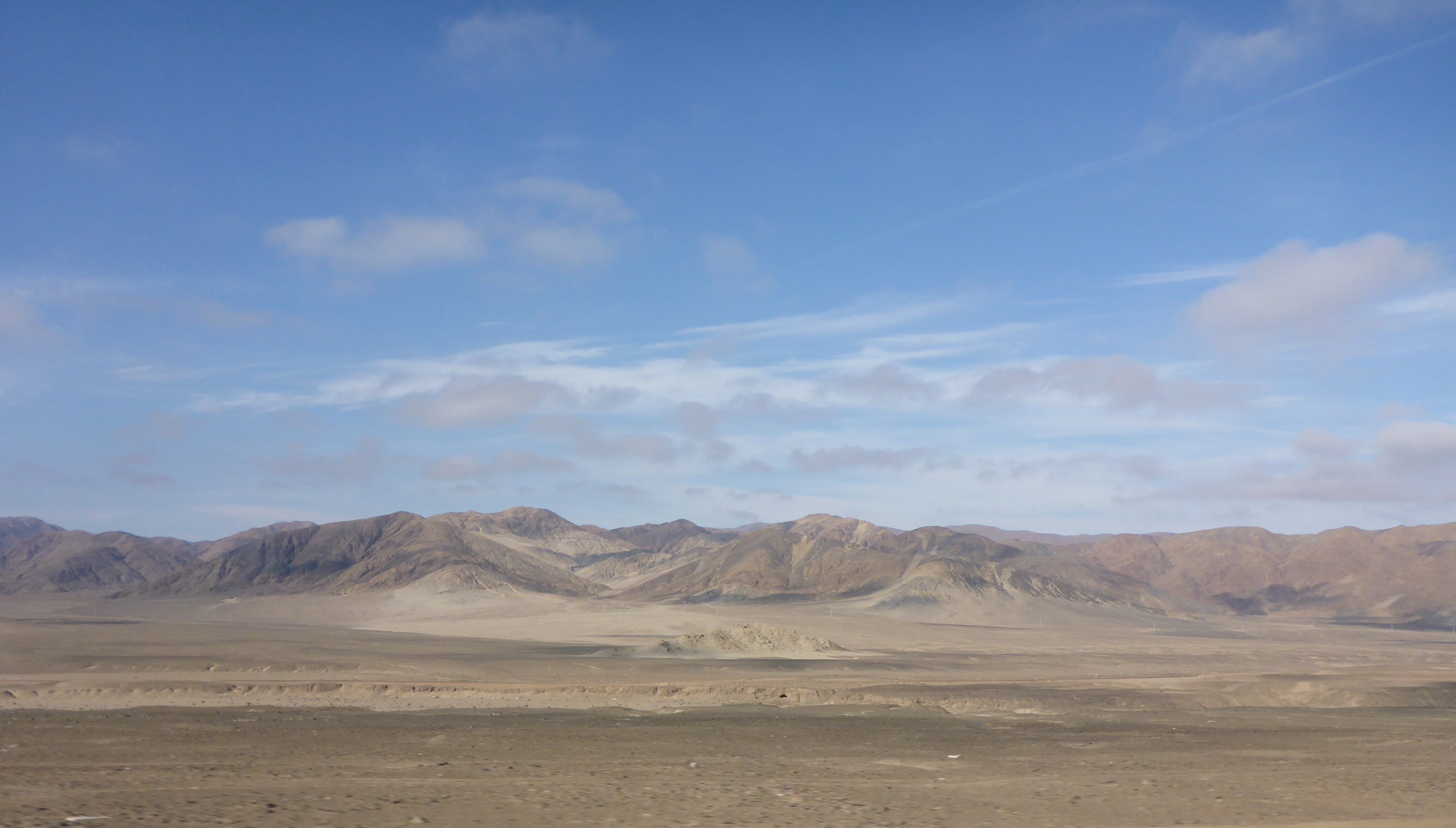
The way the scenery changes in this part of the world is always so sudden and dramatic. We head up the hill and quickly end up in a very harsh and arid desert. Just as suddenly, as we descend to cross a river, we find ourselves riding through a fantastically lush and fertile valley of alfalfa, corn, onions, avocados, fruit and even vines.
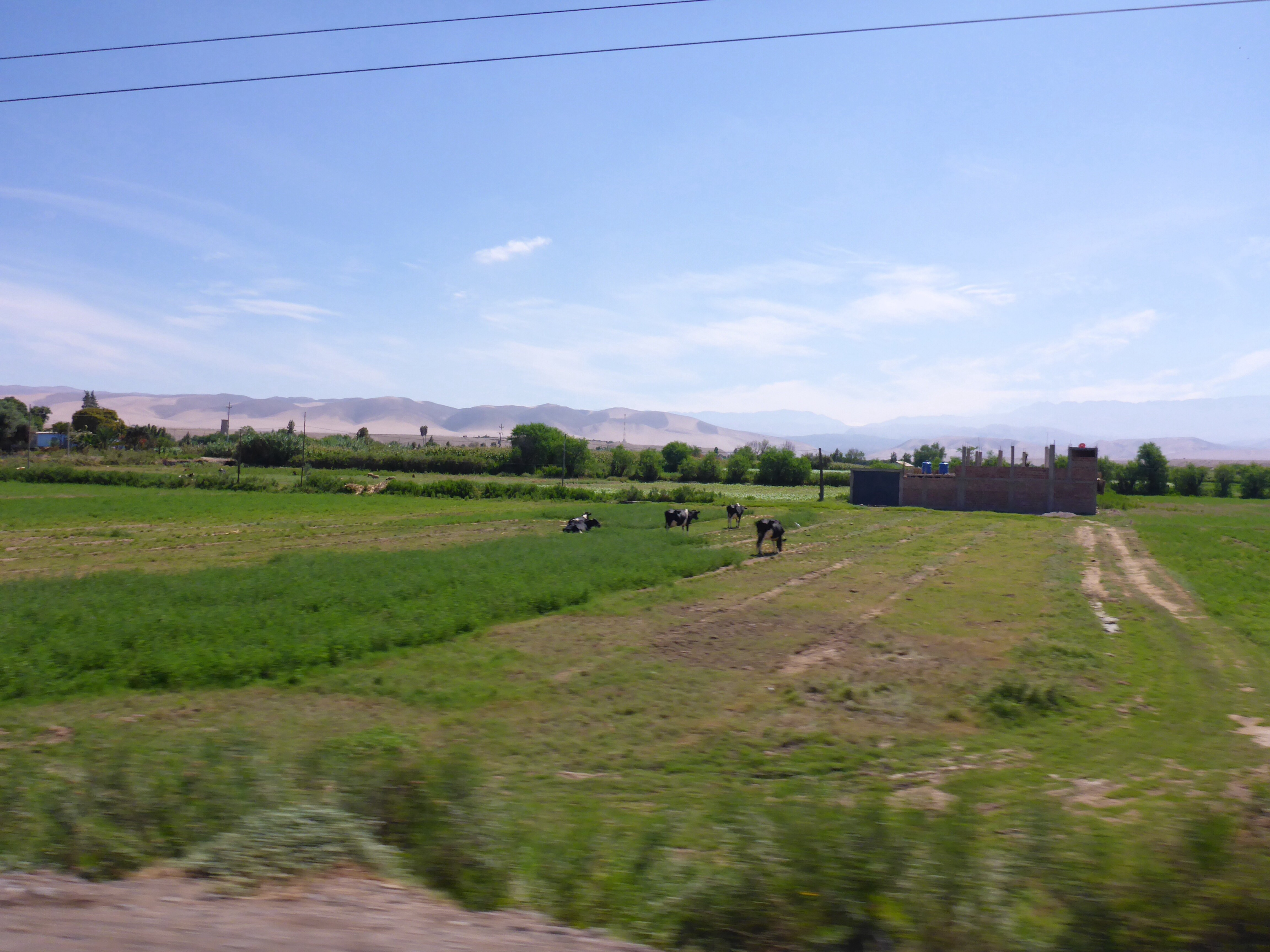
Lush valley just north of Tacna

Lush valley just north of Tacna

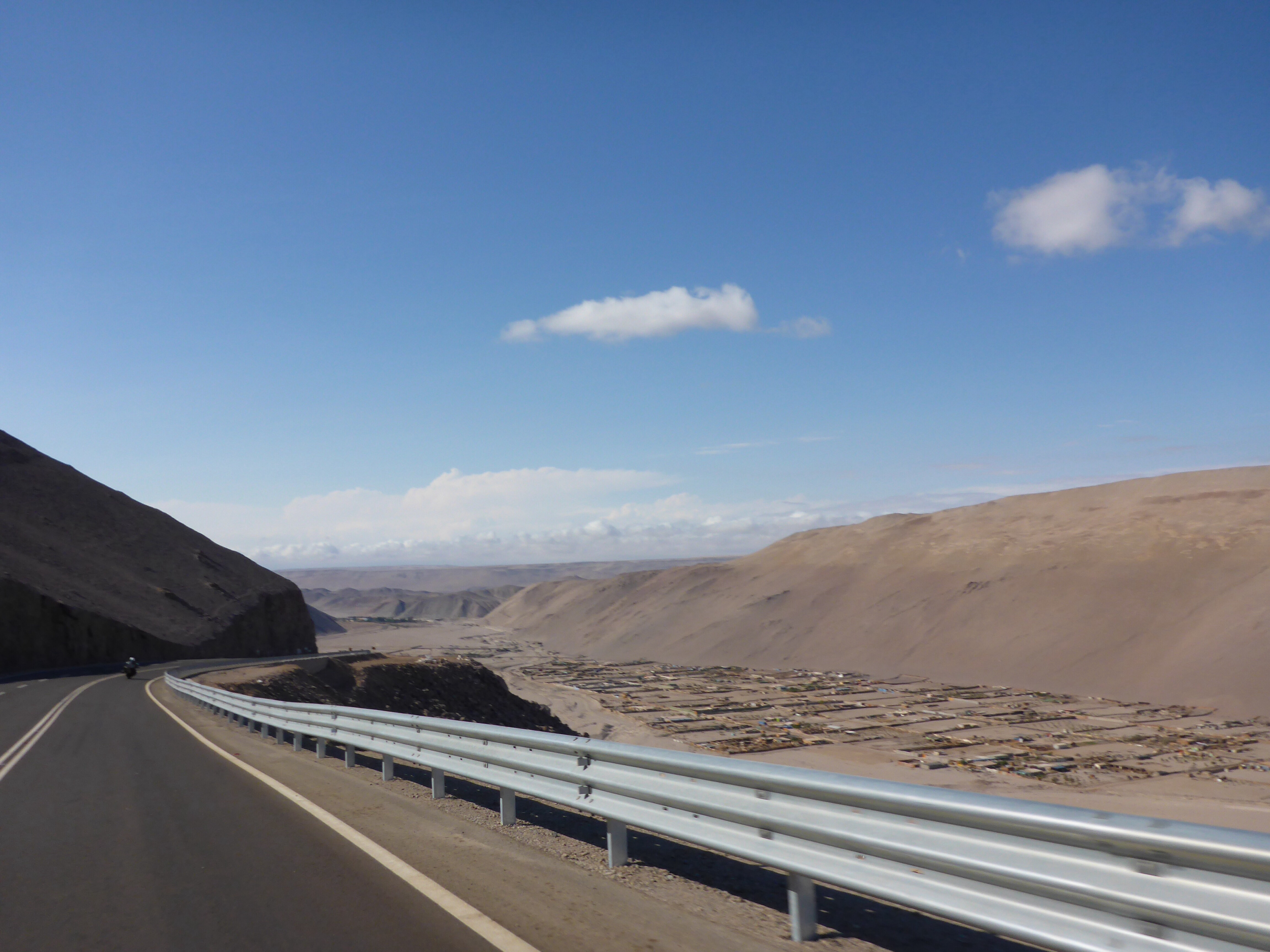
We are very puzzled at the obviously defined parcels of land. Outside Tacna, we saw tiny brick blocks, then they were woven windbreaks with huge “private property – no entry” signs and now, 10′ out of town, there are no shacks or huts, just rocks or the odd branches to mark a property entrance. I suspect blocks of land have been allocated to people by the government but why and how?? And always such barren land. Why bother?? What could anyone do with that land?? I can’t find anything about this but would love to know if anyone reading this has the answer.

What are these tiny concrete blocks outside Tacna??

What are these tiny concrete blocks outside Tacna??

What can anyone do with these land parcels outside Tacna?

What can anyone do with these land parcels outside Tacna?

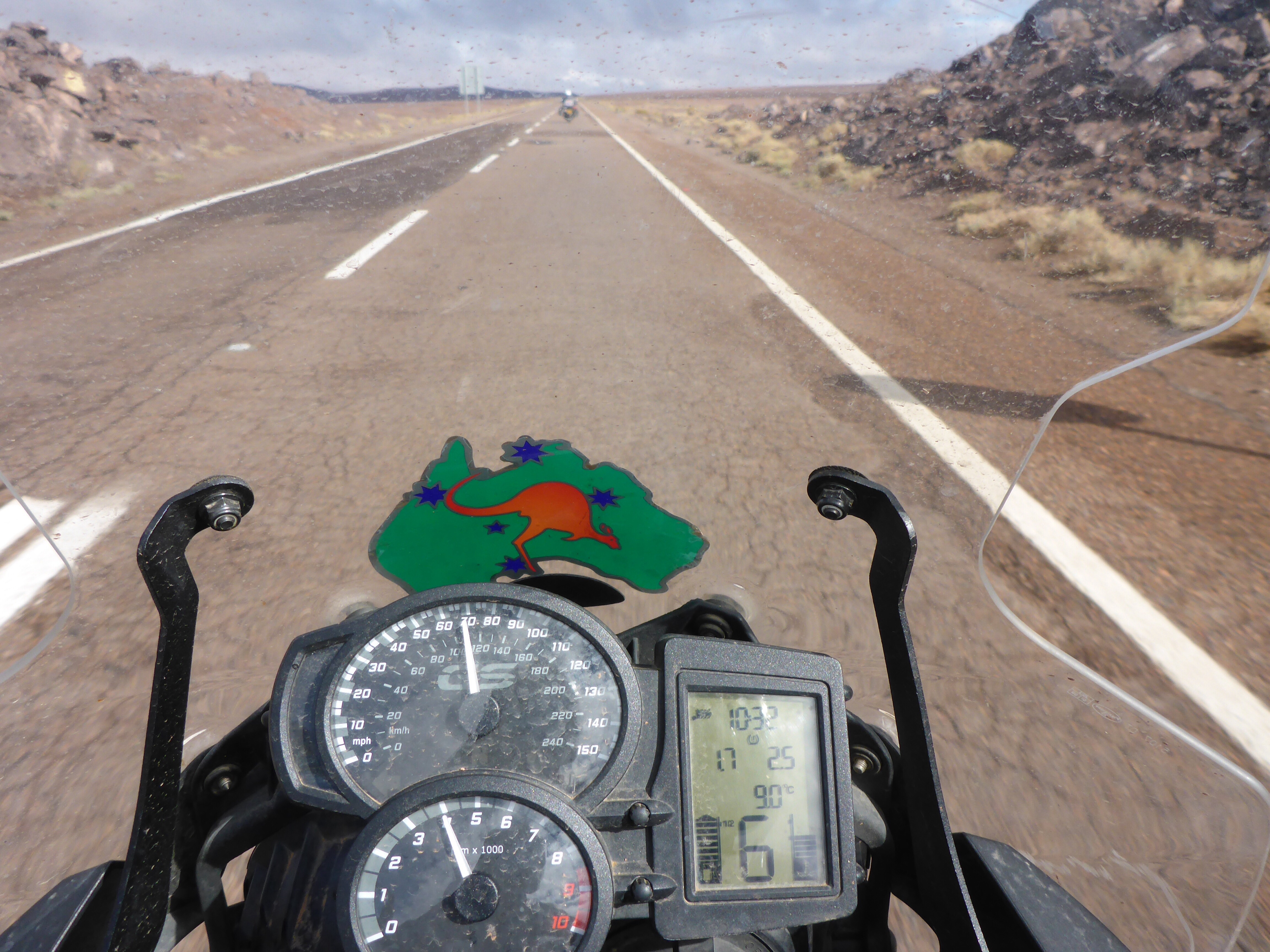
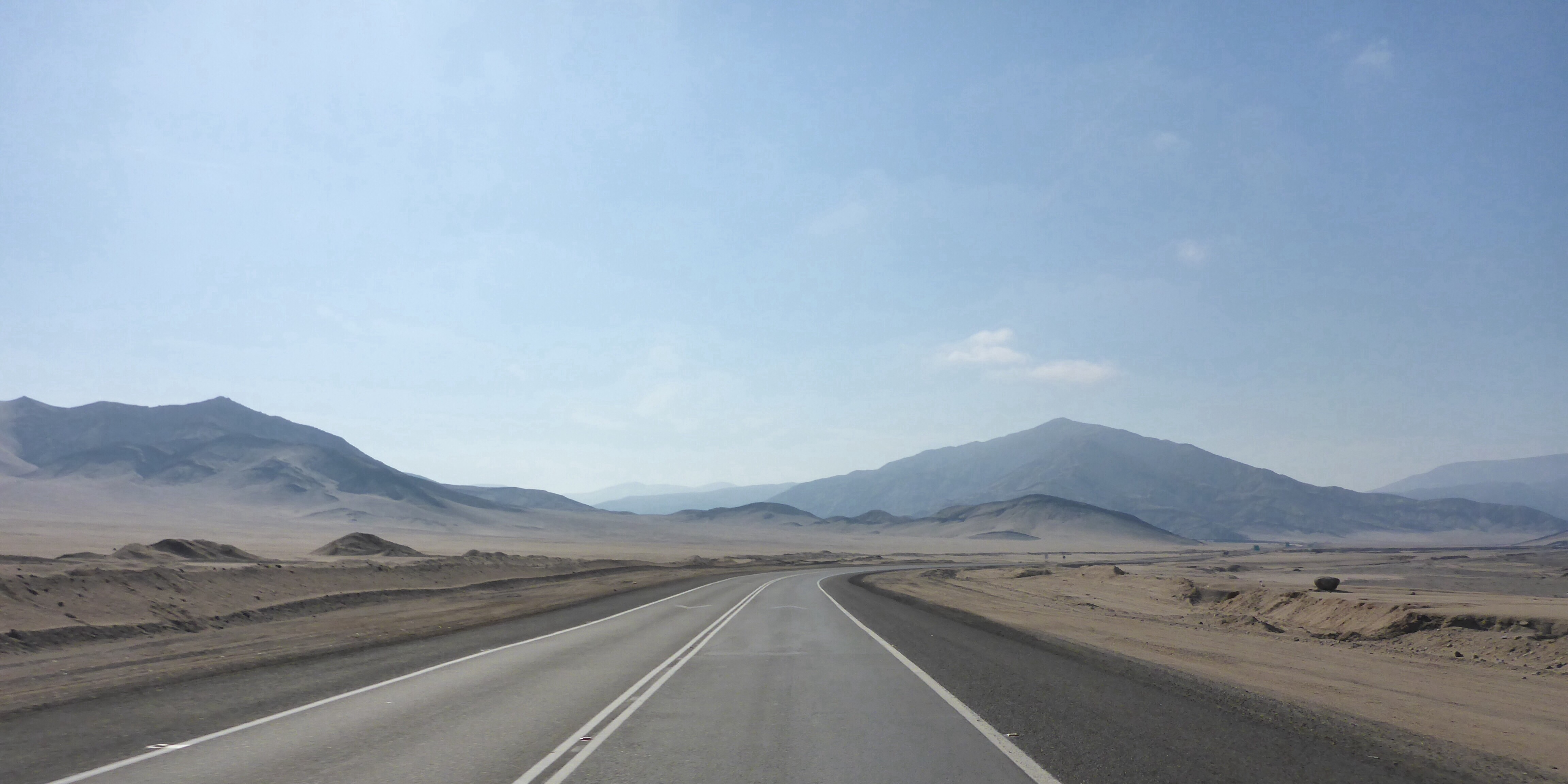
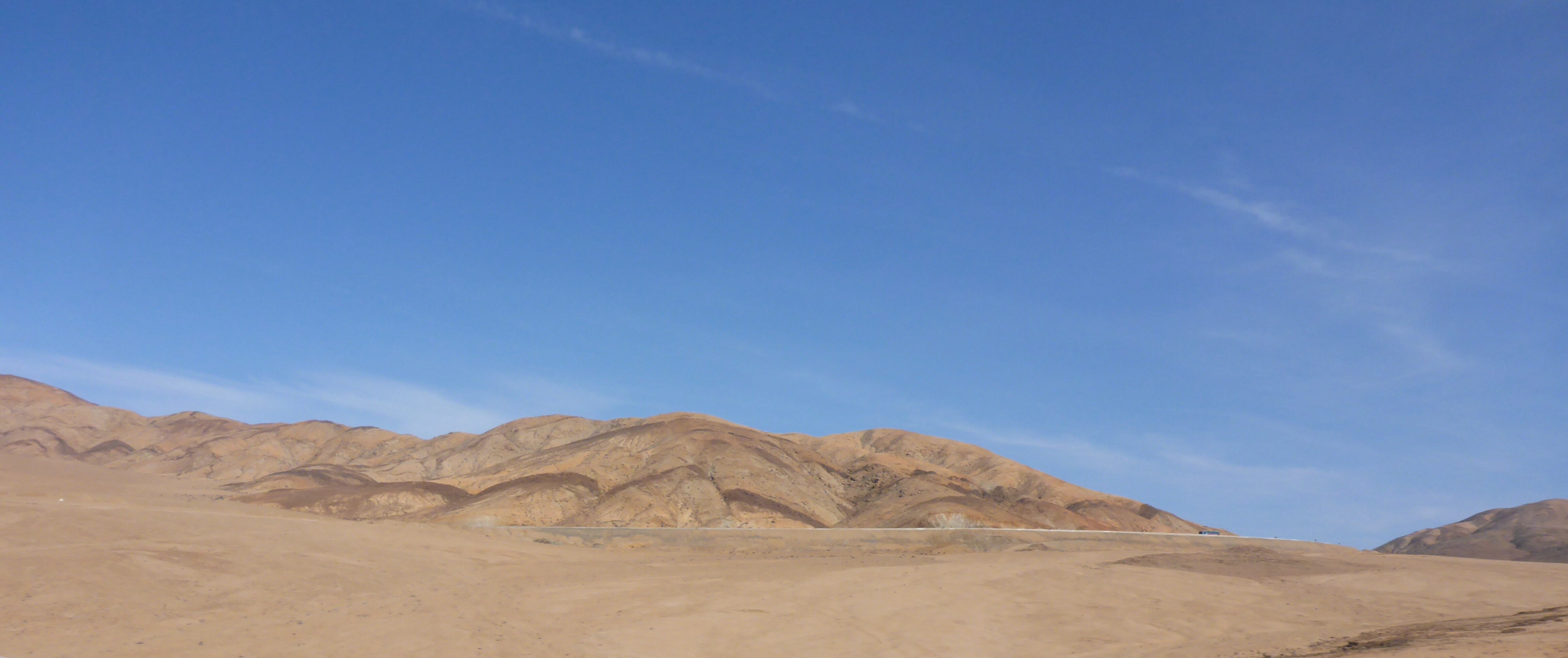
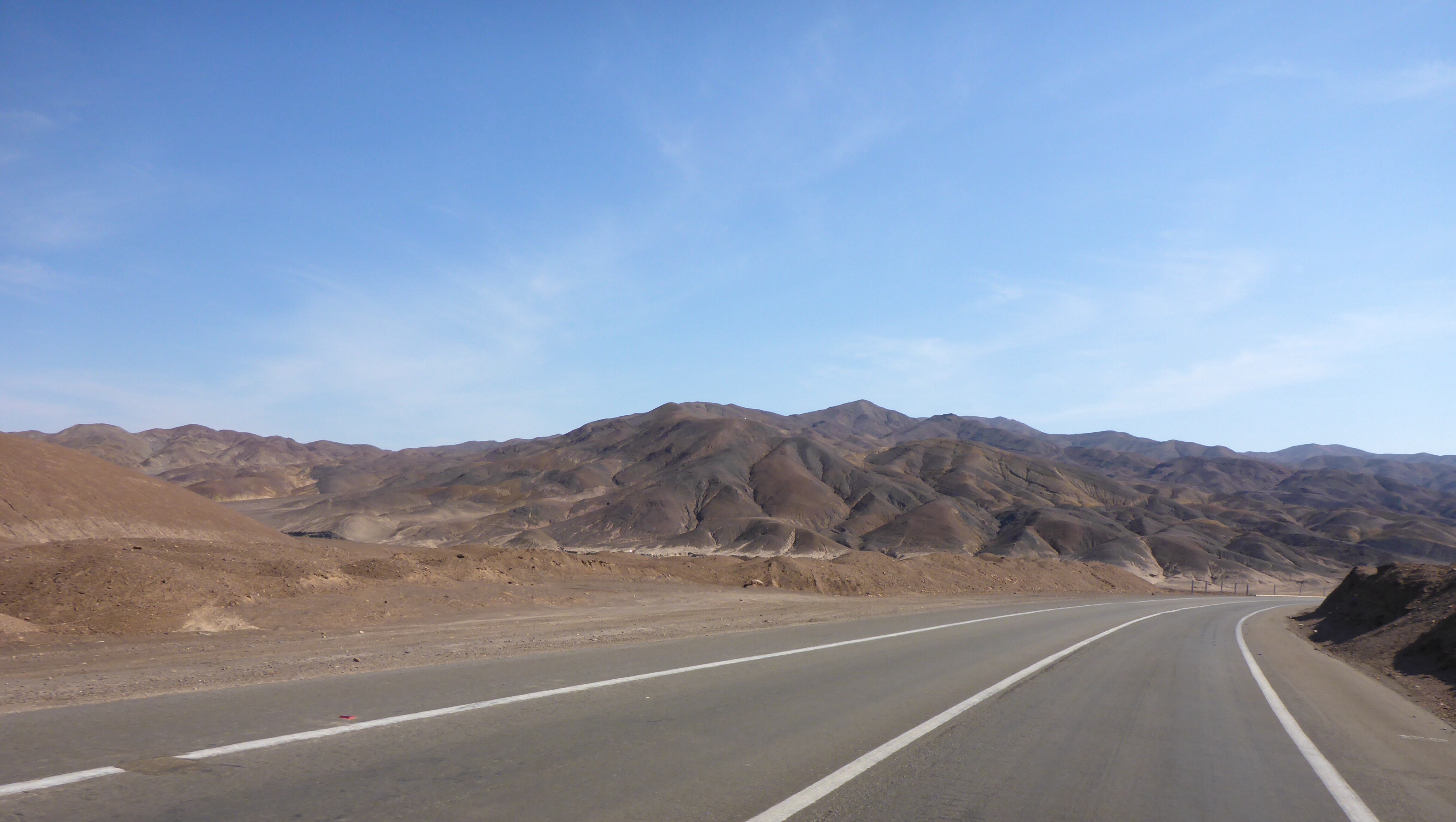
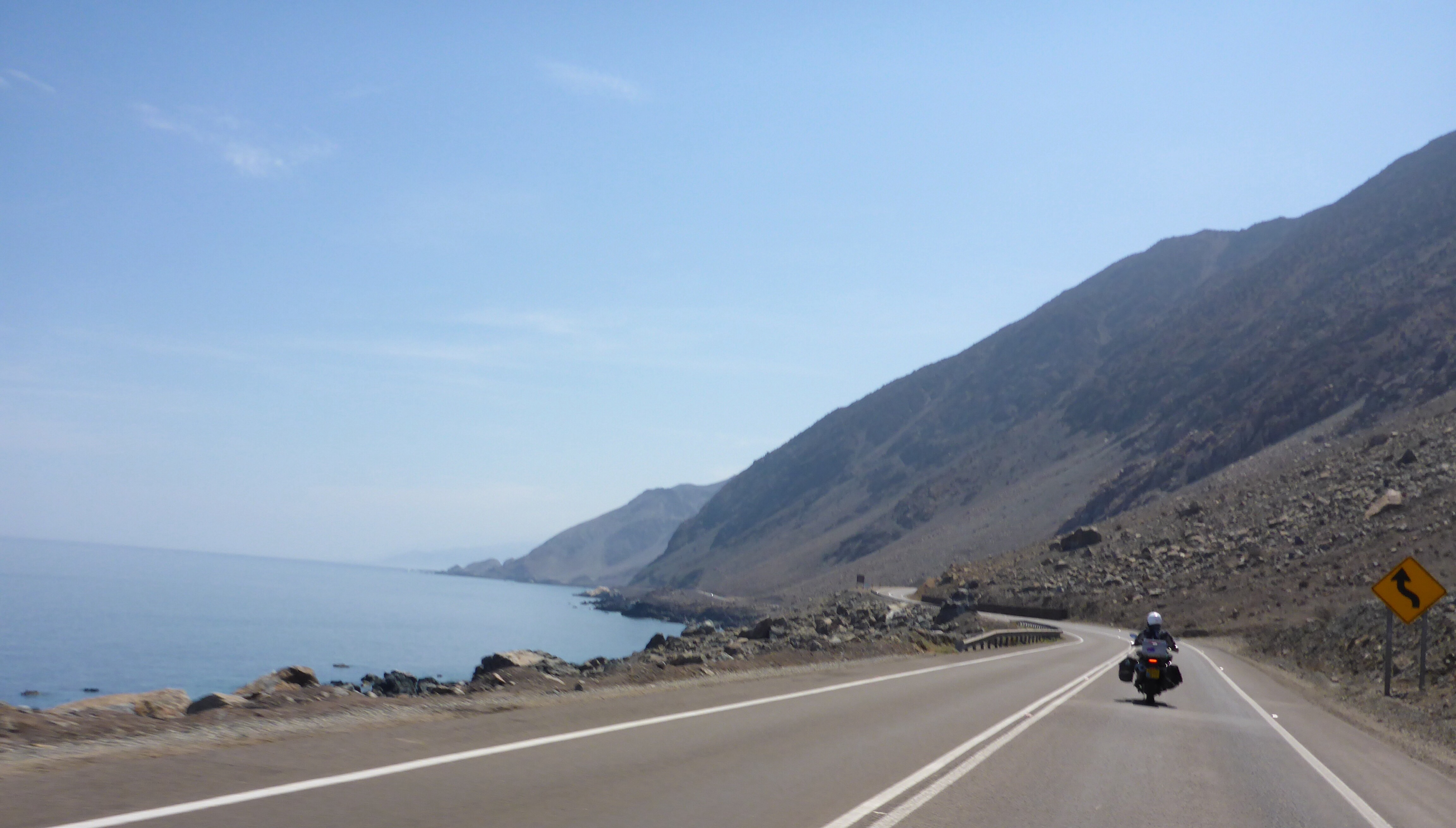
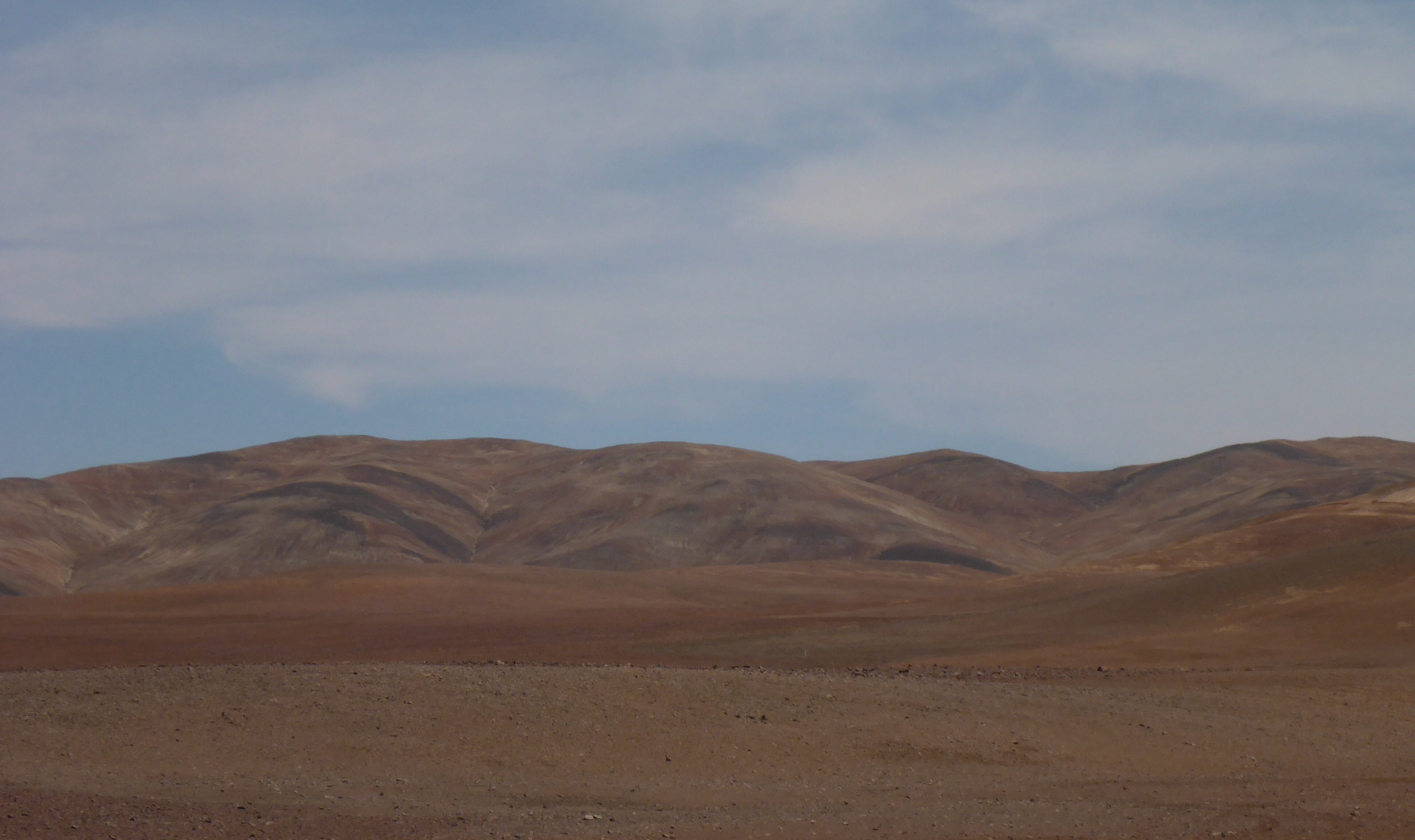
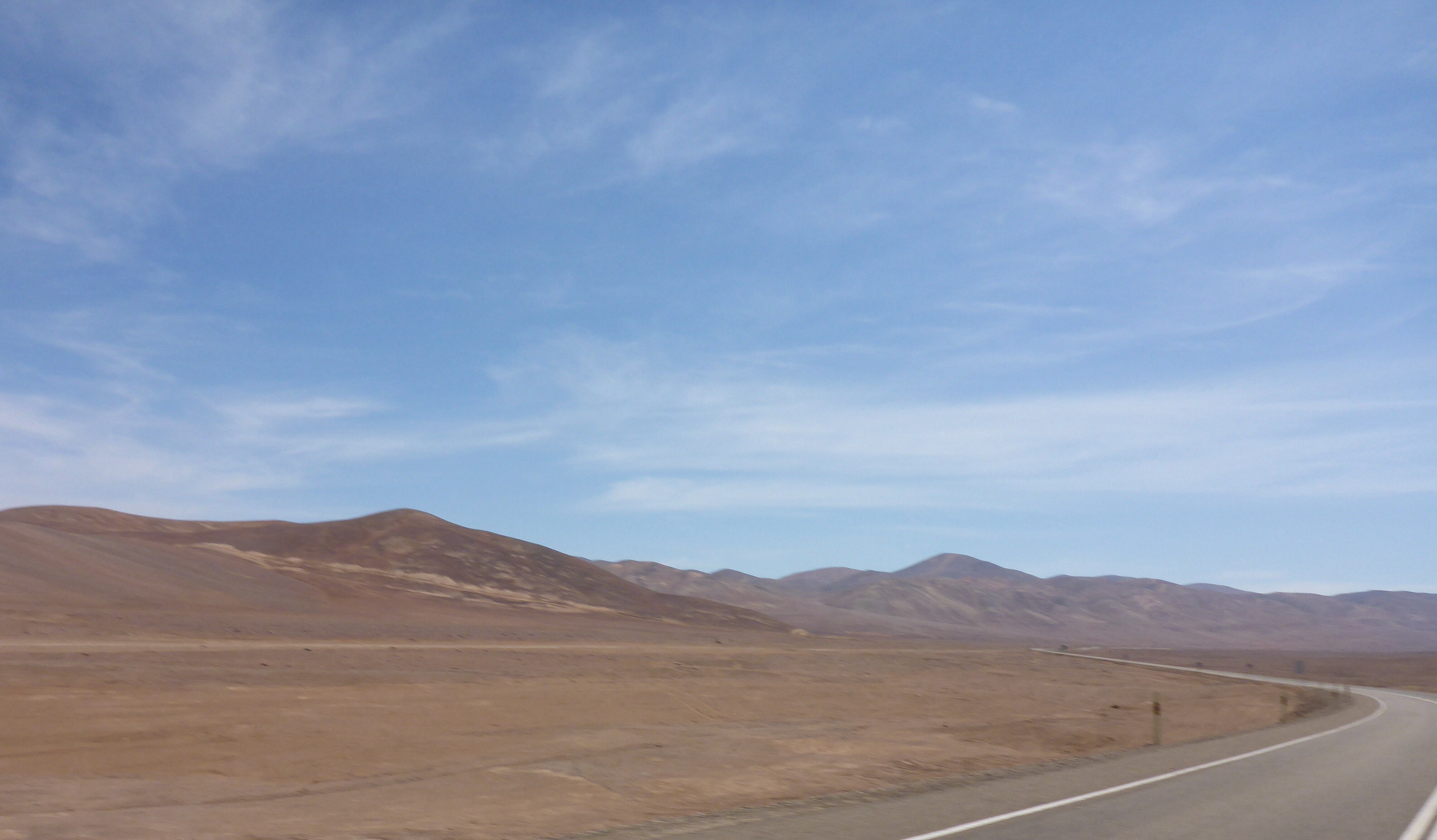
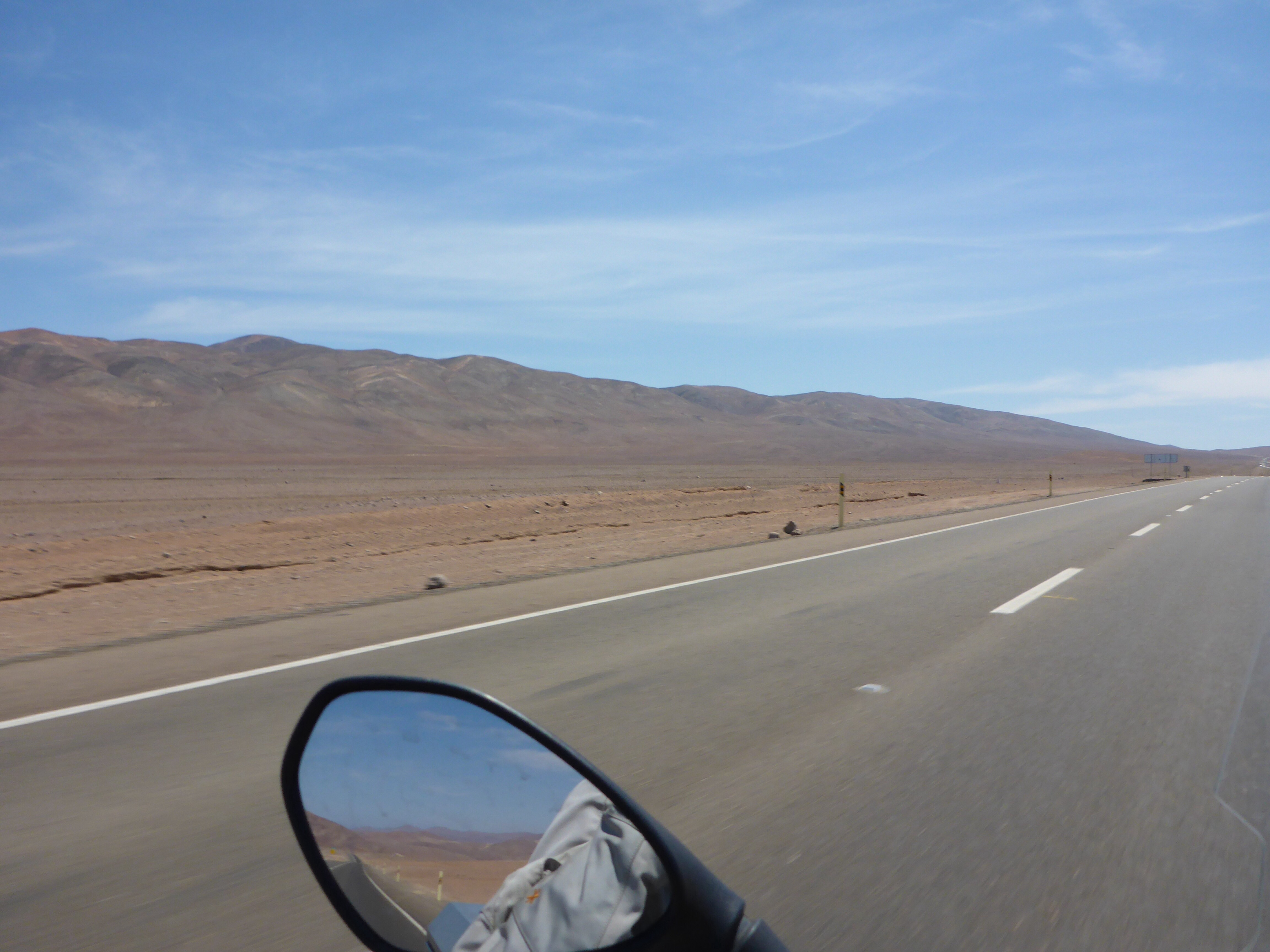
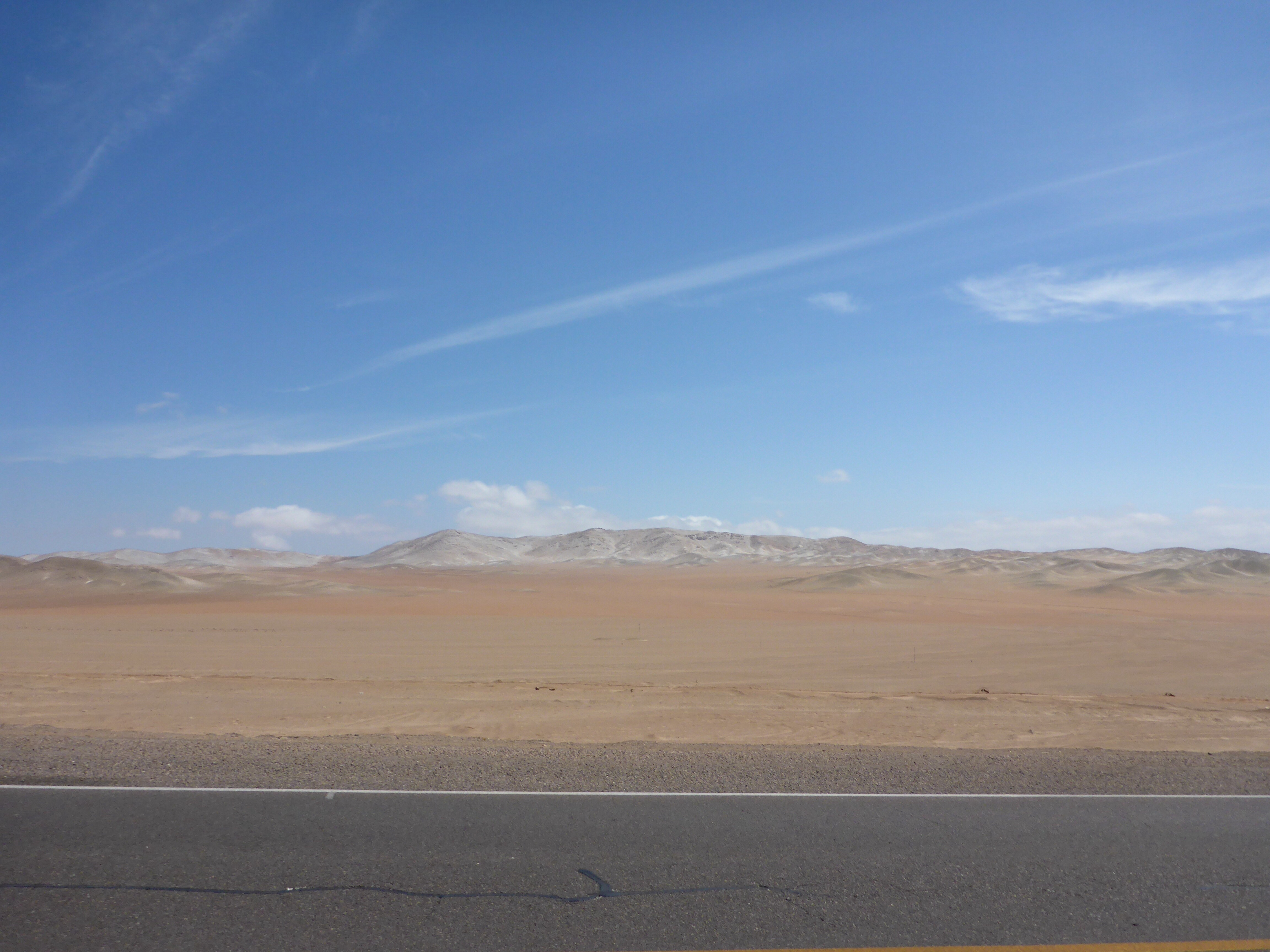
Our ride all day up to 30kms out of Arequipa has to be one of the most beautiful. Long gentle climbs to high plateaus, perfect curves for bike riding, little traffic, then stunning descents through gorges down to the greenest and lush valleys. Again, it seemed that the colour of the rock changes at every corner – how many shades of grey, beige and red can nature create?! A most magical ride. We make several stops just to take in the scenery.
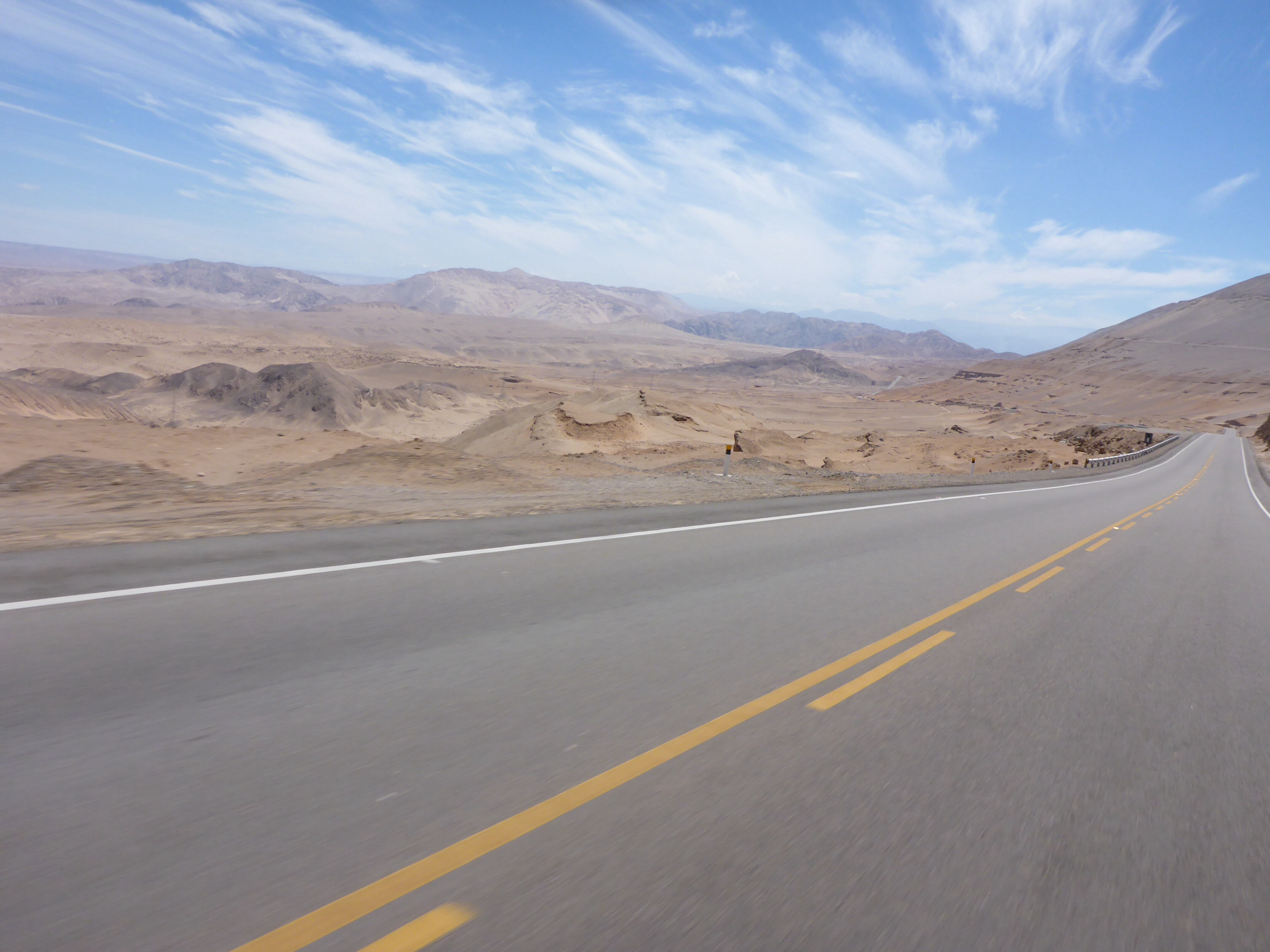
Heading down into Moquegua valley

Heading down into Moquegua valley

Moquegua valley
Moquegua valley

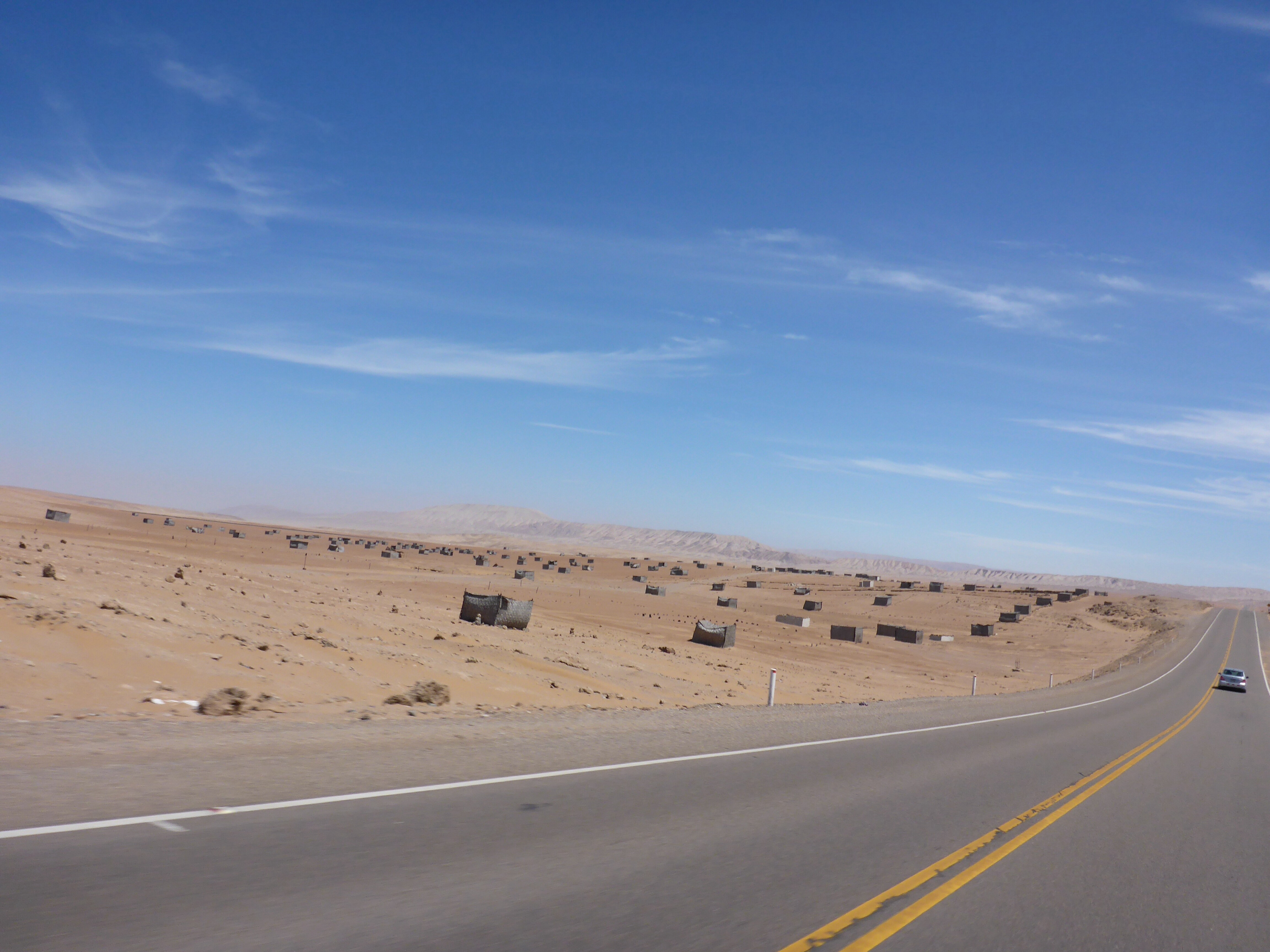
Moquegua also has those tiny parcels and shacks but there is no sign of life anywhere
Moquegua also has those tiny parcels and shacks but there is no sign of life anywhere

Along the PanAmerican Hwy between Moquegua and Cocachacra valley
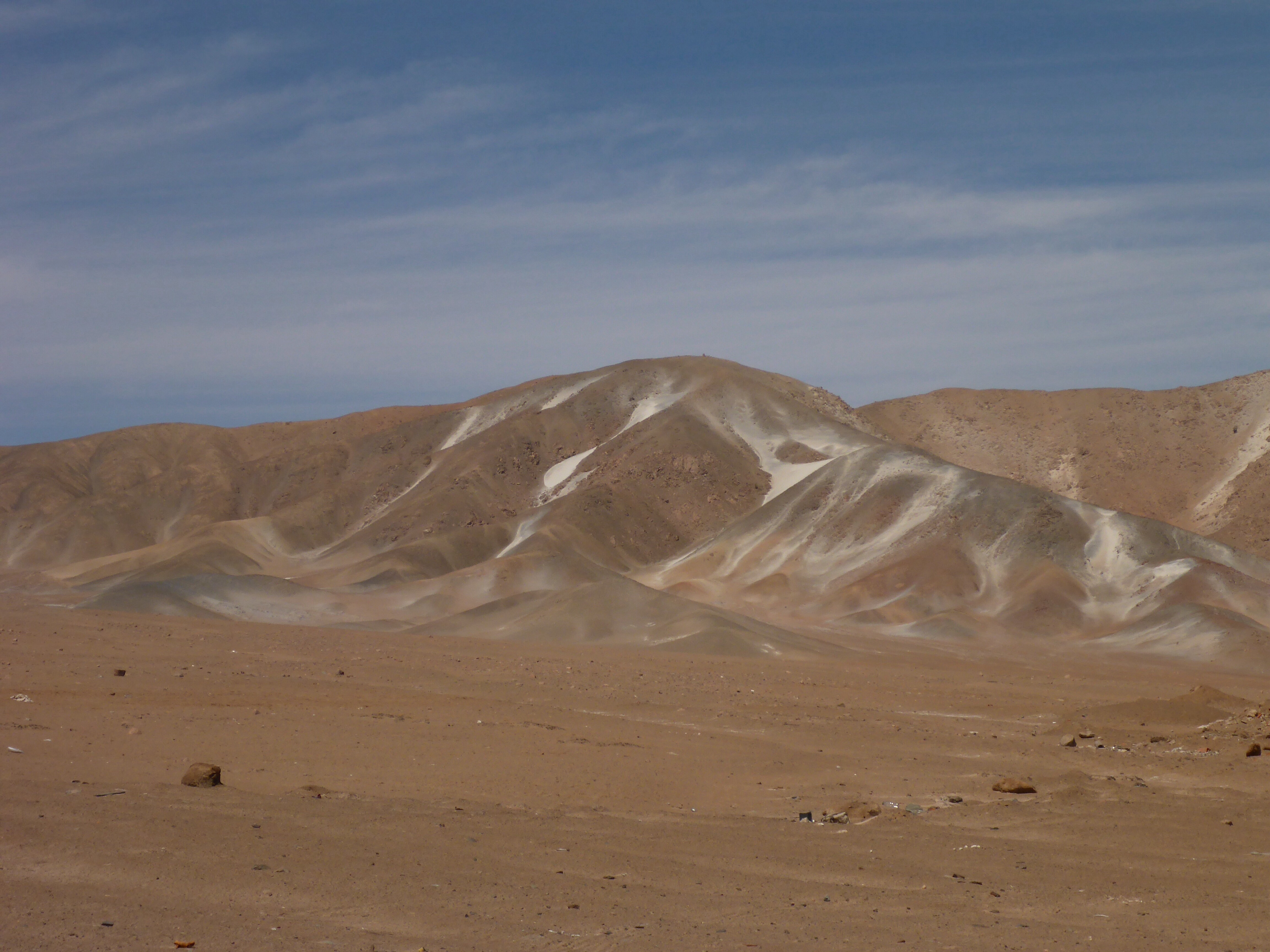
Along the PanAmerican Hwy between Moquegua and Cocachacra valley
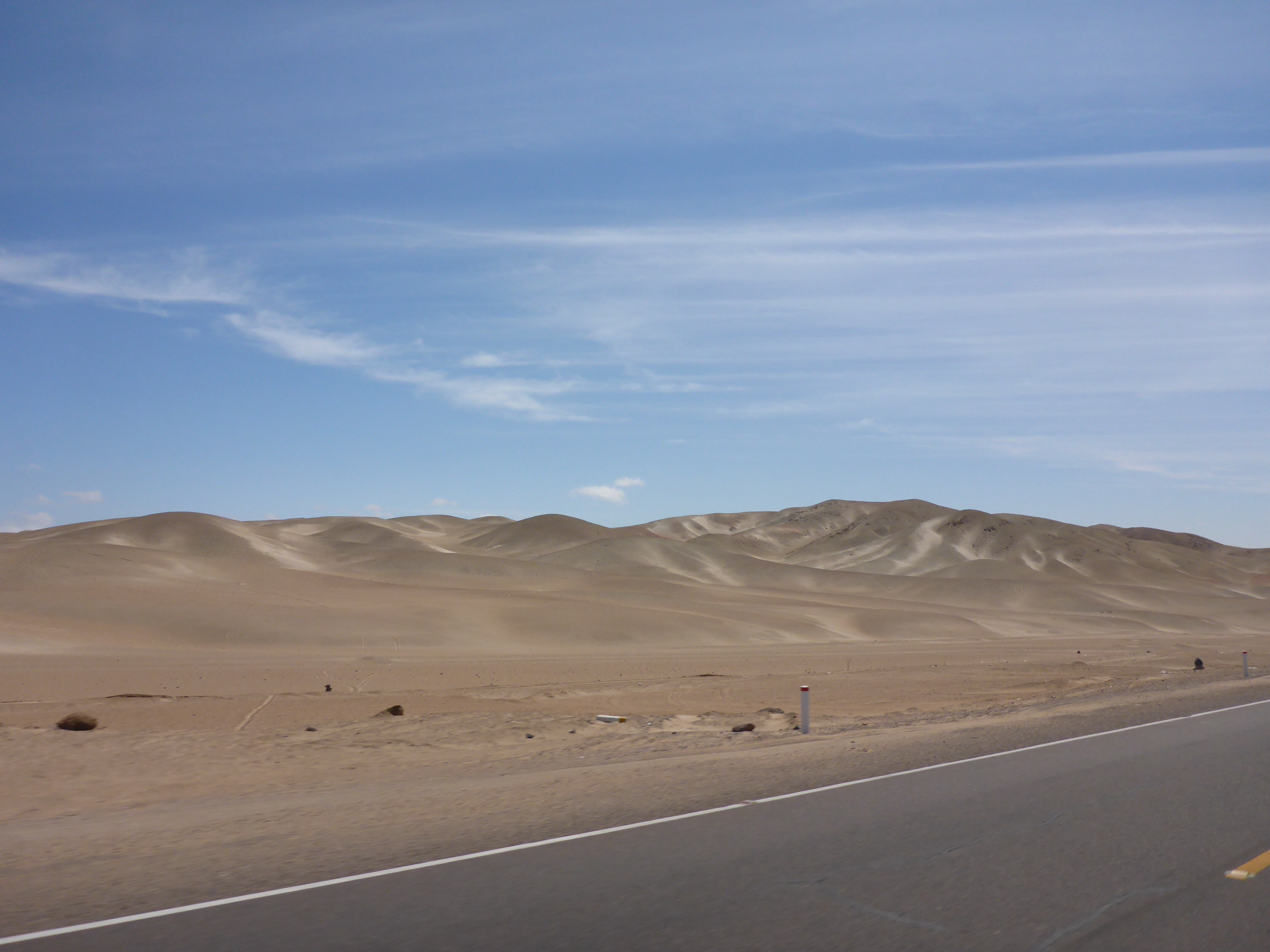
Along the PanAmerican Hwy between Moquegua and Cocachacra valley

Along the PanAmerican Hwy between Moquegua and Cocachacra valley

Starting to head down into the Cocachacra valley

Starting to head down into the Cocachacra valley

The river Tambo has carved a stunning canyon
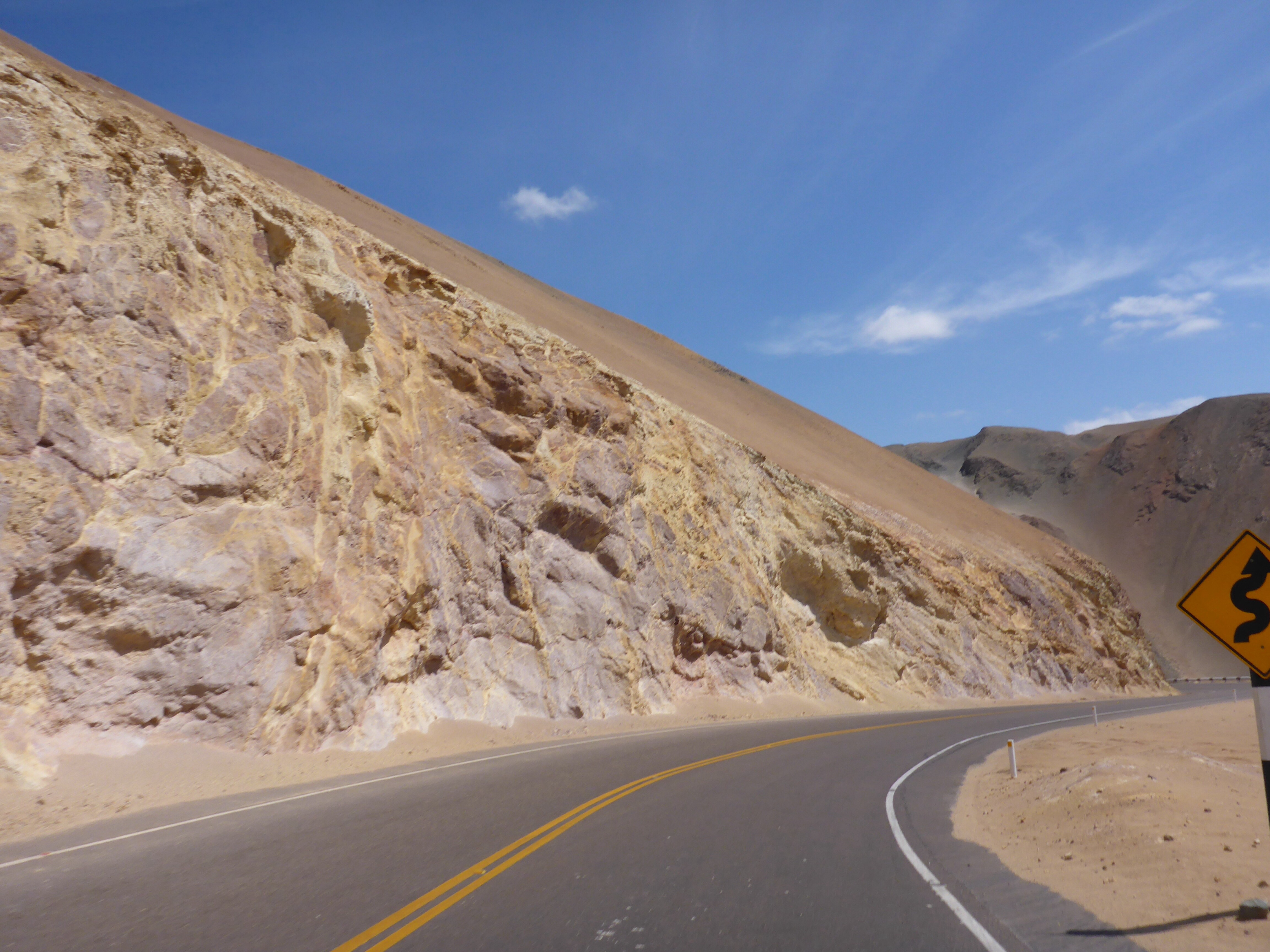
The river Tambo has carved a stunning canyon

Still going down towards the river Tambo
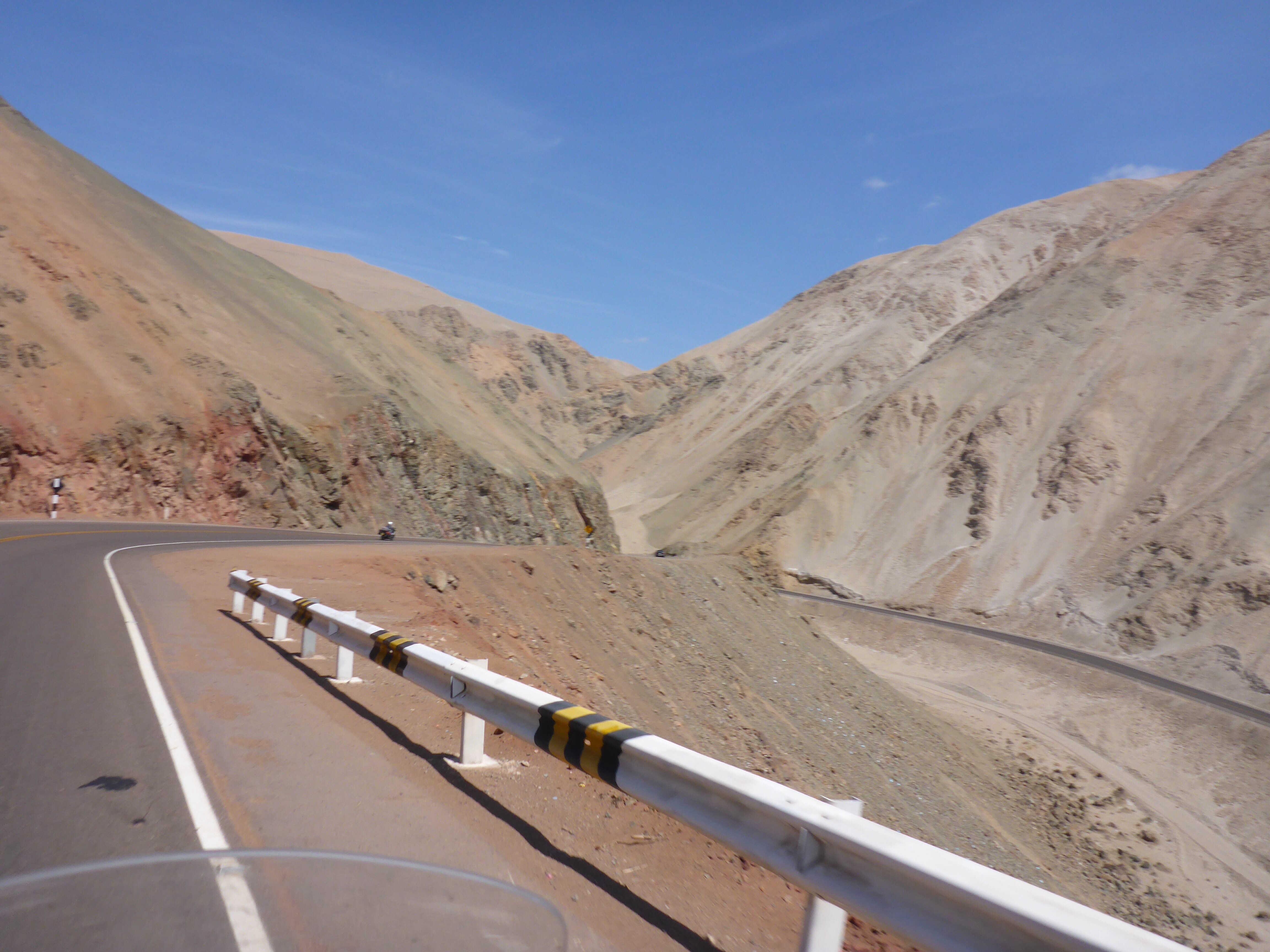
Still going down towards the river Tambo

Each turn reveals a different aspect of the canyon
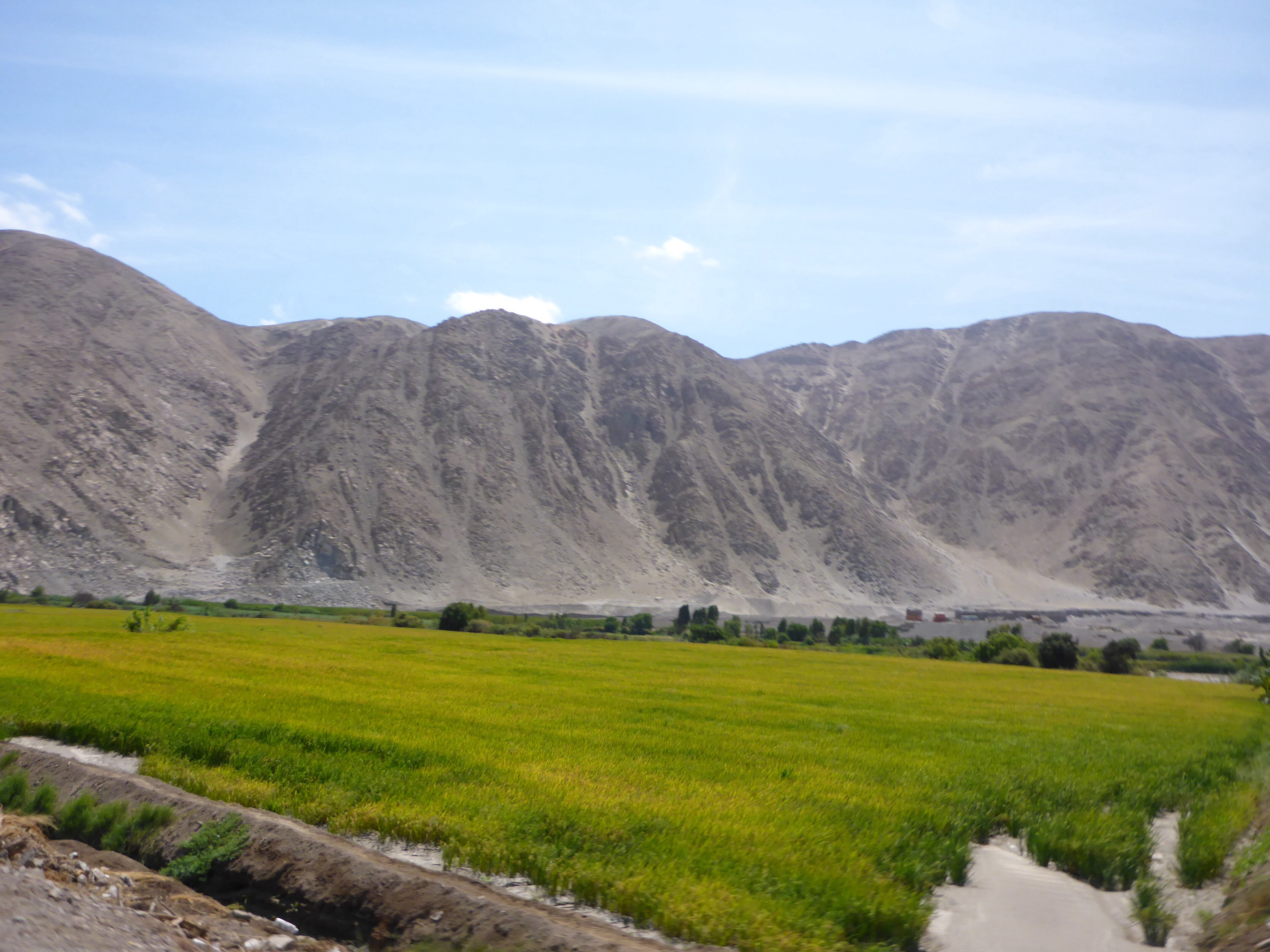
Each turn reveals a different aspect of the canyon

The lush green valley along the river Tambo
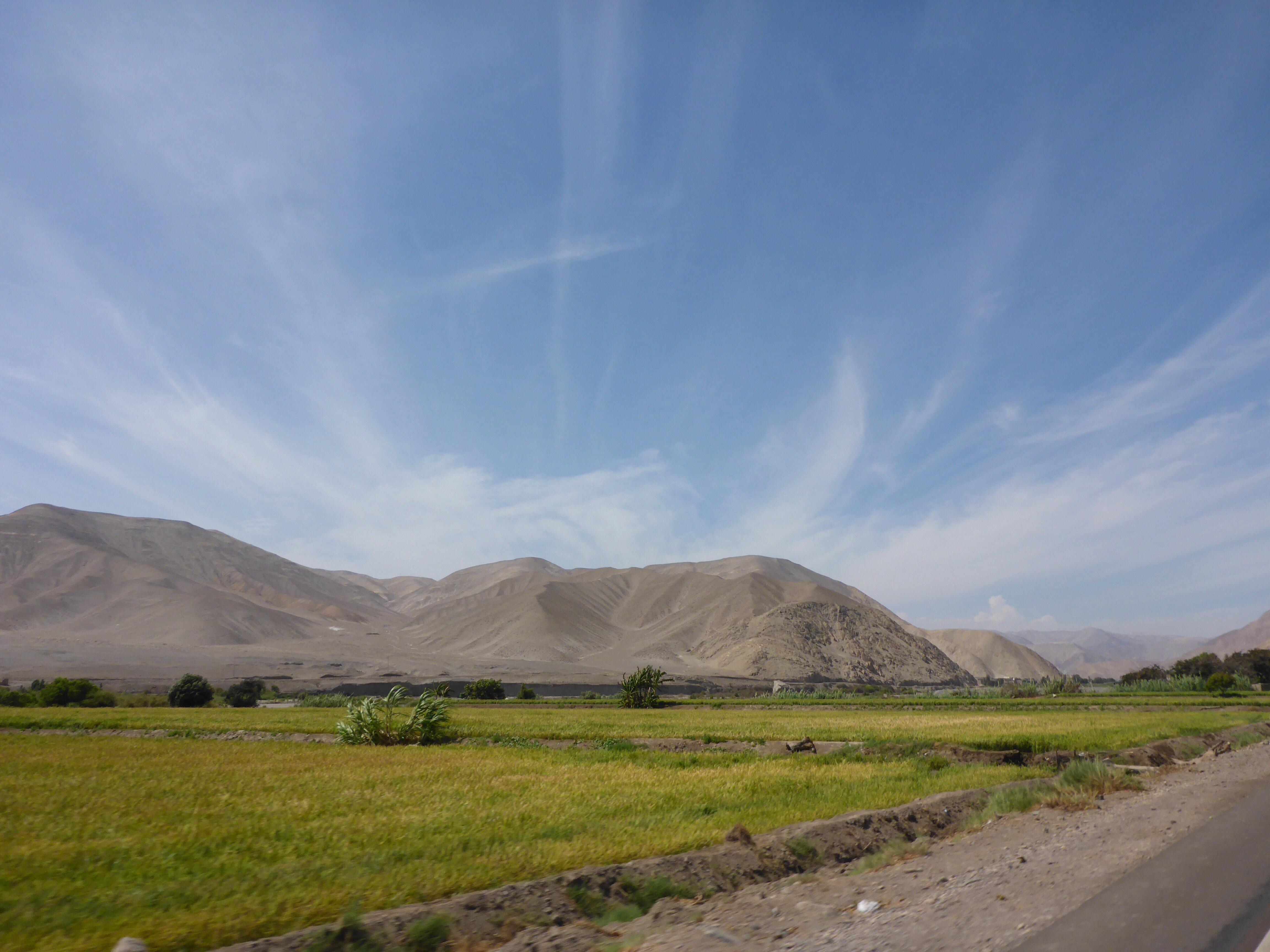
The lush green valley along the river Tambo

Looking back for a last look at the stunning valley
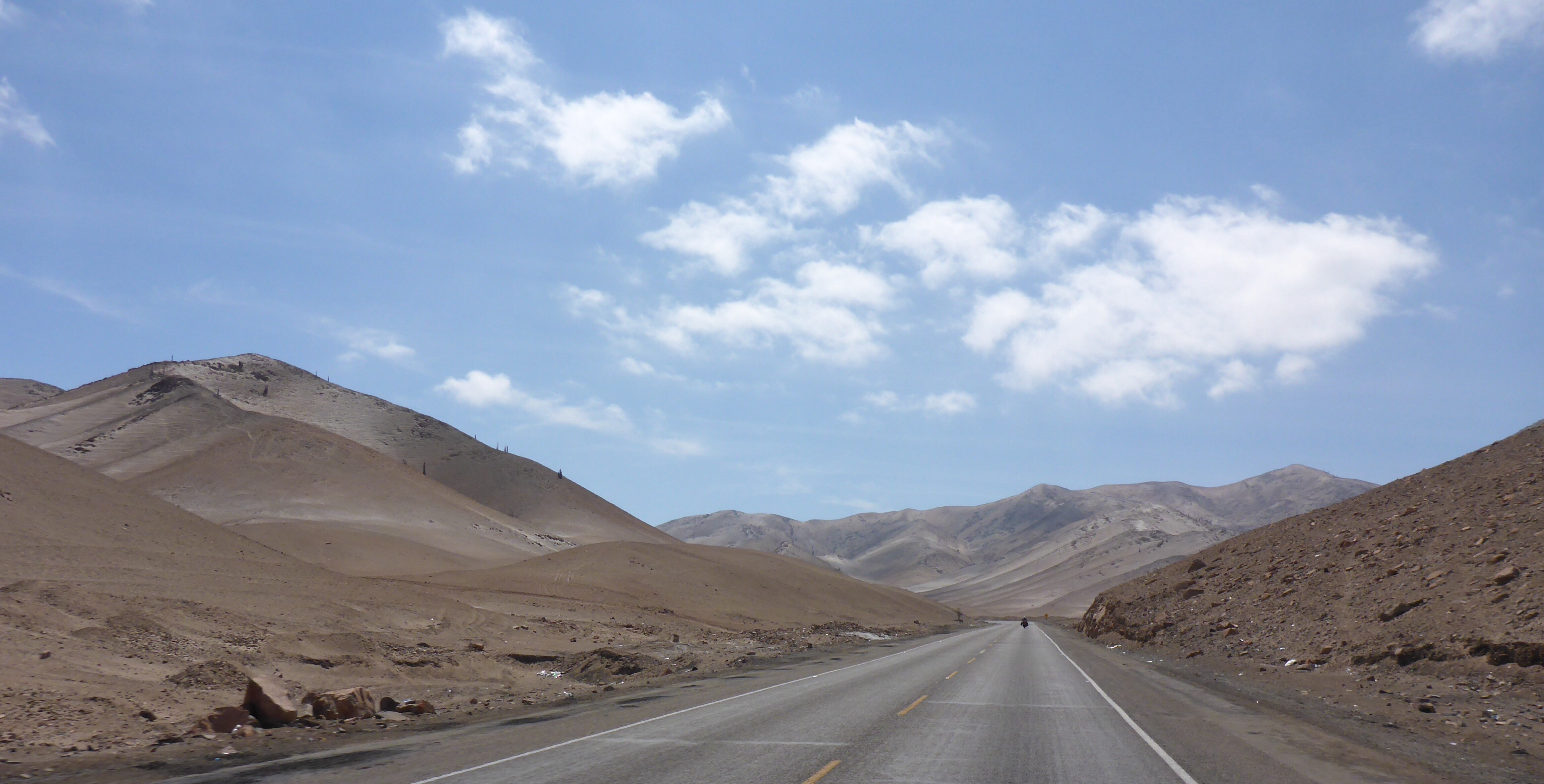
Looking back for a last look at the stunning valley

Starting another long ascent from the valley floor

Starting another long ascent from the valley floor

High plateau an hour out of Arequipa

High plateau an hour out of Arequipa

Time for another stop on this high plateau an hour out of Arequipa

Time for another stop on this high plateau an hour out of Arequipa

45' south of Arequipa - soft grey sand covers the mountains

45′ south of Arequipa – soft grey sand covers the mountains

And then we get 30kms out of Arequipa. The change is brutal. The climb up is tough as there is a massive long line of slow trucks, single lane each way, and no room to overtake – feathering the clutch for kilometers up the mountain. As we plateau, we get to a suburb of Arequipa: it is completely under water due to the recent rains!! It suddenly feels like we are back in Indian traffic – the problem is that we were not mentally prepared for that. It is horrid. Impatient drivers, stop-start, in the middle of the damaged potholed flooded road. And our poor bikes are suffering from bad fuel: both died at most inconvenient times and keep spluttering. No fun at all…

We are glad to arrive at our hotel after a very long day!!!
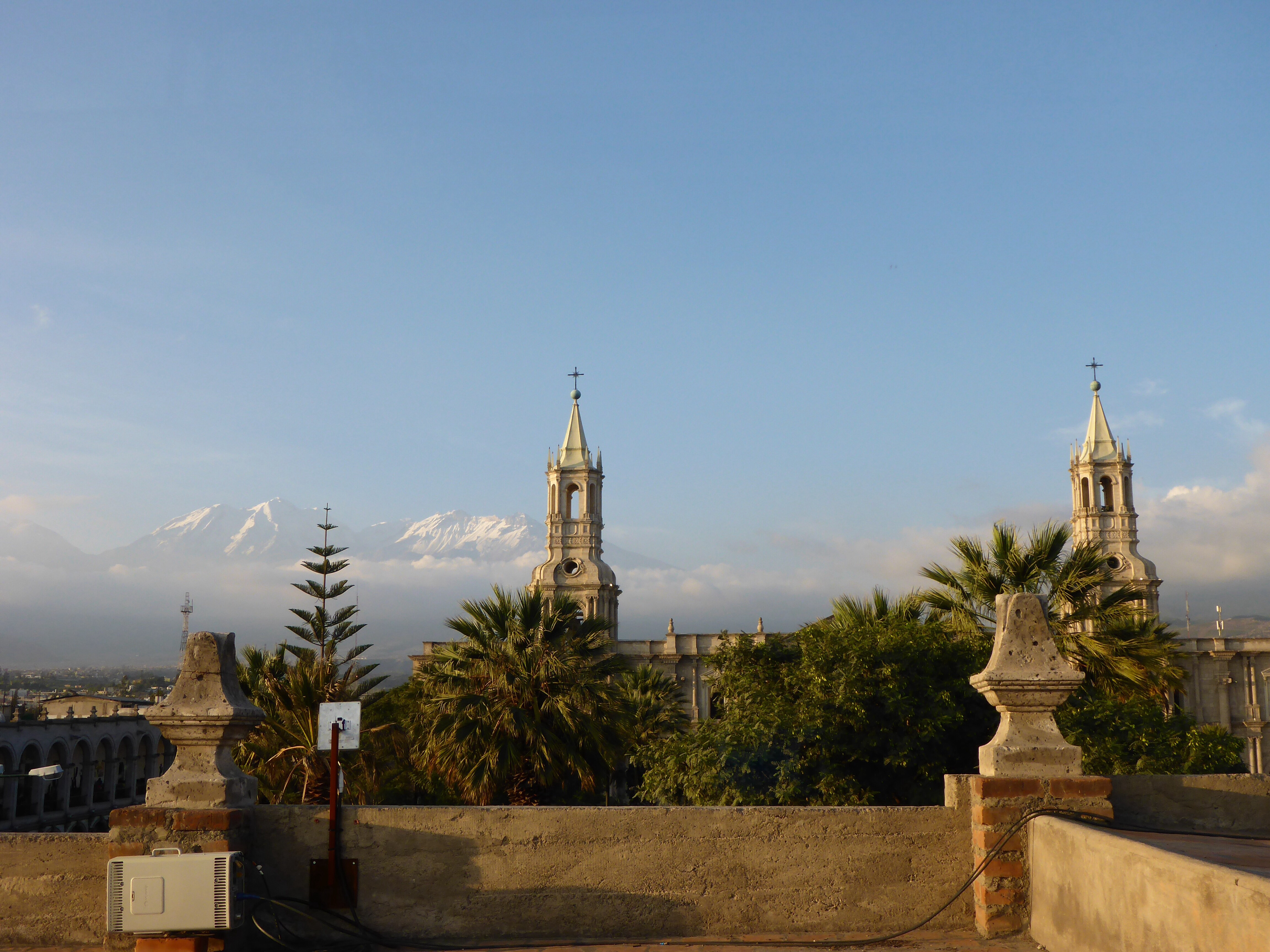
View from our Katari hotel room in Arequipa

View from our Katari hotel room in Arequipa


We end up spending 5 days in Arequipa. Our bodies said rest, so we did. Our hotel, right on the Plaza de Armas is beautifully located. We are right in the centre of yet another UNESCO world heritage listed site. Arequipa was founded in 1540 shortly after the Spanish conquest and the architecture is breathtaking.

We have the most awesome view from our room and from the rooftop breakfast area, looking across the main square towards the cathedral and the Misti volcano to the north east, the peaks of Chachani to the west of it, and Pichu Pichu to the east. Yes, the square is noisy at times, with several processions leading up to Easter early evening and daily loud demonstrations against mining in the area, but we find it all very interesting. At least there are no dogs barking or roosters or thumping music all night as we have had in many places in South America so we wake up rested. The Plaza de Armas with its stunning colonial architecture and colonnaded balconies and all the buildings within the world heritage site are made of light grey volcanic rick called sillar which is actually quite bright in the sunlight, giving Arequipa the nickmane “white city”. It is truly stunning.
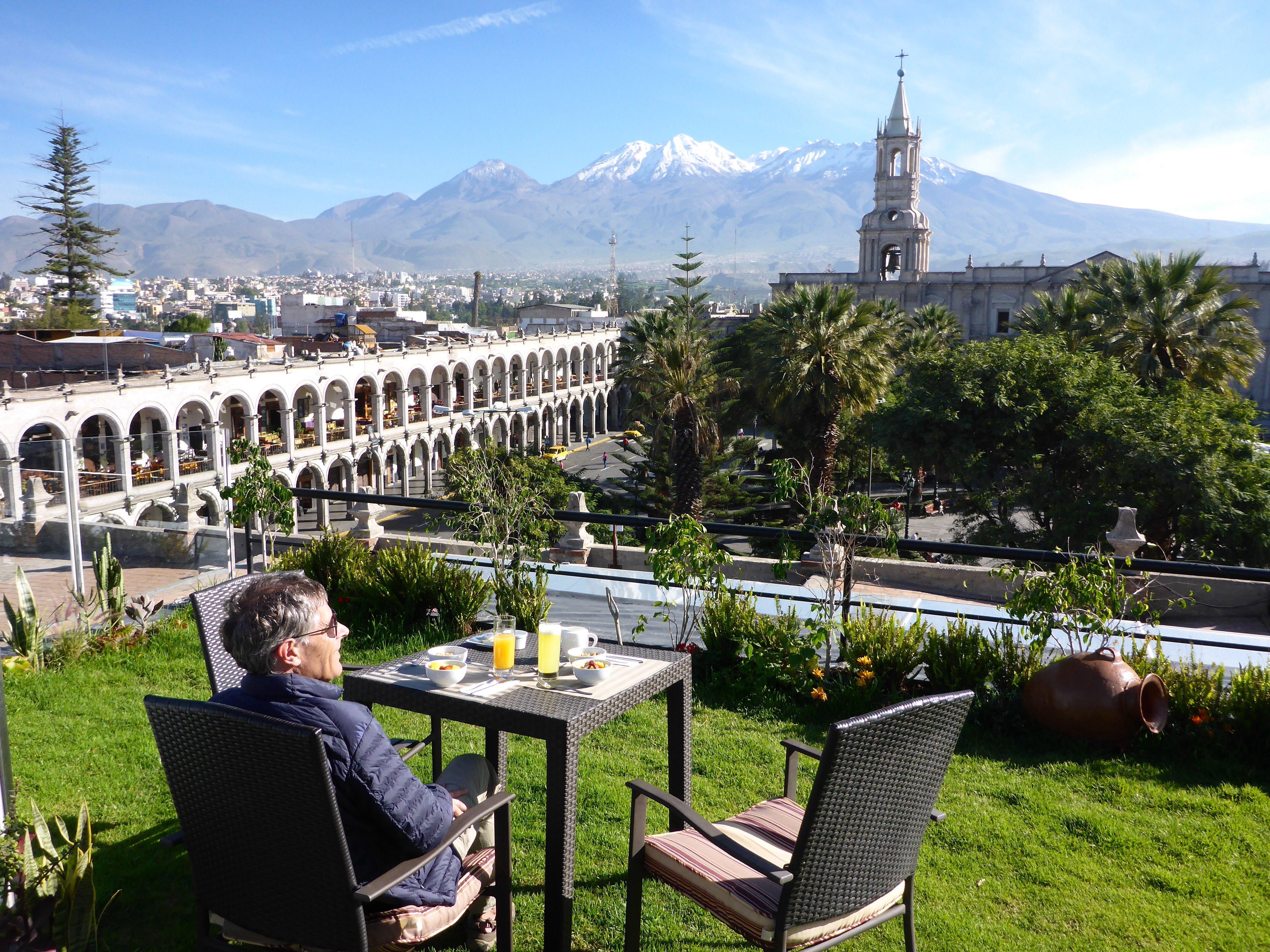
Our breakfast 'room' at the Katari hotel n Arequipa

Our breakfast ‘room’ at the Katari hotel n Arequipa


The historical centre is full of lovely old buildings, intricate baroque facades and porticos, archways and vaults, robust thick walled buildings, and gorgeous little courtyards and open spaces – and travel and souvenir shops but we simply ignore all these. It is a visual delight.
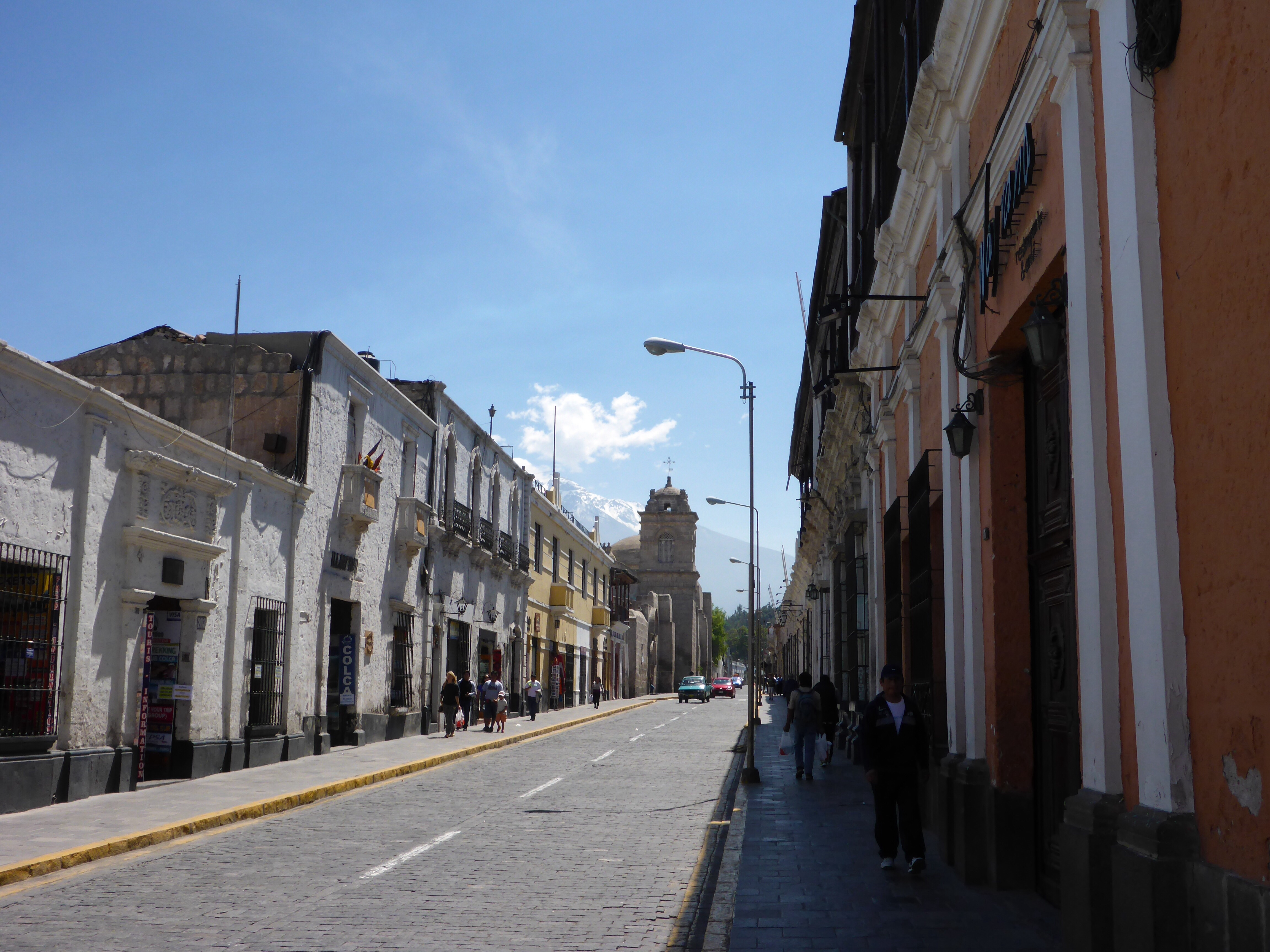
Santa Catalina street, Arequipa

Santa Catalina street, Arequipa

Fabulous stonework and courtyards in Arequipa
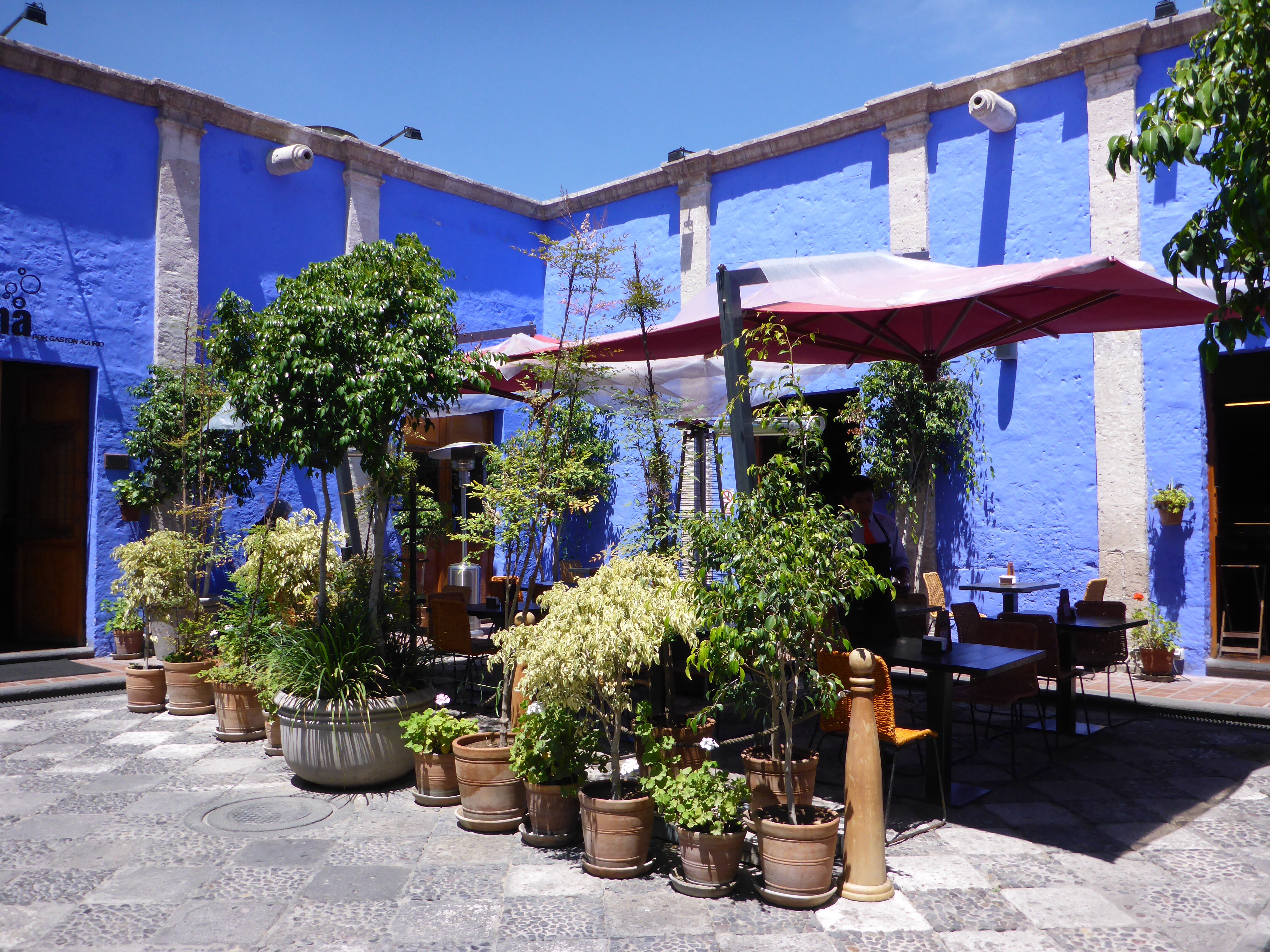
Fabulous stonework and courtyards in Arequipa

Chi Cha - lovely spot for fresh fruit juice in Arequipa

Chi Cha – lovely spot for fresh fruit juice in Arequipa

Our time in Arequipa has been a great stop – bike maintenance, photo upload, blog entries, washing and great meals, fantastic pisco sours, several walks and a number tourist sites including the Santa Catalina convent, the Cathedral, and the market.

The Monasterio de Santa Catalina is a huge complex covering 20,000 square metres right in the centre of the city founded in 1579. It originally housed up to 175 nuns, of privileged background, who were able to continue their lives as they knew it in their own houses, with servants or slaves. The Pope introduced some ‘reforms’ in the early 1870s and put a stop to these privileges: all the nuns then had to live in one single large room, their beds separated by a simple curtain. Walking through the convent, it felt like we could have been in a tiny Spanish village – it was beautiful. It was definitely worth having a guide take us through the complex and explaining its history.
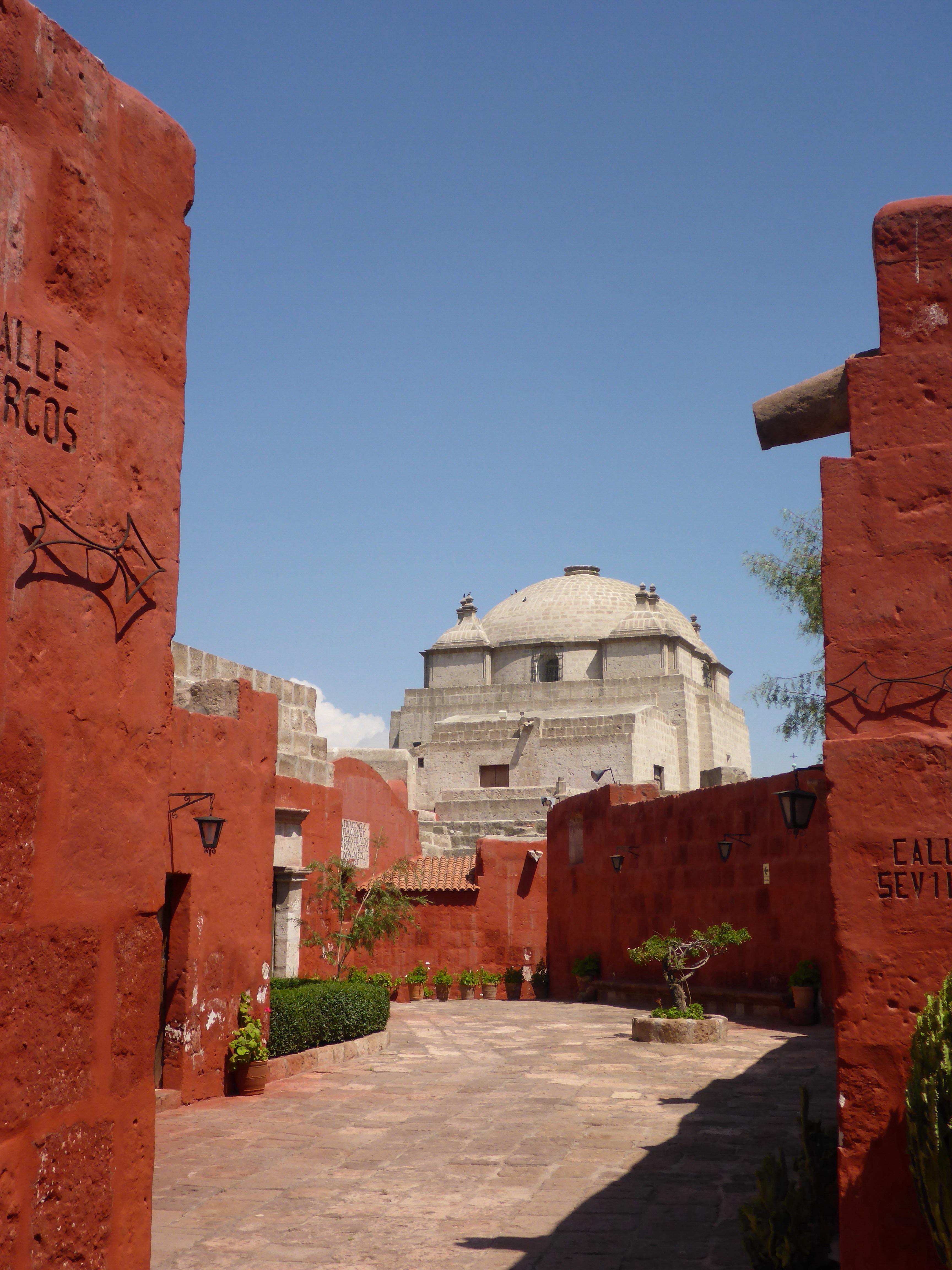
Monasterio Santa Catalina, Arequipa
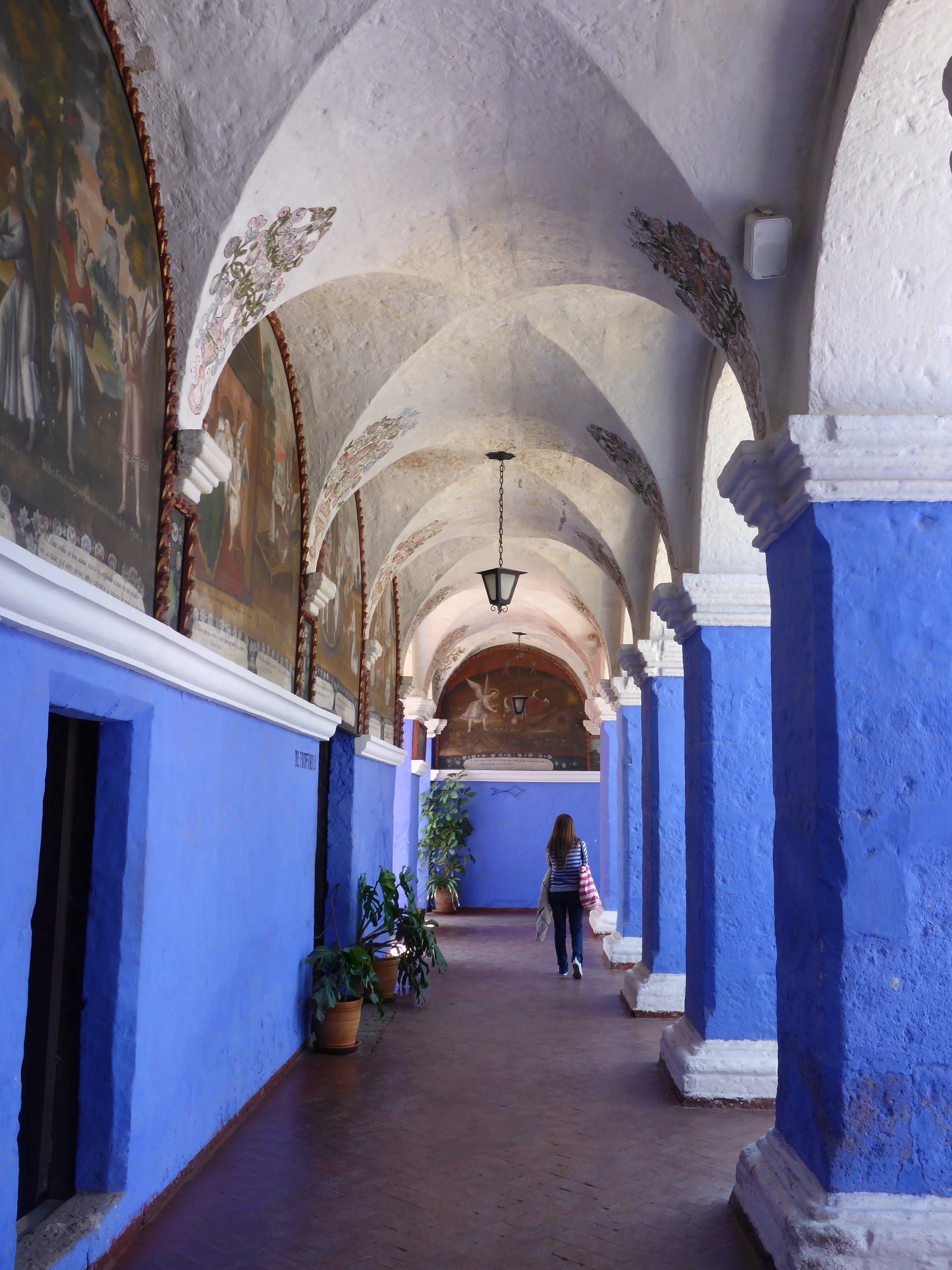
Monasterio Santa Catalina, Arequipa
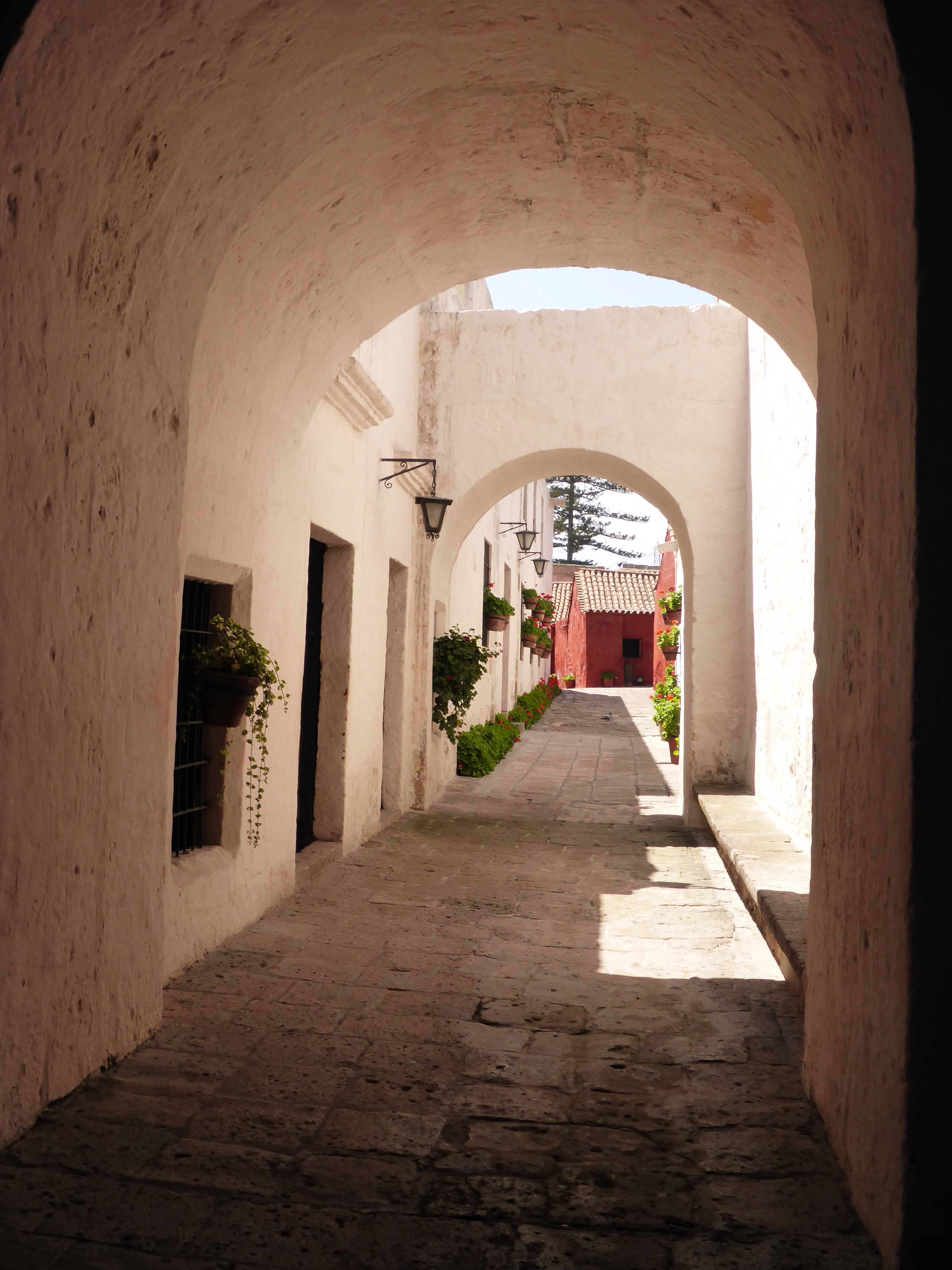
Monasterio Santa Catalina, Arequipa
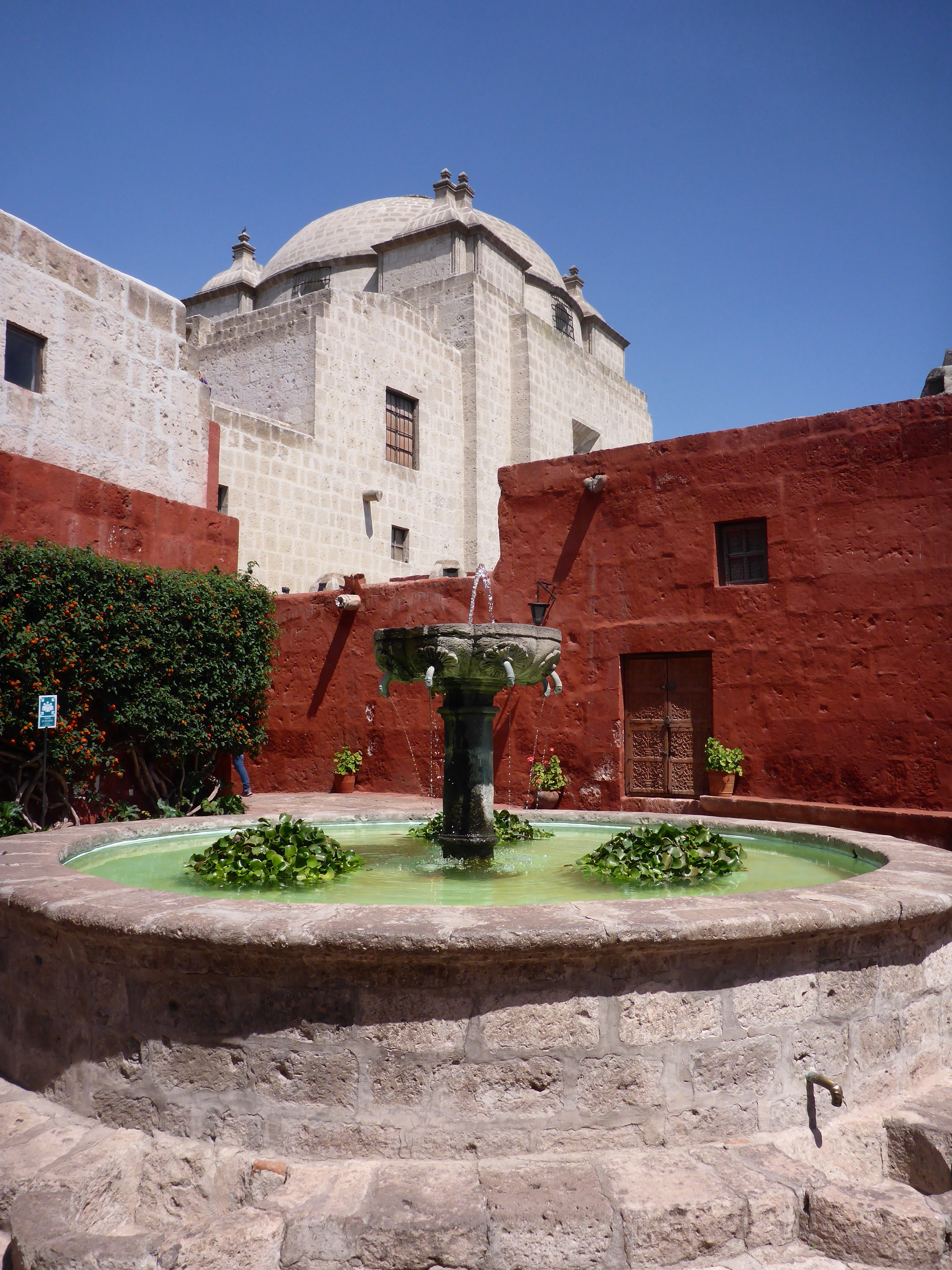
Monasterio Santa Catalina, Arequipa

Monasterio Santa Catalina, Arequipa

Monasterio Santa Catalina, Arequipa

Monasterio Santa Catalina, Arequipa

Monasterio Santa Catalina, Arequipa

We tried to visit the cathedral and several churches a number of times, but they were either closed or had a church service – we felt it inappropriate to walk around them at such times. While Anthony rested one day, I decided to try and visit the cathedral. I find the side entrance, pay the entrance fee and am asked to wait for the guide: you can only visit the cathedral and its museum with a guide. Again, it was worthwhile and interesting. Originally constructed in 1656, it was gutted by fire in 1844, rebuilt shortly thereafter then destroyed in 1868 by an earthquake. It was completely rebuilt then another large earthquake hit in 2001 toppling one of its towers. My timing could not have been better: the organist is practicing and we are treated to magnificent music during the tour – how special. I think the guide is required because we are taken to rooms that hold priceless objects which are either no longer used (had belonged to previous bishops) or only come out once a year for special occasions such as Easter or Christmas.
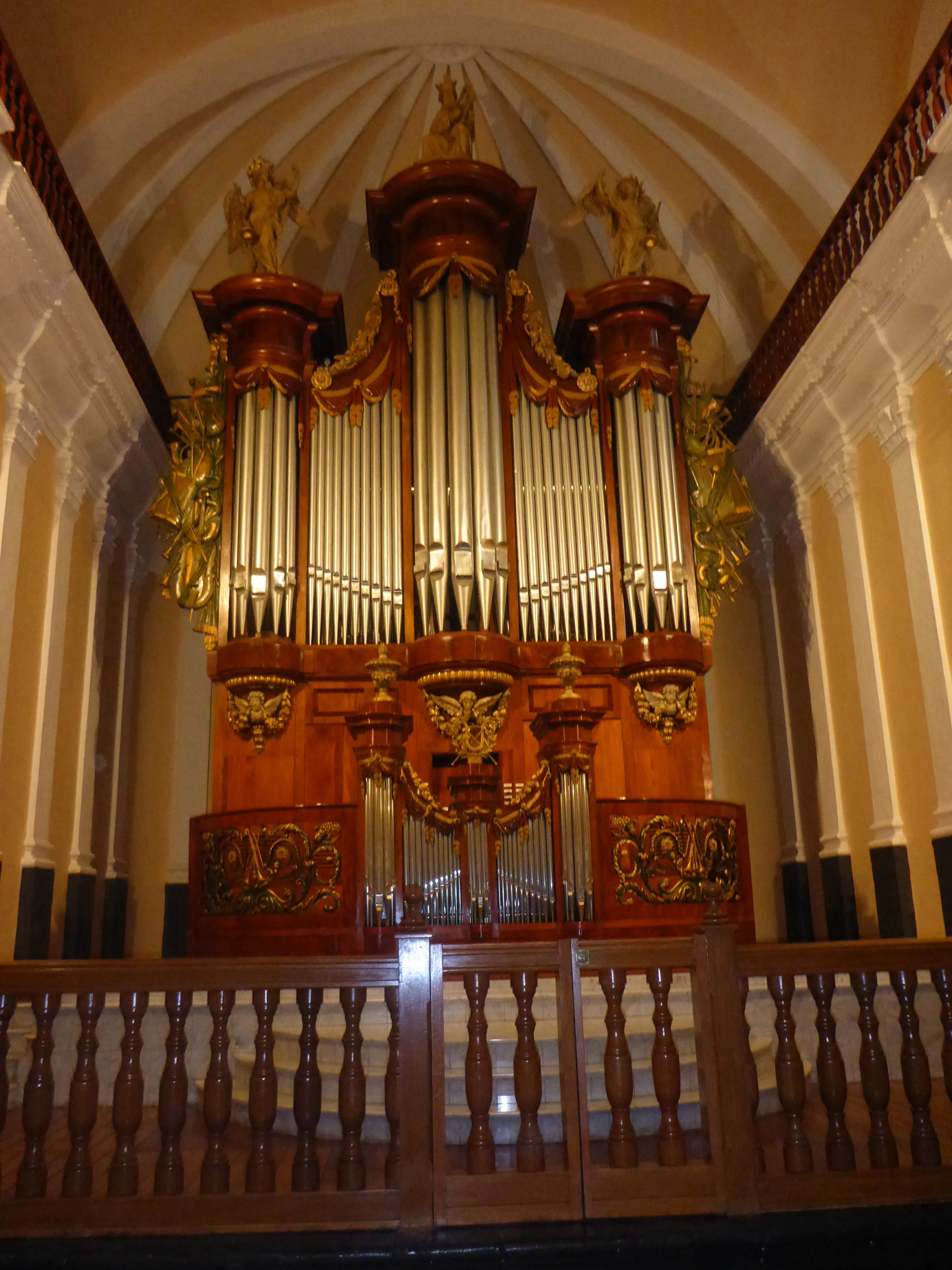
Arequipa cathedral's Lauret organ from Belgium

Arequipa cathedral’s Lauret organ from Belgium
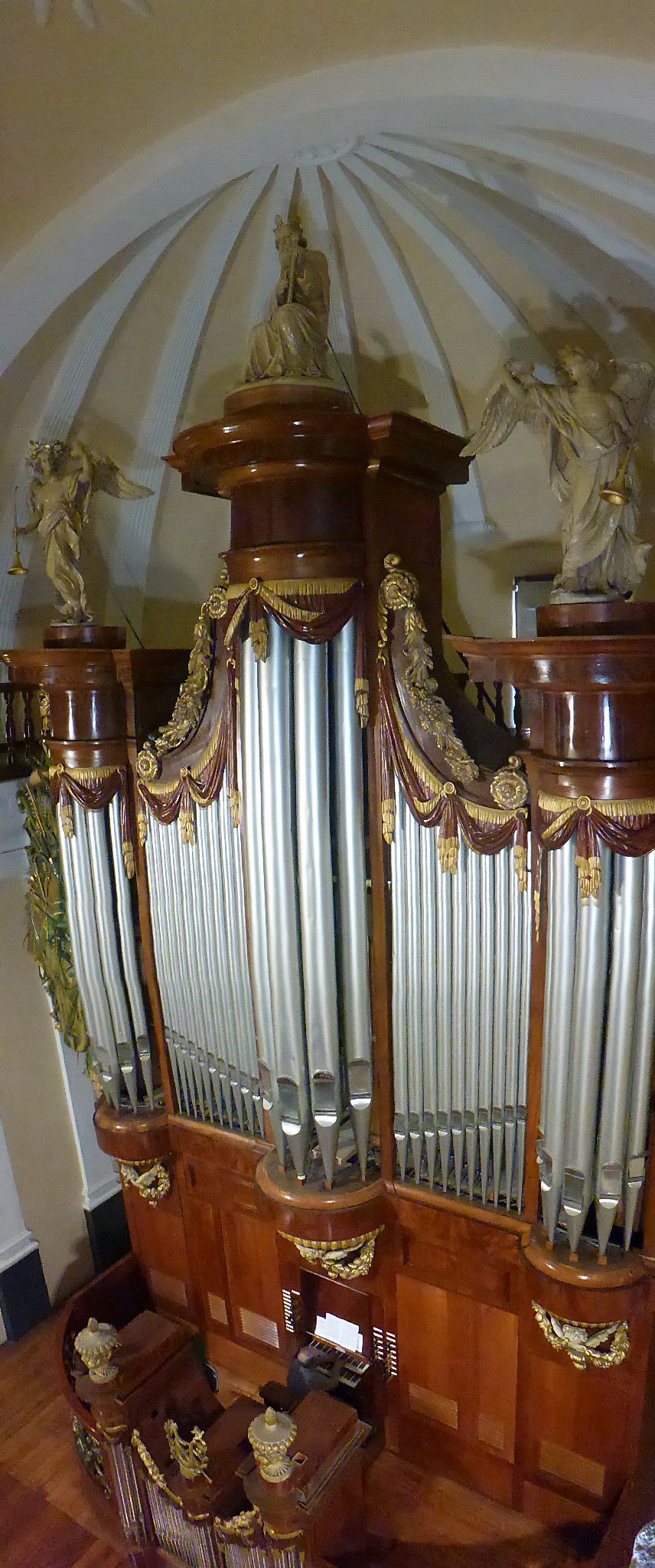
Arequipa cathedral's magnificient Belgian pipe organ

Arequipa cathedral’s magnificient Belgian pipe organ

Arequipa cathedral 'false marble' apostle statue, made of wood, chalk, honey and oil
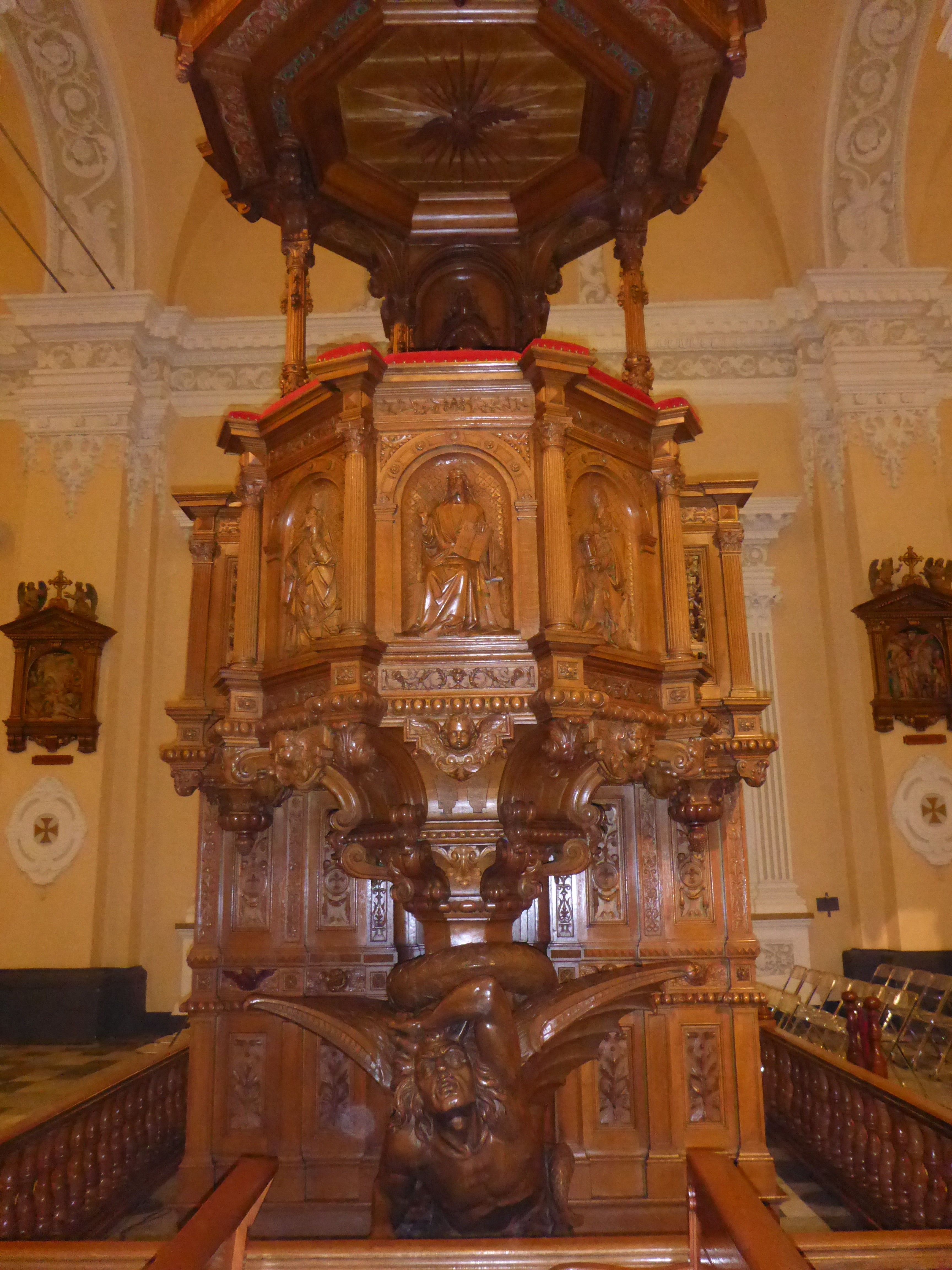
Arequipa cathedral ‘false marble’ apostle statue, made of wood, chalk, honey and oil

Oak pulpit made in Lille, France has a devil carved at the base

Oak pulpit made in Lille, France has a devil carved at the base

View of Arequipa Plaza de Armas from the cathedral bell tower

View of Arequipa Plaza de Armas from the cathedral bell tower

Our hotel is across the square, to the right of the flags, with grass on the roof (our breakfast area).
image

We always love local markets and the one in Arequipa was no disappointment.

Arequipa San Camilo market
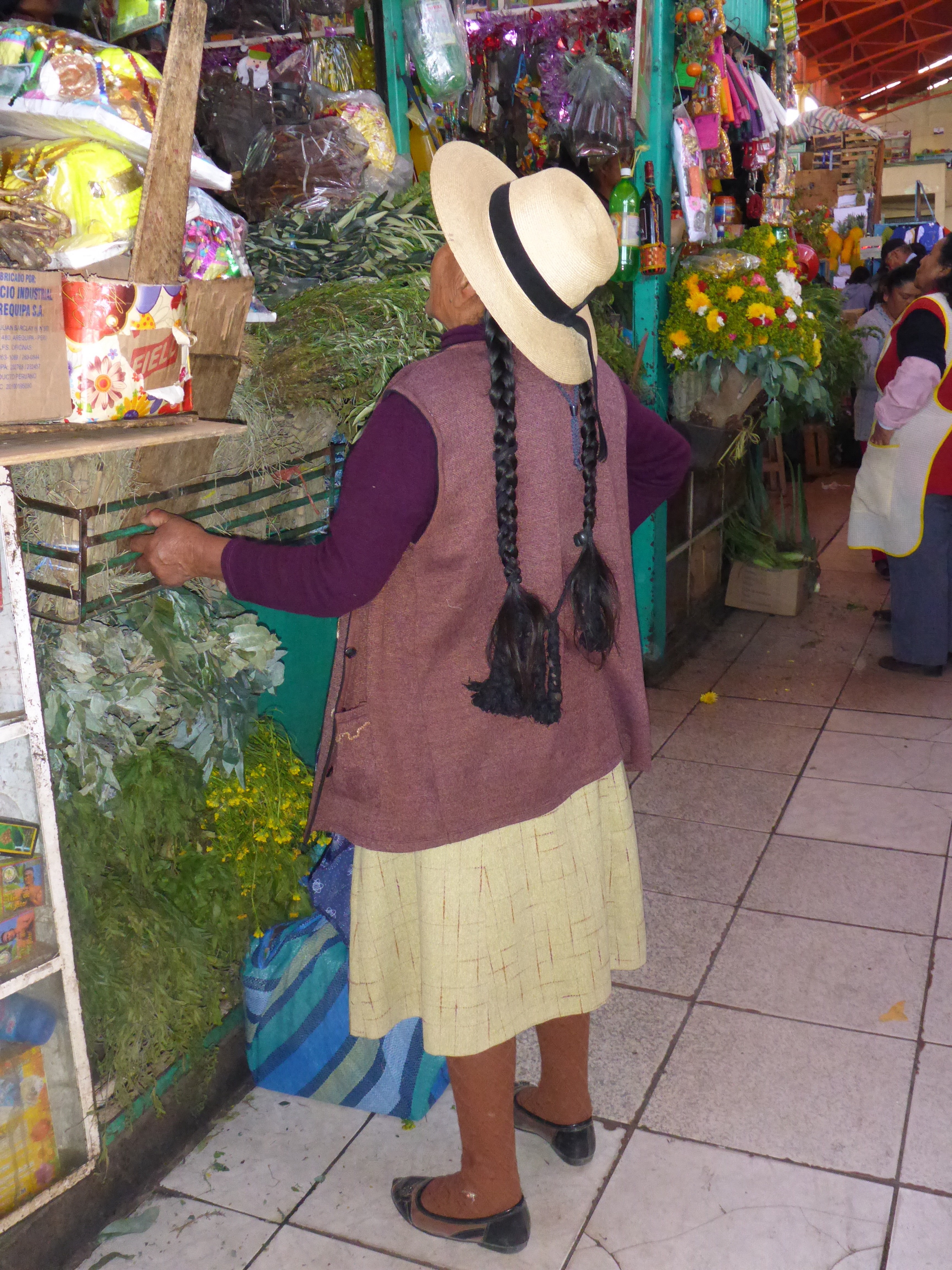
Arequipa San Camilo market

San Camilo market

San Camilo market

Our last afternoon and I go out for one last wonder about town. I feel like some local human contact rather than visiting another museum or church. Maybe I’ll just sit in the Plaza de Armas? No, I’ll look for a hairdresser. After walking for 45′, I finally find one at the end of a tiny alley. She is free so I put myself in her hands. As she cuts my hair in a way I have never seen before and with a pair of scissors I remember having as a child for artwork and makes a deep dull clunk as she snips away, I think how things have changed: I used to drive for an hour to get to a hairdresser on the other side of Brisbane and pay a small fortune because I liked the way she cut and coloured my hair. Now the end result really doesn’t worry me. It just needed trimming, that’s all. I communicate as best I can with the hairdresser, once again wishing I knew more Spanish. The hair cut only cost me $4 but better still, it was a lovely experience.

Our extended stay in Arequipa has been perfect, really lovely and we are both ready to get back on Streak and Storm and make our slow way to Nazca tomorrow morning.

– Anne

Onward to Peru

We leave San Pedro de Atacama with rain clouds gathering. Snow has fallen to the east causing the road to Argentina and Bolivia to be closed. We could not have proceeded in that direction even if we wanted too. We have decided to move out of Chile and get into Peru. We seem to have ridden endlessly through the Atacama desert in its various forms and we both feel like a change of scenery.

Cold and rain we have not experienced for many months. We realise that in the 8 months on the road traveling, this is only the 8th day of rain! While our trip timing was to avoid the wet seasons as far as possible, I think we have done exceptionally well. A recent comment on the blog noted that we only seem to have pictures with blue skies and sunny days and was that a reflection on how we feel? The answer is yes, we are always happier on blue sky days and while the occasional cosy grey day makes a change, blue skies are our natural habitat.

Rain is waiting for us - we can see how much snow has fallen overnight in the distance

Rain is waiting for us – we can see how much snow has fallen overnight in the distance


Today leaving San Pedro de Atacama is the coldest day we've had

Today leaving San Pedro de Atacama is the coldest day we’ve had

While we press on through the rain, which is unusual for this very arid region, we have to count ourselves lucky that we have missed the worst of the flooding in the Atacama, which is playing out in towns we passed through and stayed at less than a week ago. At each fuel stop we are greeted with a TV screen showing the devastation that such extreme weather for this region is doing. In desert regions, towns cannot justify stormwater drainage systems and when rivers overflow there is nowhere for the water to flow but into houses and businesses. Power and communications are cut to the north of Chile, some cities are without power and the damage to roads will be extensive.

Where we stopped for lunch - chicken is out so it was only boiled rice and fresh tomatoes - nice change from canned tuna and dry crackers

Where we stopped for lunch – chicken is out so it was only boiled rice and fresh tomatoes – nice change from canned tuna and dry crackers

Every petrol stop and restaurant is showing the destruction currently unfolding in Northern Chile

Every petrol stop and restaurant is showing the destruction currently unfolding in Northern Chile

Despite the wet conditions, which improve as we get further north, we make good progress towards our coastal destination of Iquique.

Salar de Pintados national park

Salar de Pintados national park


Coastal clouds south of Iquique

Coastal clouds south of Iquique


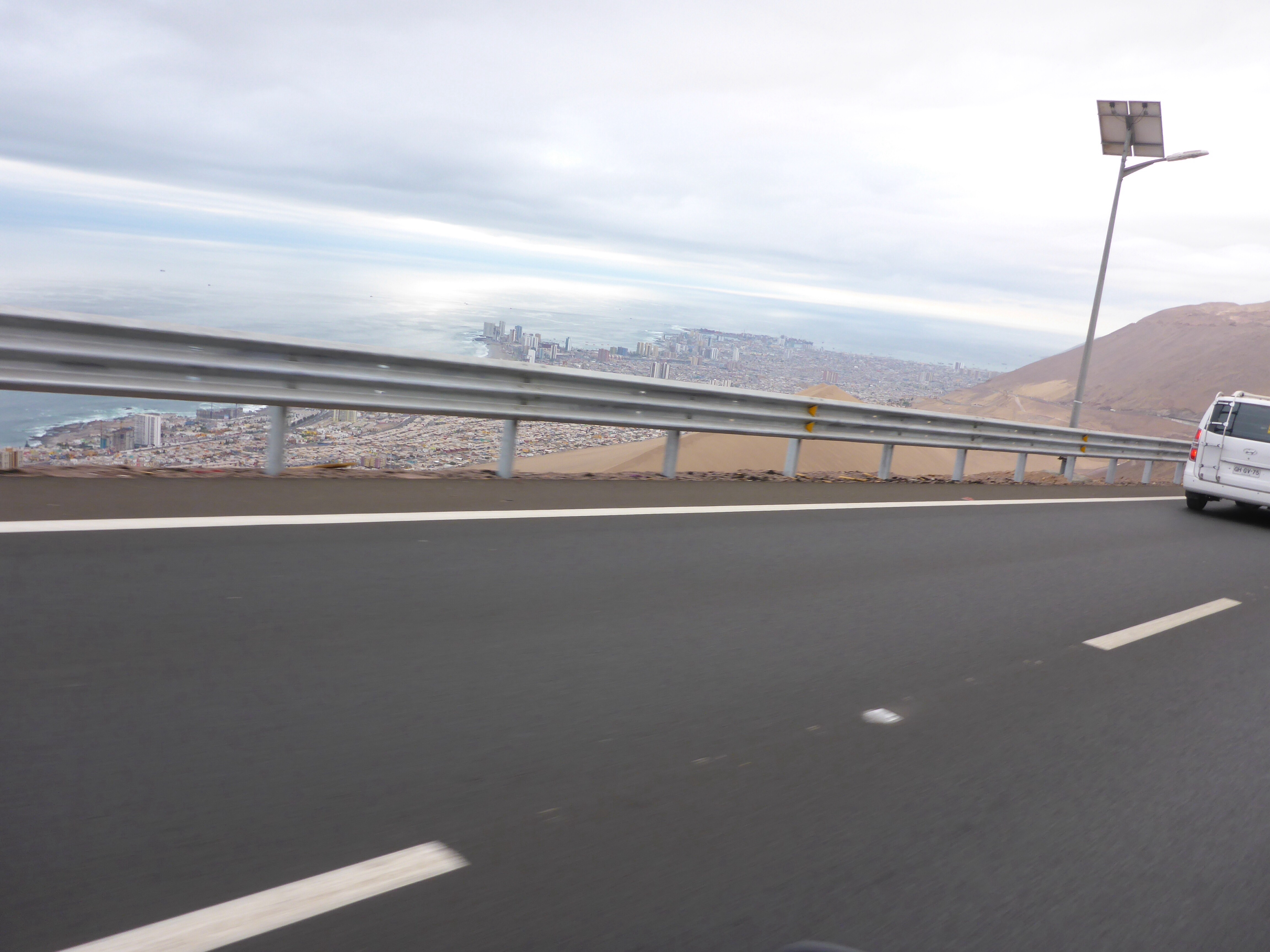
The road approach to Iquique is nothing short of spectacular: a 600 metre (2,000 feet) decent from the town of Alto Hospicio cut into the steep side of the mountain runs for over 10 kilometers. As we ride down it feels like we are in an aircraft making our decent to land. Amazing feeling!
On our way down into Iquique

On our way down into Iquique


As we ride towards our hotel, we see multiple tsunami warning signs and with Iquique, like so many other Chilean coast cities pressed up against the mountains, evacuation is not easy. In Iquique’s case, it is compounded by having only a single road, the one we arrived on, as an escape route. On 1 April 2014, less than a year ago, an 8.2 magnitude earthquake occurred offshore, followed by up to 20 aftershocks of 5.0 magnitude or greater, caused many thousands of residents to abandon Iquique entirely, heading to nearby town of Alto Hospicio, a tsunami-proof town 600 meters (2,000 feet) above Iquique. The problem was that the road surface was damaged, and the only way out was to walk up the steep road we had entered up to Alto Hospicio as many did with small children and strollers.
Iquique tsunami warning sign

Iquique tsunami warning sign

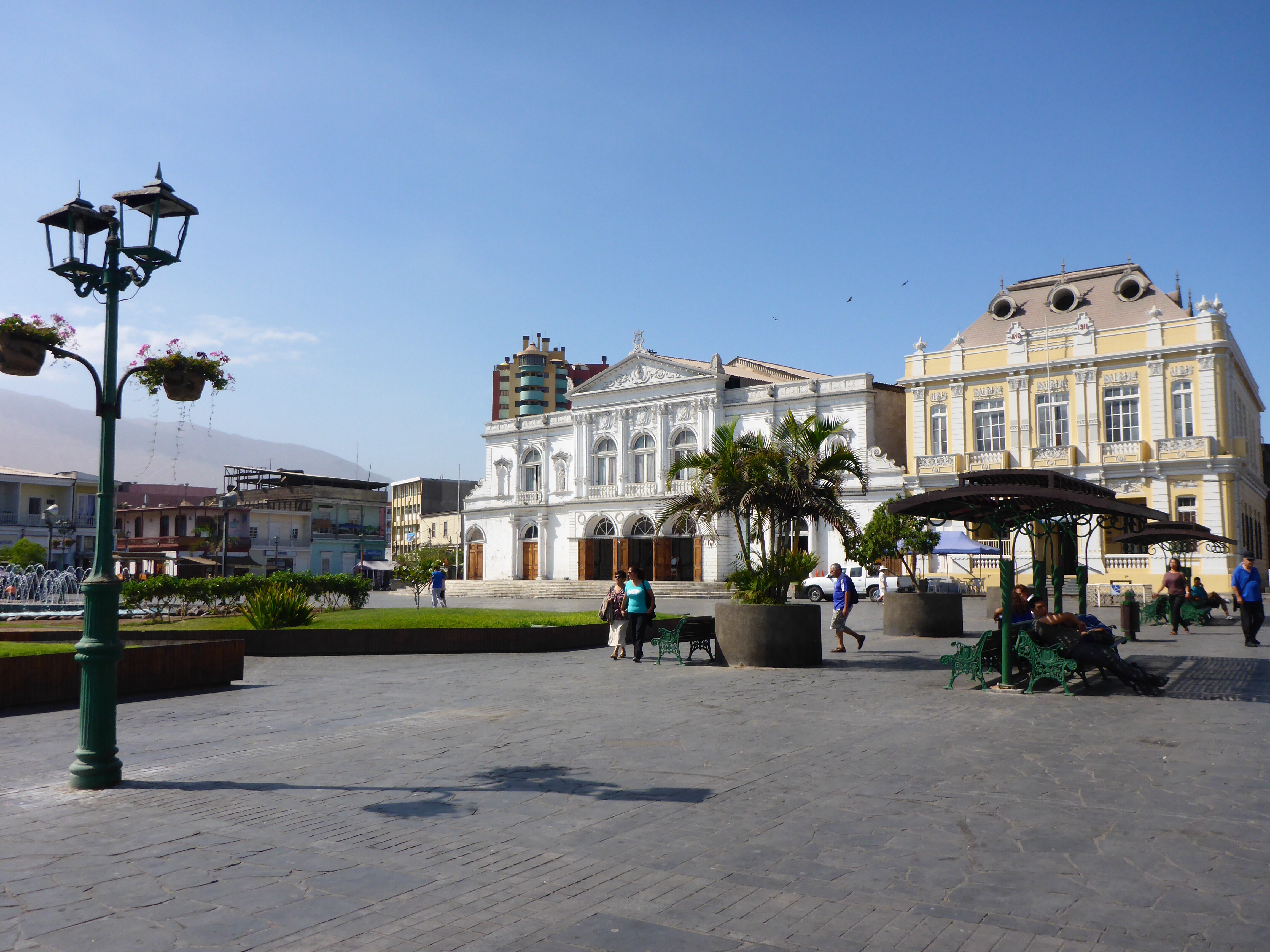
Plaza Prat de Iquique

Plaza Prat de Iquique

Iquique was the location of our first real negative encounter with locals and a salutary reminder of how a series of events can lead to a confrontational situation without the intent of either party to reach that position. It happened in a car park, the details are irrelevant now, but being told to reverse over two speed humps with no room to maneuver or help and about 15 cars hooting (at us or for us, we are not sure) left us leaving Iquique with a bad taste.

From time to time, as we have headed north on Ruta 5, our path has been crossed by dry riverbeds that have necessitated the road to make a small detour from its path to make the crossing. As we depart towards Arica we can see on the map two significant canyons running to the Pacific Ocean that require detours of 20 to 30 km to cross. The first is the Quebrada de Chiza which provides a magnificent decent to the canyon floor. Here we encounter some of the strongest and unpredictable crosswinds, caused by wind funneling up from the ocean via the Quebrada de Camarones, we have ever ridden in. We were protected to an extent on the 20 plus kilometer decent, but on the canyon floor we are fully exposed. While we are used to persistent wind in our travels, being in the canyon brings extra hazards. Anne is swept from her lane across the oncoming lane to the start of the hard shoulder and then back again like a giant wind slap. There is nothing we can do except hang on (as stopping is not an option or you would definitely be blown over) and keep going. Luckily traffic is light. The power of nature is always to be respected and here, nature was reminding us of that. We were glad to make the customs post at Cuya and then hug the canyon wall as we climbed out on the other side. Not something we would like to repeat.

Before heading down into Quebrade Chiza canyon

Before heading down into Quebrade Chiza canyon

Camarones valley

Camarones valley


Riding down towards Arica

Riding down towards Arica


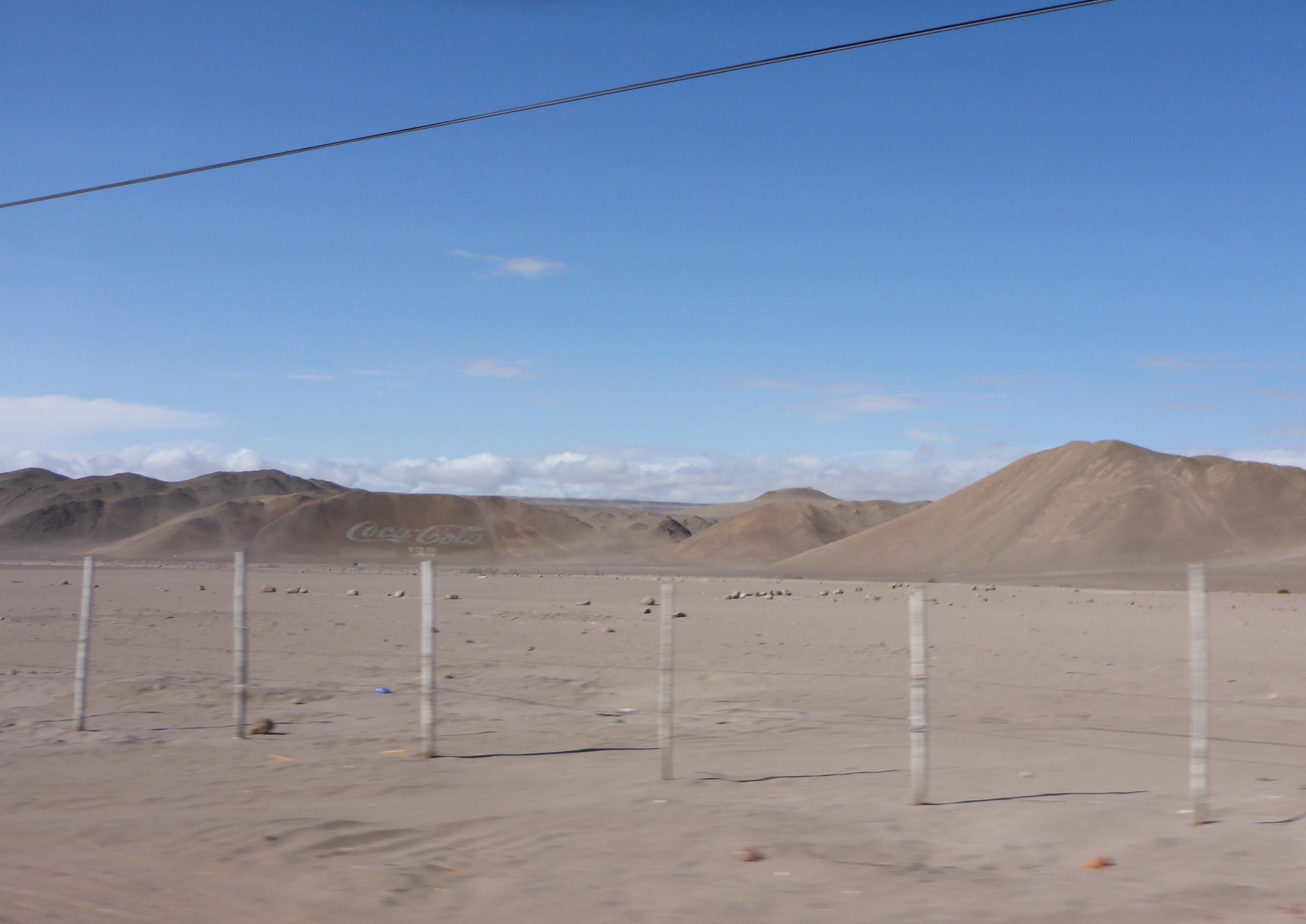
The largest Coca-Cola logo (50x120 metres) made out of 70,000 empty bottles outside Arica

The largest Coca-Cola logo (50×120 metres) made out of 70,000 empty bottles outside Arica


We are glad to reach Arica our last stop before we cross into Peru. We are only some 30 kilometers from the border.
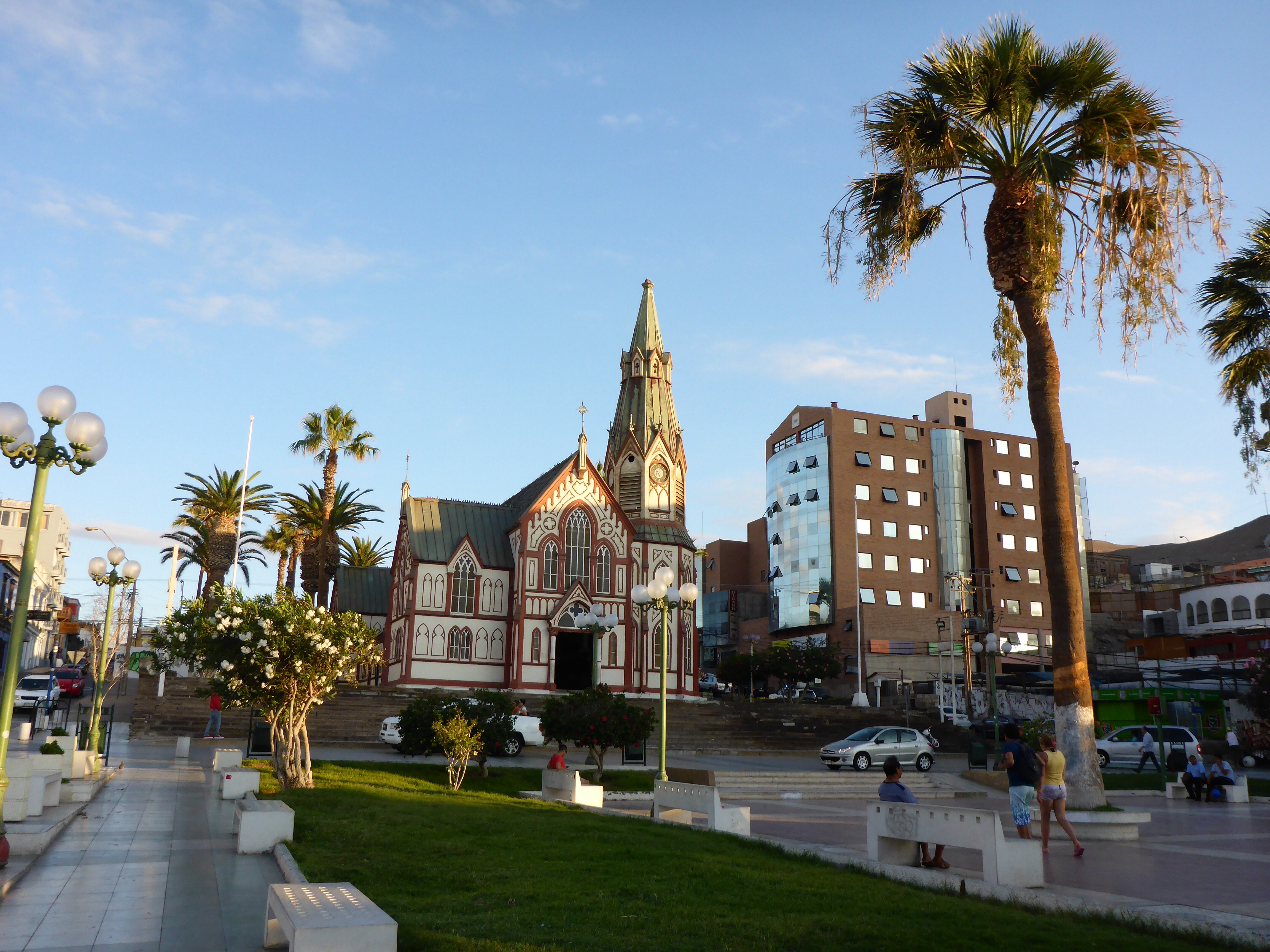
San Marcos de Arica church designed by Gustave Eiffel

San Marcos de Arica church designed by Gustave Eiffel

A short ride of about half an hour from Arica sees us at our first border crossing in a month. The luxury that people in the European Union have of just driving across the border without stopping does not exist here. We have found that the information available on the web can very quickly become out of date and therefore the timing and requirements have changed. As usual the actual crossing details are recorded in over Visas and Borders section. Suffice to say that the only unusual aspect of this crossing is going to the cafe cashier to purchase a multi copy form needed for the crossing process. Very helpful people on both the Chilean and Peruvian sides sees the process over in about two hours, fairly normal for us, plus the border was not too crowded.

Level 1 of the Chilean customs & immigration building - cafetaria where you buy carbon copies of RVP

Level 1 of the Chilean customs & immigration building – cafetaria where you buy carbon copies of RVP

Peruvian border post at Santa Rosa

Peruvian border post at Santa Rosa


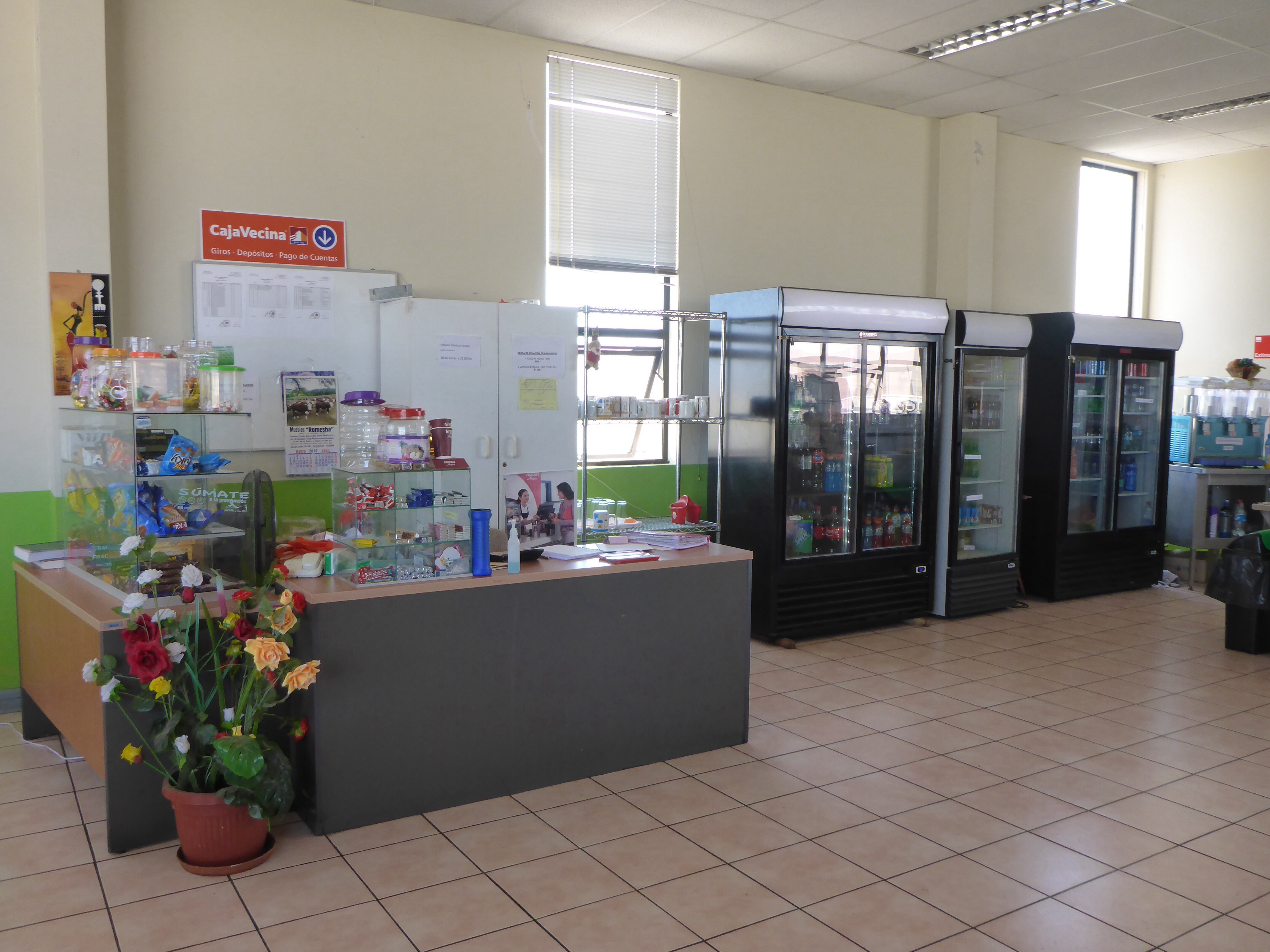
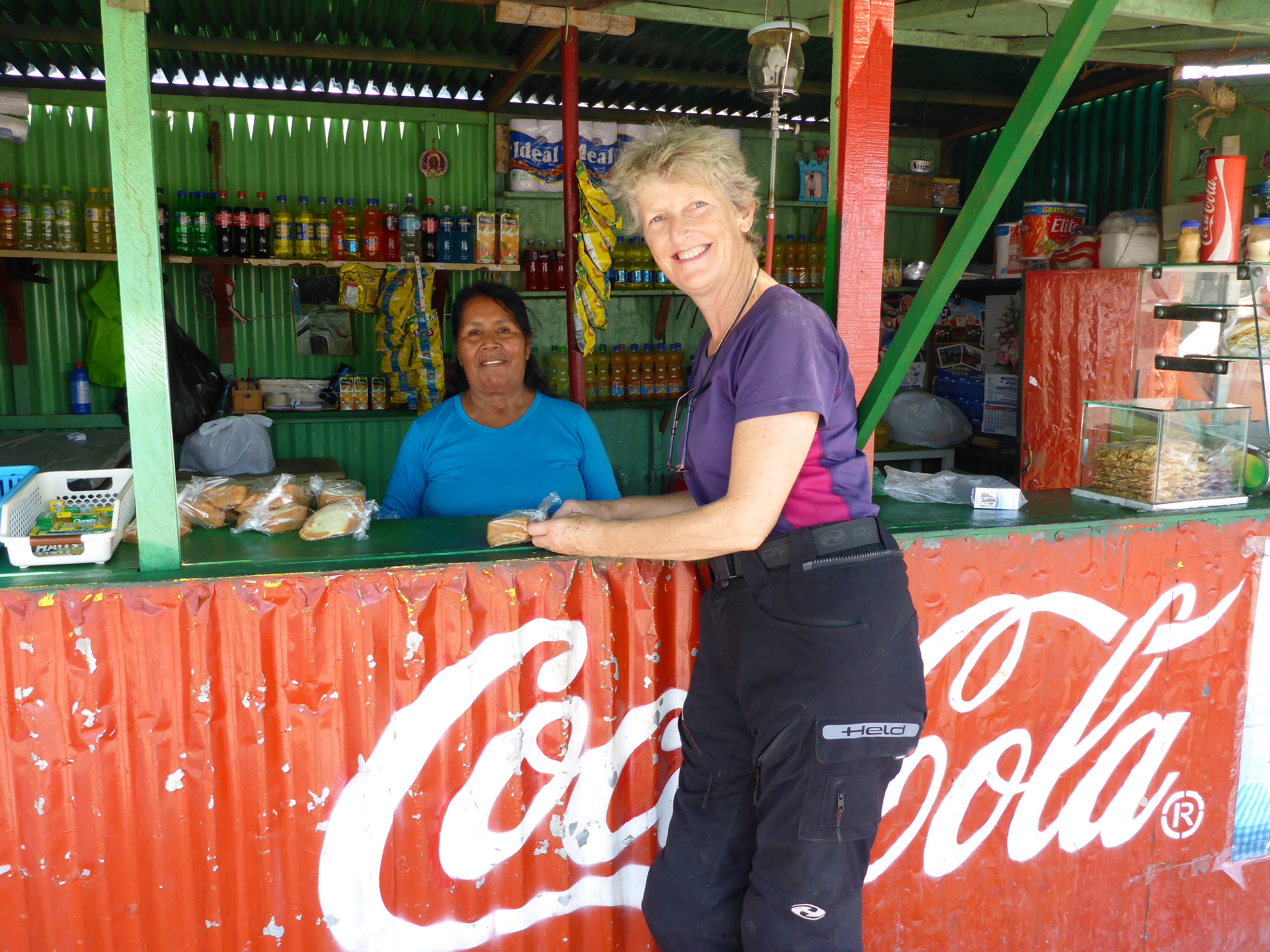
Across from the SOAT building, this lovely lady gave us a piece of cake to go with our cold drinks

Across from the SOAT building, this lovely lady gave us a piece of cake to go with our cold drinks


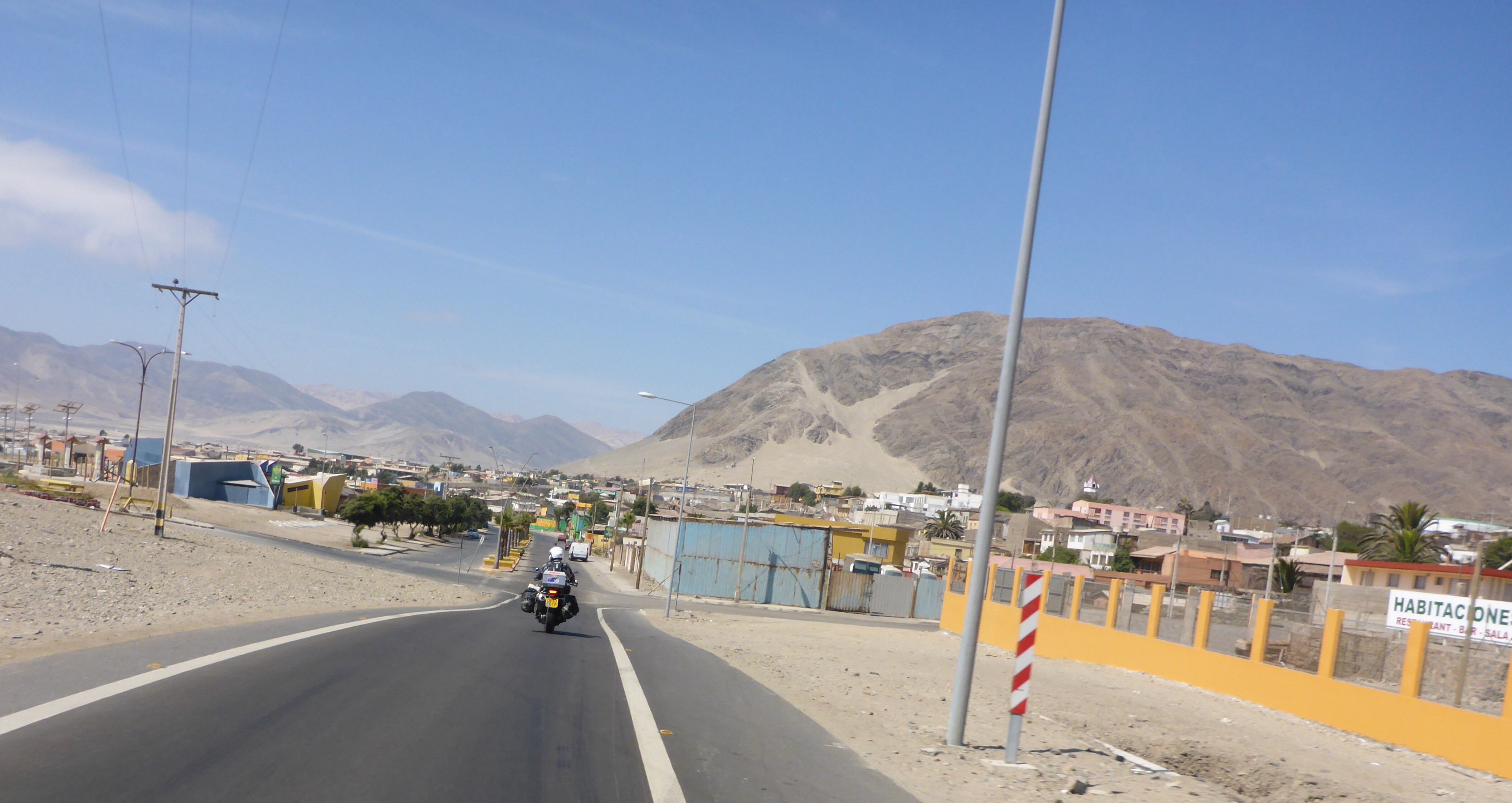
A quick stop to pick up SOAT Insurance and half an hour sees us into Tacna and our first interaction with Peruvian traffic reminds us that we will have to raise our situational awareness after Chile.

I have had the same chain since the journey started and it has covered over 25,000 kilometres with the occasional adjustment. I am now having to do almost daily adjustments as the stretching has accelerated significantly and it really rattles by the end of the day. We will need a new chain and sprocket set in Lima. The weight and bulk of the parts meant that we do not carry those spares, but there is a reasonable BMW Motorrad network in the capital cities we pass through.

– Anthony

San Pedro de Atacama

There is so much to see around San Pedro, we decide we will take a few organised tours for a change. We have not researched the tour agencies, of which there are many in town, walk into the first one we get to, Cosmo Andino, have a good feel for the owner Martin and go ahead and book 4 tours! We tend to use our gut feel a lot of the time and it usually works fine so we are happy to commit to 4 tours in one hit. The first one is an afternoon and sunset in the Valle de la Luna. We could easily go there on our bikes and on our own, but with all the recent rain, we decide it is best done on 4 wheels. The next day is the Aliplanic lagoons – a long day, at altitude. Next the El Tatio Geysers at even higher altitude with a 5am departure time, and finally the Salar de Tara. That’s the plan anyway… Very exciting! It will be something different for us.

We woke up in our ‘rustic’ cabin on the outskirts of San Pedro having been devoured by mosquitos all night! Never expected mosquitos here! Because of the recent rain and lightning, we had no electricity last night so couldn’t use our great Indian electric mosquito repellent. On top of mosquitos, the constantly barking dogs made sure we hardly got any sleep too. And no hot water this morning – or for the following 2! Our rustic cabin quickly turned out to be run-down cabin but luckily, the fabulous view made up for it. Lucky then first place we went into in San Pedro for lunch had not only fantastic food, but working internet. The internet at our cabin was set up in a tree in the middle of the property!! Not normally a problem in the driest desert on earth…

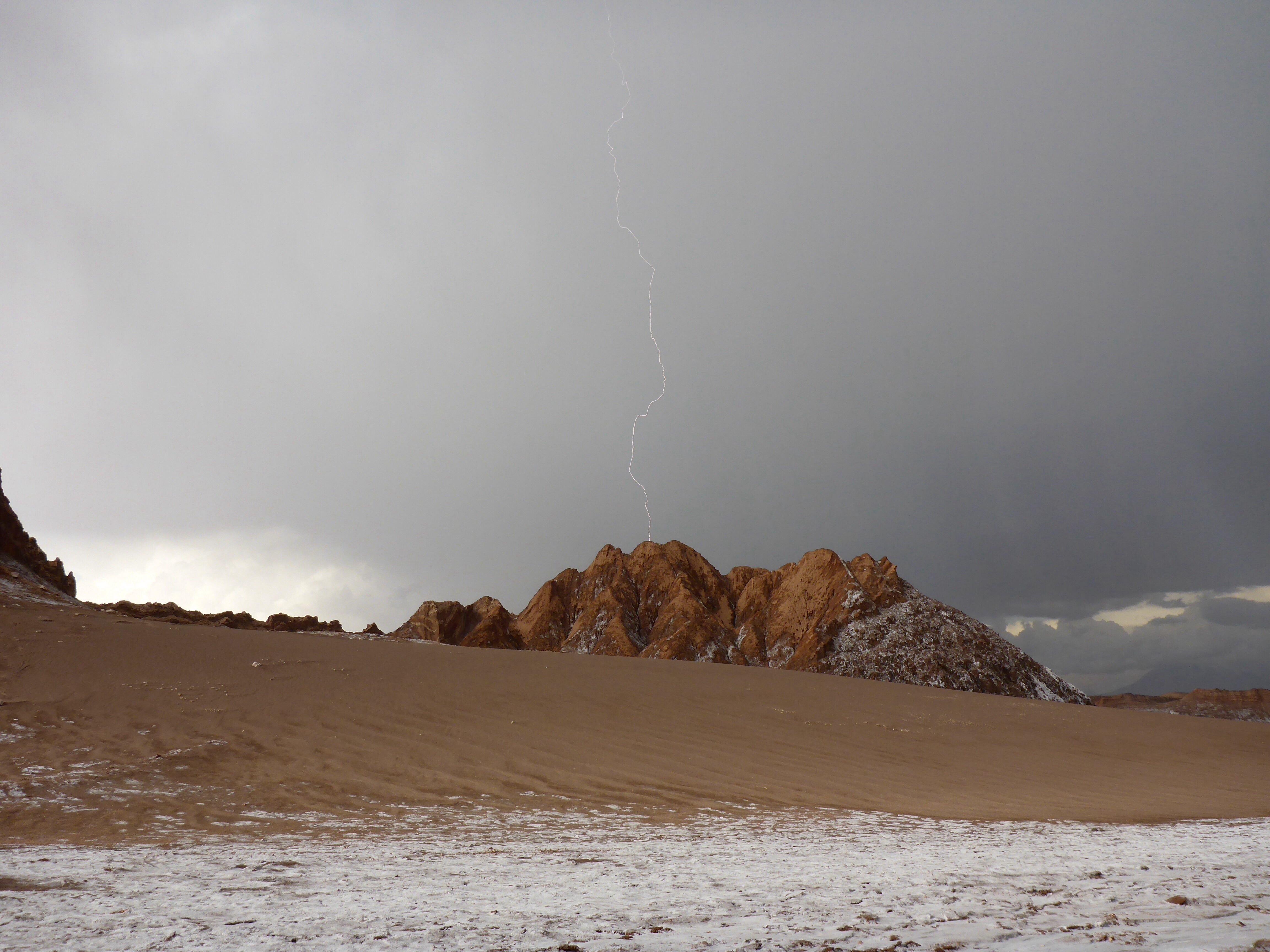
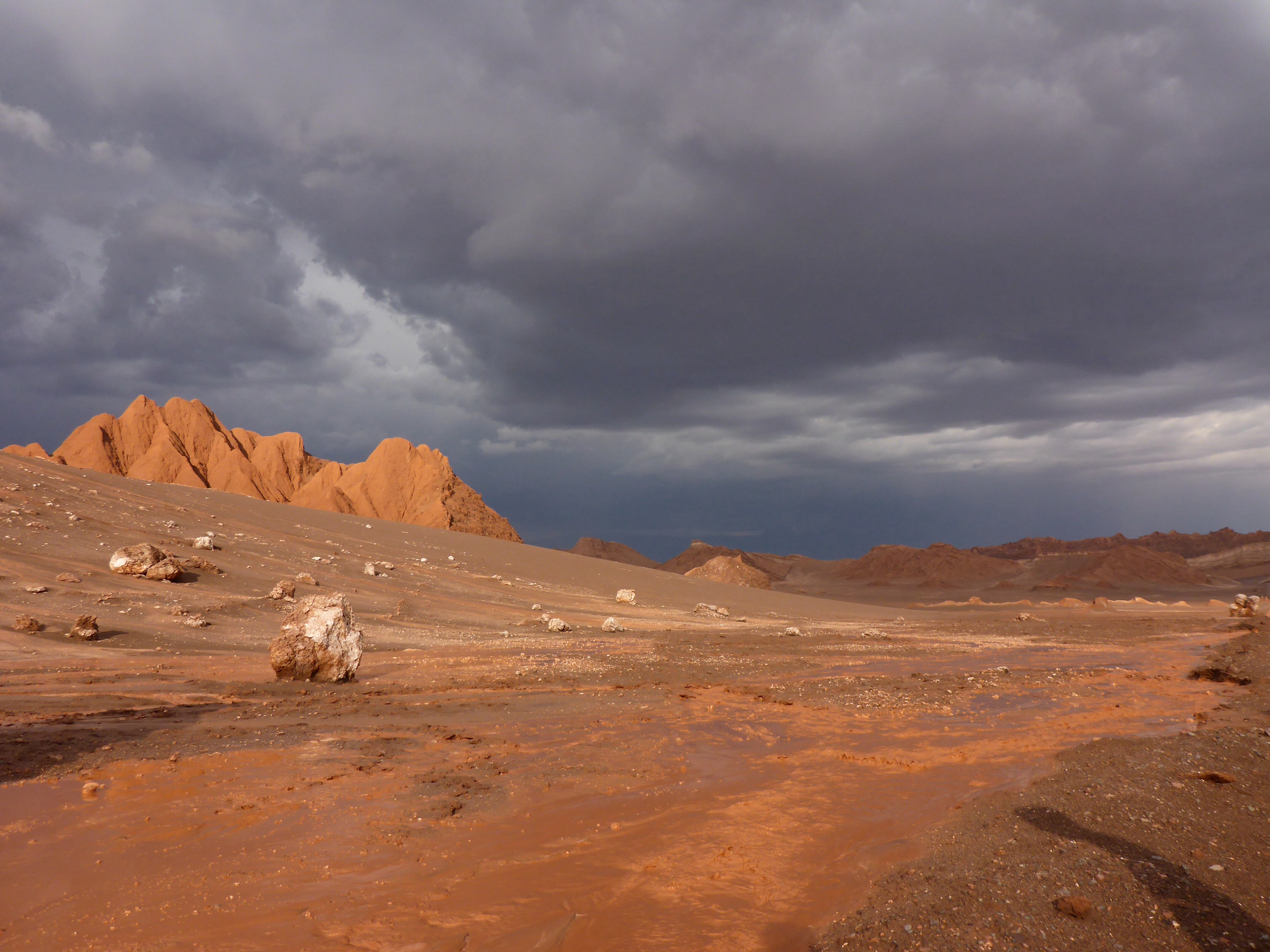
Our trip to the Valle de la Luna, with 13 other tourists started beautifully, the storm slowly growing and providing interesting lighting, then we got drenched and admired spectacular lightning strikes across the desert for a couple of hours. Truly magical.

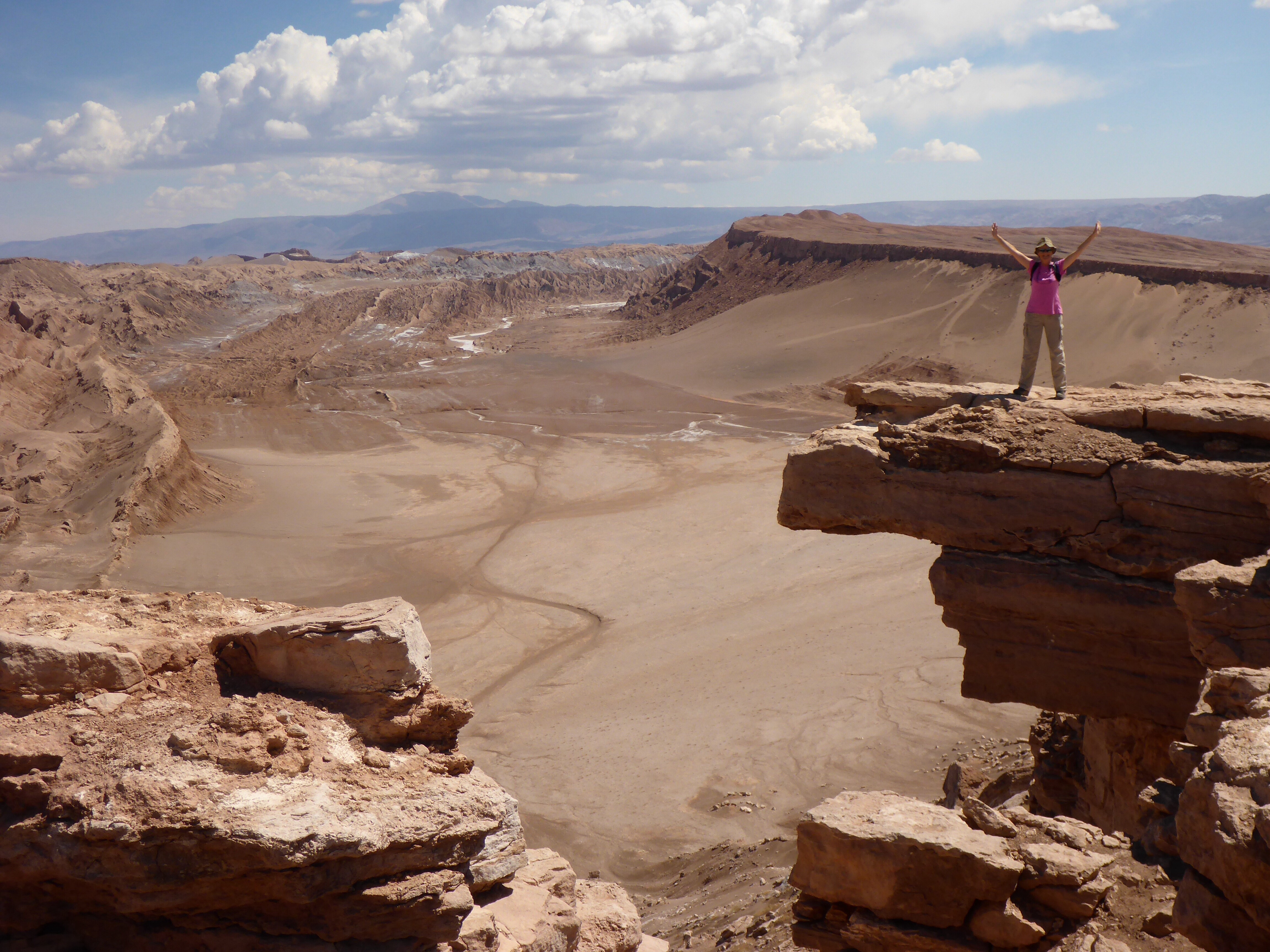
Anne above the Valley de la Luna, San Pedro de Atacama

Anne above the Valley de la Luna, San Pedro de Atacama

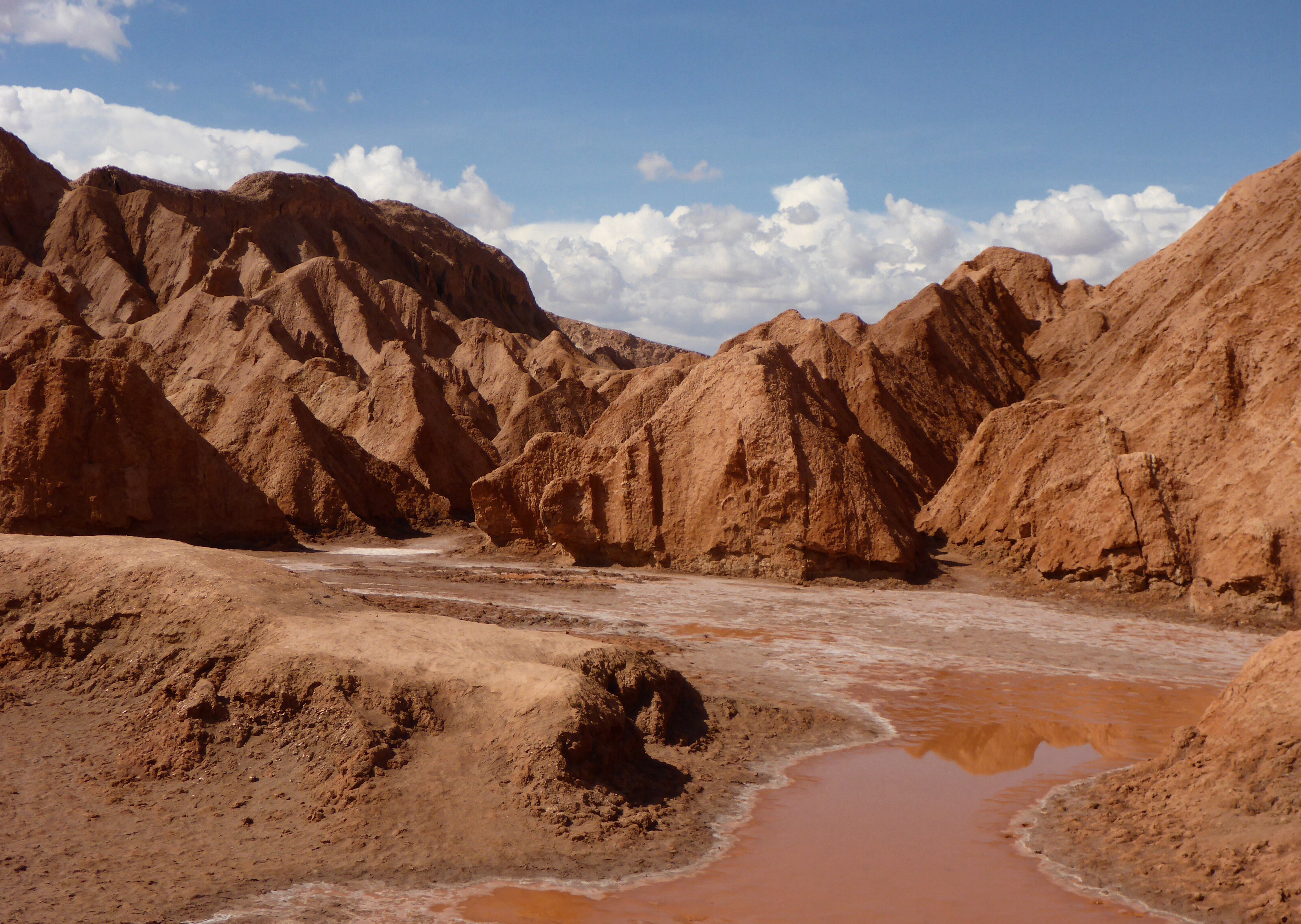
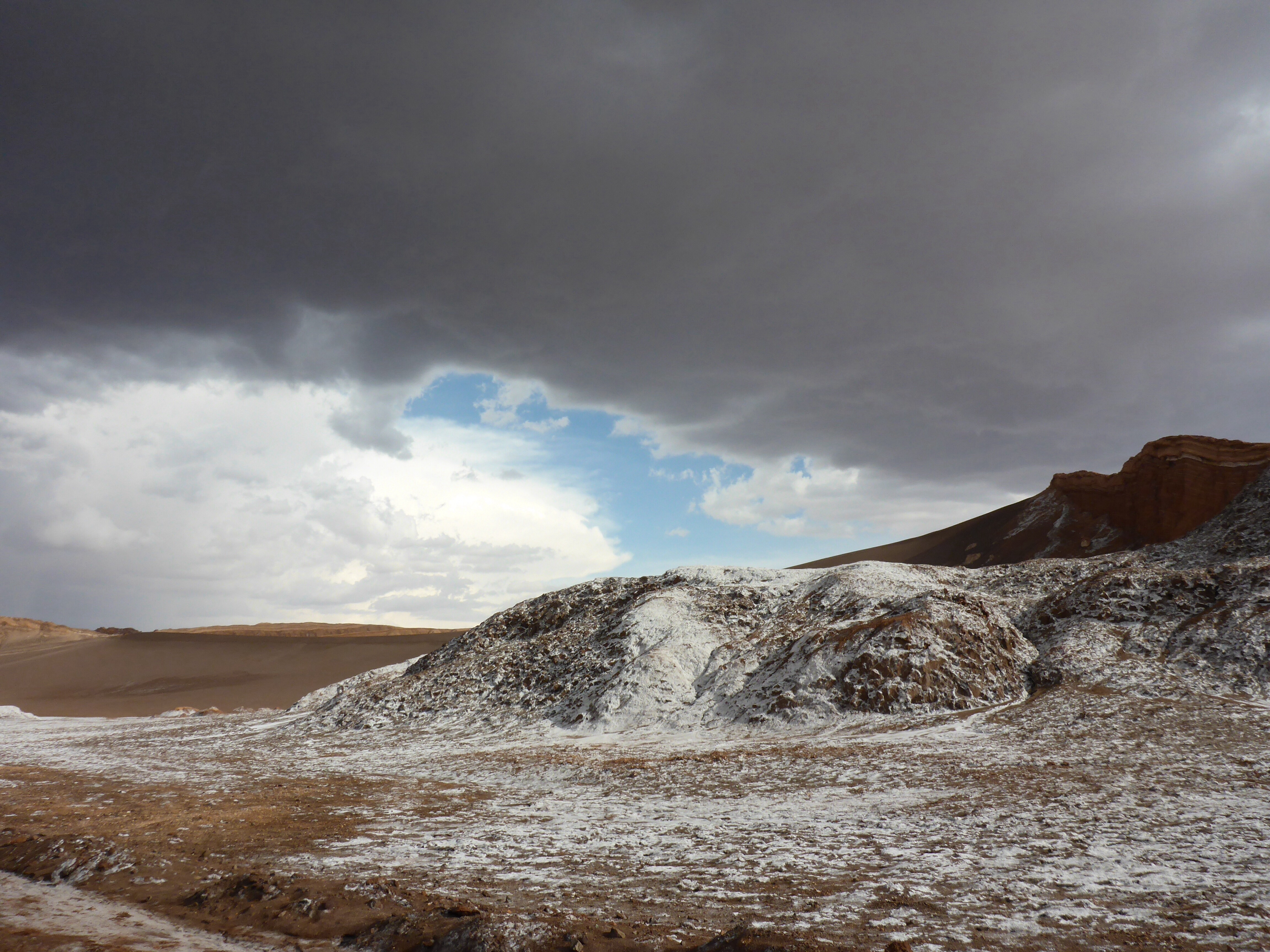
Valle de la Luna after rain for 2 days

Valle de la Luna after rain for 2 days

Great thunder and lightning show in the Valle de la Luna - salt in the foreground

Great thunder and lightning show in the Valle de la Luna – salt in the foreground

Valle de la Luna

Valle de la Luna

Valle de la Luna

Valle de la Luna

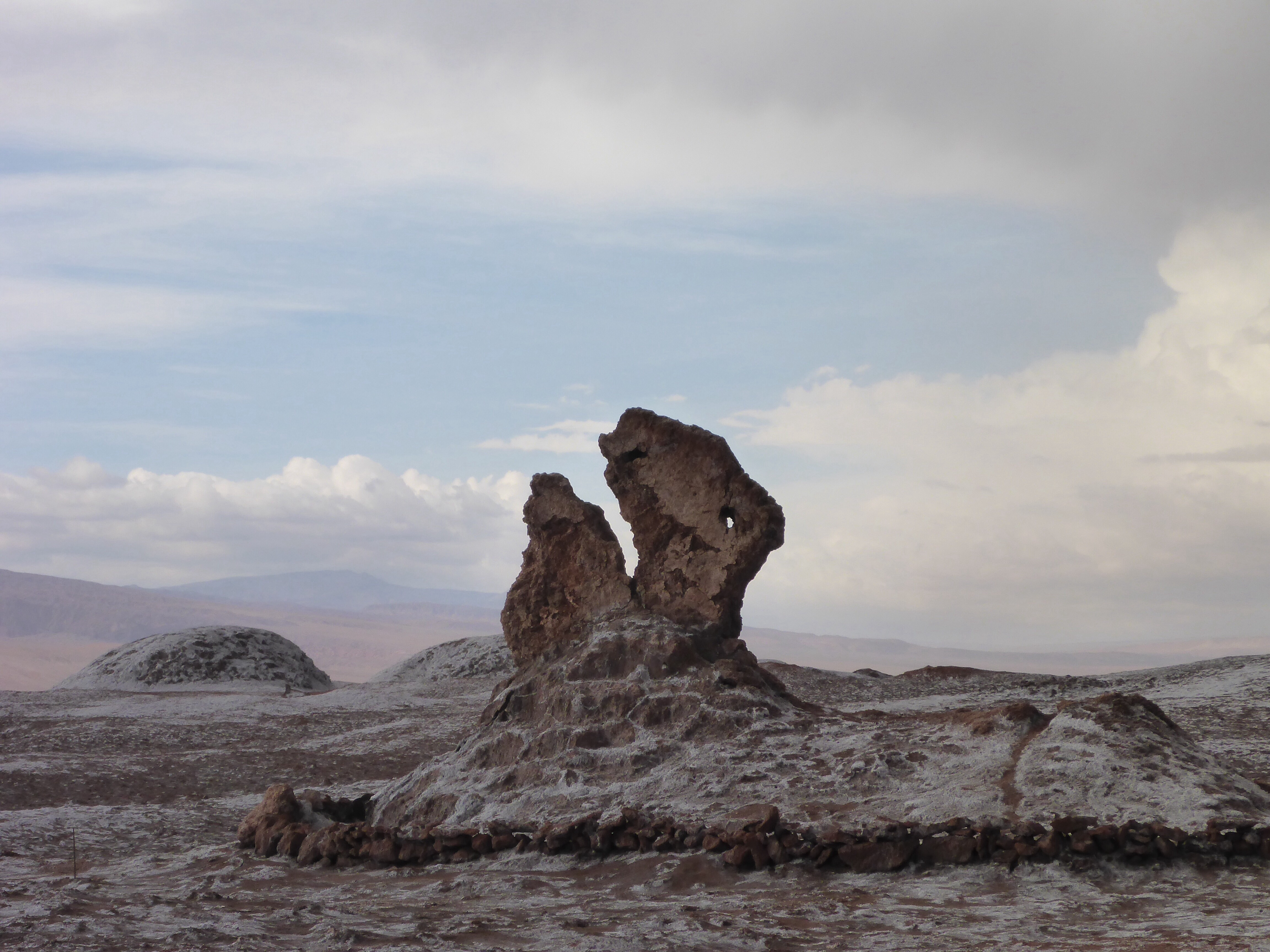
Rock formations in the Valle de la Luna

Rock formations in the Valle de la Luna

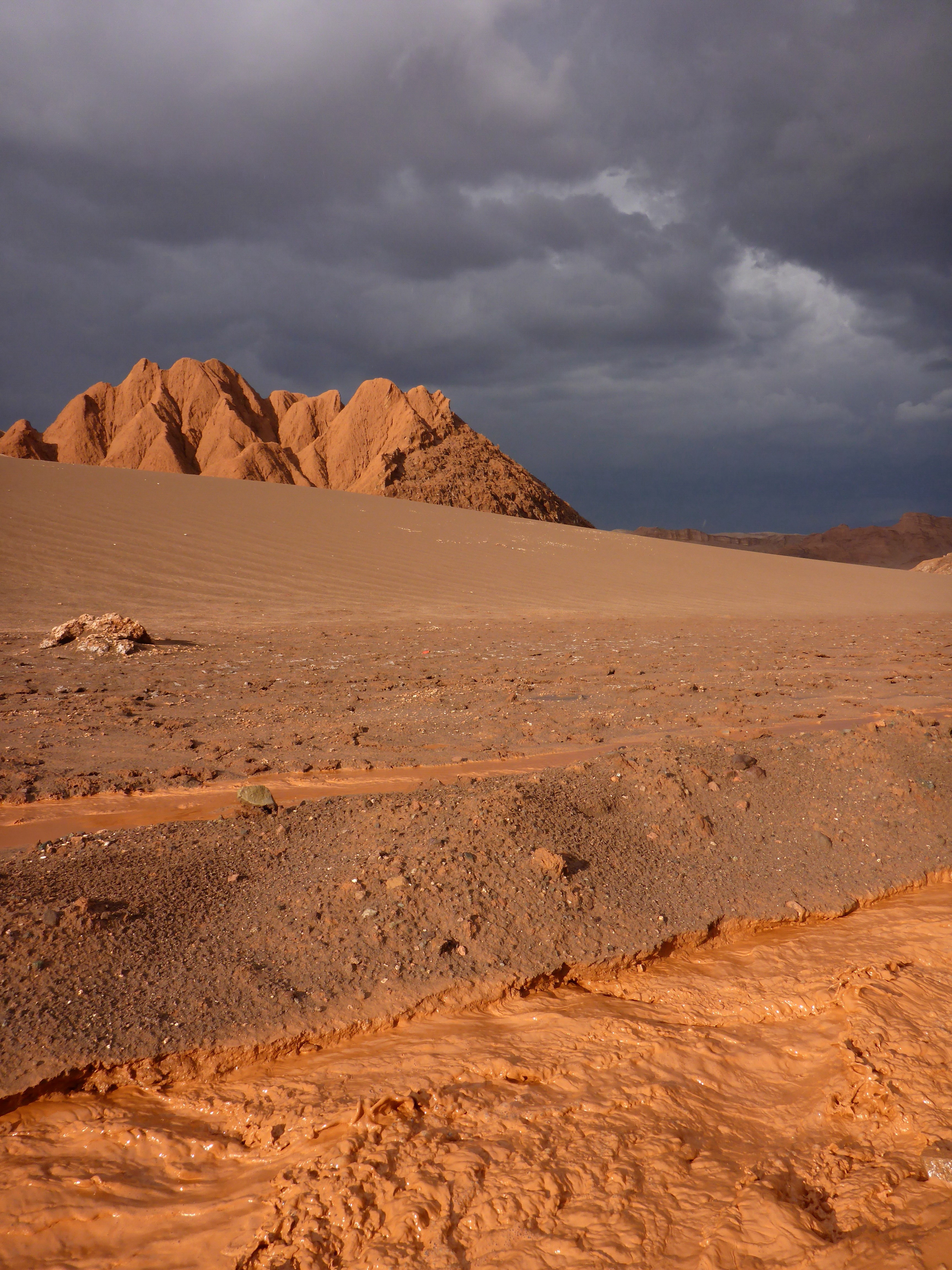
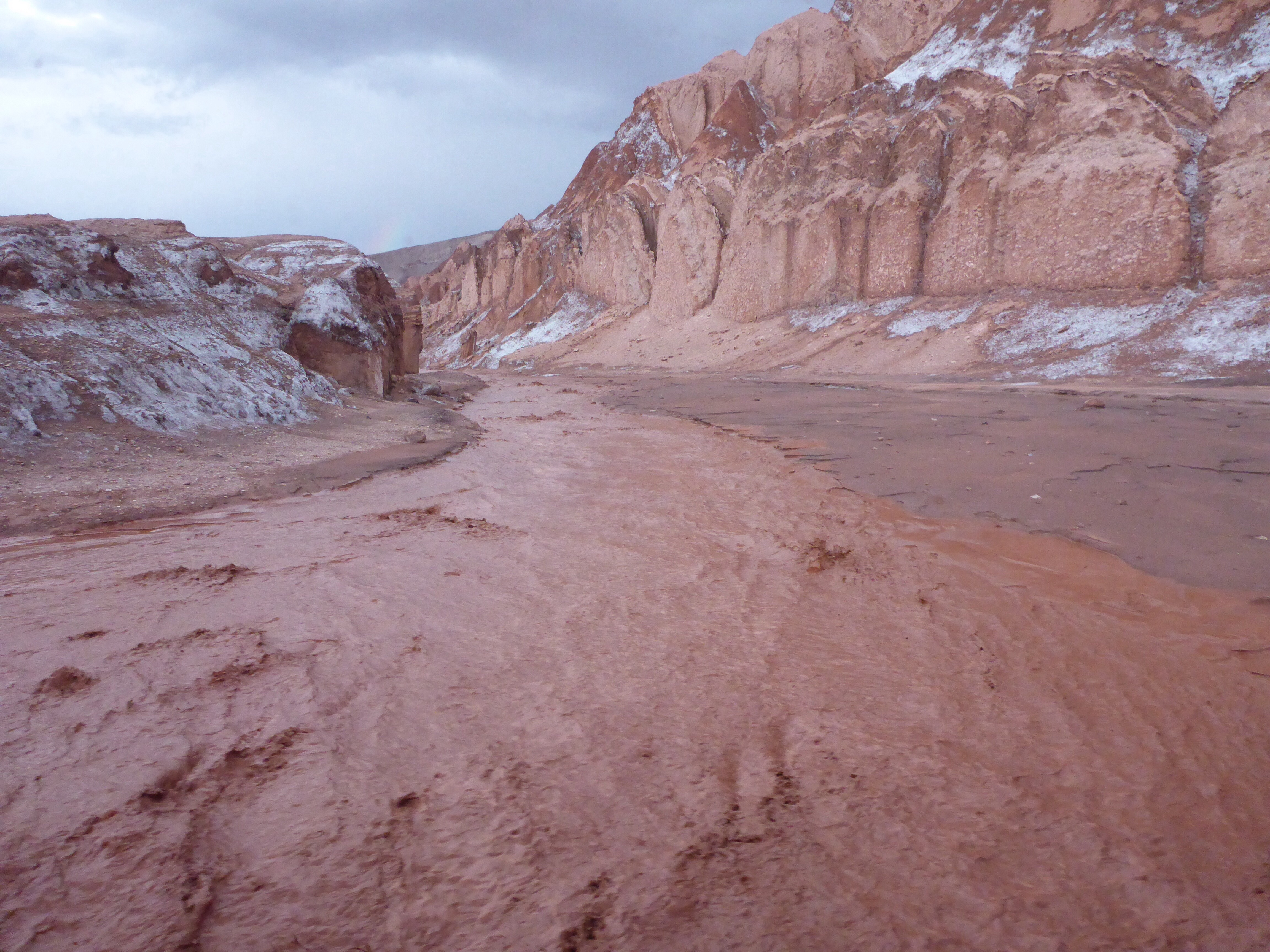
Valle de la Luna with rushing water from the storm

Valle de la Luna with rushing water from the storm

Valle de la Luna

Valle de la Luna


It was decided it was too dangerous to go to our sunset viewing point because of the amount of rain, so we turned back a little earlier than scheduled. We got stopped along the way – the road is closed due to flooding, we have to leave the park another way. We turn around and find a couple of vans ahead of us, stopped at a gate. It is locked. No one has a key or knows who to contact to get it opened. The queue of vehicules behind quickly builds up. Then suddenly we hear commotion, I look outside my windown, I notice water running down the road. Flash flood!!! Looking further up the road, some have already turned back, rushing back up the mountain to safety, driving across the flooded creek bed.

Our road out of the Valle was cut off by floods, so we went another way, but this gate is padlocked - what now?

Our road out of the Valle was cut off by floods, so we went another way, but this gate is padlocked – what now?

Flash flood in the Valle de la Luna - see the water running down on the right and up the road - every vehicule quickly returned up the hill

Flash flood in the Valle de la Luna – see the water running down on the right and up the road – every vehicule quickly returned up the hill

Crossing the flash flood to backtrack up the hill

Crossing the flash flood to backtrack up the hill


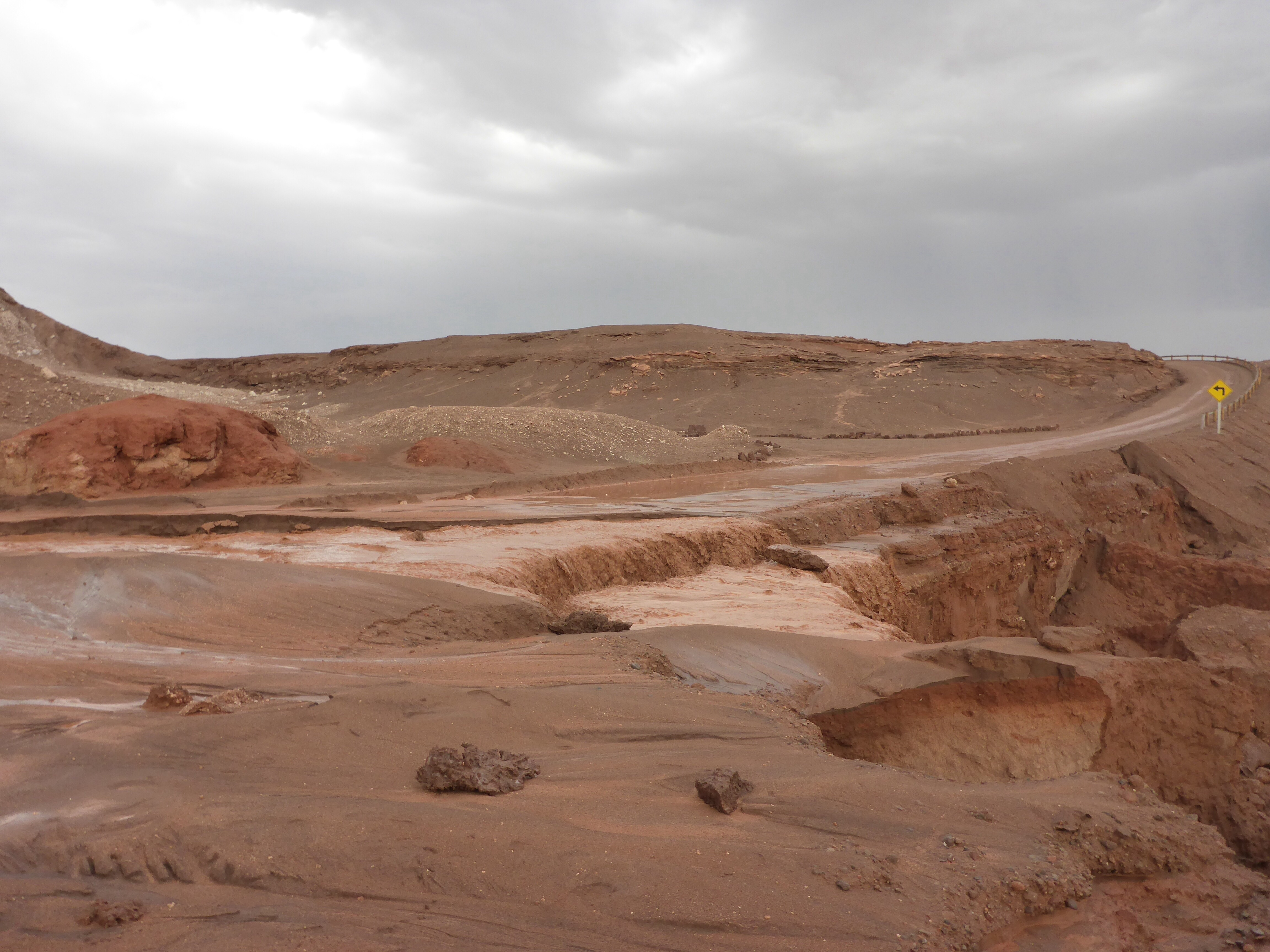
The rain is quickly leaving its mark in the Valle de la Luna

The rain is quickly leaving its mark in the Valle de la Luna

We get to the original problem area: a creek has broken its banks and flooded the road which is also breaking up. The tour guide calls his manager. 2 vans will come and get us if we can wade across the creek. The original van will be left behind for now.

This is our little obstacle in the Valle de la Luna

This is our little obstacle in the Valle de la Luna

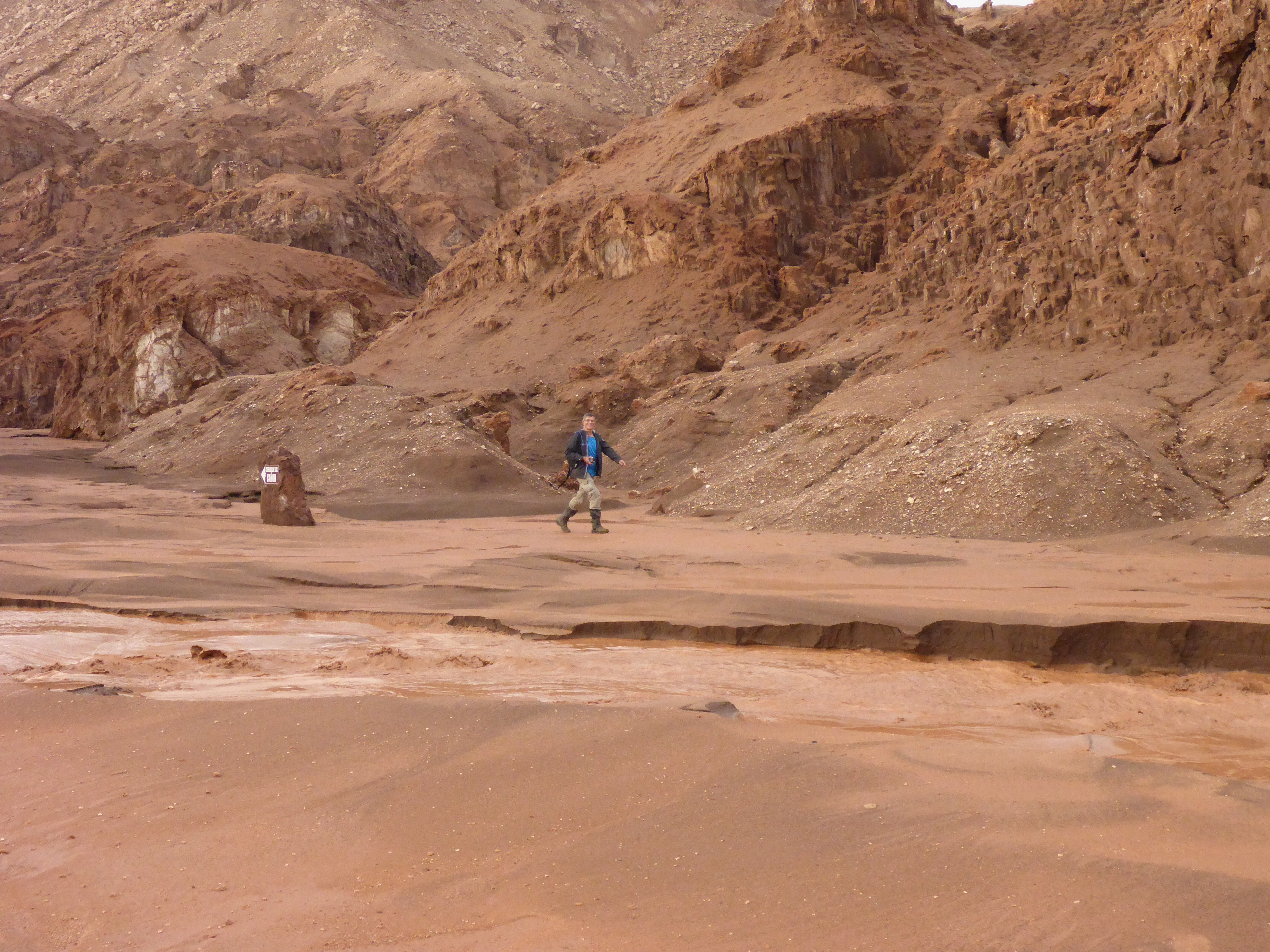
Anthony was the first to find a place to cross in our now waterproof boots and doesn't he looked proud of himself?!

Anthony was the first to find a place to cross in our now waterproof boots and doesn’t he looked proud of himself?!

We are all safely across - we are the only 2 with dry feet.

We are all safely across – we are the only 2 with dry feet.

Now safely in our rescue vehicule, Martin stops to update the authorities who have heard of all the people stranded in the valley

Now safely in our rescue vehicule, Martin stops to update the authorities who have heard of all the people stranded in the valley

The tour company, guide and driver all managed the situation brilliantly. How lucky are we to have seen this part of the world under such rare conditions. According to wikipedia, evidence suggests that it hadn’t rained at all from 1570 to 1971 and while we were there, we got 7 years’ worth of rain in just 12 hours.

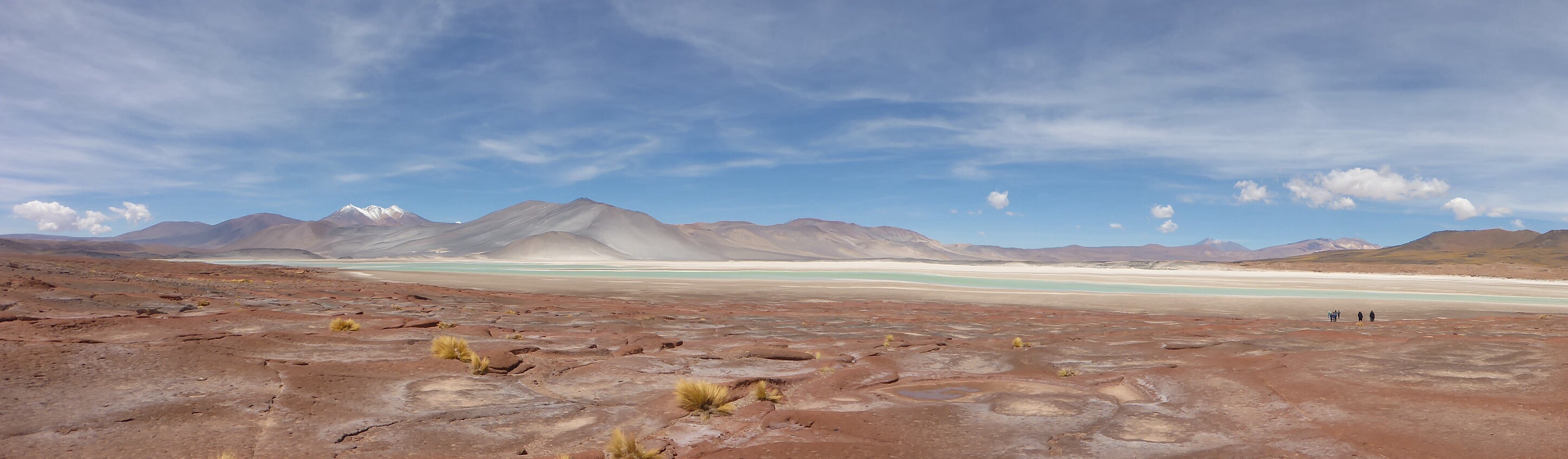
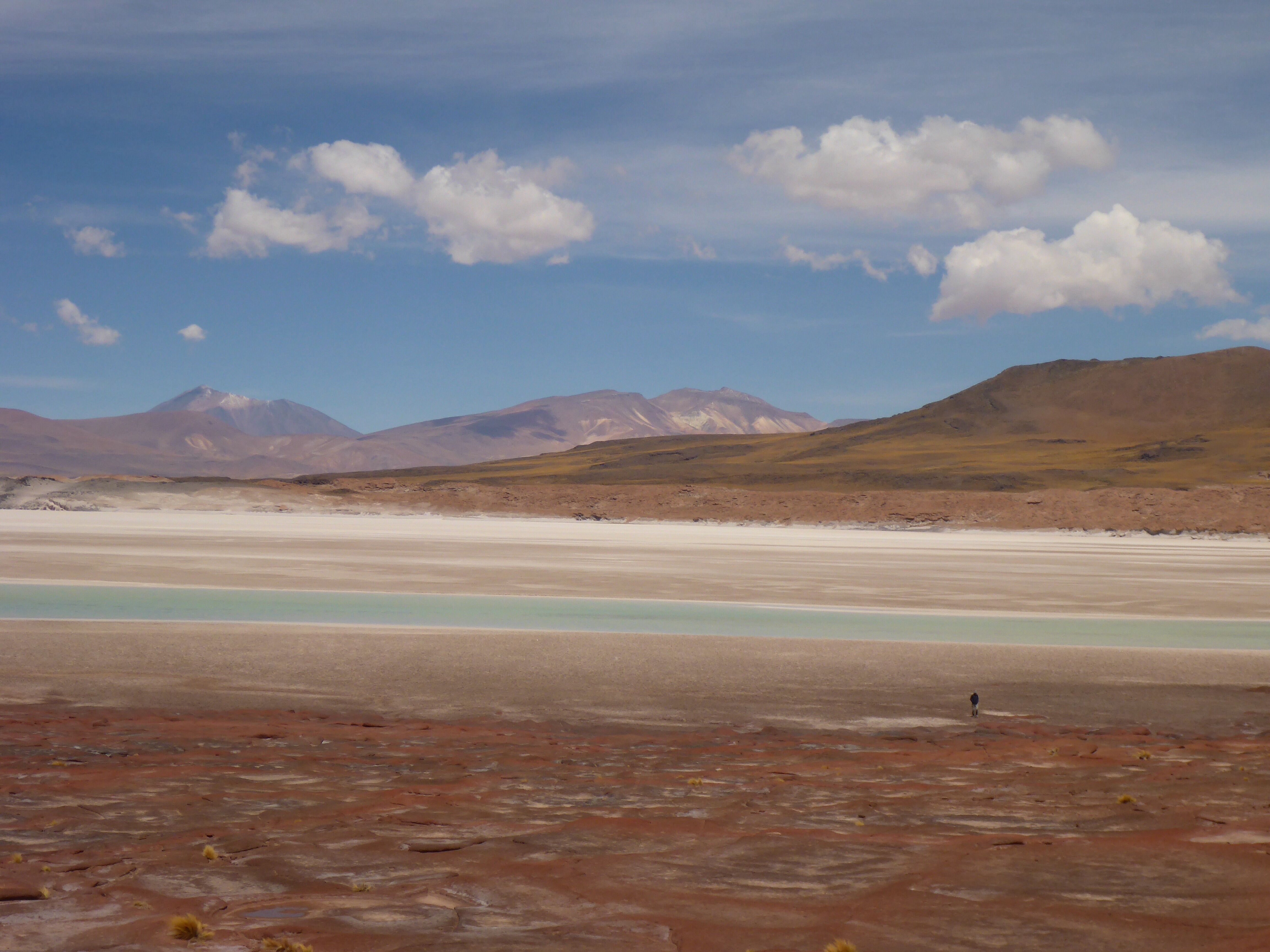
The second tour takes us to the Altaplino lagoons, high plains lagoons, with a pick up at 7am and breakfast planned for 8.30am. The scenery was breathtaking:

Vicuñas, one of two wild South American camelids, ancestors of the domesticated alpacas

Vicuñas, one of two wild South American camelids, ancestors of the domesticated alpacas

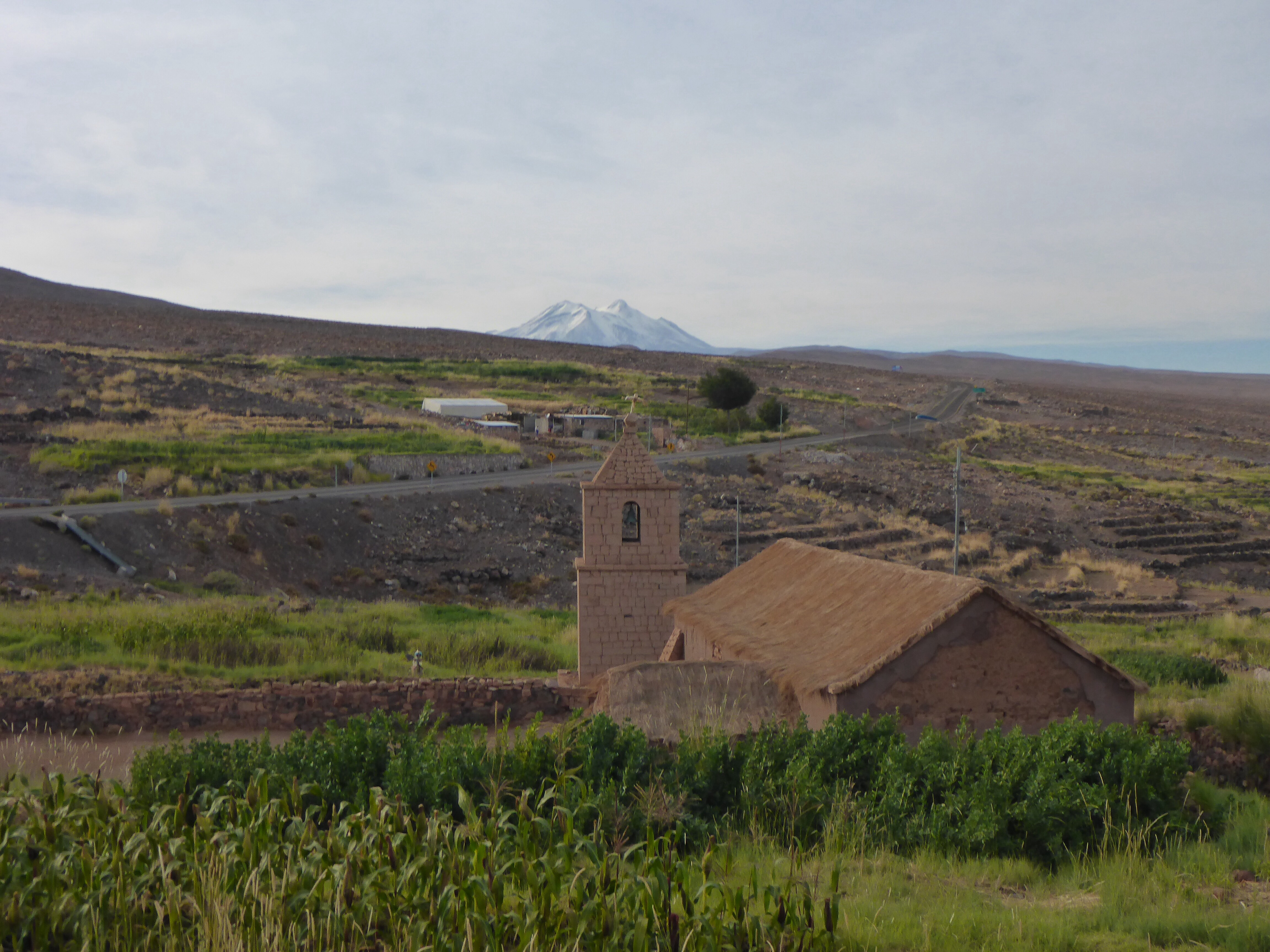
Tocanao village church and terraces on our way to the altiplanic lagoons

Tocanao village church and terraces on our way to the altiplanic lagoons

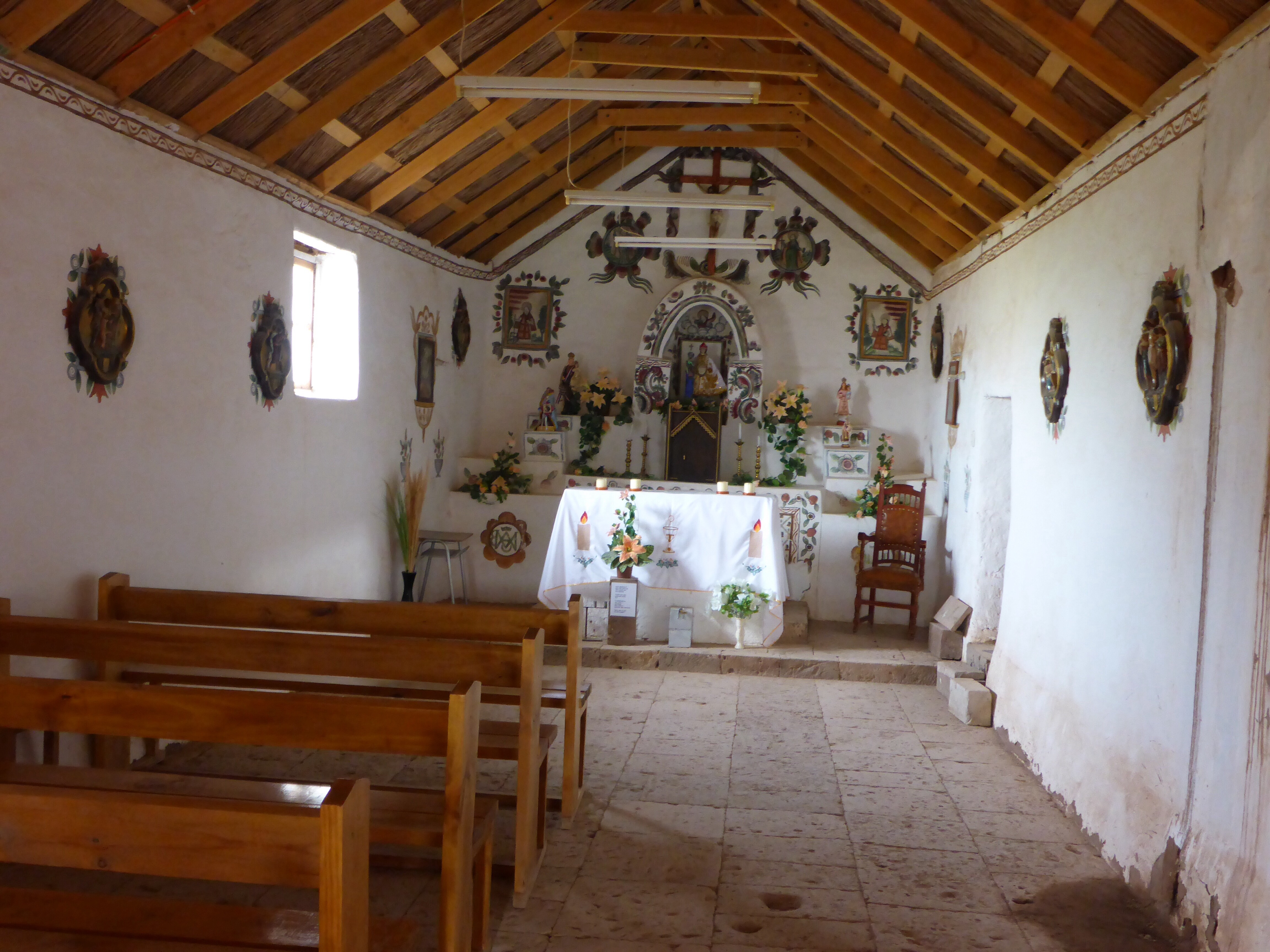
1750 church in Tocanao

1750 church in Tocanao

The separate bell tower of the Tocanao church

The separate bell tower of the Tocanao church

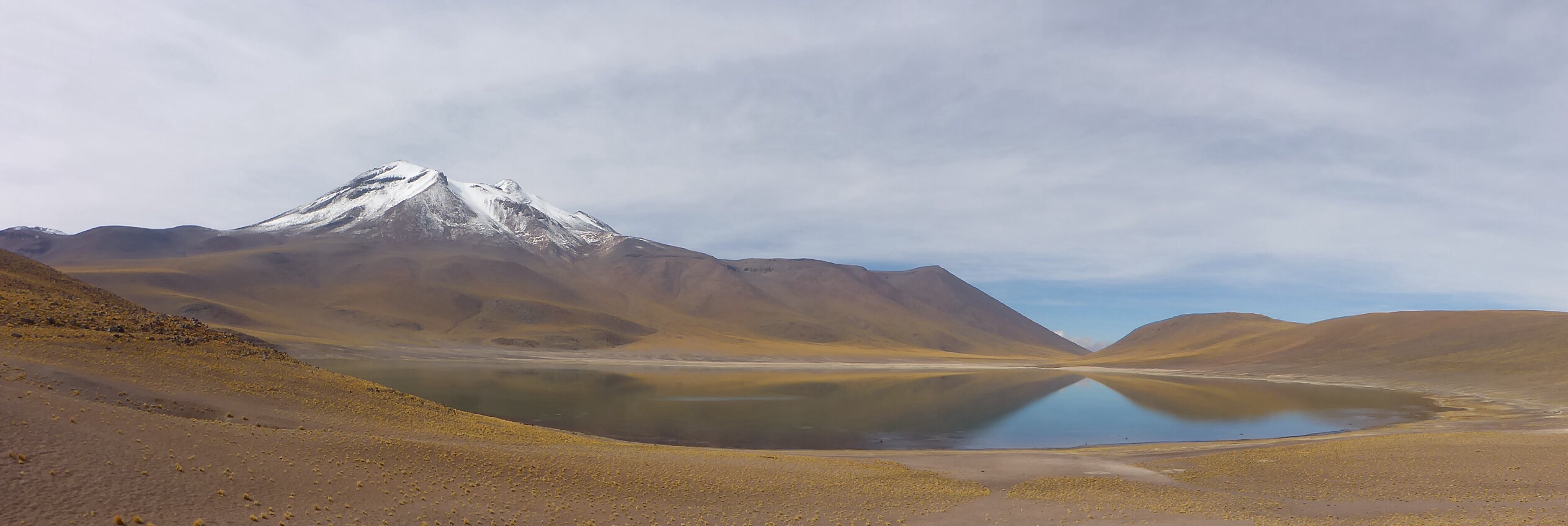
Miscanti Lagoon

Miscanti Lagoon

Miscanti lagoon

Miscanti lagoon

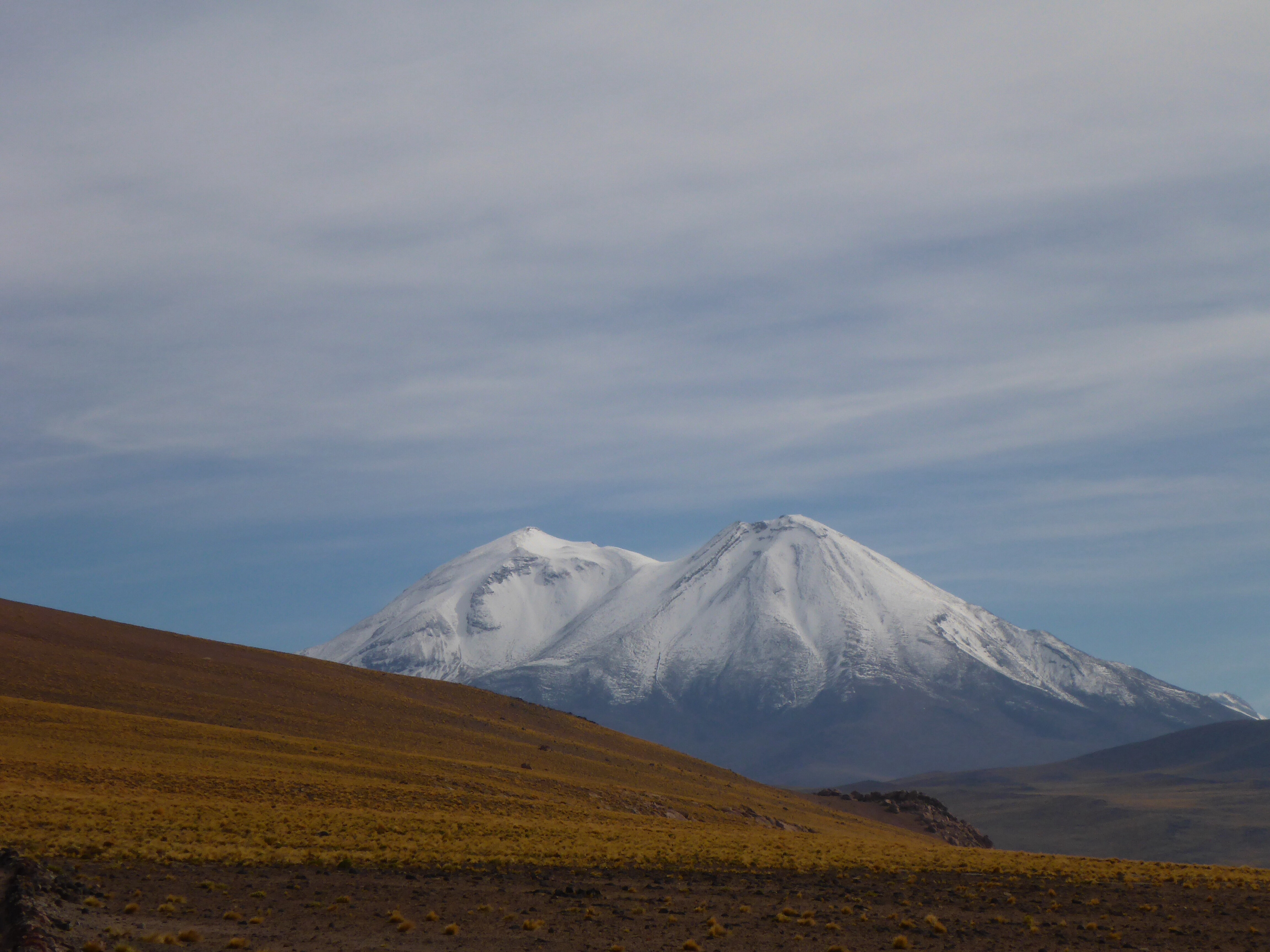
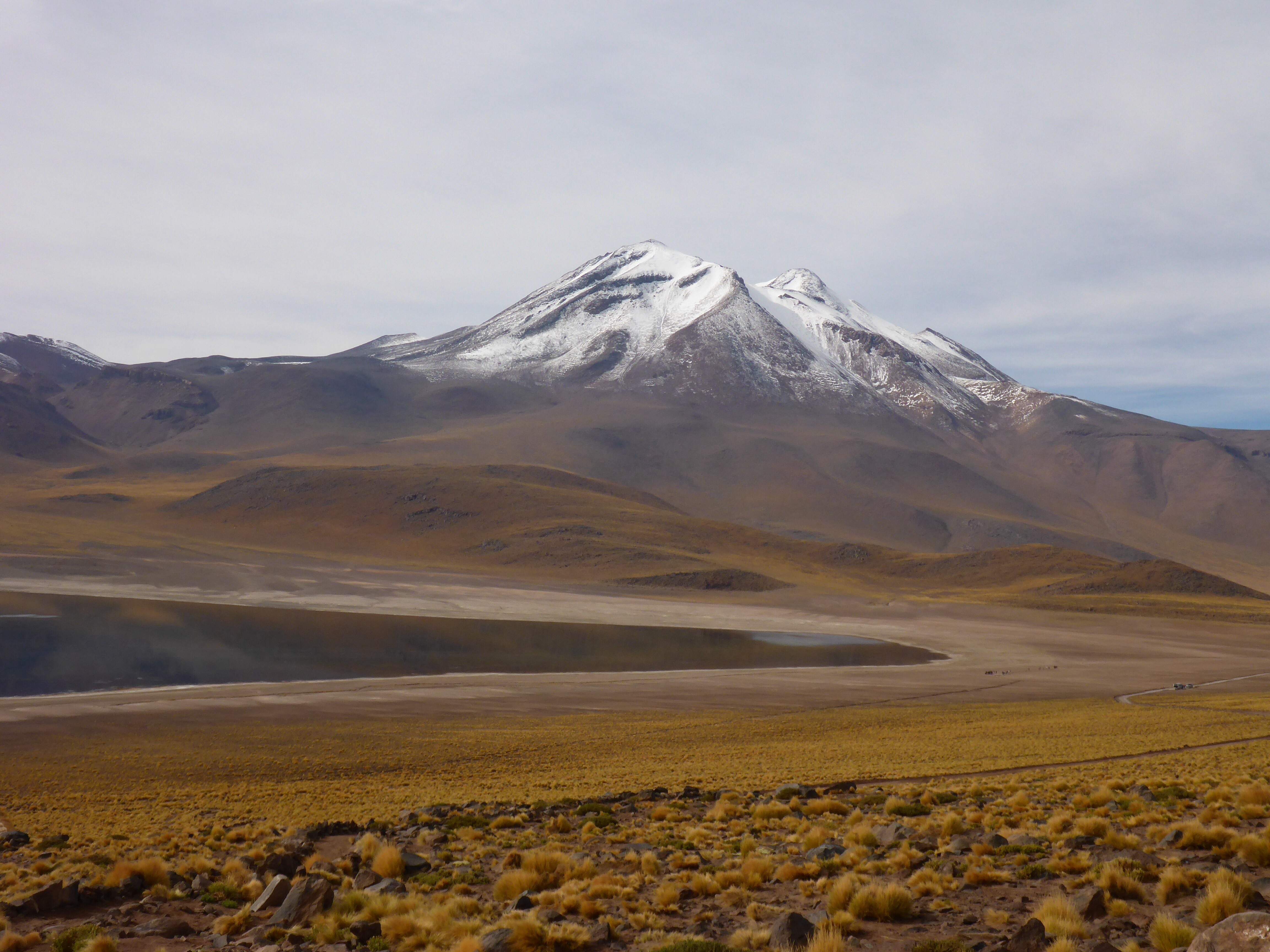
Lascar volcano seen from Miscanti lagoon

Lascar volcano seen from Miscanti lagoon

Walking along Miscanti lagoon towards Miniques lagoon and looking back

Walking along Miscanti lagoon towards Miniques lagoon and looking back

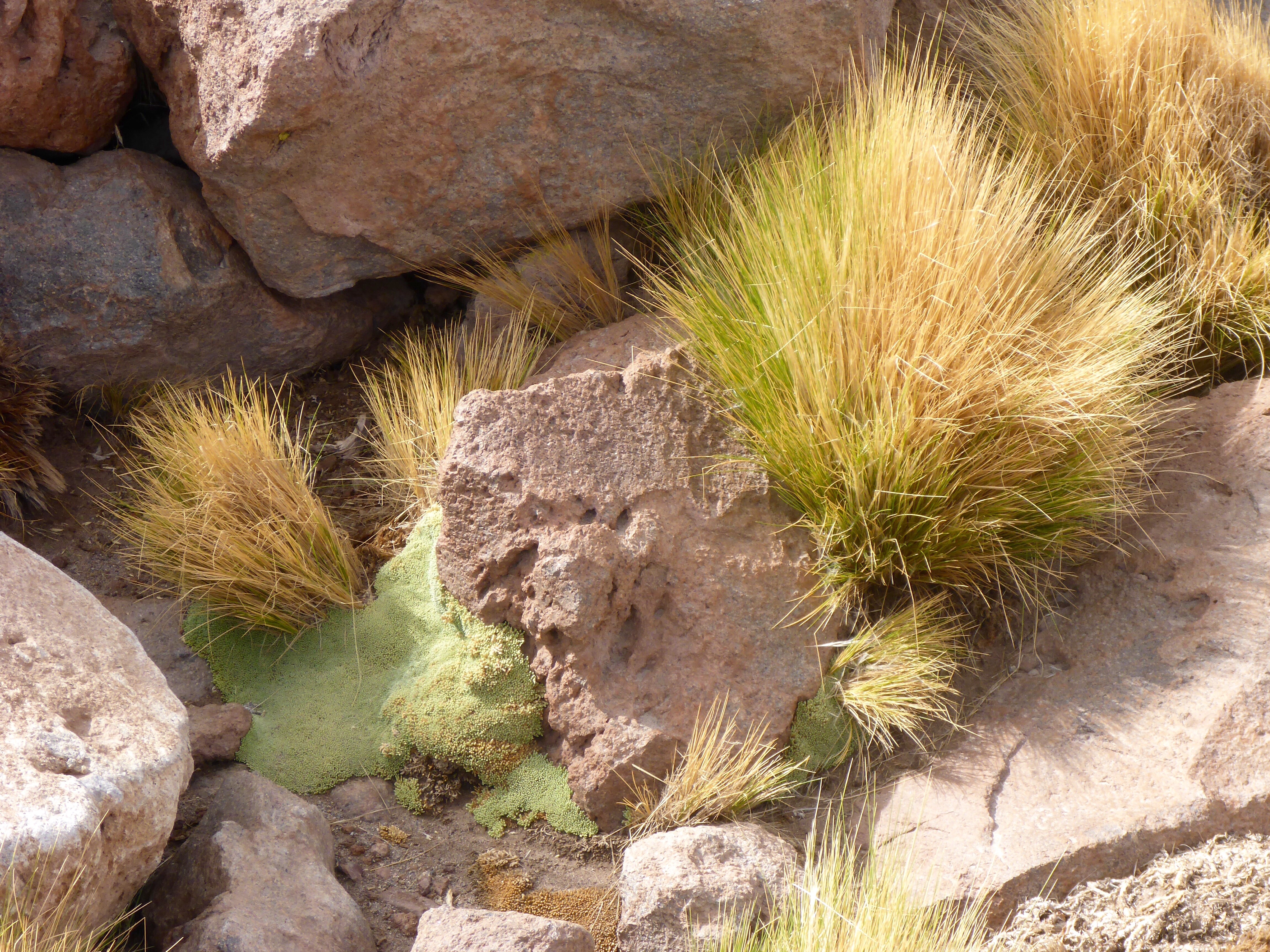
The only green vegetation I came across - beautiful moss

The only green vegetation I came across – beautiful moss

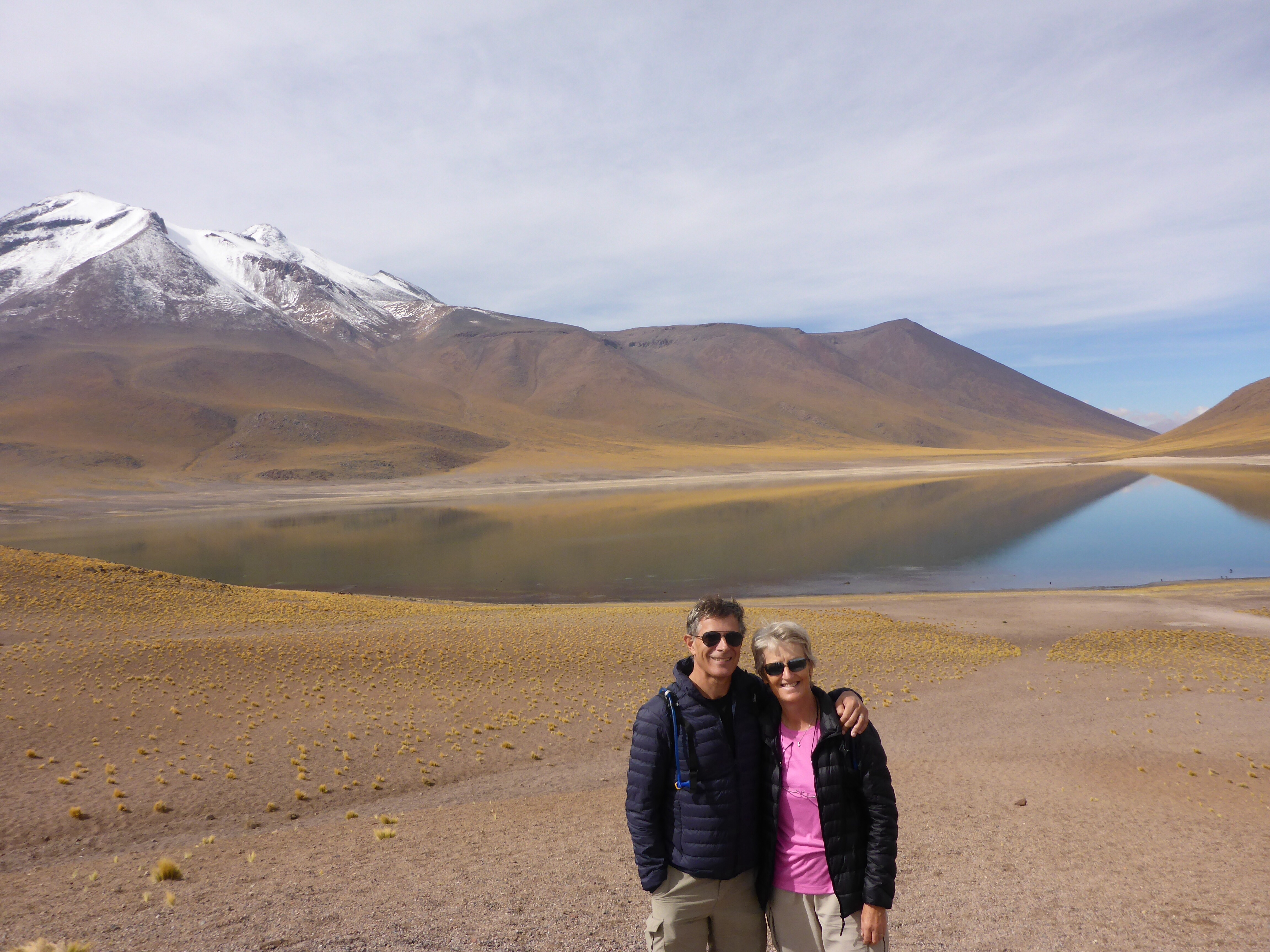
Miniques lagoon

Miniques lagoon

At Miniques lagoon

At Miniques lagoon

Lascar volcano

Lascar volcano

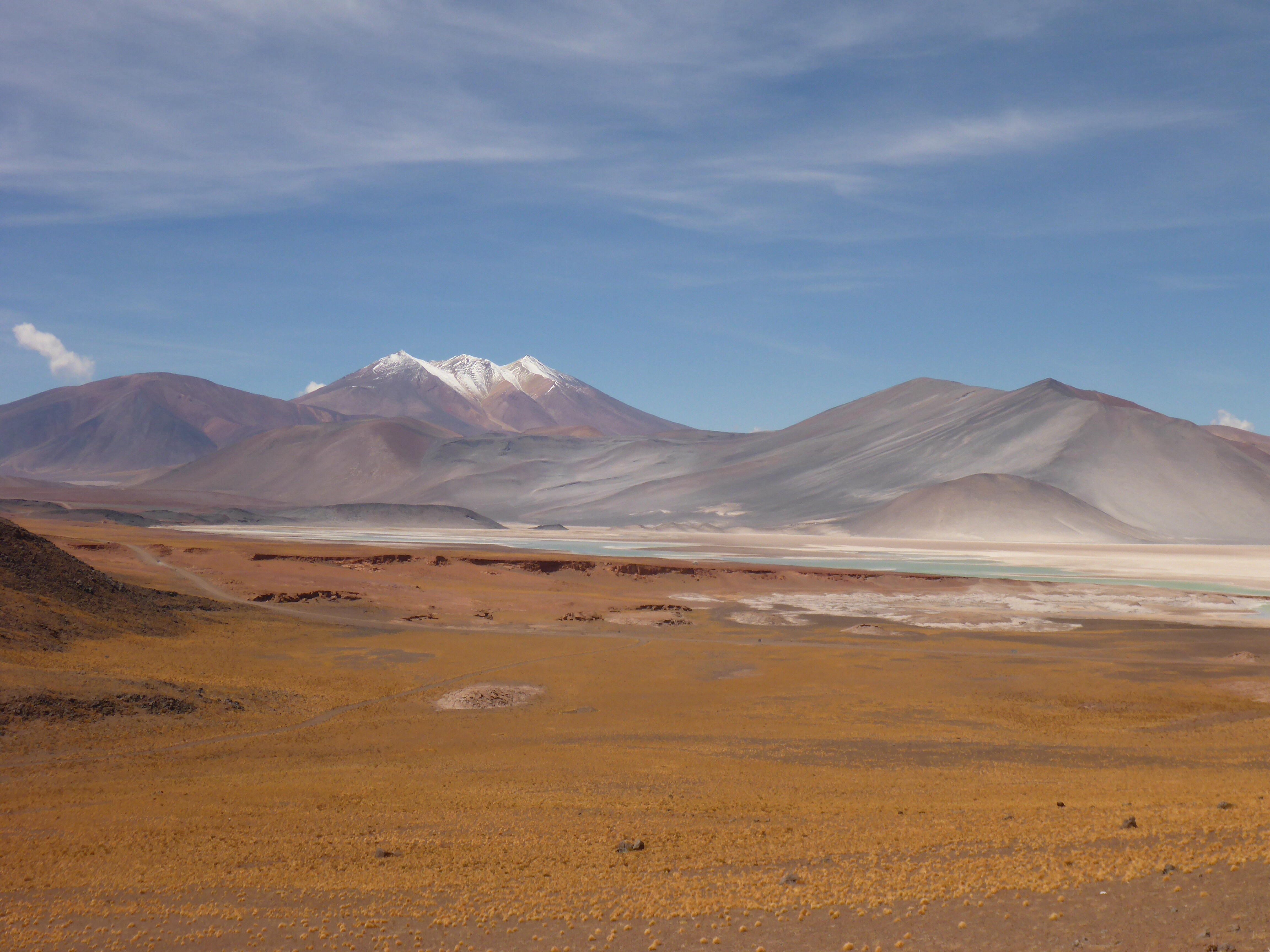
Salar de Talar

Salar de Talar

Salar de Talar

Salar de Talar

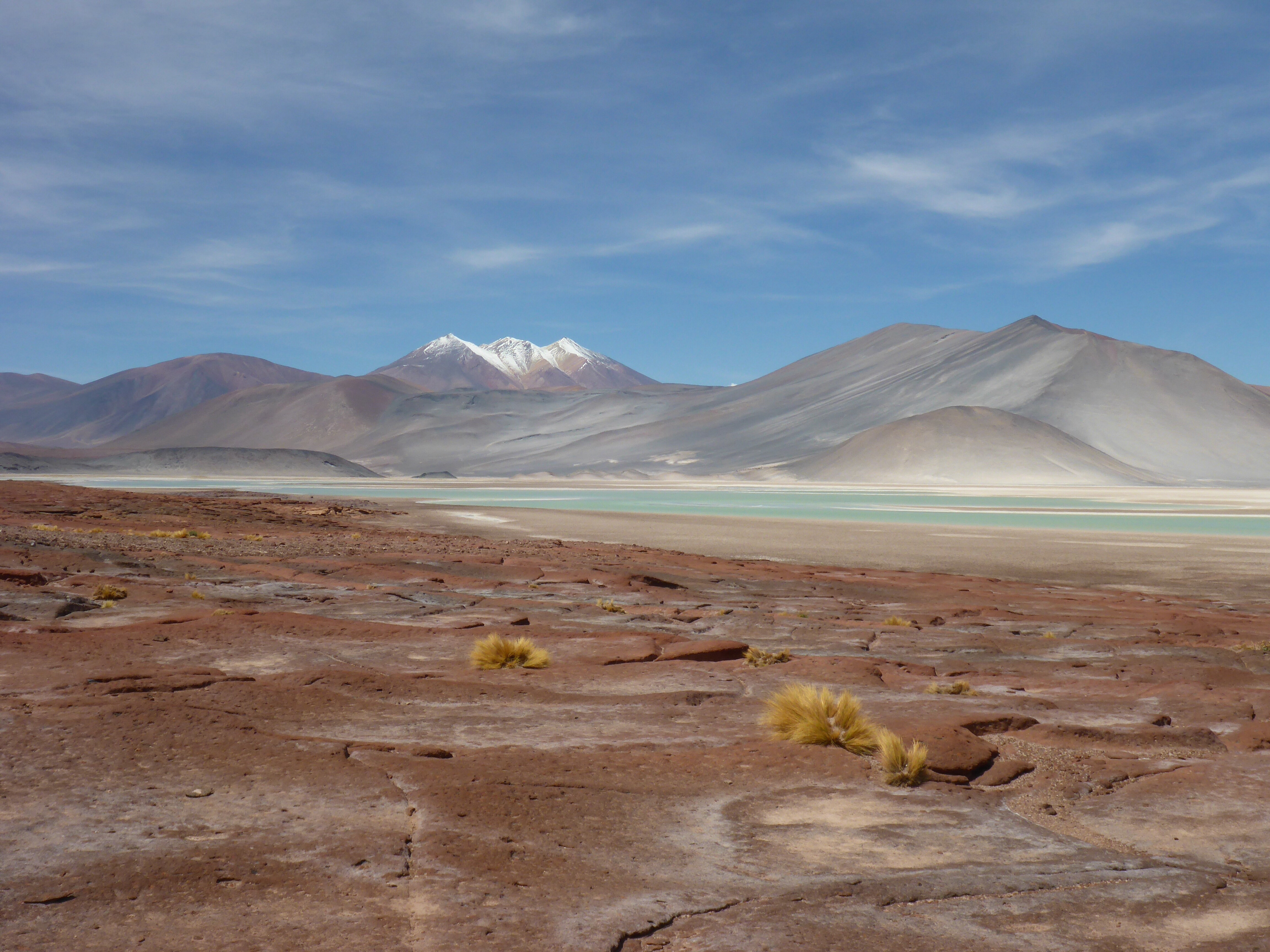
Salar de Talar

Salar de Talar

Anthony walking back from the water's edge at the Salar de Talar

Anthony walking back from the water’s edge at the Salar de Talar

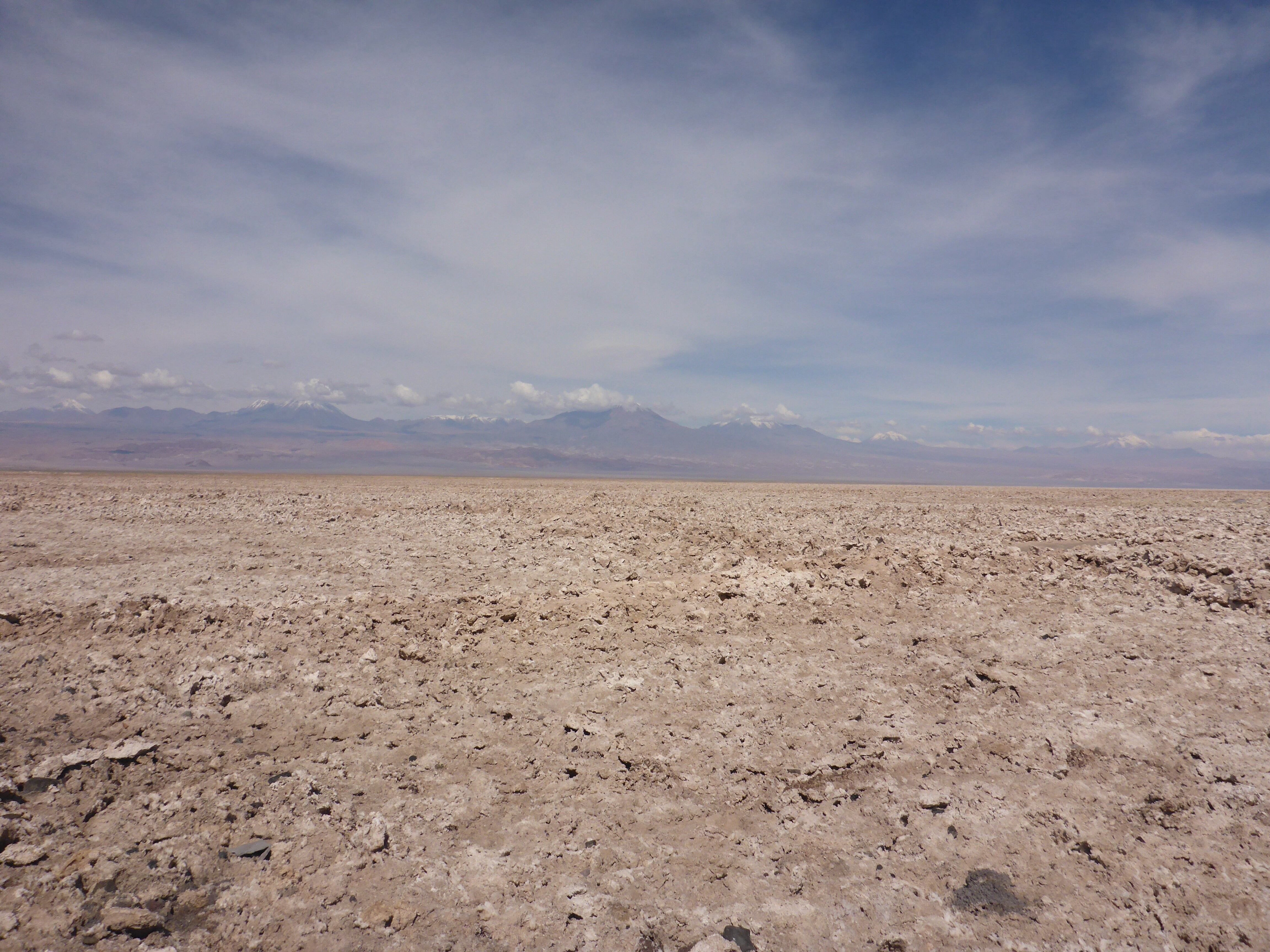
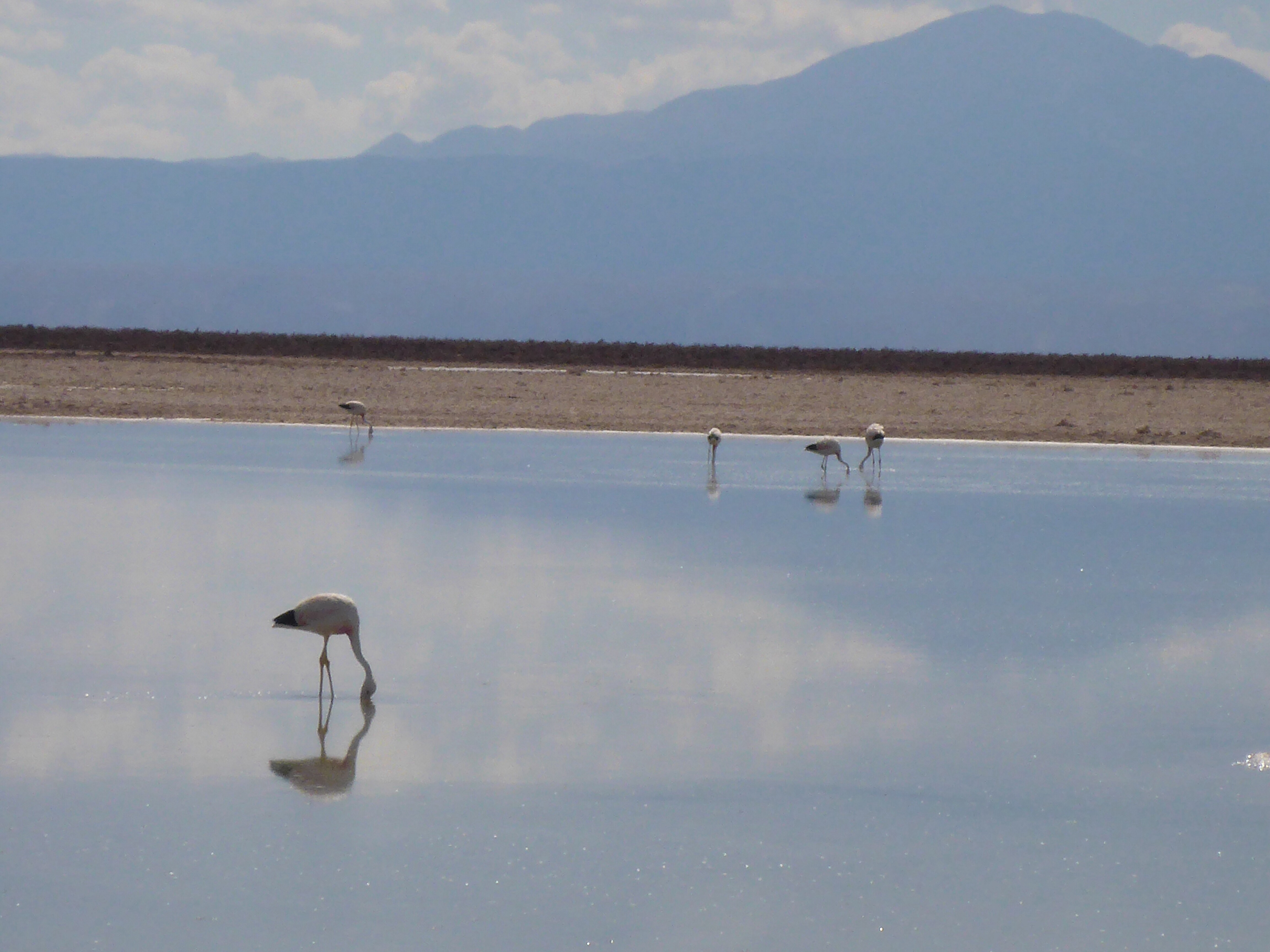
National Flamingo Reserve within the Salar de Atacama

National Flamingo Reserve within the Salar de Atacama

Andean flamingos at the National Flamingo Reserve within the Salar de Atacama

Andean flamingos at the National Flamingo Reserve within the Salar de Atacama

National Flamingo Reserve within the Salar de Atacama

National Flamingo Reserve within the Salar de Atacama

National Flamingo Reserve within the Salar de Atacama

National Flamingo Reserve within the Salar de Atacama

The order in which we visited the various sights was changed due to the rains the previous evening and some road closures. Unfortunately, our tour guide was not as experienced in managing change as yesterday’s guide so we had breakfast at 11am, after an unexpected 45 minute walk between lagoons (not good for Anthony’s ankle) and lunch was served at 16.45. A combination of altitude and lack of food made sure I got hit with altitude sickness, despite making sure I drank heaps of water all day (which took care of the evening, night and next morning for me). We decide that I cannot make the next two tours which go up to higher altitudes quicker than today and Anthony decides that 2 tours is more than enough for him so will cancel his spots on the next 2 also. While we have our ridiculously late lunch, we get our guide to call the manager and release our spots for other tourists. We have no idea if we will get our money back but it’s too bad. We go into the agency the next day, speak to the manager, and we are happy to report he refunded what we didn’t do without any fuss. Thank you Martin.

It was interesting talking to Martin, a Dutch man who arrived 28 years ago, and understanding why everything is so expensive in San Pedro. San Pedro is not connected to the grid (environmentalists don’t want to scar the scenery with power lines) so they have to use diesel to power electricity generators (diesel is one of the most expensive ways of providing electricity), everything has to be trucked in, and water treatment requires reverse osmosis to remove arsenic which occurs naturally, but in high levels in this area.

While it was good to go on organised tours for a change, and it was nice to meet a few travellers, we both feel that this way of travelling is not for us. We would have stopped so many more times just to admire the stunning lighting and listen to the silence…

So we spend the next couple of days recovering, going into town to use the internet at our favourite little restaurant and at a ‘French’ bakery on the main town square and doing some bike maintenance. Both motorcycle chains need tightening, but Anthony’s, which is still the original chain, a lot more than mine. Hmmm, we will have to keep an eye on that… Our bikes are completely covered in mud that has dripped down from the mud roof of our cabin but we decide there is no point in cleaning them yet. It continues to rain those next two days up to our departure.

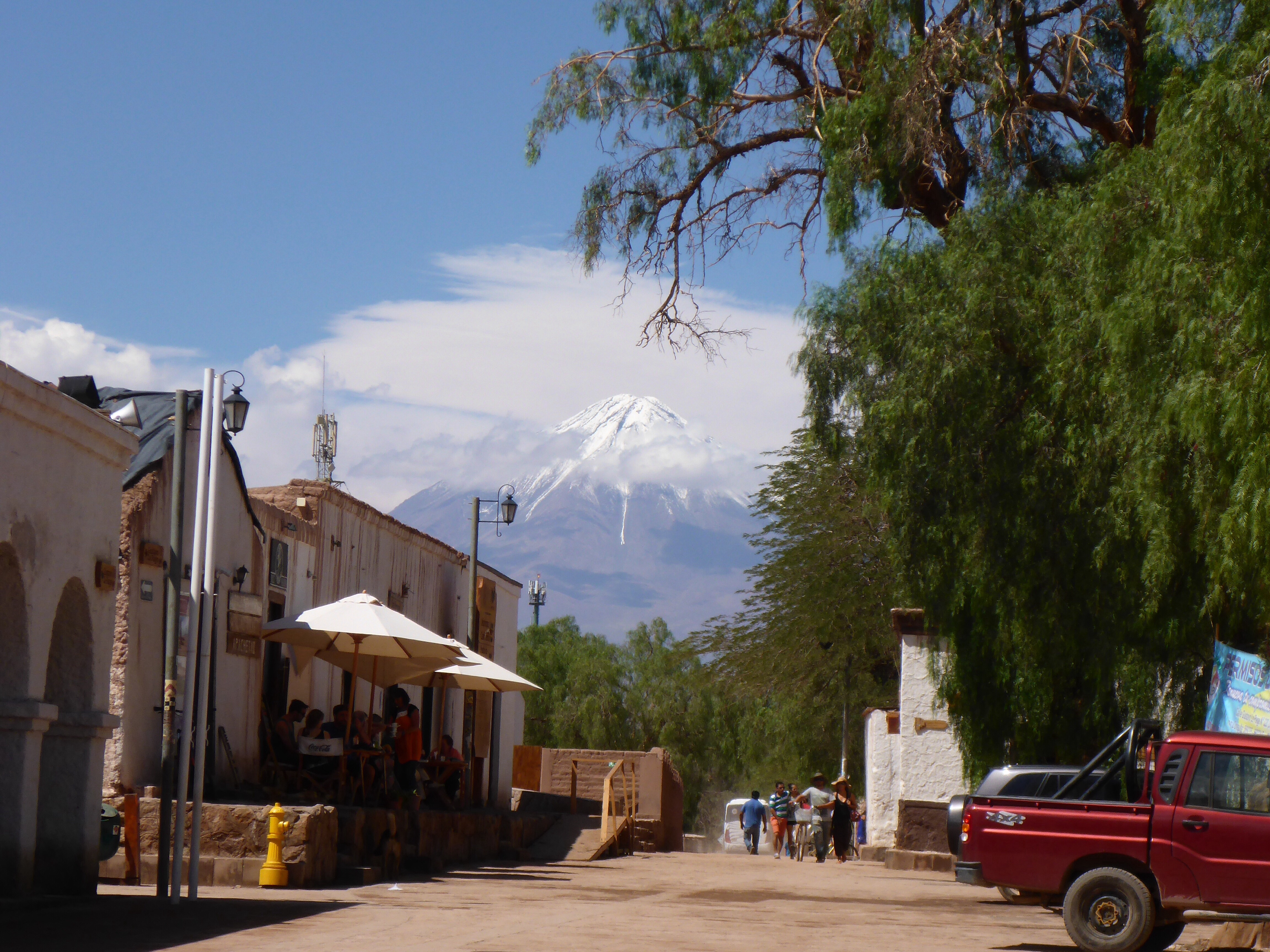
Licancabur volcano seen from San Pedro de Atacama town centre

Licancabur volcano seen from San Pedro de Atacama town centre

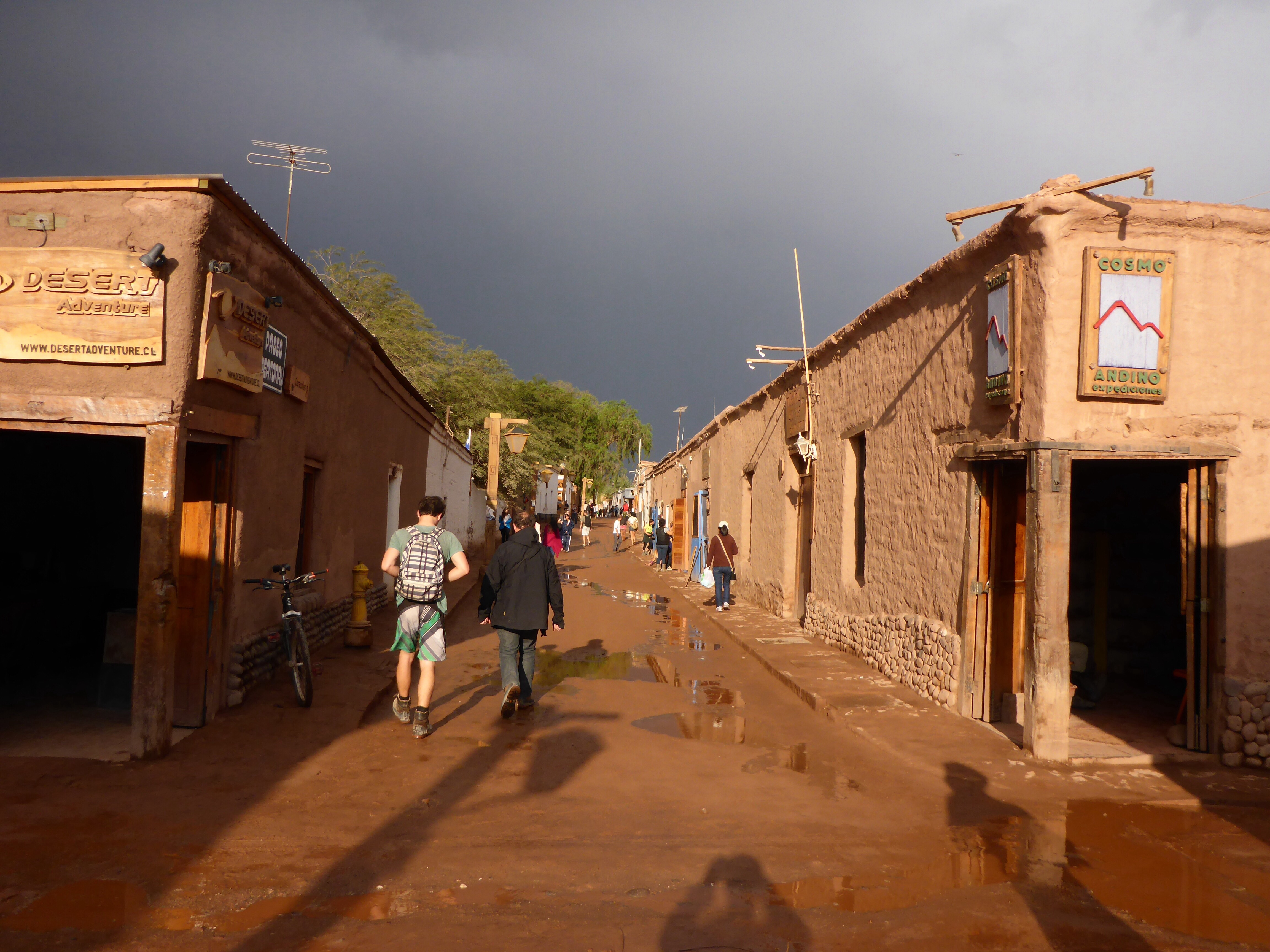
San Pedro de Atacama after another storm

San Pedro de Atacama after another storm

San Pedro de Atacama town centre

San Pedro de Atacama town centre

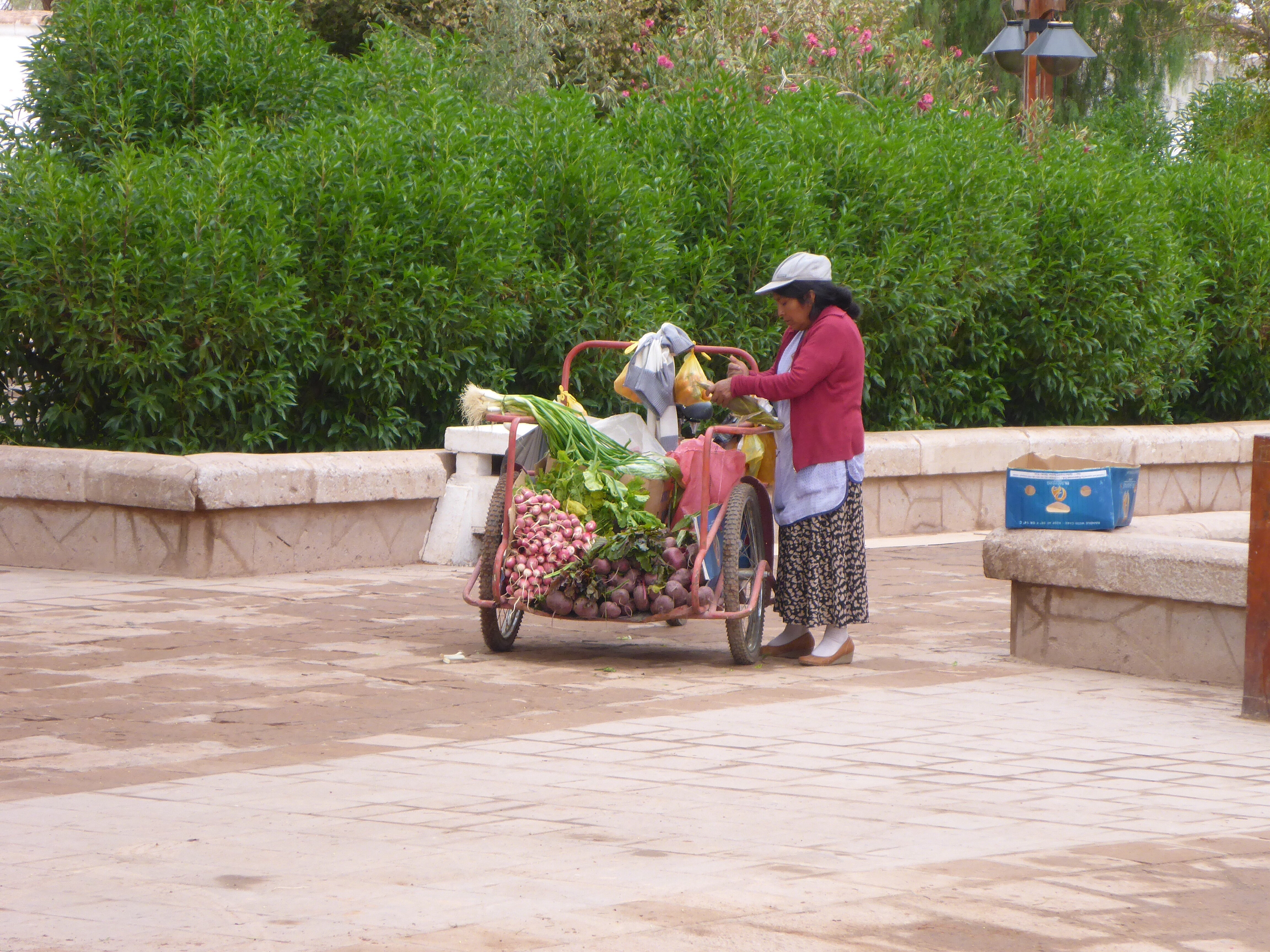
Fresh vegetable seller on San Pedro de Atacama town square

Fresh vegetable seller on San Pedro de Atacama town square


Enjoying another glorious sunset from our cabin

Enjoying another glorious sunset from our cabin

I have to tell you that we found out that the road to Bolivia has been closed due to up to 20cm of snow and landslides. So even if we hadn’t taken the hard decision to give Bolivia a miss, we would have not been able to enter there from San Pedro as we had originally planned anyway. Amazing how things work out…

What an experience San Pedro de Atacama has been, my favourite place being the Salar de Talar – so many gentle colours and so stunning. Time to start heading north again tomorrow and sing into my helmet and Anthony’s ears 🙂

– Anne
Vicuña to Antofagasta

After a beautiful breakfast of fresh fruit, avocado, home made jams and good coffee, we finally leave Vicuña for our slow ride up to Antofagasta. The morning is so cool at 13 degrees that we pull over after 30′ to put one layer of thermals on – what a difference that makes!!
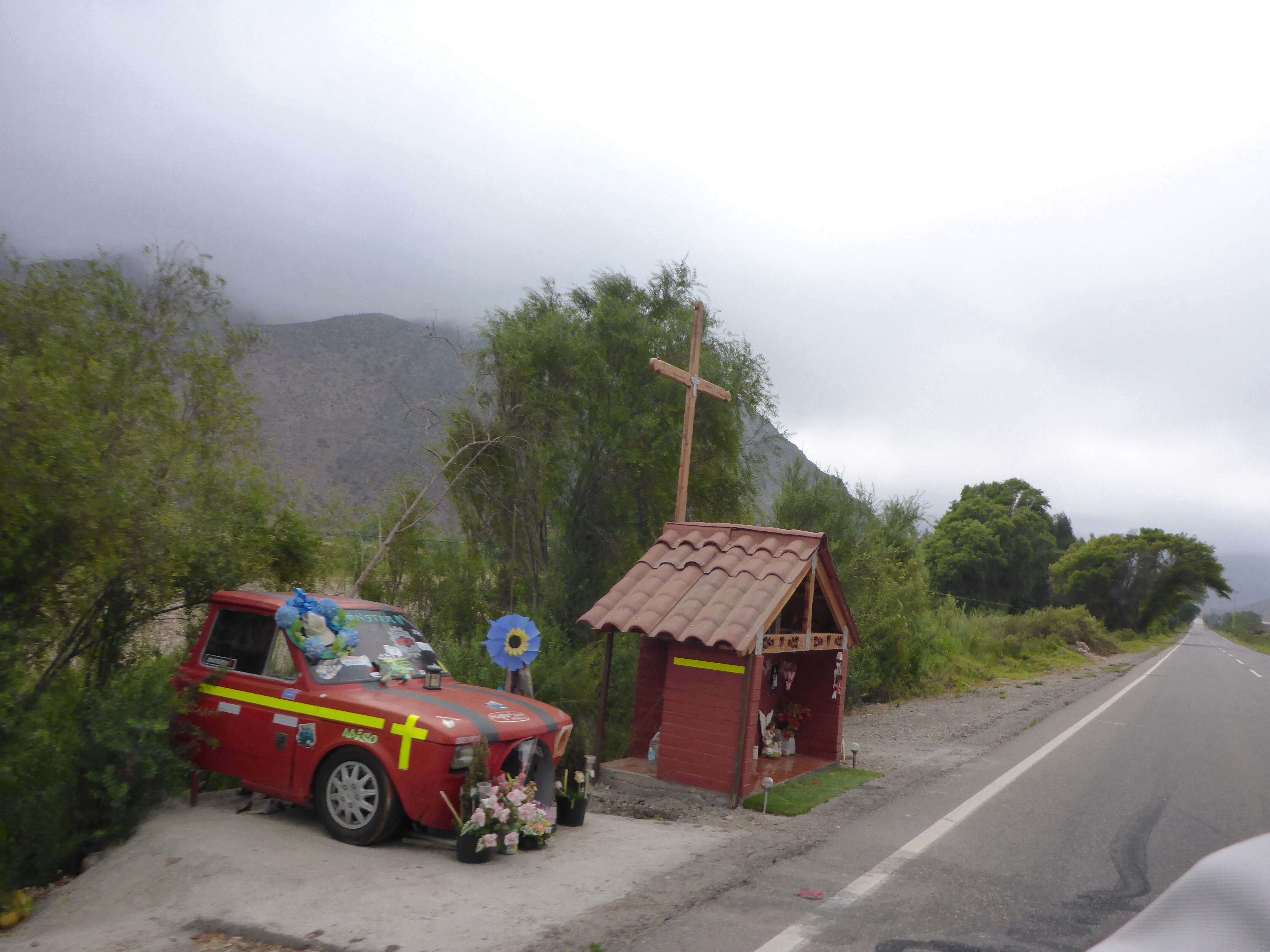
So often on our trip, I’ve found that I forget to mention or take photos of commonplace sights. We see them so often, we forget to even mention them. Time to mention one of them now as the road from La Serena to Vicuña had some of the more elaborate ones we’ve seen: roadside shrines. The first ones I’d noticed outside Santiago looked more like small colourful kennels – you may have noticed the odd one in some of my previous photos. I had taken a photo of some of them where we stopped and had some of Mitch and Mary’s sandwiches but didn’t post it as they were just before Anthony’s accident!! Anyway, the shrines we see are either religious ones (to the Virgin Mary, Christ, a local patron saint), or to Difunta Correa (Deolinda Correa had set out with her infant son in search of her husband who had been forced to join the army in the 40’s – she died of thirst, but not before putting her son to her breast and he survived. Bottles of water are left to calm her thirst) or to victims of car accidents. Sometimes, the accident ones are often placed at very distracting places, often on both sides of a bend or on straight stretches of road with several crosses, presumedly where many people died, in a coach accident maybe?? You know never to focus on an obstacle whatever you are driving as if you do, you are likely to end up where you are looking, maybe that’s why we often see multiple shrines in one spot… I haven’t wanted to take close up photos feeling it was intruding, but the first ones here were taken where we stopped to put on that extra layer of clothing.
Roadside shrine in Chie

Roadside shrine in Chie

Shrine to Defunta Correa

Shrine to Defunta Correa

Shrine to accident victim in Chile

Shrine to accident victim in Chile

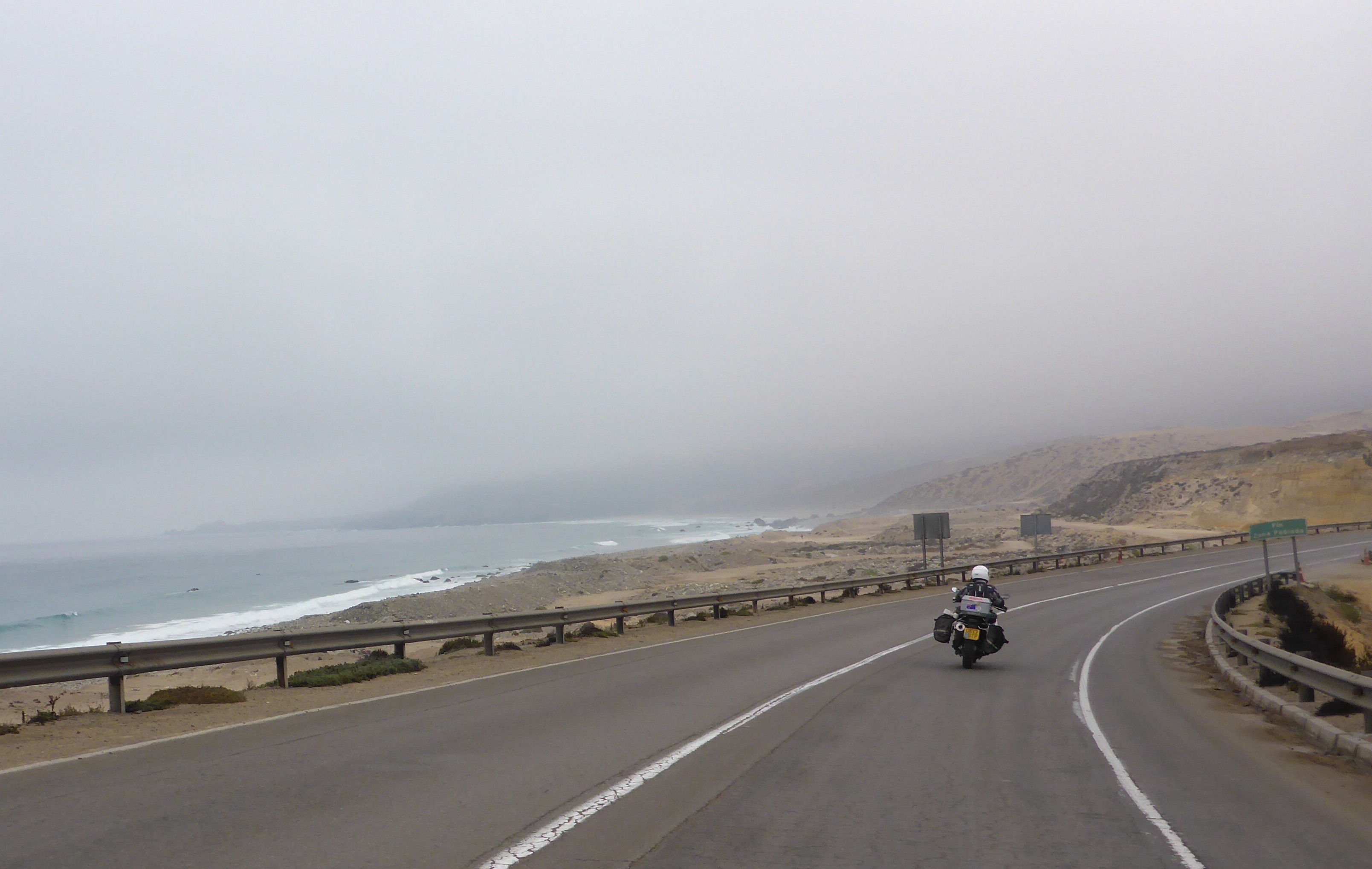
It is cool today heading north of La Serena

It is cool today heading north of La Serena


The Ruta 5 north of La Serena is being upgraded so we end up stopping many times as the traffic is controlled one lane at a time. North of Vallenar, it is back to perfect dual highway. We feel we might even make it to Bahia Inglesia which I have been told many times by different people is an absolutely stunning place and worth a visit. But the road is so perfect and easy, it quickly becomes boring and as we get close to the Copiapo by-pass, Anthony tells me he is getting tired. Time to stop, change of plans and find a place for the night in Copiapo.
Shades of grey of the Atacama region heading into Copiapo

Shades of grey of the Atacama region heading into Copiapo

Outside Copiapo and time for a change of plan

Outside Copiapo and time for a change of plan

The sole reason for Copiapo being of any size is to support the mining industry in the area. It soons become obvious that people are there because they have too. One miserable place, miserable hotel receptionist, sad hotel which had seen better days but had been left to slowly decay, and very very aggressive drivers. We couldn’t wait to get out of there.

No photos of Copiapo!!

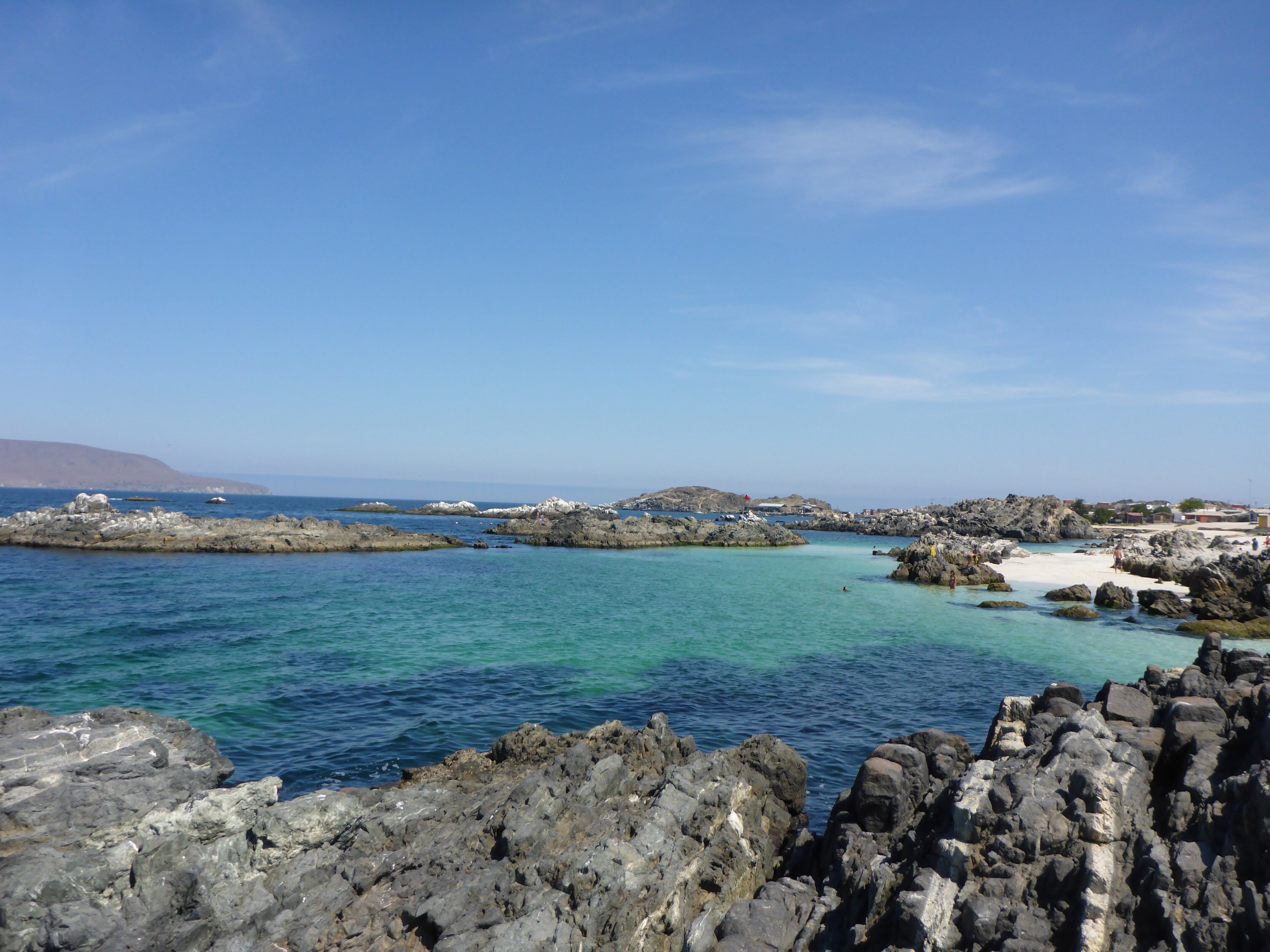
A short ride to Bahia Inglesia where I have tentatively eyed a place for 2 nights, on the outskirts of the village. We park the bikes and go for a walk along the beach. It has a gorgeous little bay, as per the photos, many restaurants along the beach front, but that is it!!! It was too cold and windy for us to have a swim so we had a lovely lunch. We pick one of the few places that doesn’t have music blaring. Oooh those fresh scallops were delicious!!!!!!!

Heading west out of Copiapo to Taltal

Heading west out of Copiapo to Taltal

More shrines on our way to Bahia Inglesia

More shrines on our way to Bahia Inglesia

Bahi Inglesia in the distance

Bahi Inglesia in the distance

Bahia Inglesia beach

Bahia Inglesia beach

Bahia Inglesia beach

Bahia Inglesia beach


We ride out to the cabanas I’d found. Oh dear…. On a rocky desert beach, with a couple of trees planted for the website images no doubt – so unappealing… Quick turn around and change of plan again, and we head to Chañaral.

Fabulous shades of grey of the Atacama

Fabulous shades of grey of the Atacama

Heading to Taltal

Heading to Taltal

Another shrine outside Bahia Inglesia

Another shrine outside Bahia Inglesia

This is definitely mining region outside Chañaral

This is definitely mining region outside Chañaral

Heading north to Chañaral

Heading north to Chañaral

Lava flows down to the ocean south of Chañaral

Lava flows down to the ocean south of Chañaral

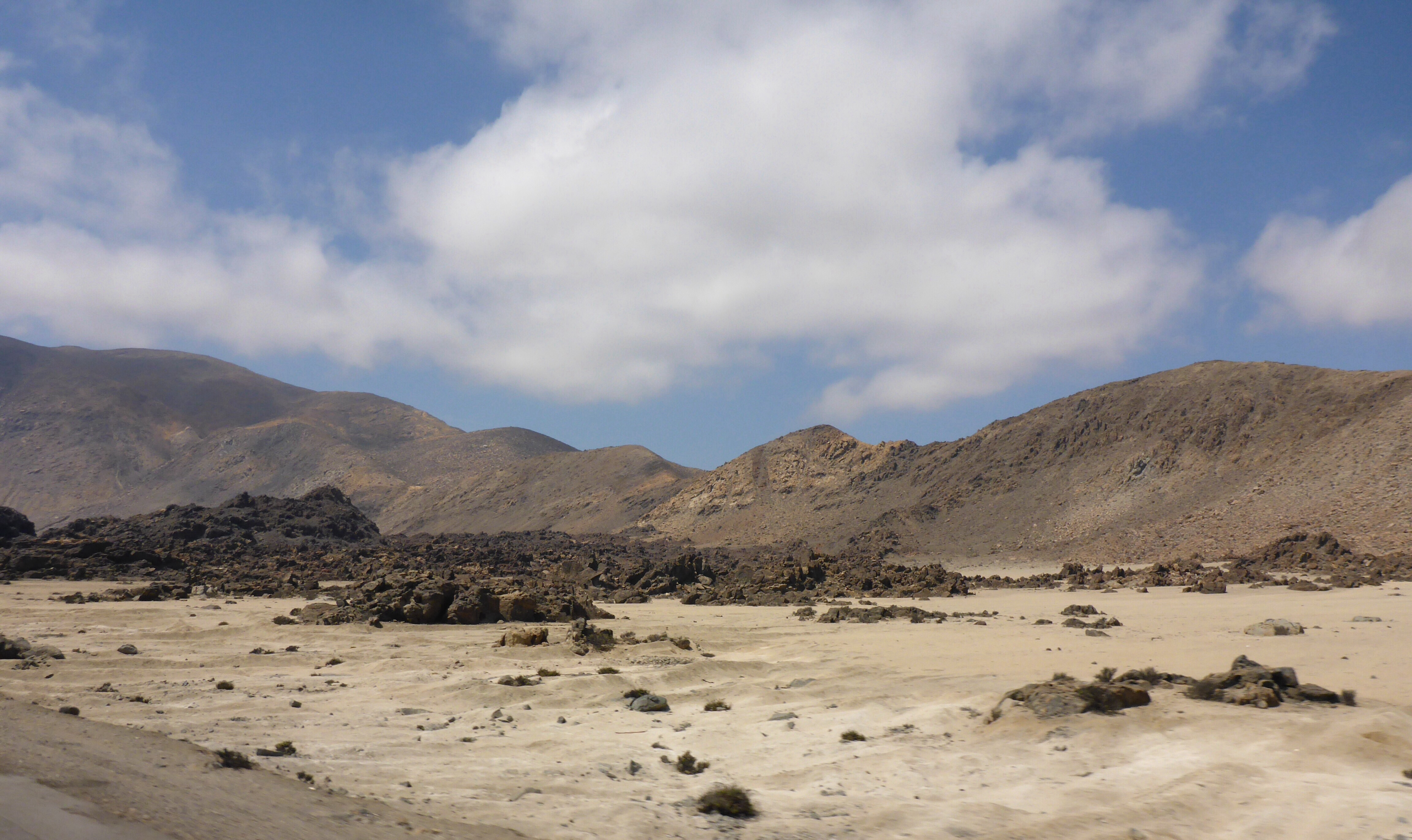
It is now early afternoon and the winds have definitely picked up. The road hugs the coast and the scenery is quite dramatic, with lava flows right down to the ocean. Yet again, a geologist’s paradise. Our neck muscles strengthen as we ride at angle for a while.

Chañaral

Chañaral

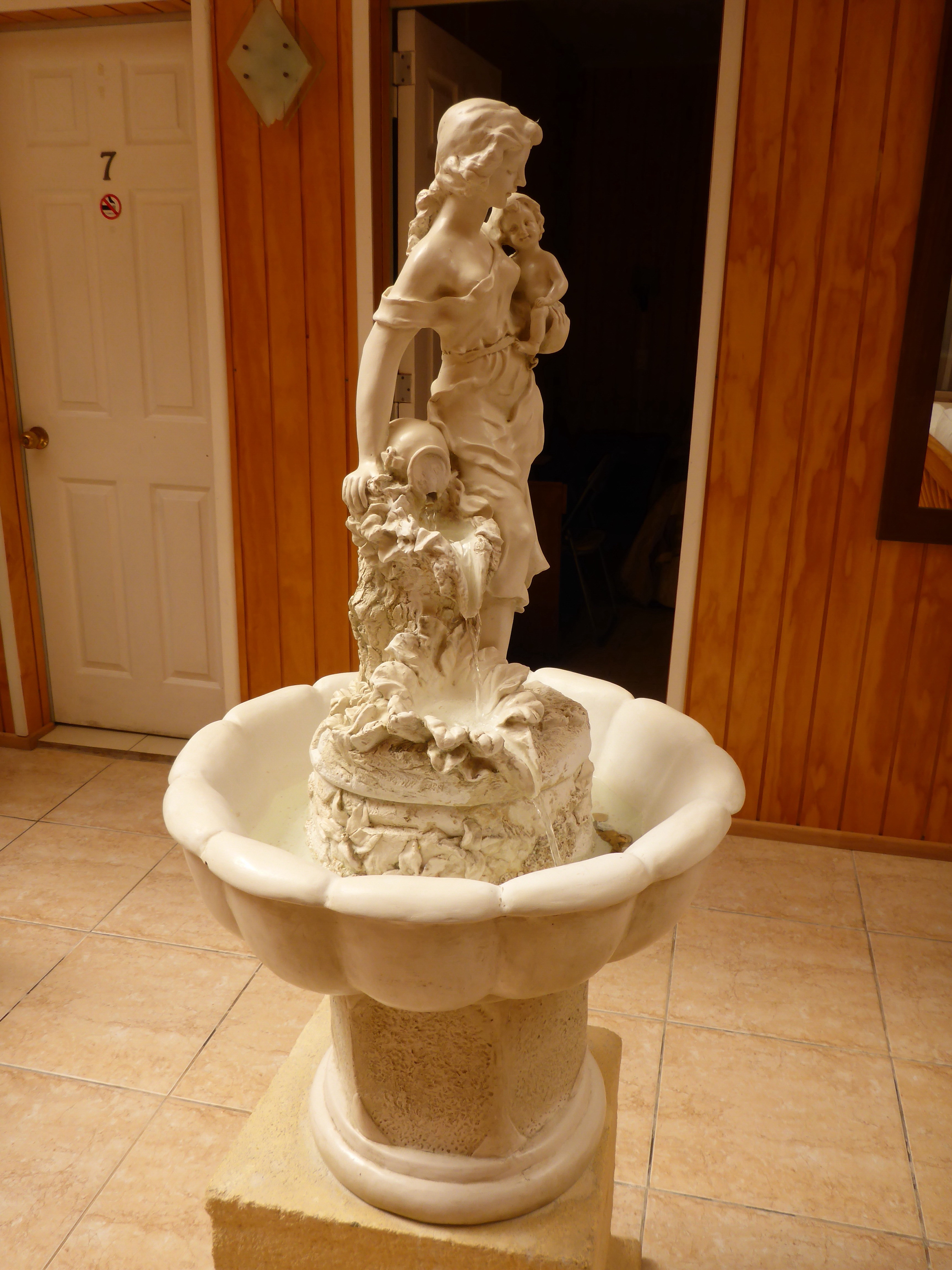
After riding around Chañaral for a while, we find another hotel listed on Anthony’s GPS which has a nice name: Aqua Luna. It is interesting how places always have an instant feel. The receptionist at this tiny hotel was so friendly and shows us to our room. It is a funny little hotel where all the rooms are towards the back so the only natural light and fresh air come from a central passage way. Outside our room is a plastic fountain with trickling water – maybe not to our taste, but they did try!!

Outside our hotel room in Chañaral

Outside our hotel room in Chañaral

At one stage, I asked for some water and the receptionist immediately organised a huge urn. Later she asked if we needed some more. For dinner, we went through town to a restaurant she recommended. On the way, we enjoyed seeing what shops in Chañaral stored. We find our favourite type of store: it has everything from the brightest bras to industrial strength compressors. At the restaurant, we ordered pizzas, zin queso for me (no cheese) explaining that I am allergic (all in Spanish!! i don’t know much but . When they arrive, I take my first mouthful and immediately taste the unmistakable taste of queso. I quickly grab a tissue, dispose of my mouthful,and inspect my pizza. It’s not too bad, it will be fine I tell Anthony. But the young waiter spotted what I had done and comes over. I say that I can cut the piece off and I’ll be fine. No, he will get another one made he insists. What service!!! A tiny restaurant, in a tiny place and what unbelievable service.

Outside our hotel room in Chañaral

Outside our hotel room in Chañaral

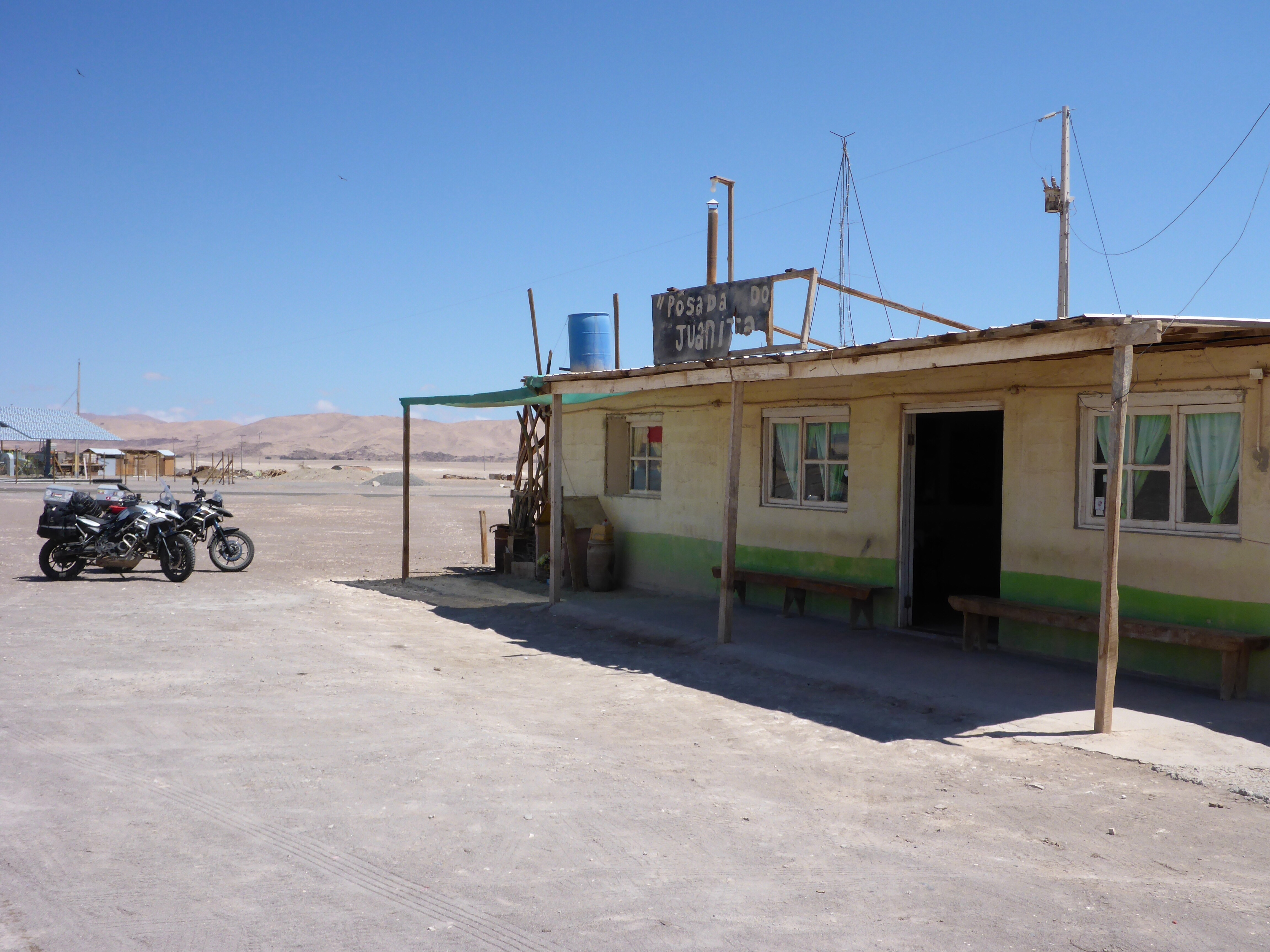
Chañaral was a lovely spot to stay over – time to head off to Antofagasta. First main stop was Taltal, also on the coast. I got chased by two big dogs which was a bit unnerving but we stop outside the Victor Hugo school for a fresh juice. Although the waterfront has been renovated, and the council wanted to make it a pleasant place, the locals thought otherwise… The public toilets are permanently locked, need I say more… We did enjoy watching the seals and birdlife but decided to move on and have our lunch on the road.

Atacama shades of brown

Atacama shades of brown

Atacama shades of grey

Atacama shades of grey

Atacama shades of beige

Atacama shades of beige

Always look back and admire the scenery

Always look back and admire the scenery

More shades of the Atacama desert

More shades of the Atacama desert

Atacama shades of brown

Atacama shades of brown

First sign of  life and vegetation - moss surviving on dew coming into Taltal

First sign of life and vegetation – moss surviving on dew coming into Taltal

Taltal

Taltal

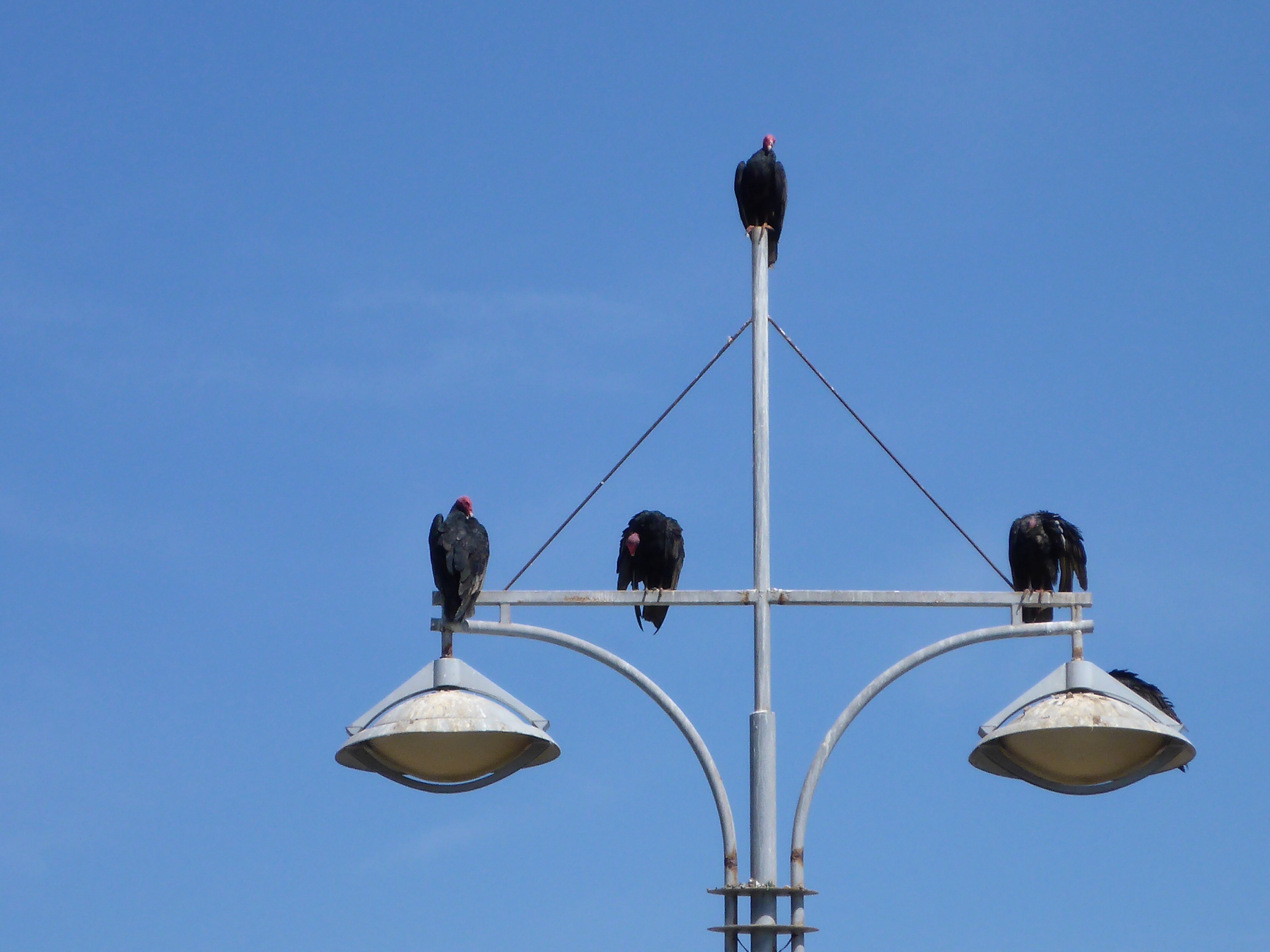
Vultures in Taltal

Vultures in Taltal

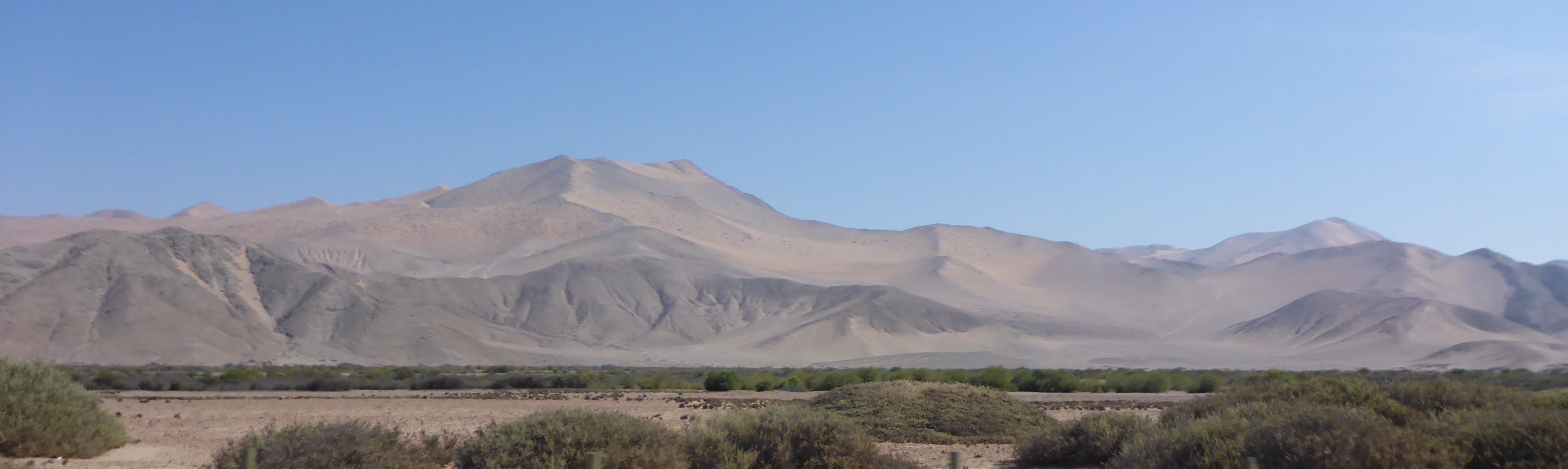
What a ride to Antofagasta!!! Absolutely stunning. We chose to take CH1 then B710. Yes, it was windy, very windy at times and a painter’s paradise. Any home renovator would know how many shades of white there are: natural, china, bone, limed, porcelain, shell. The scenery was magical. We saw more than 50 shades of grey: celladon, mallard, bilby, yarwood, dove, moon. So many shades of brown: raw sienna, burnt umber, Gold oxide, nutmeg, walnut, leather, burnished bark, caramel; of red: burnt sienna, indian red oxide, burgundy, carmen, terracotta . So many shades of beige too. It is difficult to capture the beauty of this desert but I hope some of the photos show some of it.

More dramatic scenery north of Taltal

More dramatic scenery north of Taltal

Shade of reds and browns of the Atacama

Shade of reds and browns of the Atacama

Shade of reds and browns of the Atacama

Shade of reds and browns of the Atacama

Atacama

Atacama


Atacama

Atacama

More neck strengthening hours on the bike. We find a sheltered spot to stop and have lunch, near the Paranal Observatory, which is closed except on Saturdays. As we eat our tuna and dried crackers on the edge of the runway, a truck slows down, the driver shaking a carton of juice at us. We do a thumbs up, he stops, he hands over a full litre of apple juice and he takes off again. So nice!!!!

Thank you for the apple juice!!

Thank you for the apple juice!!

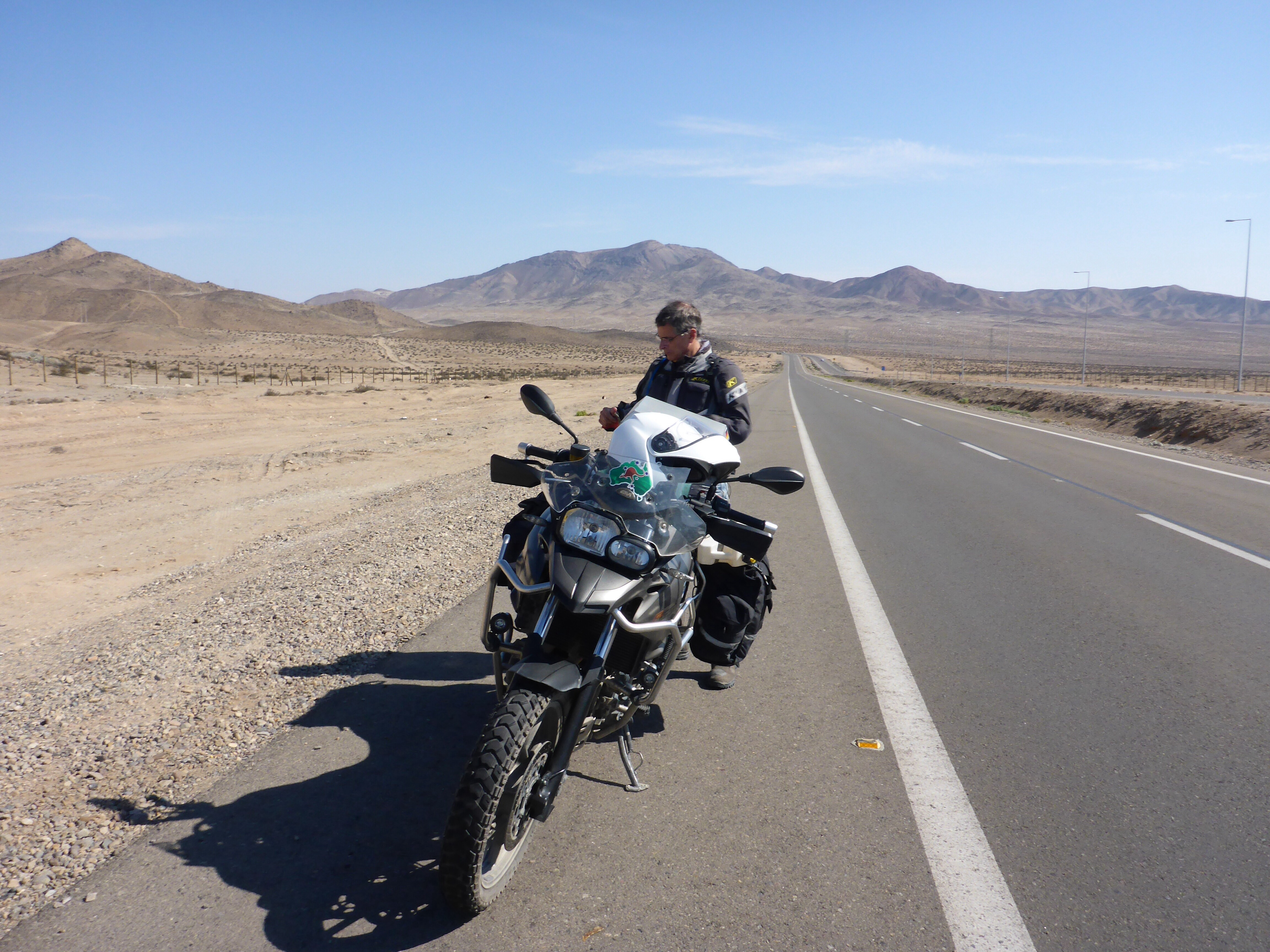
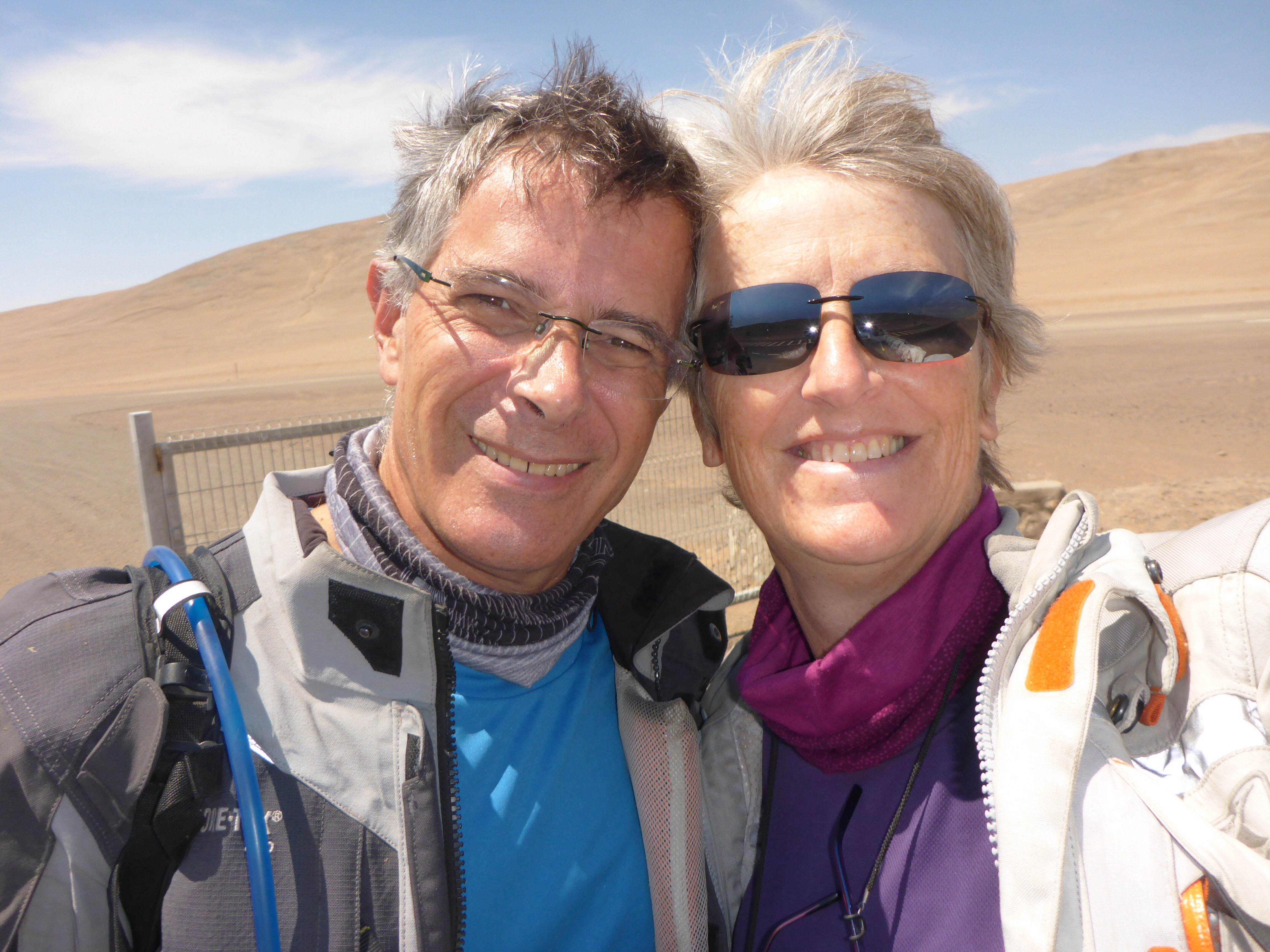
Time for a selfie in the windy Atacama desert - runway in the background

Time for a selfie in the windy Atacama desert – runway in the background


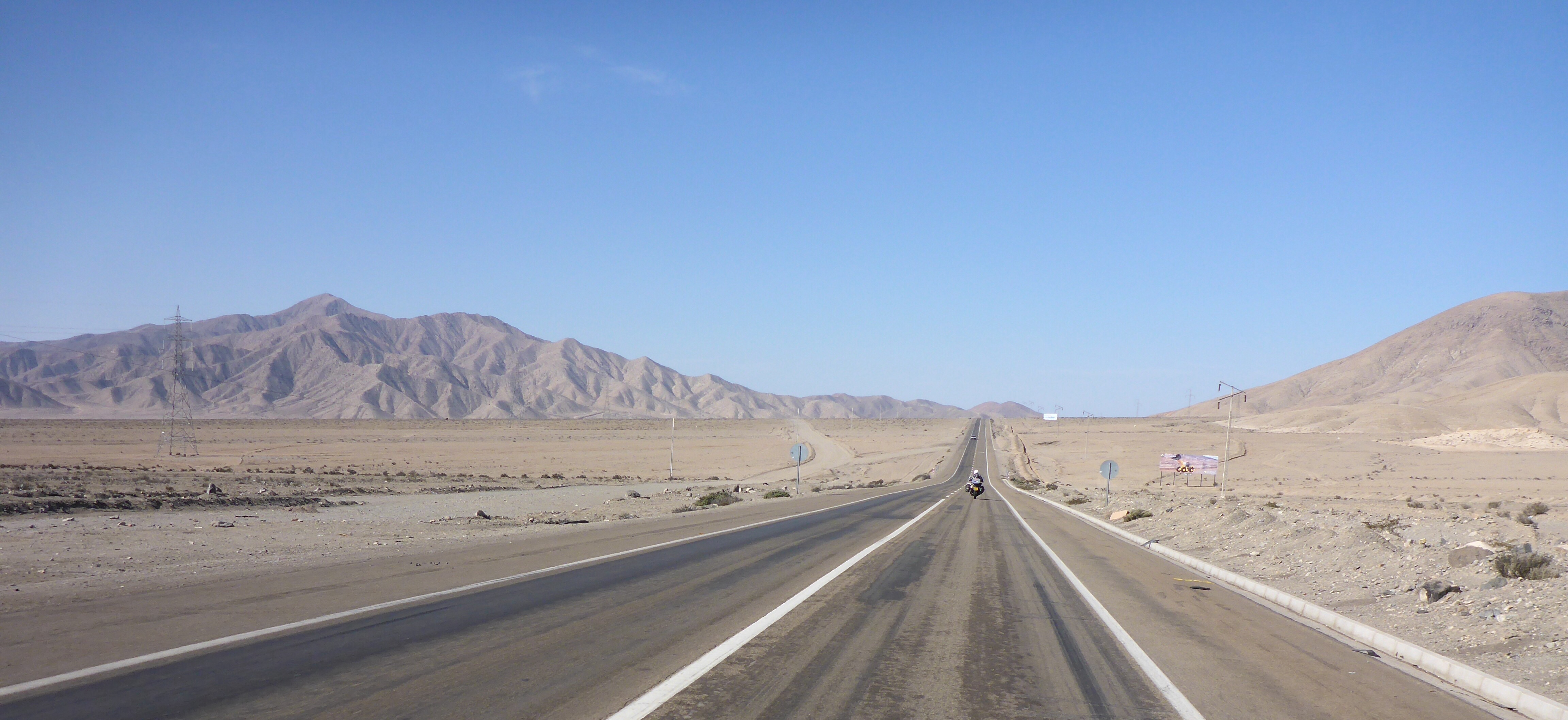
The Atacama is vast and beautiful and deserted

The Atacama is vast and beautiful and deserted

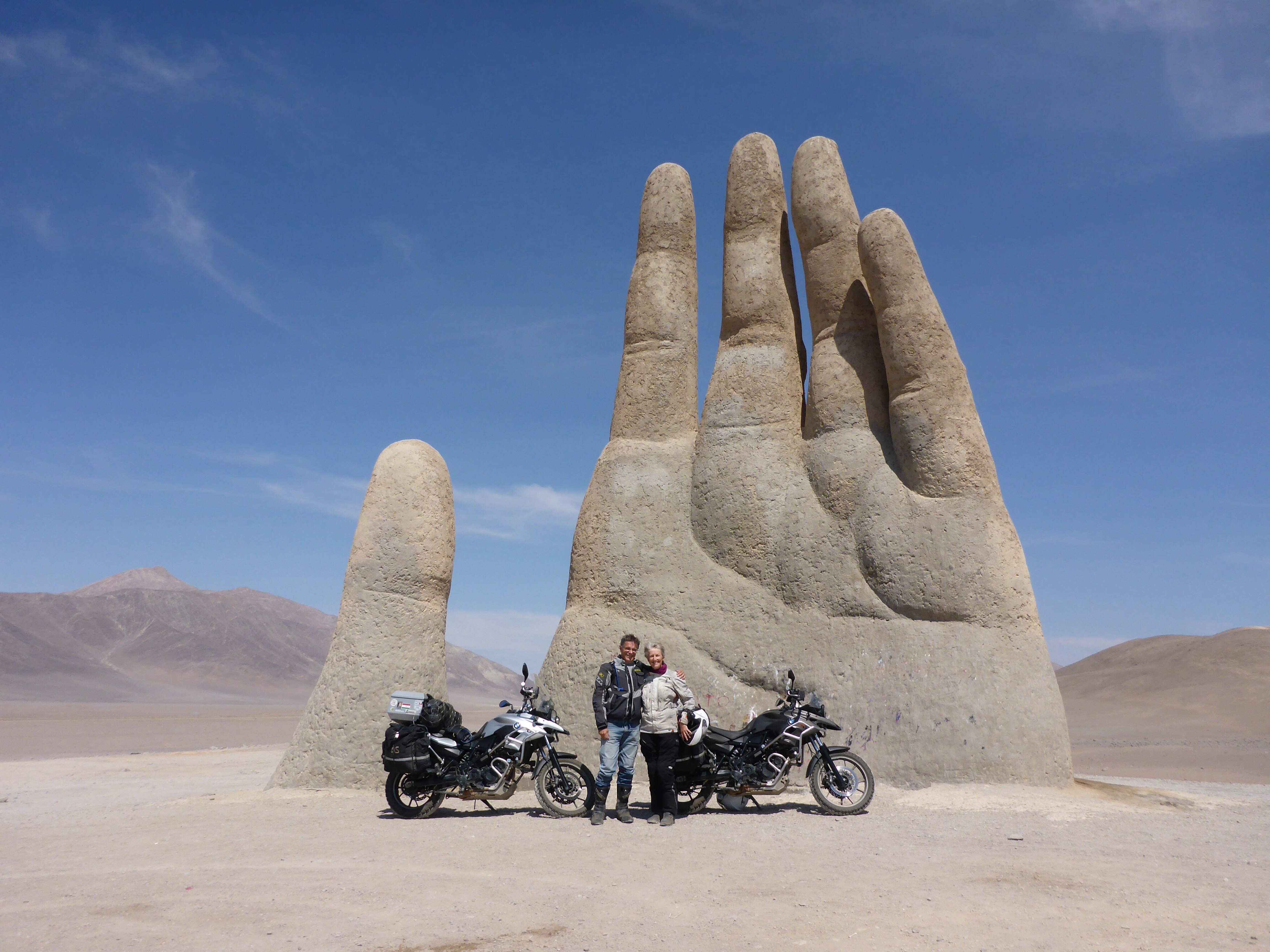
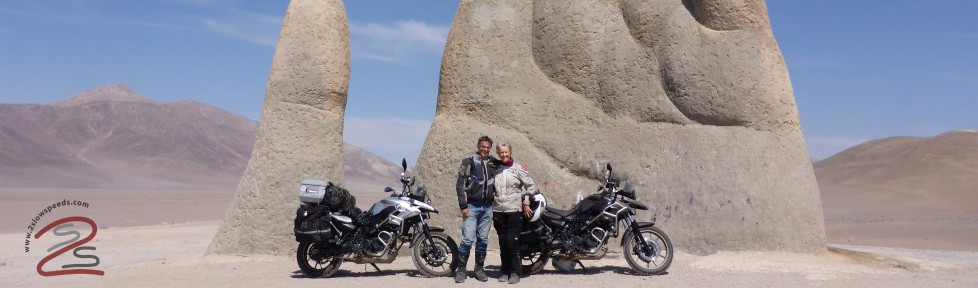
A couple of hours later, we get to a great sculpture, El Mano Del Desierto.

El Mano del Desierto

El Mano del Desierto

The hand in the background

The hand in the background

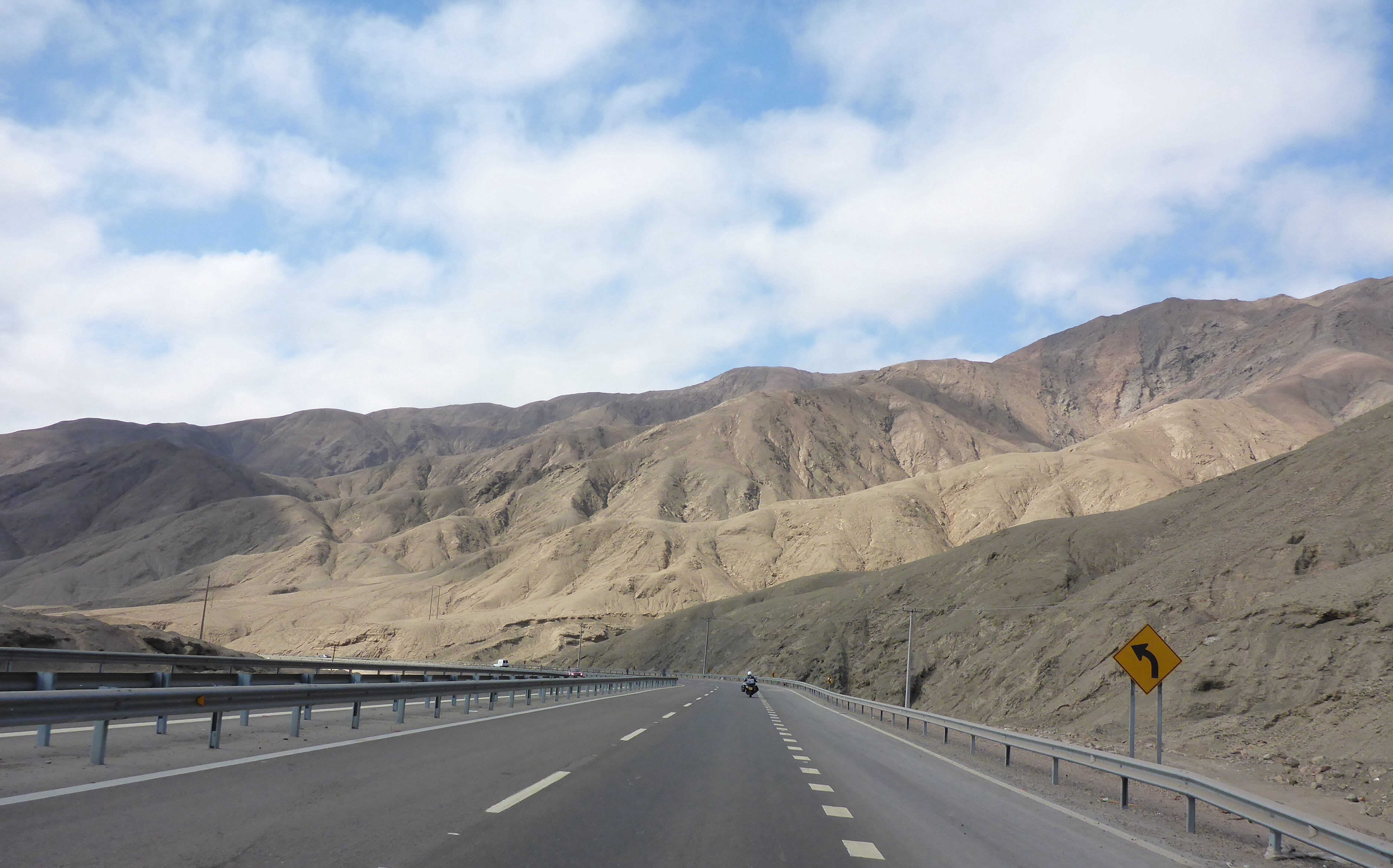
Every new corner gives us new shades

Every new corner gives us new shades

We make good time and get to Antofagasta just after 4pm. We head to our apartment on the northern end of Antofagasta for the next 2 nights but the concierge was only given a bunch of envelopes with apartment numbers on, but with no name, so couldn’t help us. We ring a few numbers, but I have been given wrong numbers. Hmmm, strange… So we are left with having to find another hotel!! At 6pm, rush hour, not my favourite time to find accommodation. We turn the bikes around, I get chased by a very angry barking Alsatian, and stop at another hotel. After being told they are full, they search some more and miracle, they have one last room!!! Bliss. Thank you!!! It is luxurious. Great place to catch up on washing and photo uploading :-). I immediately contact booking.com who apologise and tell me they will do what they can to compensate us for any additional costs incurred.

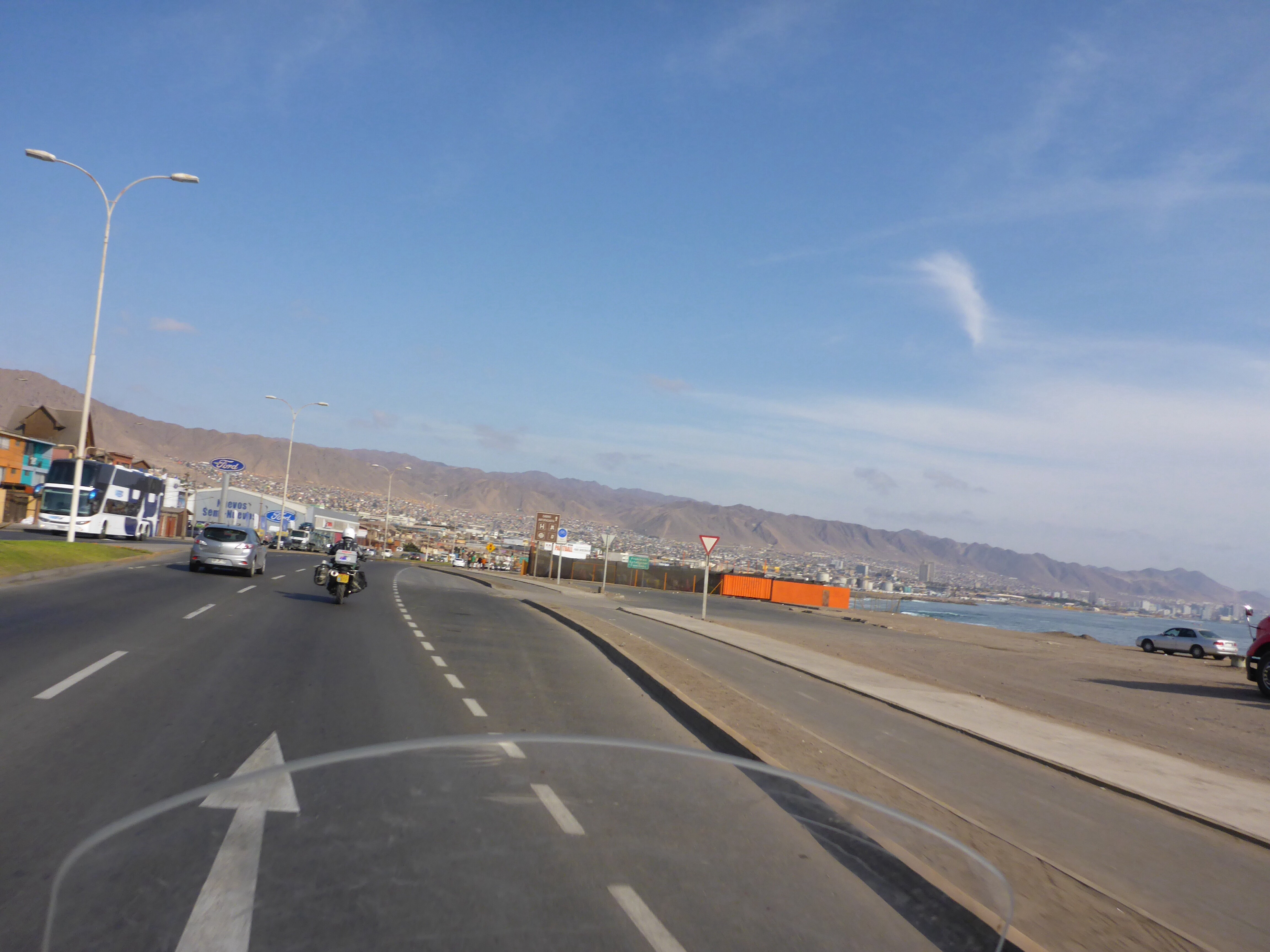
Heading back into Antofagasta in search of a new hotel

Heading back into Antofagasta in search of a new hotel

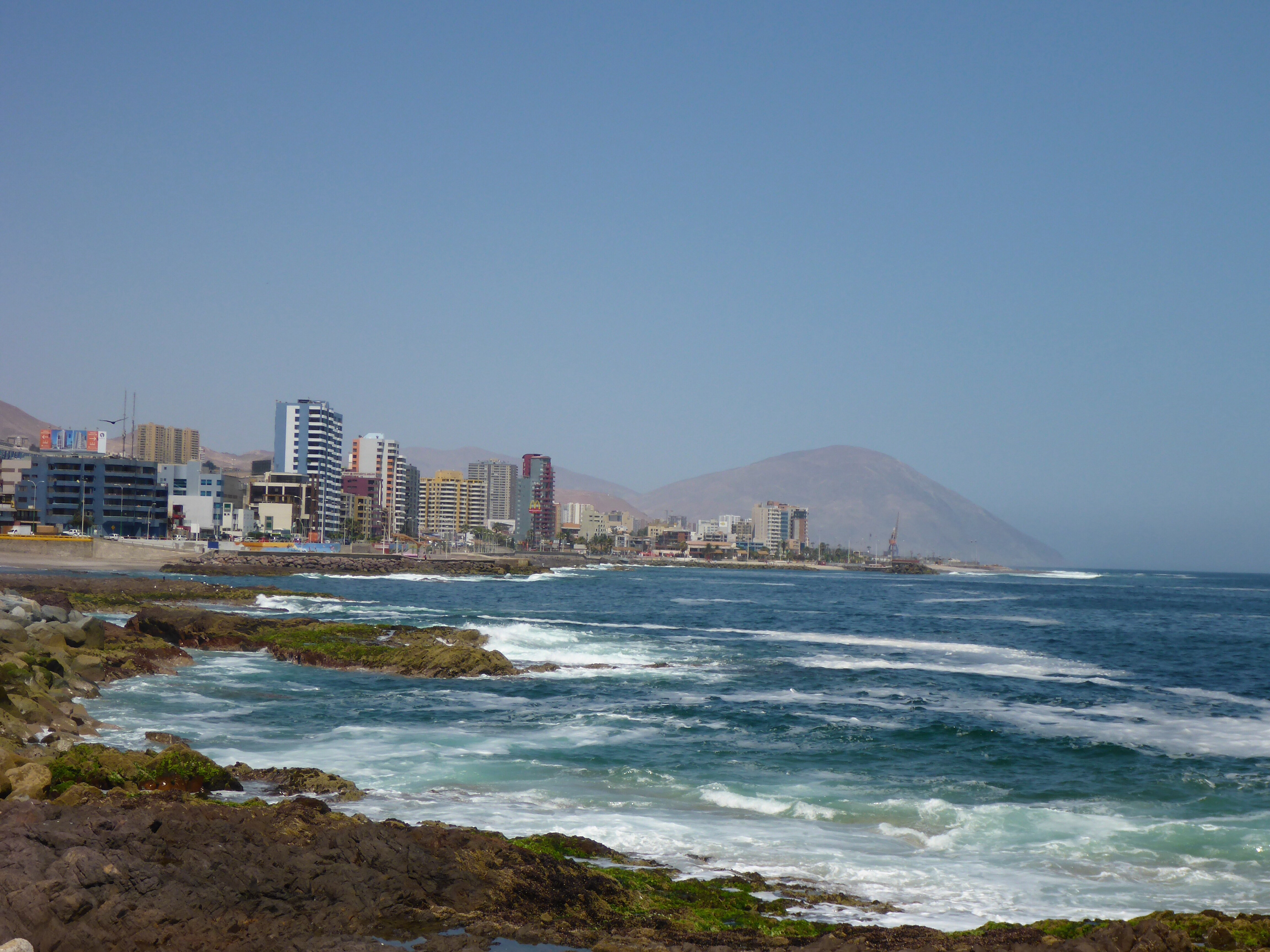
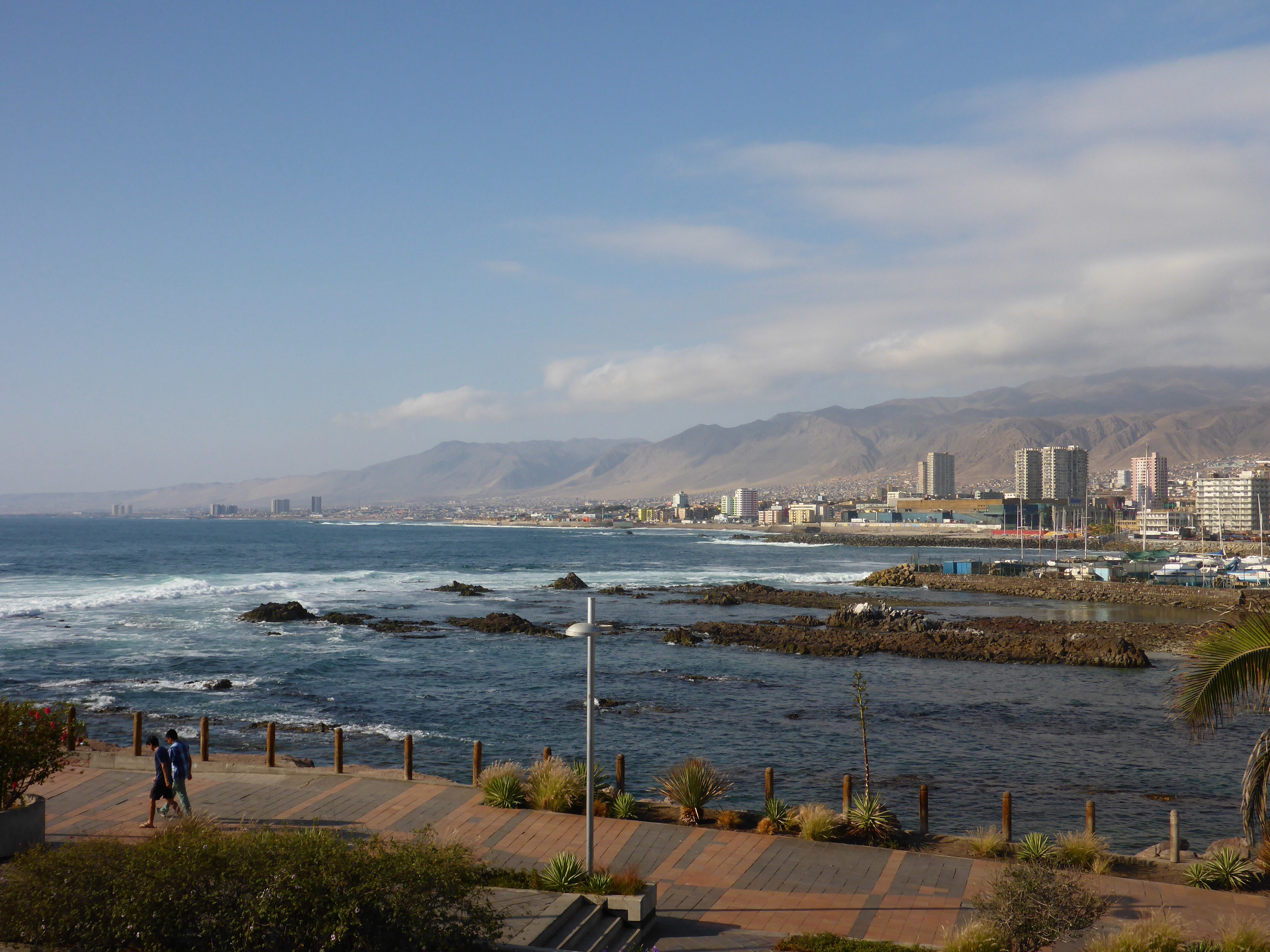
Antofagasta coast

Antofagasta coast

Another selfie in Antofagasta

Another selfie in Antofagasta

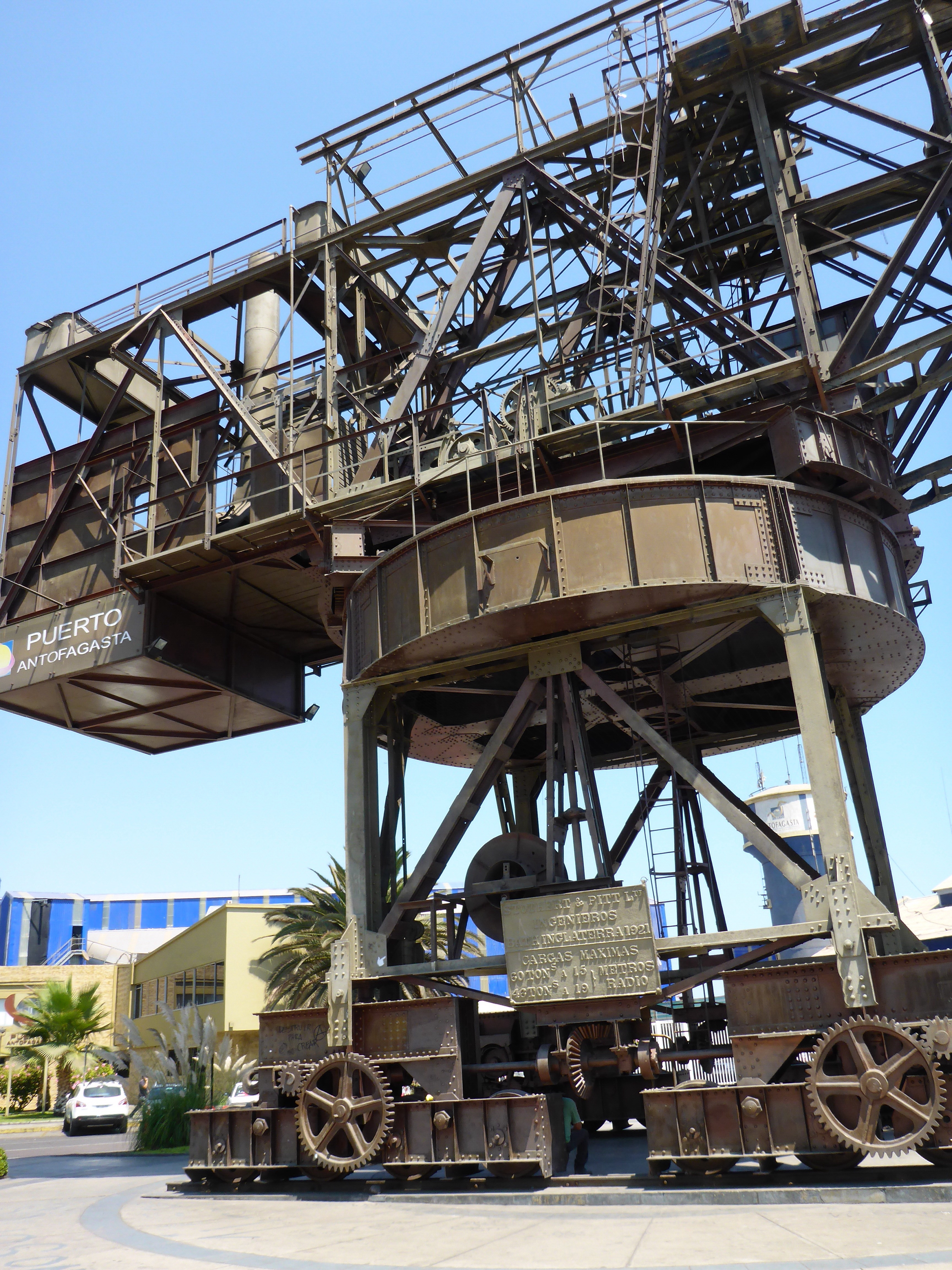
Made in Bath, UK

Made in Bath, UK

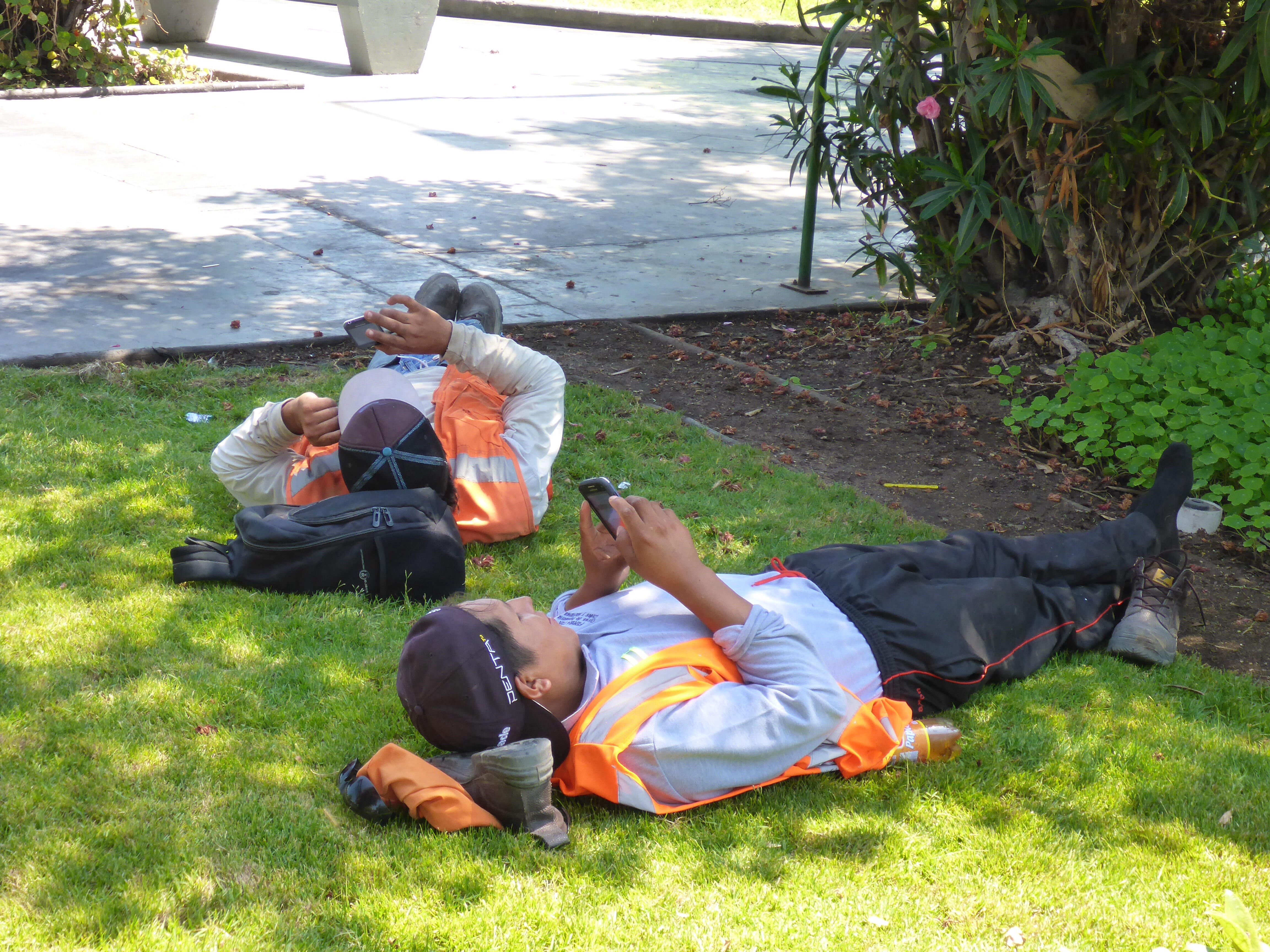
Surfing and texting is a worldwide phenomenon

Surfing and texting is a worldwide phenomenon

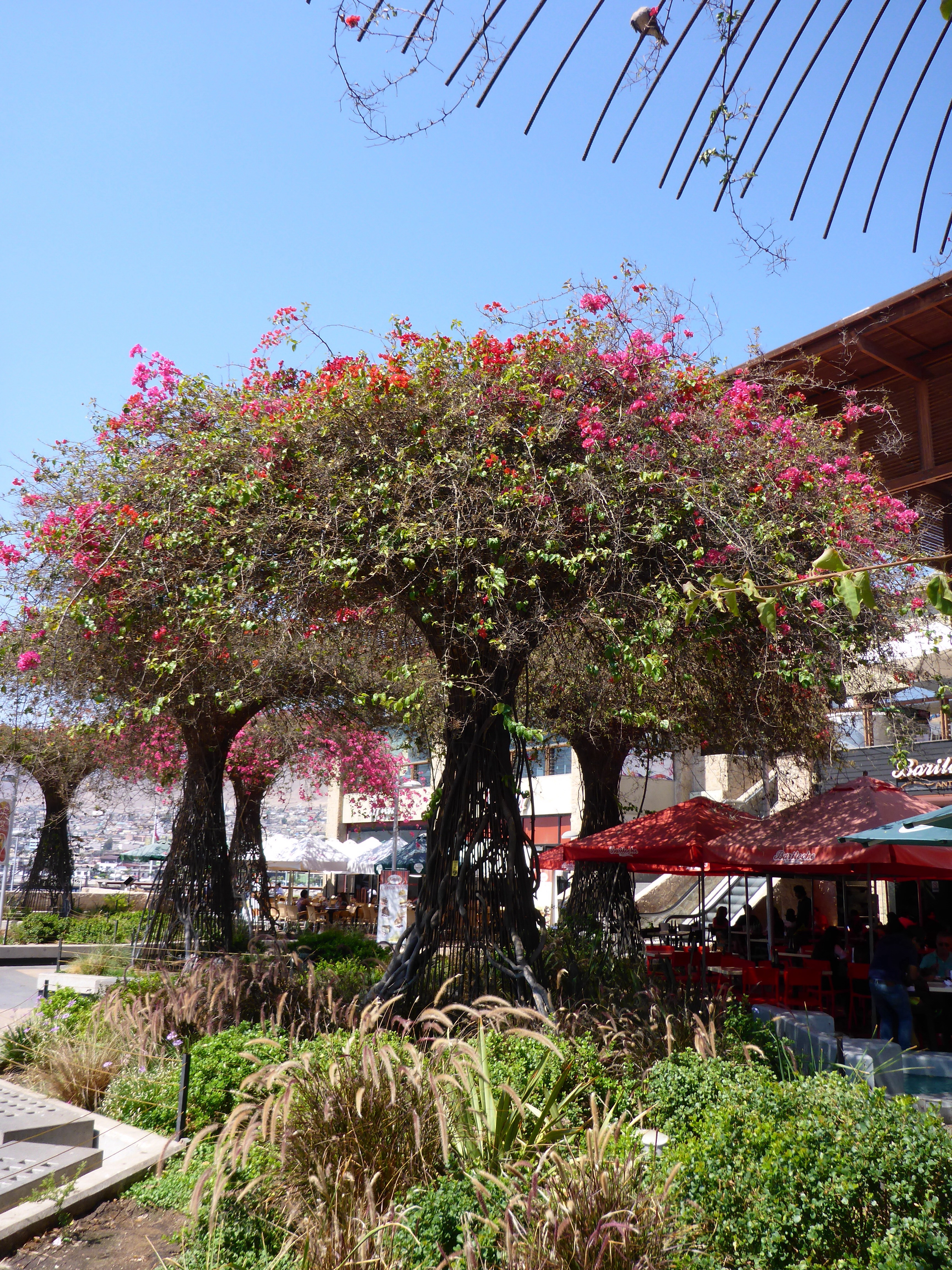
Loved this way of training bougainvellias into 'trees' in Antofagasta

Loved this way of training bougainvellias into ‘trees’ in Antofagasta

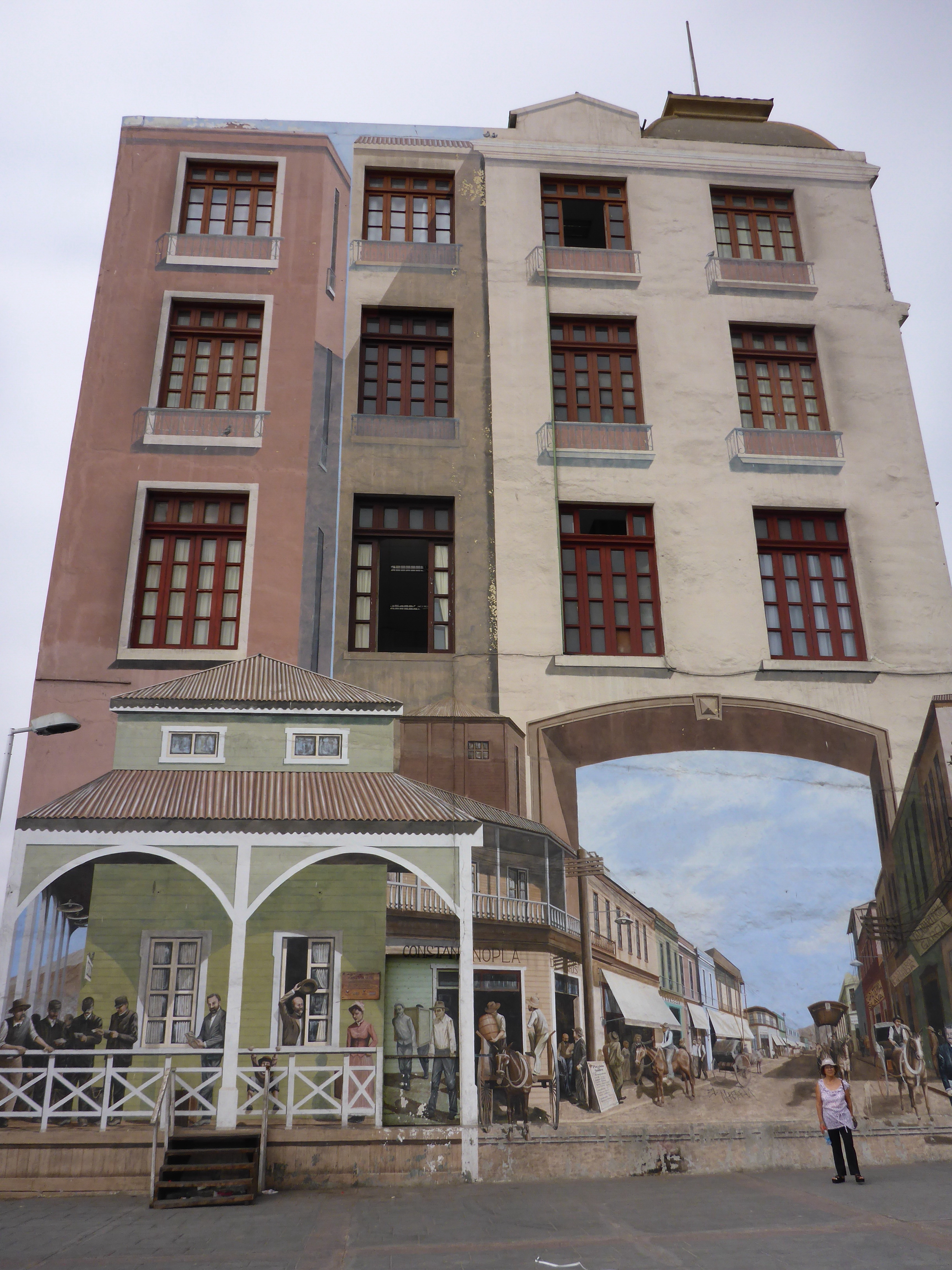
Part historic part mural in Antofagasta

Part historic part mural in Antofagasta

The Andes coming into the ocean at Antofagasta

The Andes coming into the ocean at Antofagasta

View from our hotel room of the colourful houses of Antofagasta

View from our hotel room of the colourful houses of Antofagasta

We spend a day stroling around Antofagasta and basically lounging around in our room.

– Anne