Yazd

Our best city GPS ahead of Anthony – we’re just 1′ away from the hotel now
We set off from our beautiful hotel, which was formally a 180 year old house with three courtyards and endless rooms off them, to see the sights of Yazd.
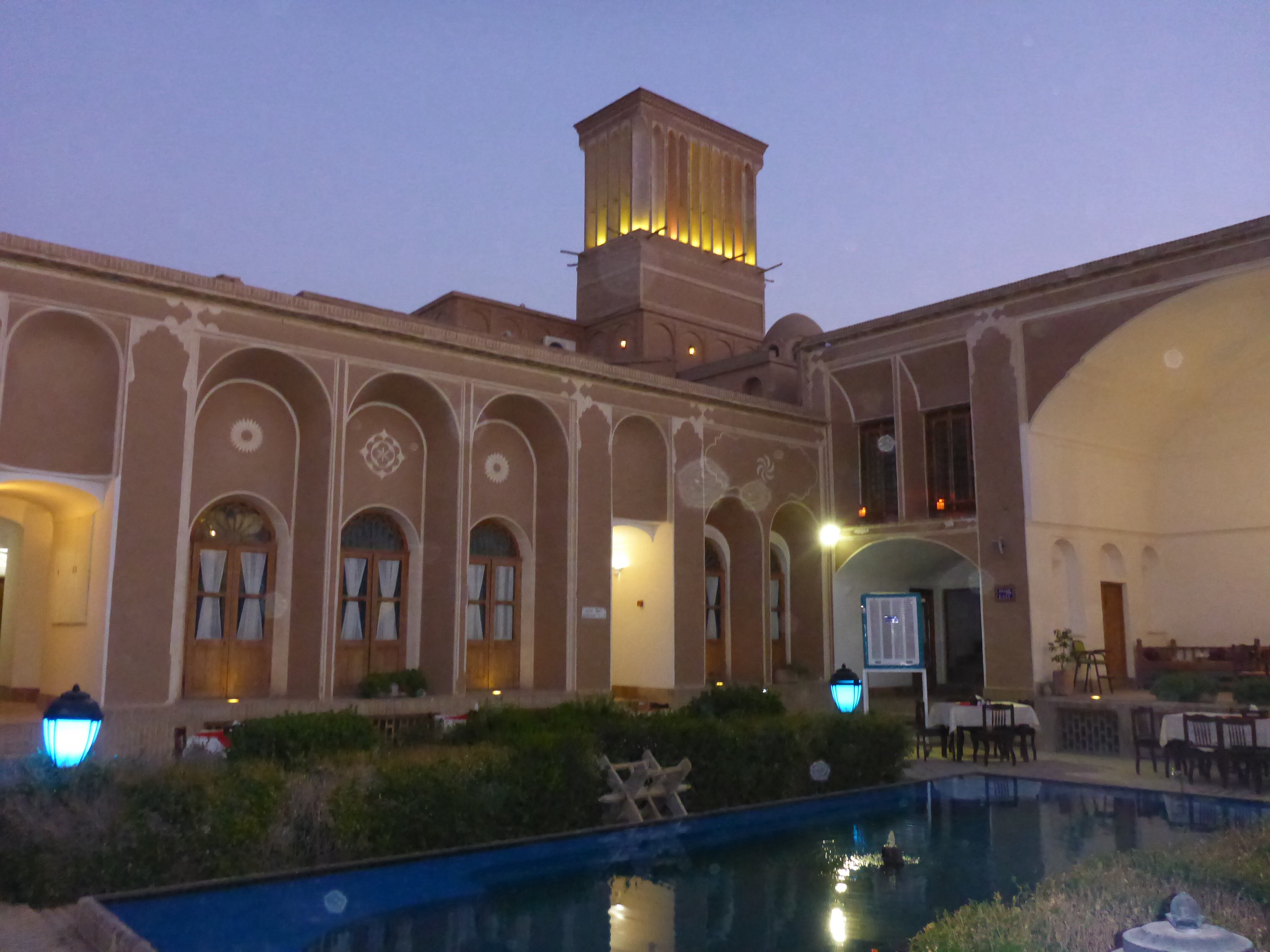
Our hotel in Yazd – the Laleh
Rather than take the main roads which form large rectangular blocks, we will navigate the smaller lane ways towards the centre of the old city. We start confidently, but are soon surrounded by collapsed and derelict mud brick buildings. More interestingly, they are on multiple levels, abandoned courtyards below and ruined buildings above. Given the flat nature of the terrain, there must have been significant excavation to create these courtyards. Could this have happened at the same time as the water storage facilities were dug? The large size of the houses, and the upkeep required may have led to their abandonment over time. An additional impediment to keeping these buildings would be the installation of modern services such as sewerage, piped water and electricity.
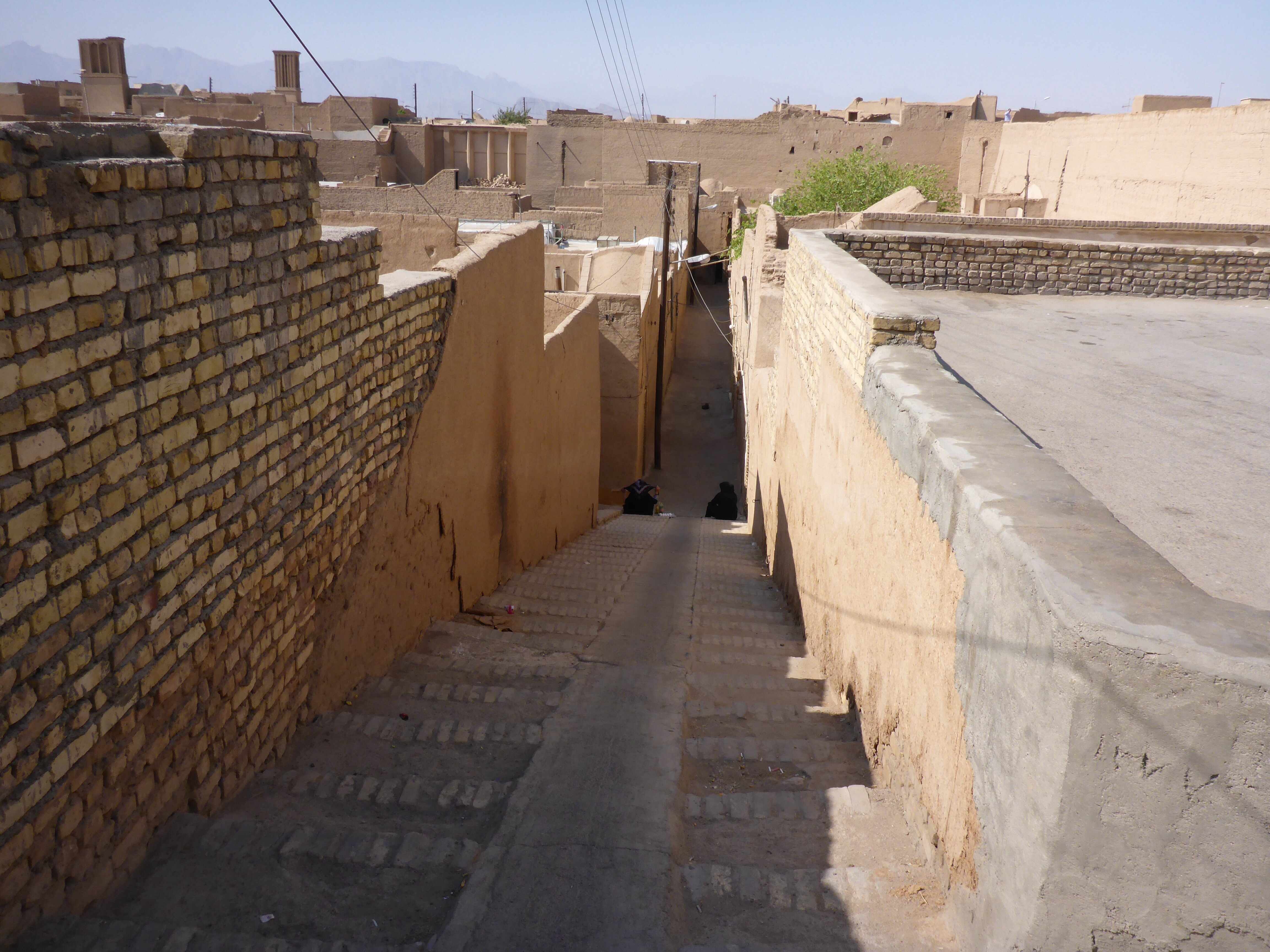
Backstreets on our way to Yazd city centre
Back on track, we emerge into the busy centre of Yazd. Here, many more women are dressed all in black, unlike in Tehran and Esfahan. Are the smaller cities more conservative or is it due to the fact we are moving towards the Baluchi region of Iran? As we set off for the Mosques on Anne’s itinerary, we see for the first time the local bread making process in action. The video, posted below, shows how the pebble marked effect is created in a two step process. In the first step, the dough is hand thrown onto a round cushion like object that has raised knobs which would have been pebbles in older times, then the resulting pizza base like bread is tipped off the cushion onto a circular metal plate that is rotating the bread to be cooked both into and out of the oven. As each piece is finished, it is quality checked and placed on a wooden rack, but they are gone in a flash. People buy up to 20 at a time for meals at home, so the bakery production line of five people runs flat out just to keep up with demand. We are offered a a piece, Anne suggests we take a reject, because of a small hole in one part. It’s delicious, bread that was baked in the last 30 seconds.. The cheerful banter with each other and us, seeing the process in front of my eyes, these are the type of experiences I enjoy while travelling.
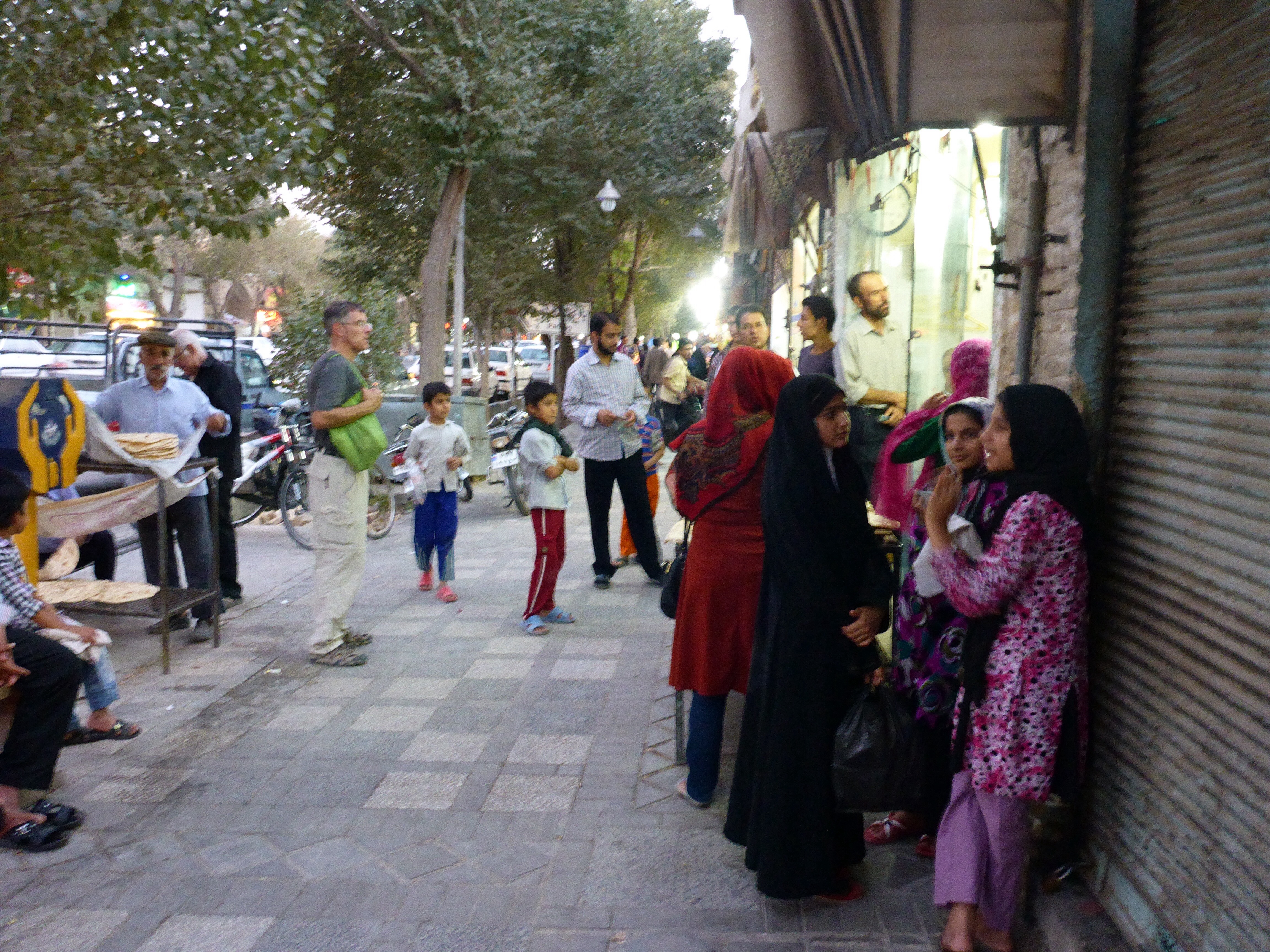
Queue outside our favourite bread shop, Yazd, Iran
In the bazaar, we find the usual types of shops seen elsewhere, but we note very little foodstuffs sold in the bazaars we have visited previously, while there are many varieties of clothing, spices, jewellery and hardware all mixed up.
The food tends to be on the streets here or in specific areas of the bazaar. This does not always apply to spice shops whose presence we detect as the smell of delicious spices. While most spices are sold separately there is always a large bowl that contains layered spices, 16 in all that is used in Chicken dishes. I must say that the best food we have tasted in each city has predominately been the home cooking of our friends and their families.

16 spices for chicken, Yazd, Iran
We encounter a new type of shop that just provides filling for pillows and cushions. You bring the inner linings and choose the quality softness and volume you want and you pay by the weight. We have noticed so many young children, but have not seen any pregnant women. Is this because loose outer clothing hides this from us, or do they not venture out in the later stages of pregnancy?
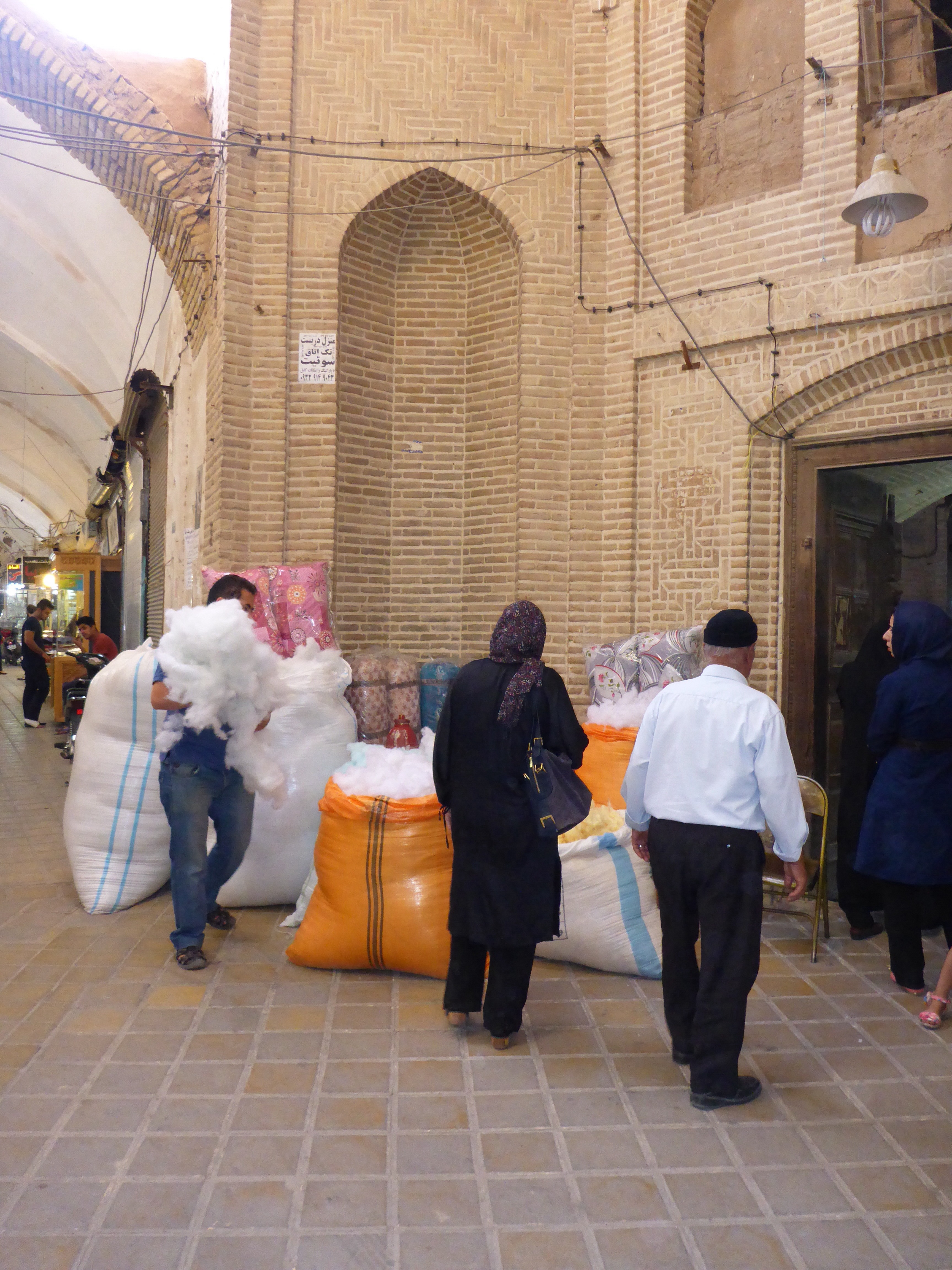
Select your preferred pillow stuffing, Yazd bazar, Iran

Then weigh your pillow stuffing selection, Yazd bazar, Iran
Anne is intent on finding and photographing the highest minarets and wind towers in Yazd. The only problem is that they all seem similar to the pictures we have seen and all about the same height.
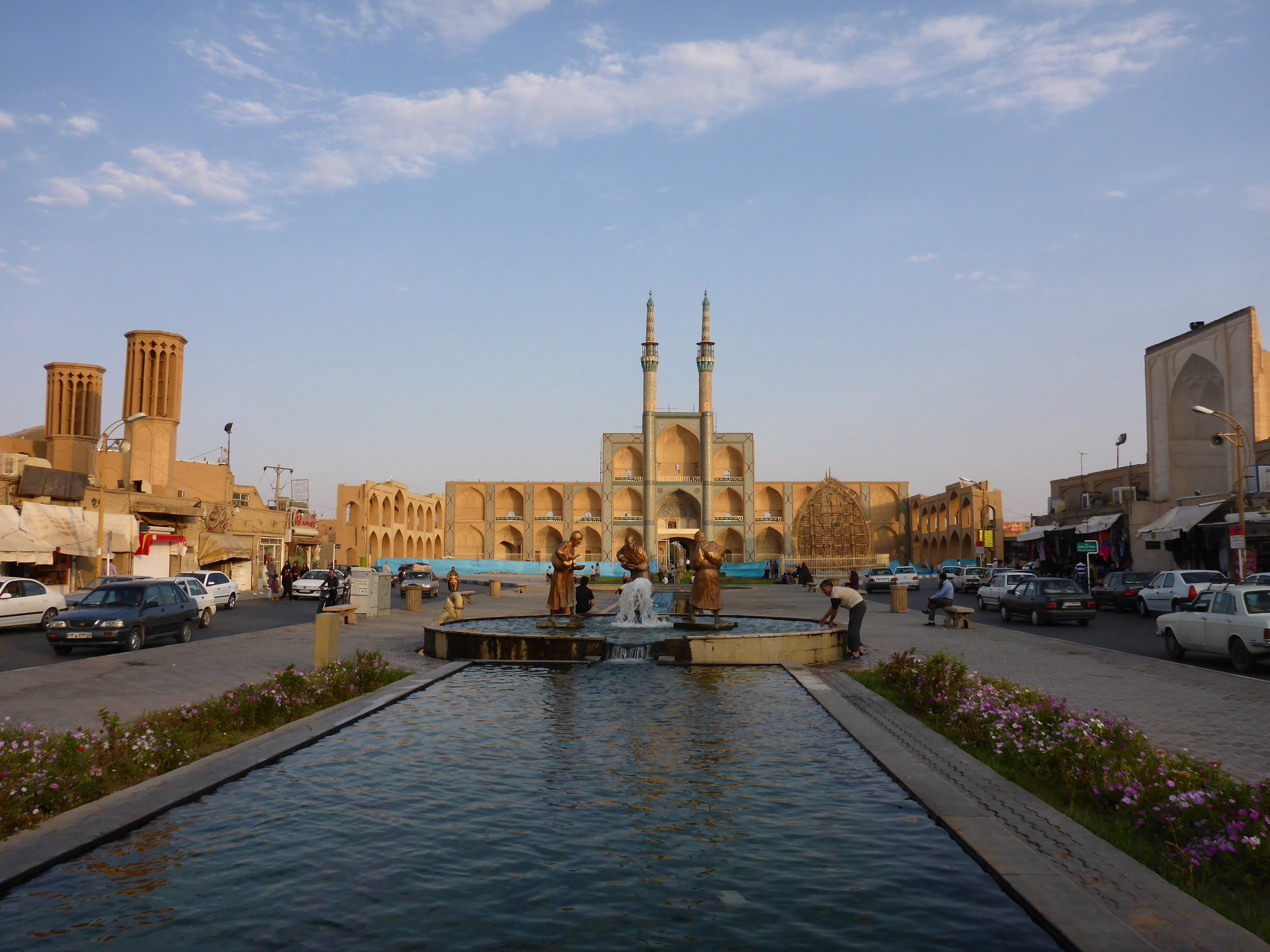
Amir Chakhmaq Complex, Yazd, Iran
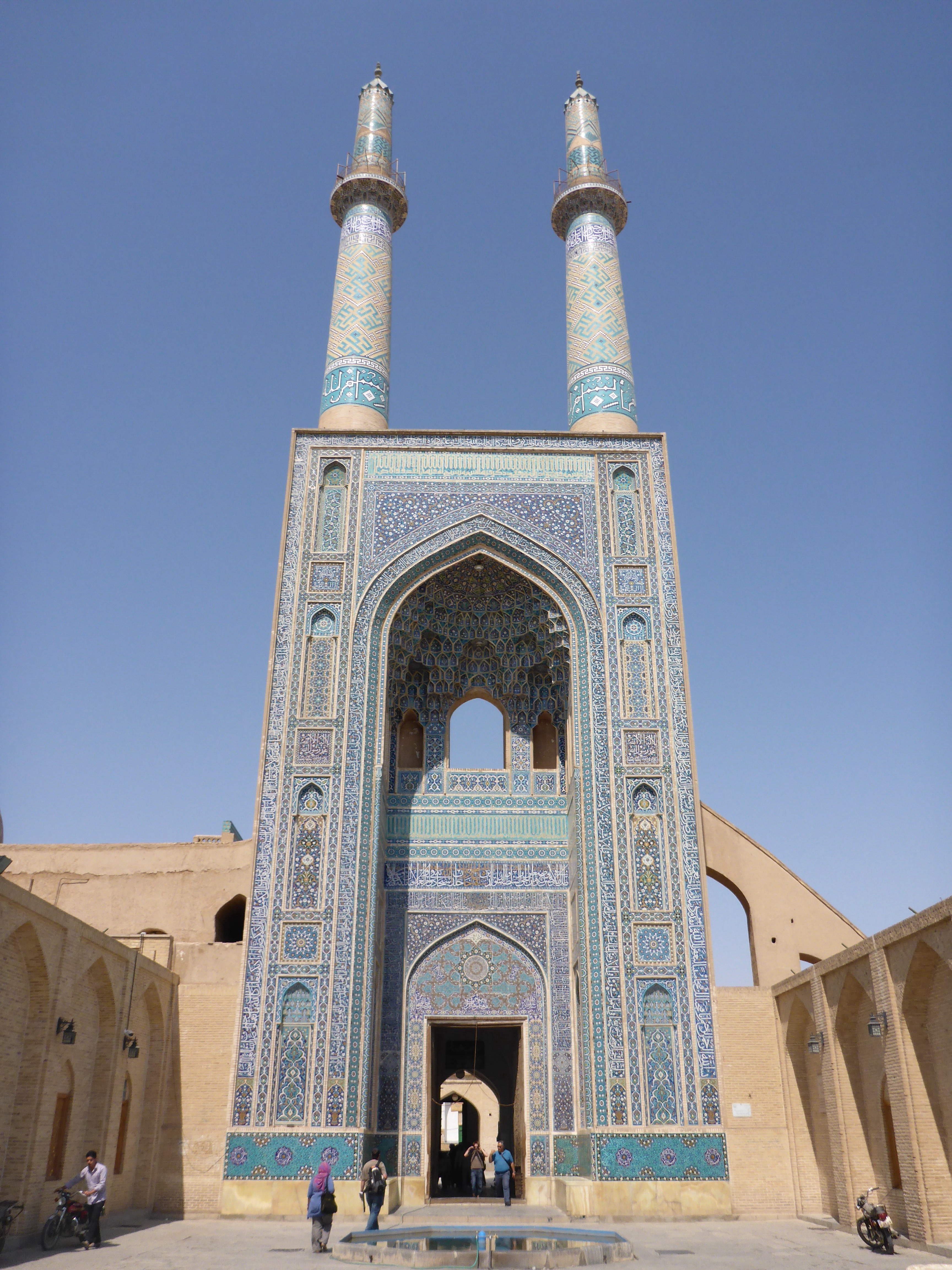
Jameh mosque, with the tallest minarets in Iran – Yazd, Iran
As we scour the lanes and alleyways moving from dark covered to light uncovered sections, always surrounded by dried mud brick walls, the city sounds fade to be replaced by silence and the occasional sound of a motorcycle navigating its way towards us – or is it away from us? It reminds me if those movies where the director uses the fading light, narrow lane ways and the sound of footsteps to show the hero/heroine is being followed, with of course the appropriate music.
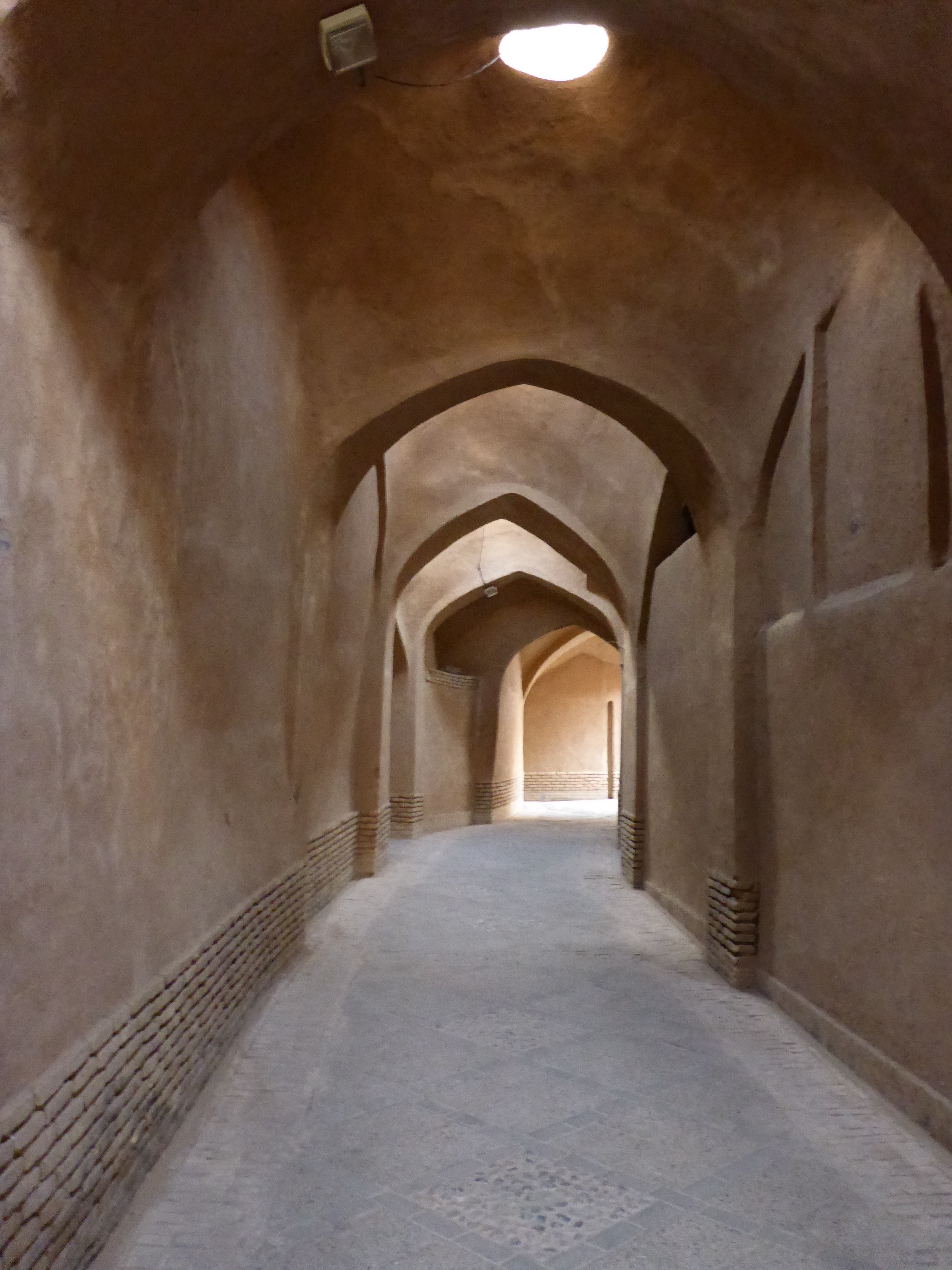
Covered winding street in the old town, Yazd, Iran
In the old town, we come across many traditional doors. They have 2 door knockers. One is long and narrow, the other round. They make different sounds and are designed to tell the inhabitants whether a male or female is at the door so that the right person opens it. You can guess which is the male or female knocker…
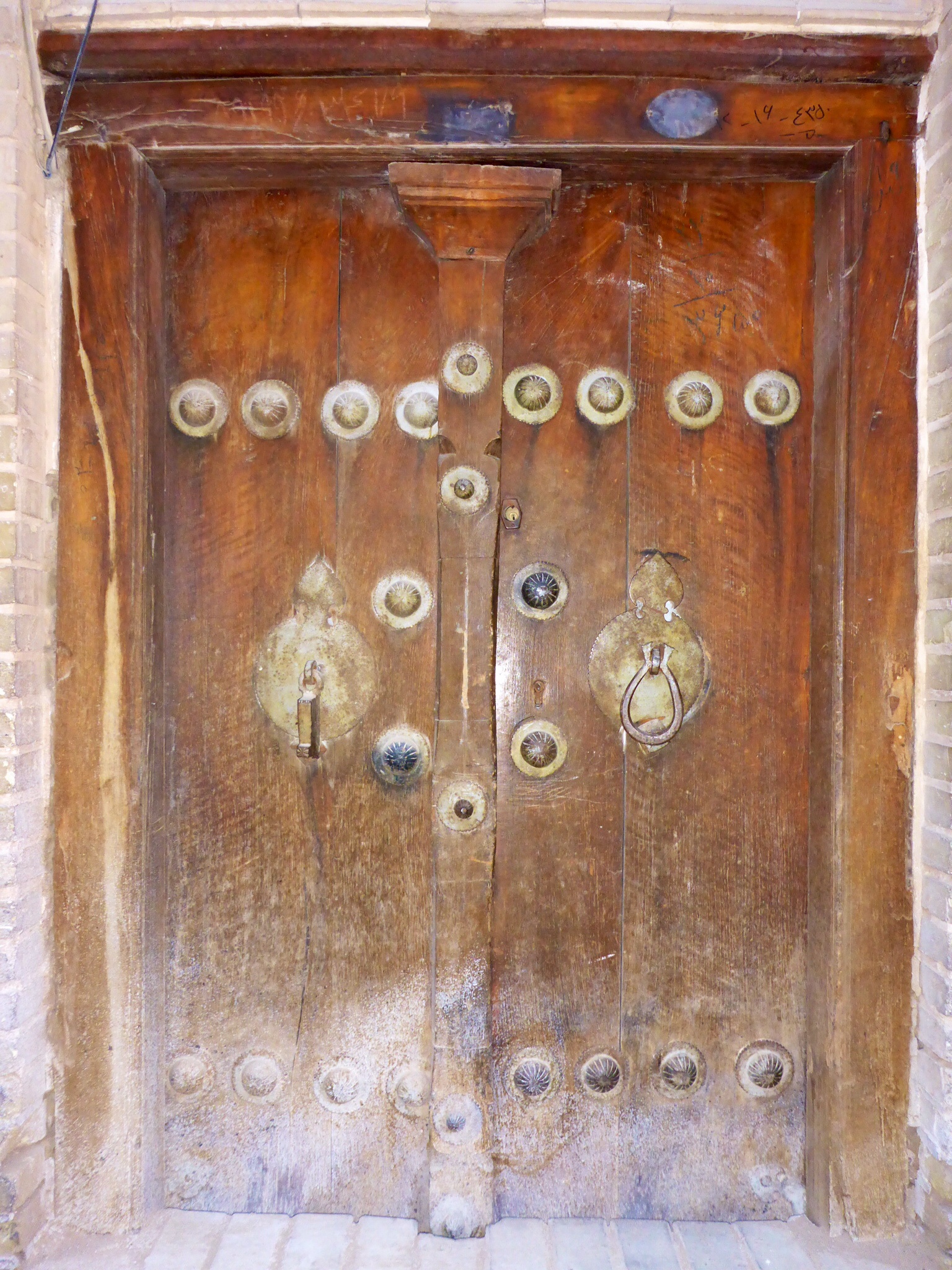
Traditional door with male and female knockers, Iran
We meet in the fading light another German speaker, running an antiques shop after his lifetime in Germany. Anne’s German comes into play again, although he does speak good English. He advises that while the city is generally safe, wondering the unlit lane-ways at night for tourists has led to incidents. Good advice which we heed.
We found this great fresh baked cake and biscuit shop. We can buy four single cakes or biscuits for about 30 cents. We have been back twice in one day and our waistlines will grow if we stay here too long. Almost across the road is this great store selling pots and pans. Anyone who has a wedding gift to buy could do no worse than get the 10ft high matching pot and pan set. Might need an adjustment to the kitchen cupboard, but a great gift that covers all numbers of visitors for lunch, dinner or any occasion.
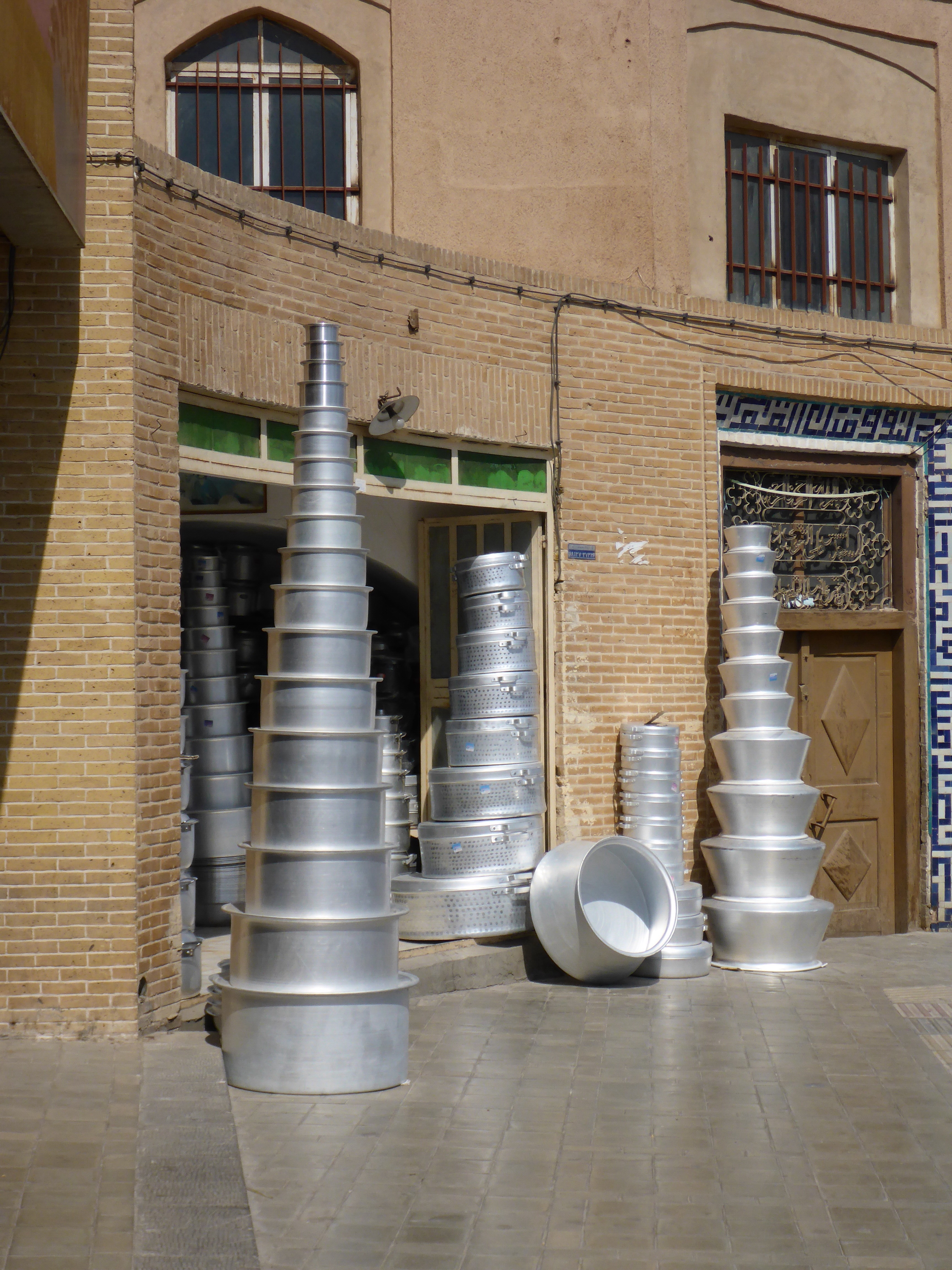
Household pots, Yazd, iran
Our second day started with a visit to the Zoroastrian ‘Towers of Silence’ where bodies were placed after death, not before, to have the bones picked clean by vultures. This practice was stopped some 70 years ago, so no vultures circle overhead while you climb to the top of the towers in the hot sun. We did see black and white pigeon at the top of the male tower, a vulture reincarnated perhaps? While the city of Yazd has encroached towards the towers, they are still surrounded by a dry desolate environment, with no sounds of birds or other wildlife, just the breeze blowing around us as we sat in a contemplative mood at the top of the men’s tower, which of course is higher than the woman’s tower, but has a gentler ascent. Anne wants all of you to know she walked up both towers, me just the tallest and easiest one.

Zoroastrian Towers of Silence, Yazd, Iran
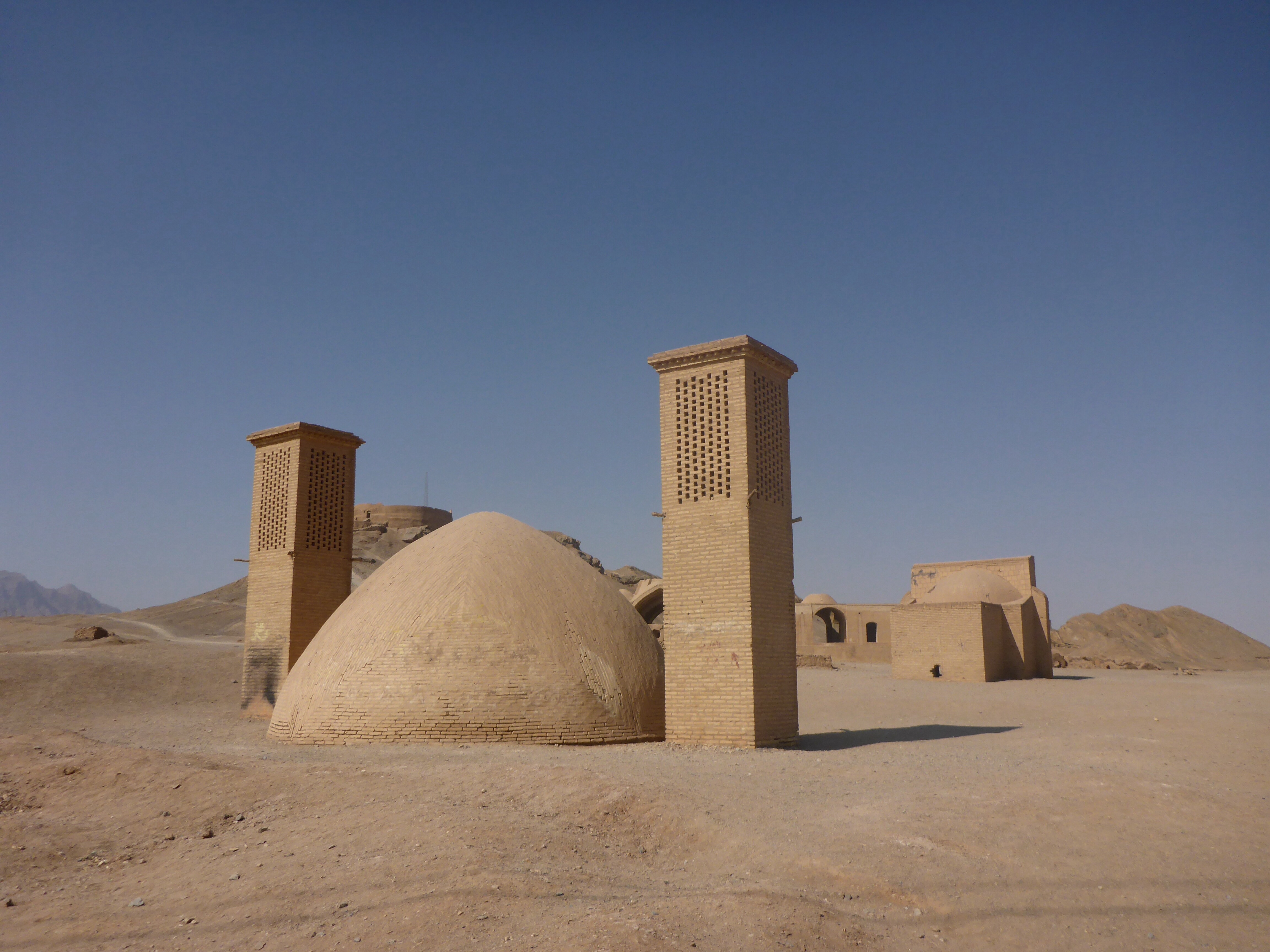
Wind towers above a water reservoir near the Towers of Silence, Yazd, Iran
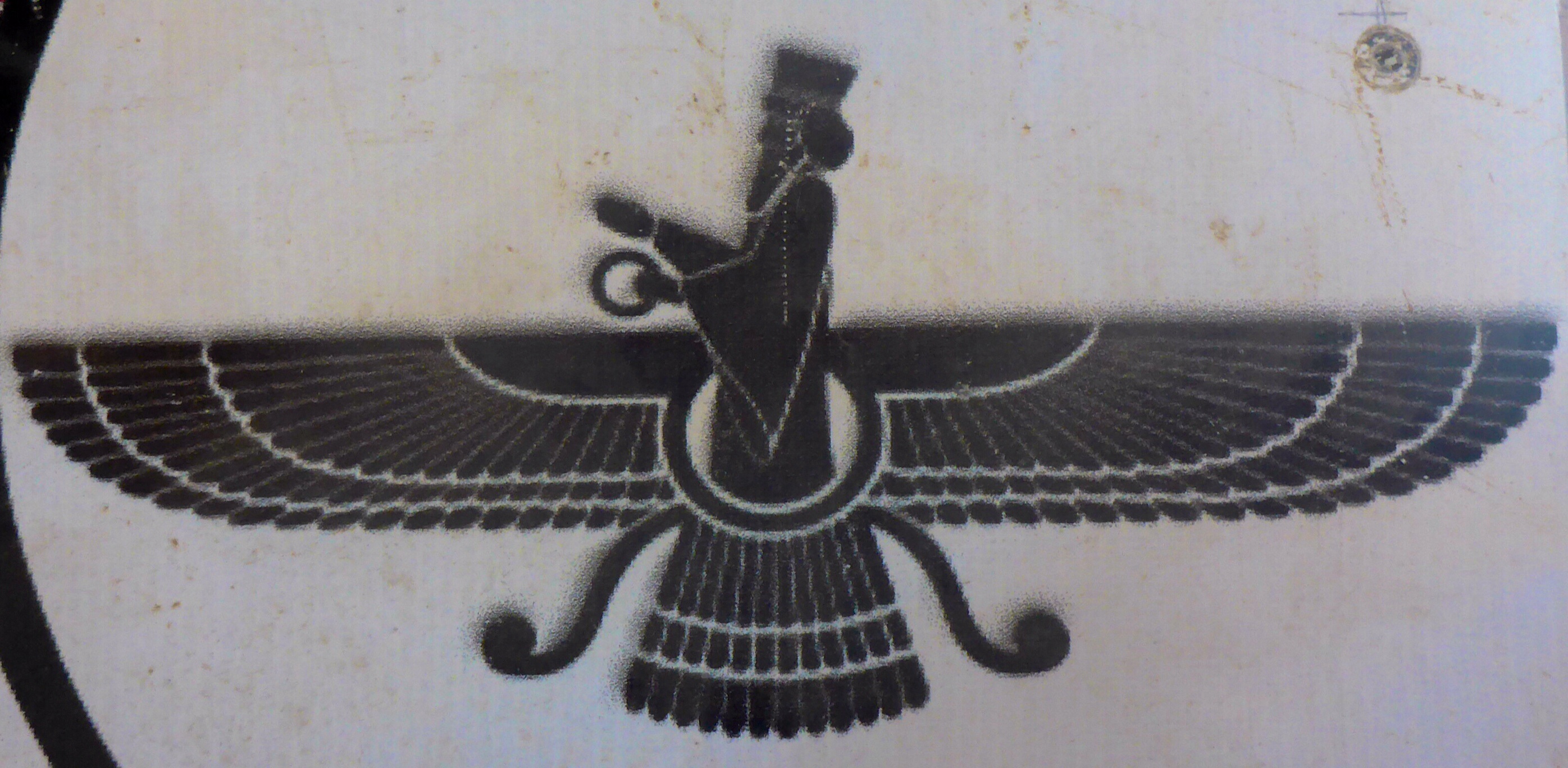
Zoroastrian symbol
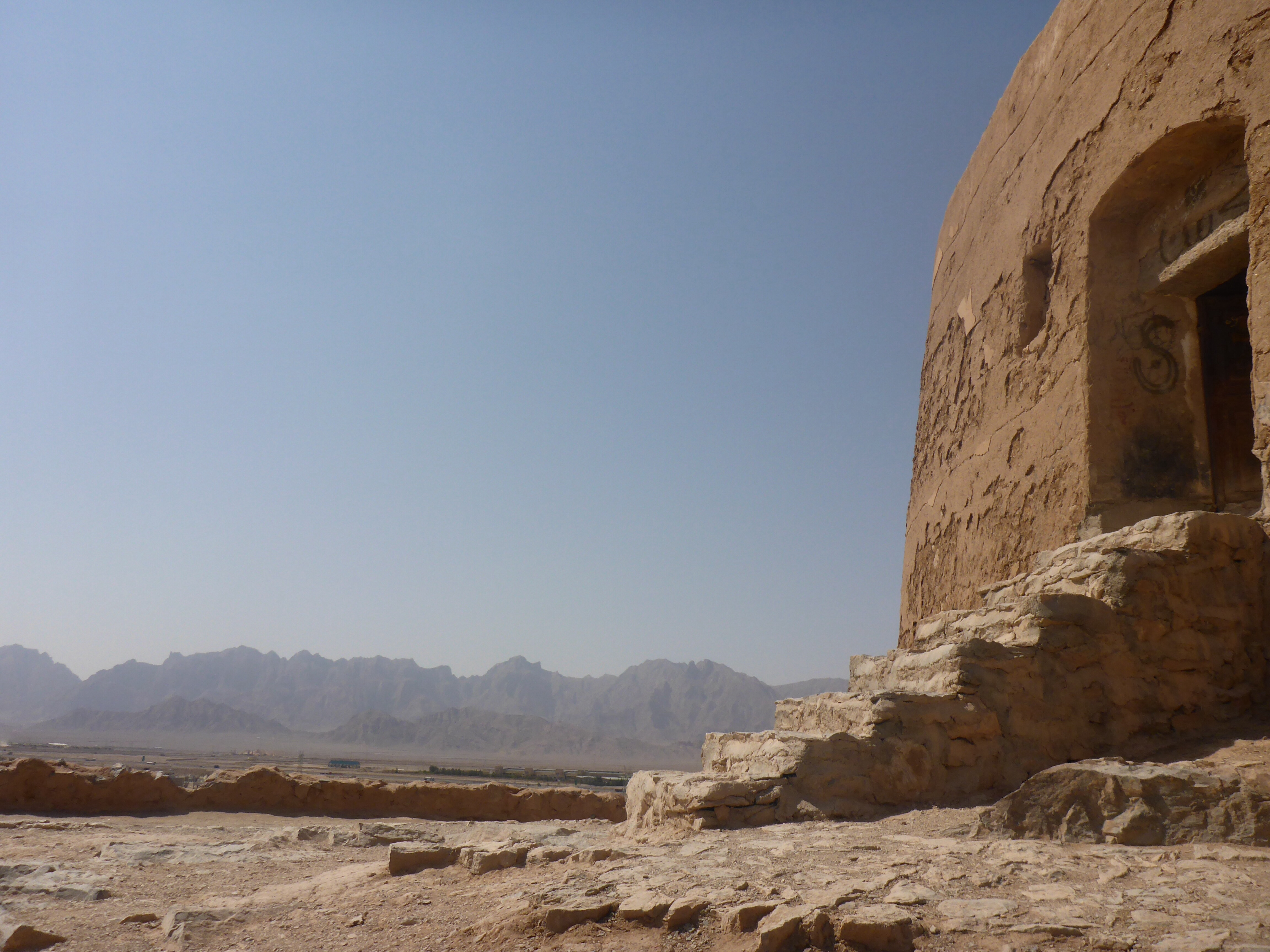
Steps into the female Tower of Silence, Yazd, Iran
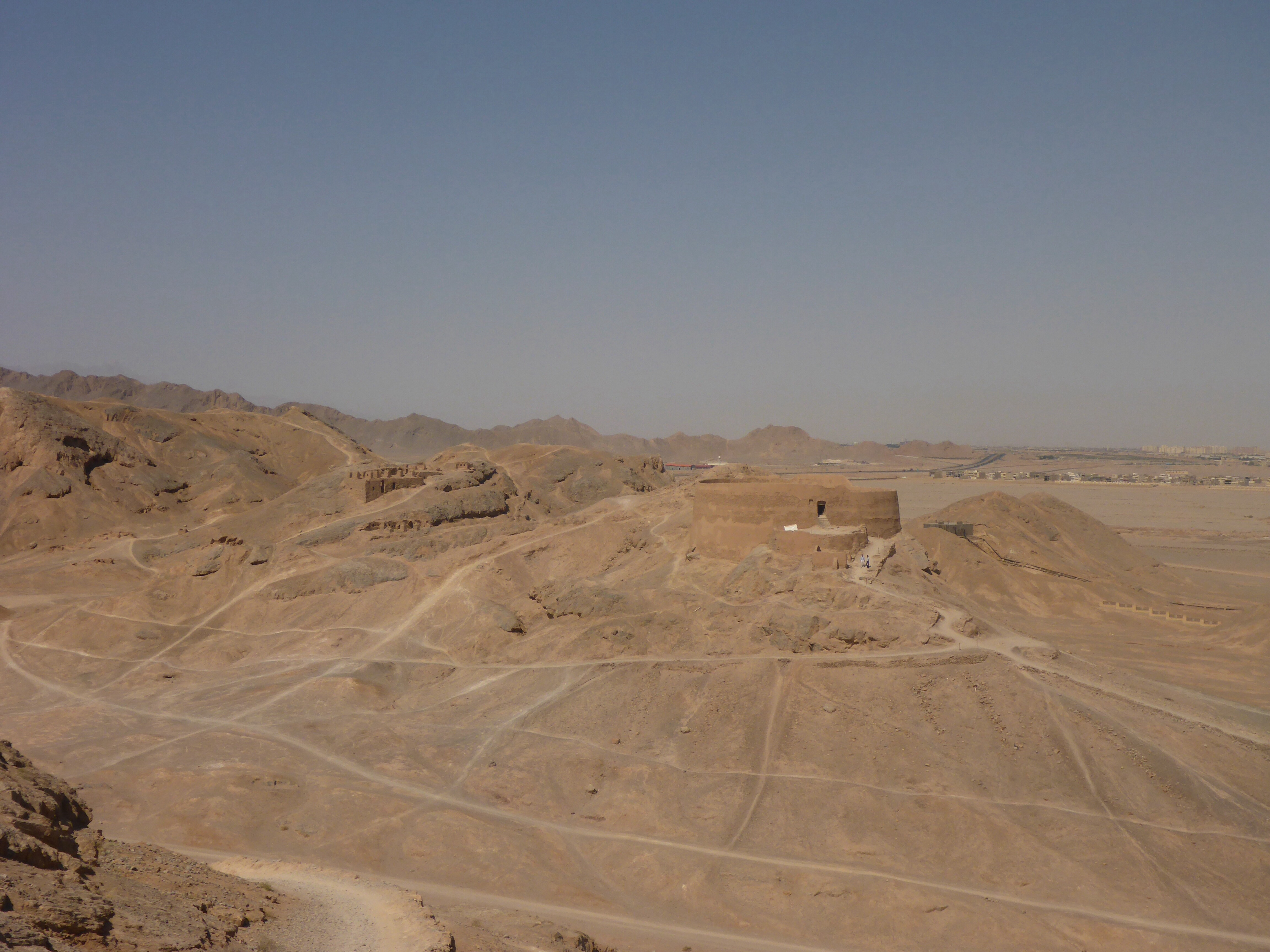
View from the male Tower of Silence toward the female one, Yazd, Iran
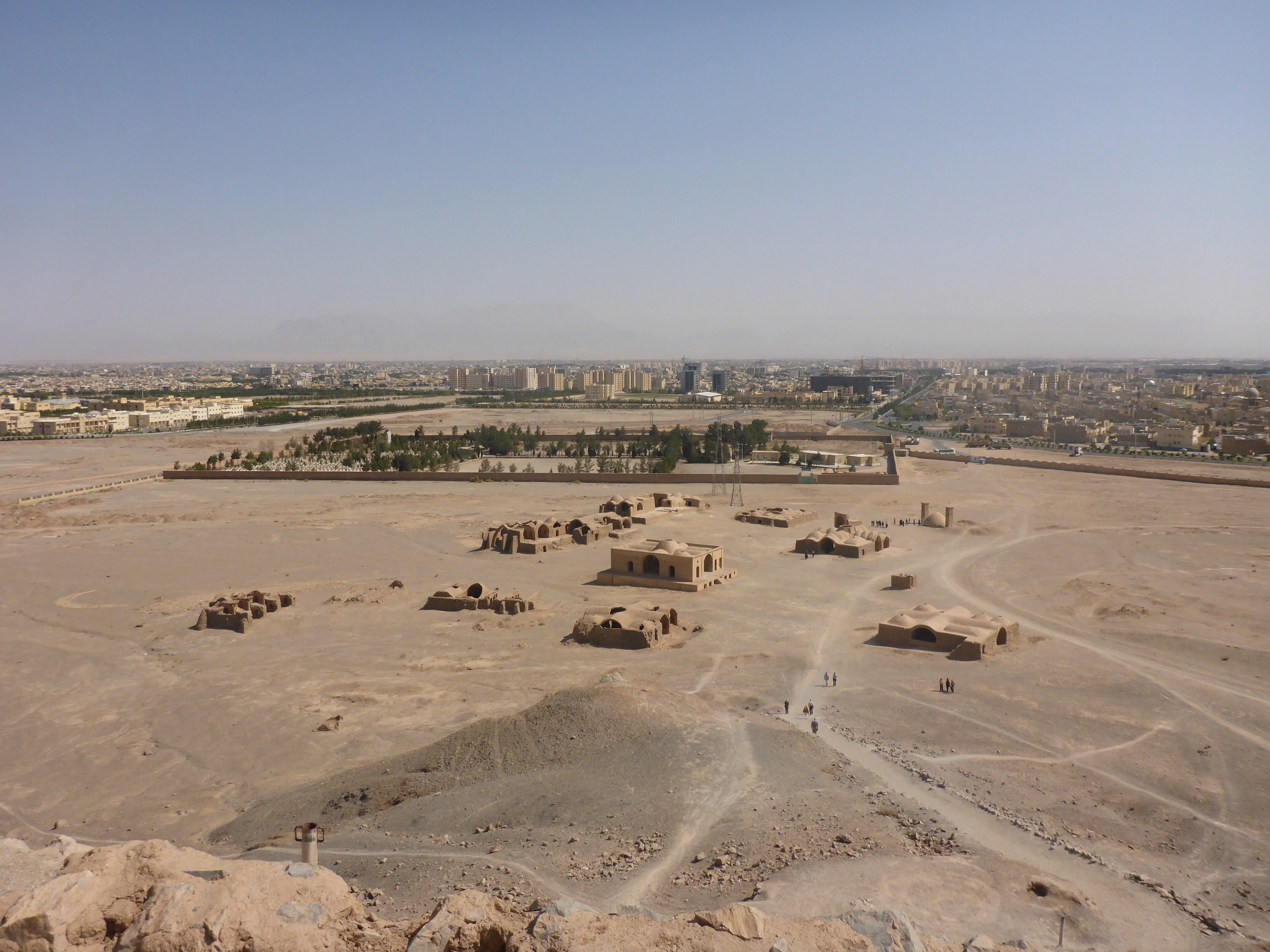
View from the Towers of Silence, towards Yazd, Iran
This was also the day that blog writing returned with a vengeance. We had both been suffering from writer’s block, which we have heard happens to writers but not experienced ourselves. So many great people and experiences in the last 10 days that I think it was all to much for our minds to organise and document coherently for the blog. This afternoon we both found that the words just flowed, hopefully readable to all of you who follow us. We were able to make up ground, we had become concerned if we leave writing for too long that we forget details and sequences. An afternoon well spent, along with a couple of naps for me in the process.
We met a charming Brazilian couple staying at our hotel. They are not only visiting Iran, but Lebanon and Jordan. Jordan we have wished to visit over the years, but the opportunity has never eventuated. The variety of countries represented we meet while travelling is ever growing, interestingly earlier this year during the peak season in Yazd, 60% of the hotel guests were Italian, rather than the usual Chinese, Koreans and Japanese. I wonder what drives the interest in Iran from different cultures from year to year?
A visit to the water museum was fascinating and informative, but left us with more questions than when we went in. The clever use of hand built underground canals or ‘qanats’ as they are called here would take water from the foothills into towns where storage reservoirs were constructed underground with flights of steps leading down to where water can be collected. Larger houses may have had direct access to water from a qanat. This to would have entailed excavation work and due to the coolness of both water and earth, food storage areas were also built. Wind towers dot the city landscape, used to remove hot air from the vicinity of the water. A complete planned water delivery system. The nature of construction was difficult and dangerous and the workers chose to wear white to work so if they were killed, and probably entombed, they would be buried in a white shroud. Today in the larger cities, this supply system has been replaced by piped water, but the domed brick storage tanks and wind towers dot the city landscape, a testament to an ingenious and clever way to manage water supply just using gravity feed in a harsh environment where every drop of water counts.
We round off our stay with an late afternoon visit to the Bagh-e Dolat Abad gardens containing the tallest Badgir or wind tower in Iran. Like many of the sights in Iran, it is down a couple of back streets and through a nondescript archway in a mud brick wall, postmarked with the scrapes of passing trucks and cars. Inside are acres of gardens filled with buildings and the imposing bagdir or wind tower, some 60 meters high. We are able to enter the building at the base of the wind tower and look up inside the construction to see the way it has been built looking like the segments of an orange. The bagdirs are designed to catch slight breezes from up to eight directions and direct them down over a pond of water creating an evaporative cooling system. We have been singularly impressed with the care and maintenance that has been given to all the gardens we have seen except this one. Weeds cover a good portion of the landscape and creepers have overwhelmed trees in other areas. Any disappointment was swept away by the views of the tower from among the pomegranate trees.
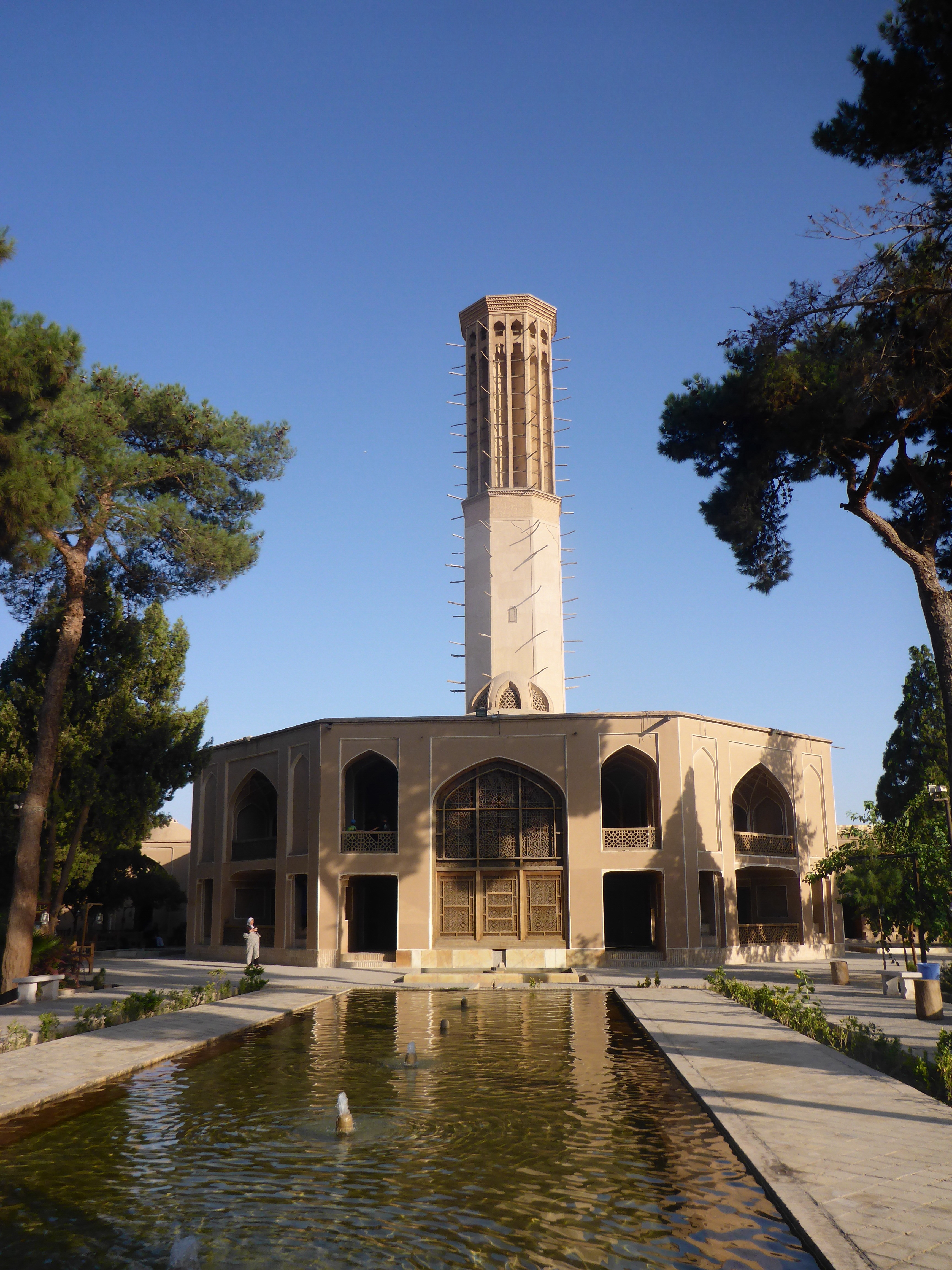
Dolat Abad with Iran’s tallest Bagdir, Yazd, iran

Under Dolat Abad’s bagdir (wind tower), Yazd, Iran

Looking up one of the ‘segments’ of Dolat Abad’s bagdir, Yazd, Iran
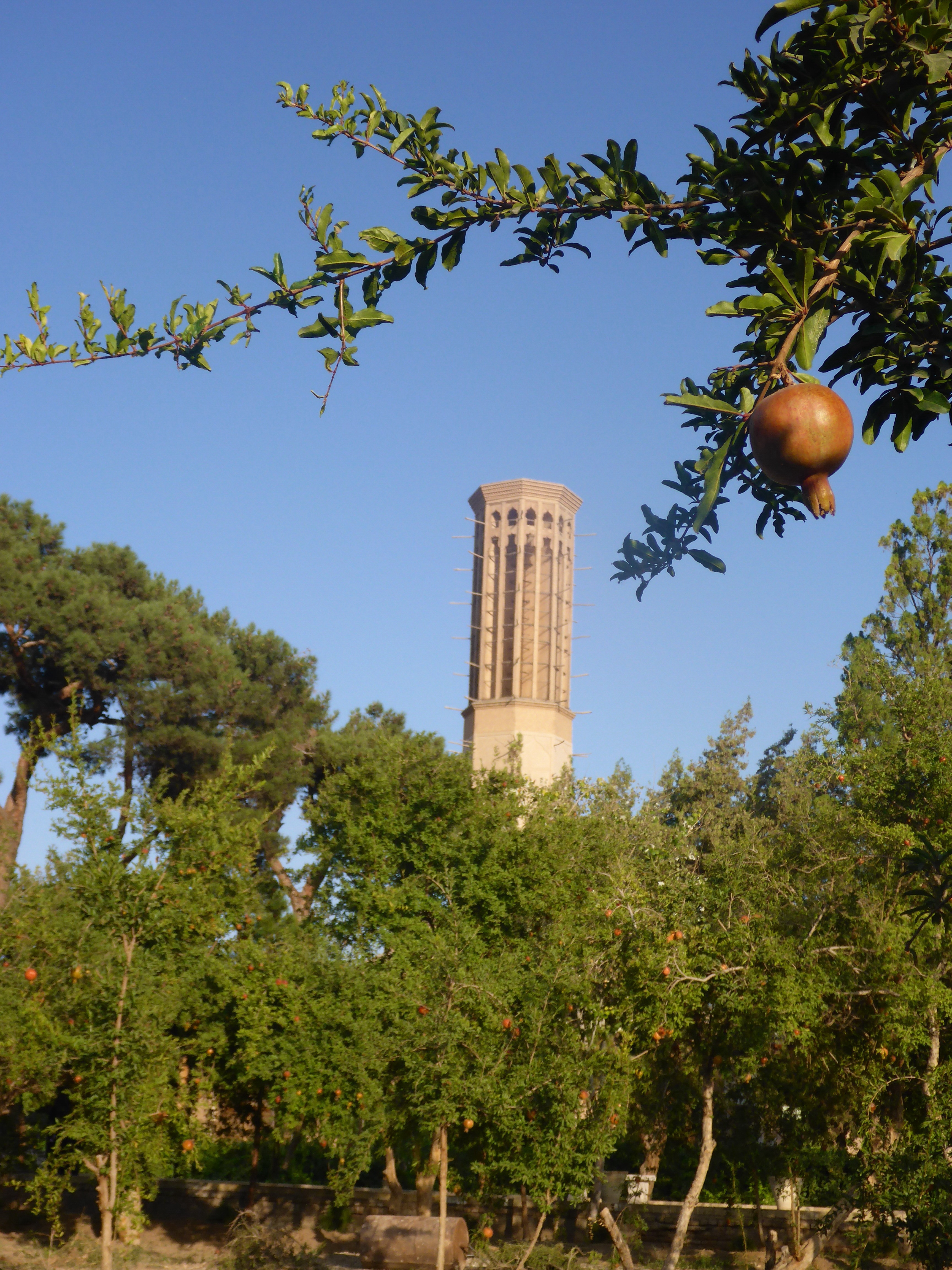
A pomegranate orchard surrounds Dolat Abad, Yazd, Iran
No taxis were to be seen for our return to the hotel. A gentlemen of uncertain age, with a car of even more uncertain age and adorned with many dents and scrapes stopped for us. He could not speak English and did not know where the hotel was. Through sign language, we indicated we could direct him. The journey was interesting as I contemplated from time to time what I would look like after impacting the windscreen, seat belts being an optional extra, but with the good graces of the other drivers we arrived in one piece looking forward to being back on the bikes tomorrow.
Dinner, packing and off to Kerman.
– Anthony
Driving in Iran
Driving in Iran and Tehran especially can be quite nerve racking, even for us with our varied riding and driving experience. The style and pace of traffic and pedestrian movement can be overwhelming and difficult to follow. We have however not noted a single incidence of road rage in-spite of actions that would drive western drivers to distraction. We see on a constant basis, actions and reactions that require intense concentration at all times, but sadly none of us are capable of sustaining that level of concentration and accidents happen here all to frequently. We have heard the phrase “people go out to have accidents” is used by staff in Iranian hospitals. The following are observations. They are not designed criticisms of the type of driving, we have enough of our own traffic problems, but a reflection on the driving style and the higher level of risk that it presents to road users.
Iranian driving observations
We start to see the Iranian driving we have heard about -drive close alongside, hold conversations, take photos, drive closely behind, pull out, overtake at speed, then cut in front and stop. The faster they overtake, the more likely they will stop sooner.
Taking a leaf from the credits at the end of movies: “The road markings depicted in Iran are fictitious. Any similarity or suggestive purpose to road markings in other countries is merely coincidental.”
Pulling out into traffic is a measured thought out process to give those already on the road enough time to adjust for their presence which is coming eventually. They do not wait for a gap as we would.
We think that you give way to traffic on the roundabout if you have an even numbered number plate and give way to traffic coming onto the roundabout if you have an odd numbered number plate, or visa versa, we cannot work it out after 2 weeks here!
Pulling over takes no care or thought for those behind you, normally the faster a car passes you the quicker it will pull over without warning and stop as quickly as it can, thought and action are one and the same.
More conscientious drivers will stop in the middle of the road, or roundabouts, to take or make calls.
Wearing gloves on motorbikes makes it impossible to text or surf the net while riding, so do not wear gloves.
Wearing helmets limits the ability to make and receive calls and smoke, so don’t wear a helmet.
Men occasionally wear helmets, their female passengers never do.
Motorbikes are mostly 125cc, but they still race past us in towns, usually with one or more passengers.
Additional Tehran motoring observations:
Toughest traffic to ride in: vehicles move quickly, see a space, fill a space. We have not ridden in a more challenging city environment. You cannot watch all directions at the same time and rely on others’ road skills or lack of, as the case may be.
Seems to resemble down hill skiing in the manner that those behind must look out for those in front, so be in front!
One way streets have a special invisible lane for motorbikes going in the opposite direction: dodge the on-coming traffic and you are ok. Very useful to avoid the one way systems – we have used it successfully.
If you find you have gone the wrong way, put the hazard lights on, just reverse and then do a u-turn, even in one way streets!
For motorbikes and mopeds, it is quicker to go the opposite direction around the roundabout if you are going to the third or fourth exit (only seen a couple of times).
Groups of pedestrians can be found walking in the road and even around, not across roundabouts and streets without any regard for traffic.
Can confirm the reason motorbikes and mopeds ride so close to the vehicle in front is to see that vehicle’s speedometer as their instruments and lights are covered by the helmet.
Vehicle lights are optional at night.
Bus lanes are great for motorbikes even if they are travelling in the wrong direction, they just get out of the way when a bus comes.
Traffic lights must be used for colourful decorations as they don’t have the same significance as we know them to have. We regularly see traffic going through very red lights with no one caring but simply adjusting their speed or direction to avoid any collision.
Traffic lights have countdown timers, but several go down to 3 seconds and stay on 3 for an unknown number of seconds, and others go from 17 seconds to 1 second in 1 second.
Having said all this, do not be put off, it is an amazing experience to see how people can operate without road rage and with a level of cooperation we do not see in the western world. You will get used to the traffic and the perceived chaos.
– Anthony & Anne
Esfahan
We leave our lovely hotel in Kashan, request help to take our luggage to the bikes, load our panniers back on the bikes and get ready to ride up the very steep, angled and weirdly corrugated driveway up to the lane-way. I had thought about it the day before and thought it would not be easy – better be careful not to lean too far to the right and fall over or you could land your chin and break neck on the hand rail. Vivid imagination sometimes… As I walked down to the bikes, I had decided how to tackle it. I can do it. It will be fine. I position my bike for the ride up… Yes I can. Aarrgghh. No!!! I chickened out. Anthony walks back down and rides my bike up. I am really annoyed at myself. Really annoyed and disappointed. Anthony tells me it was easier the 2nd time. We ride out. I keep having little chats to myself – one minute telling myself off, next telling myself to “drop it” and concentrate on the road. It’s done. It’s ok.
Our ride out of Kashan to Isfahan is short and easy, just 200 kms and quite pleasant. We stop half way to refuel and stretch our legs. As usual, our bikes attract a bit of attention.
There is no restaurant open so we open one of our cans of tuna which we eat with a small packet of chips/crisps in the shade of the closed restaurant. Several cars pull up, all from the same group and install themselves along the wall in the shade, like us. They have brought rugs to sit on and pillows to lean against, large containers of hot tea and all sorts of food.

Scenery between Kashan and Esfahan, Iran
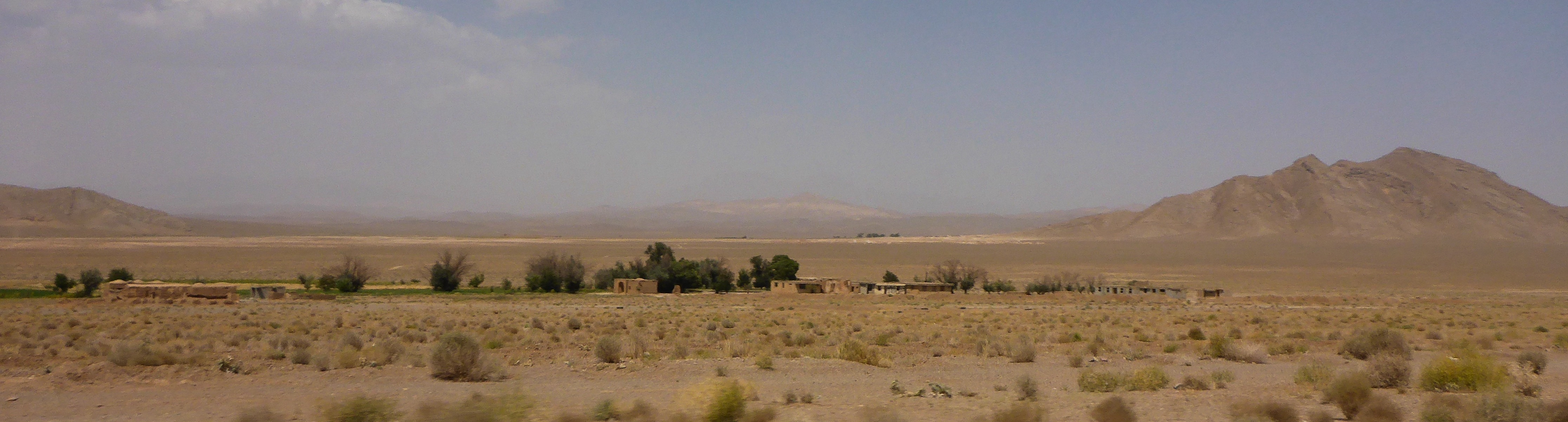
Scenery between Kashan and Esfahan, Iran
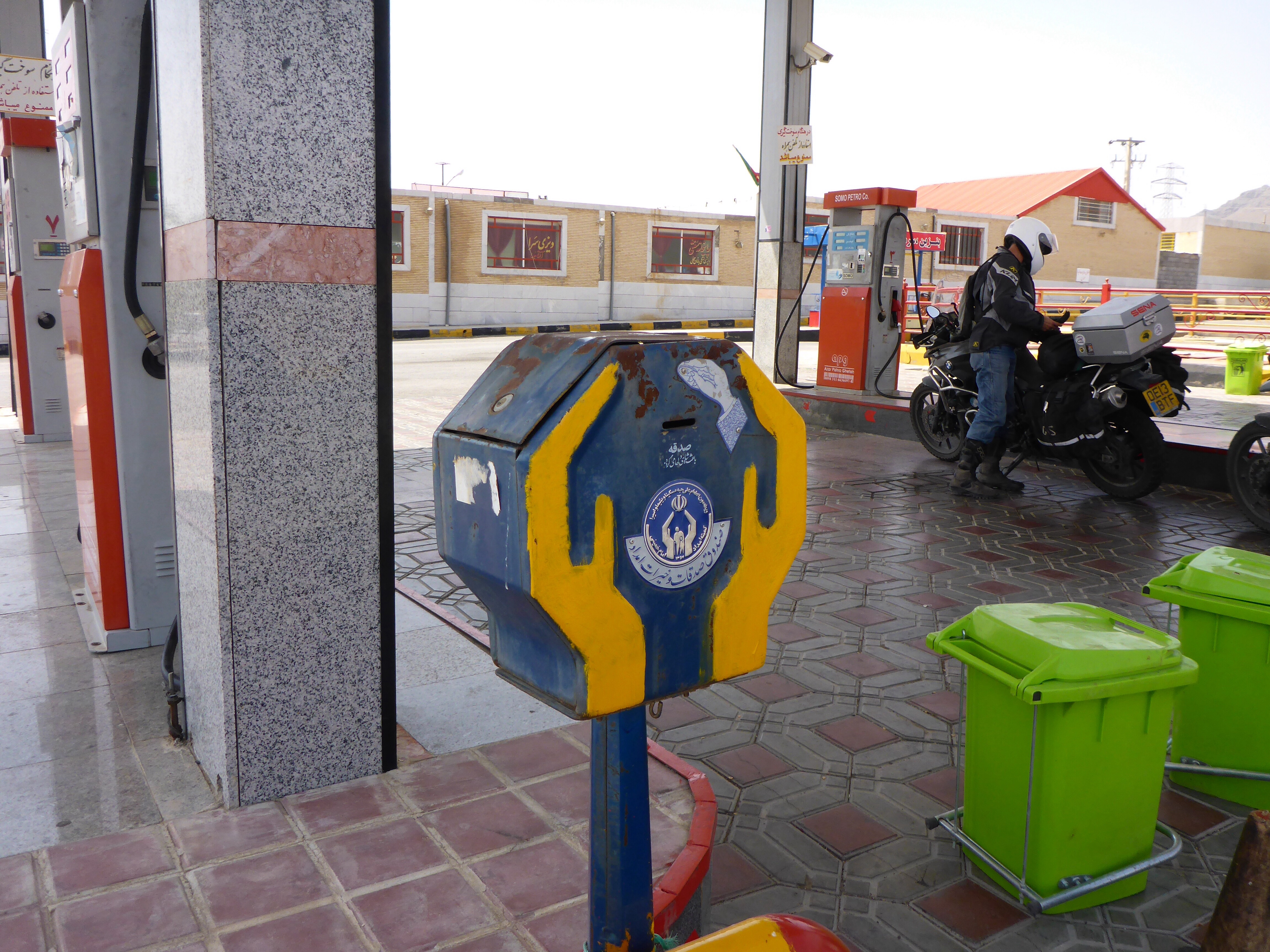
Charity boxes are found every few hundred metres in streets, and also at petrol stations throughtout Iran
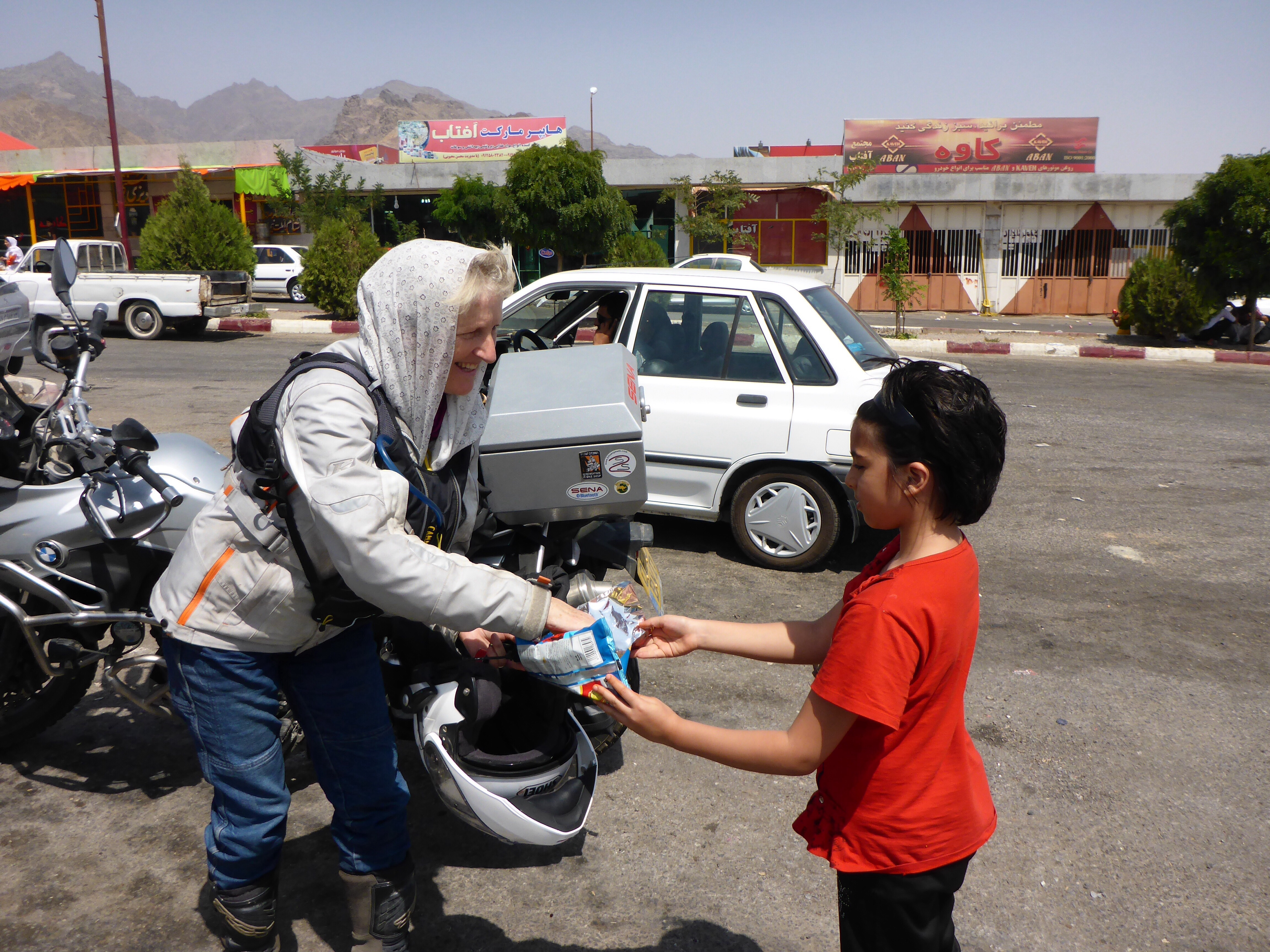
This girl came over and offered me some chips/crisps as we stopped for refreshments
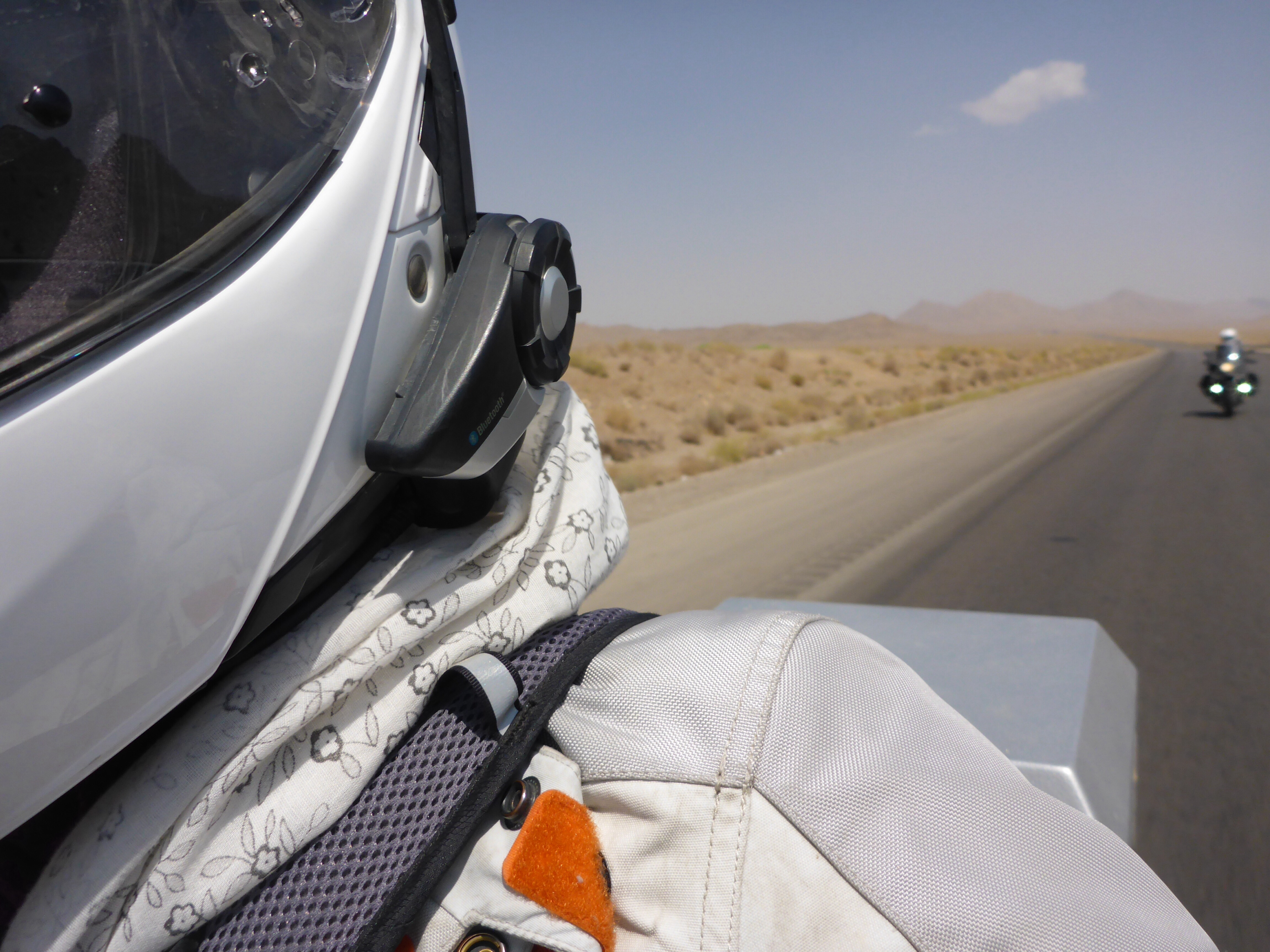
On our way to Isfahan, Iran
We had given ourselves 4 hours to get to our rendez-vous – 3 for the bulk of the route and a final hour for getting into the city centre. We are meeting friends by a large, very famous park, Bagh Ghadir, everybody knows it we are told but the GPS doesn’t and no park is shown on the GPS so once again, the GPS cannot find the address we’ve been given. But I have it on my iPad with a saved Google map. So Anthony works on locating roads, bends, roundabouts, underpasses and puts a target pin roughly where our the meeting point is. I know the name and Anthony knows the direction. Between the two of us we get close. We’ve gone through 2 underpasses – do we exit here? It doesn’t look quite right. At the traffic lights, as a driver asks where we are going, I call out the name of the park. The driver waves towards the underpass, then left. We confirm our understanding – back down here and up again or…?? The lights turn green. Rats. Was it down the ramp, and stay left or down, up and left? He takes off, and cuts in front of us. Nothing unusual. He was in the left hand turning lane, which we know means nothing here really, but he waves at forward so we think he’s going to lead us to our destination. How nice!! Just as we thought, down, off to the right, up and left at the top. At the intersection, I spot a sign “Ghadir Gardens”. He is taking us there! We eventually arrive at a park which I recognise – thanks Google Earth. We were meeting 3/4 of the way along. I tell Anthony we should stop. The driver waves towards the park on the left, and starts to turn right. We decide to pull over where he’s turning and call our friends. Just as we’re pulling over, right there are 2 people waving at us!!!! Our usual luck strikes again – thank you guide, thank you angels…
Who are these friends? A friend of a friend and we’re staying at her sister’s house. We have never met them before. And our friend has in fact never met her friend either. They know each other through social media. And it seems perfectly normal to them to put us up. Why are we not staying in a hotel you may ask? Because every single hotel I called was full. I even tried for single nights, prepared to move as necessary as we wanted to spend at least 3 nights. And it wasn’t until Afrooz asked me yesterday where we were staying in Isfahan and I told her that every hotel I had tried was fully booked for the whole of September so we would try on arrival that she said she would call her friend that evening and check with her. As luck would have it, this friend, Zoreh, was coming home to her parents at 3am from Southern Iran where she works 2 weeks on, 2 weeks off as the emergency doctor at a hospital. And of course we could stay, but her sister’s home would be more comfortable for us.
So that’s how we meet Zoreh and her nephew Mohammad, by the side of the road. The house is close by, a few short lanes away and we’re there. The garage doors are opened for us and we park our bikes in the beautifully tiled garage. The car will be parked on the street while we’re there. We are dripping wet with sweat – it got to 42 degrees again today – it is good to stop.
We meet Zoreh’s eldest sister, her husband and their daughter. Mohammad’s wife arrives a little later. We are offered glasses of iced water. And biscuits. And sweets. And chocolates. And a cool fruit drink. And fresh fruit. Eat fruit!! I am invited to take my scarf off – even though all the others have kept theirs on, even within their own home. We are shown to our room. It’s massive. I am sure we are taking someone’s room but we are assured not. That night, as we went to the toilet, we get confirmation we have taken the parents’s room as they are sleeping in the lounge.
We are thankful Zoreh speaks good English. Mohammad tries hard and Zoreh completes the sentences for him. We are invited to go over to one of Zoreh’s aunts who lives across the road. We think of how close families are in Iran still. Family members never live very far from each other. It was like that for Afrooz, Saba, Fariba and now Zoreh, except that those 4 women were largely the exception in their family. We think of our families, and how travel pulled us away from them, geographically, all those decades ago…
As we walk into the aunt’s home, we see this absolutely enormous pot, about 50x110cm, with the biggest ladle and stirrer. We are greeted by so many people, with more waving from a balcony upstairs. We don’t know who they all are. Several kids are happily playing together in the courtyard. There is a happy and relaxed atmosphere. They have prepared and cooked kilos and kilos of osh. A large table cloth is brought down into the courtyard and and we and our ‘immediate family’ have our dinner together. Anthony and I struggle with sitting cross legged – our bodies are not used to that position, we feel so stiff and awkward! Our lovely hosts invite us to stretch our legs out. Dinner finished, we all get up and leave all the others.

Zoreh’s family has prepared the largest pot of osh and prove such massive pots are household items
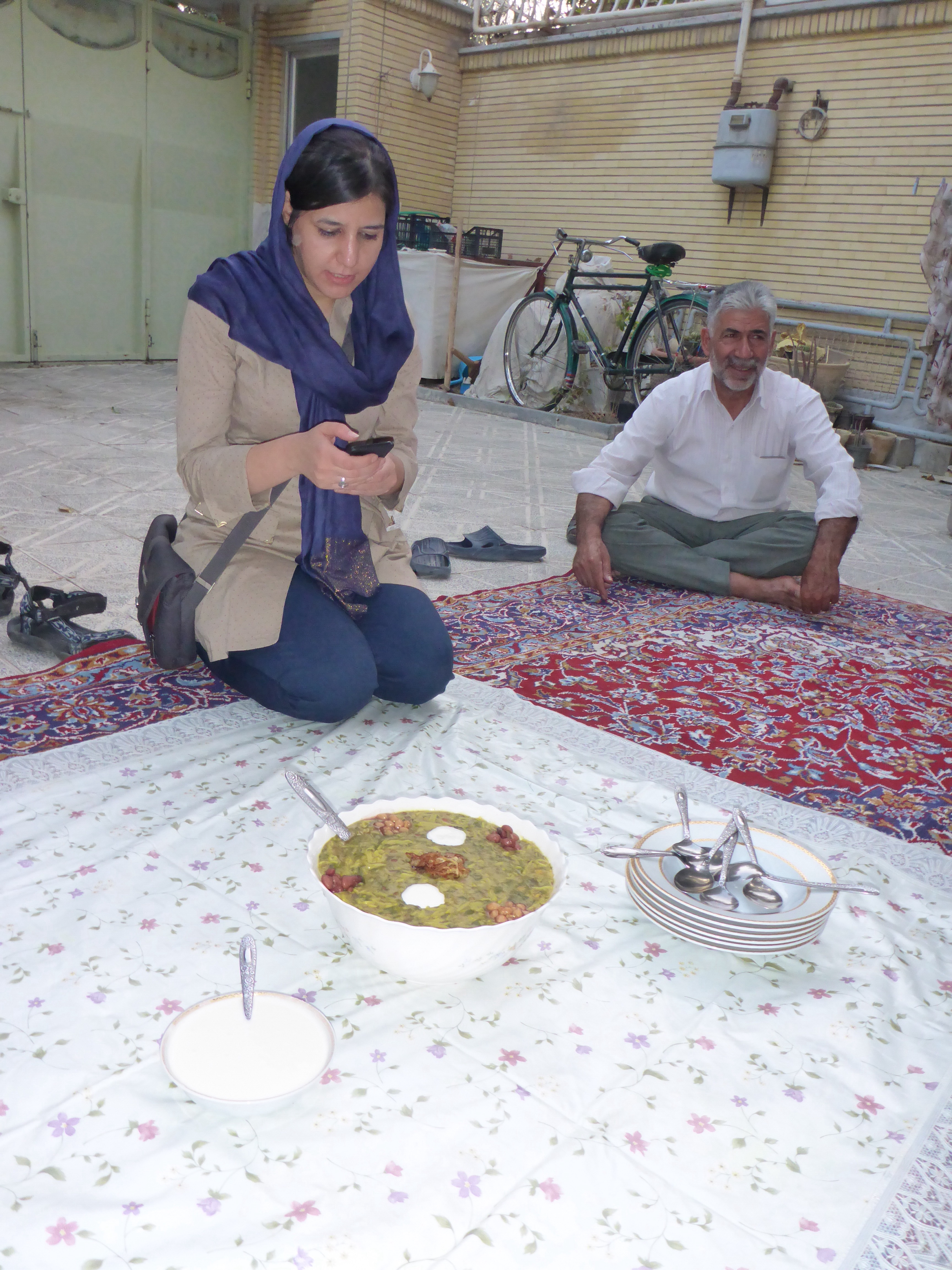
Delicious osh is being served for dinner, Isfahan, Iran
Zoreh, Mohammad and his wife Shadi take us to see the city by night. The streets are so busy, like rush hour – the night rush hour really. It seems that the whole of Isfahan is out enjoying the cooler evening air. Roundabouts, which are beautifully treed with lots of flower beds are dotted with several families having picnics. This isn’t the week end – it’s like that every evening we are told. Past the Si-oSeh-Pol bridge (30 bridges bridge), past the Khajoo bridge, and onto the main square Naqsh-e Jahan or Imam square. All beautifully lit. On the way, we stop for ice cream and a special lemon sherbert desert which is tasty and extremely sweet. We have found that Iranians love their sweets, in many forms, love salt and love sour foods. We spend a lovely evening strolling through the bazaar, stopping for tea at a very quirky tea house, admiring the bridges. We have long and very open discussions about marriage, kids, families, politics, religion.
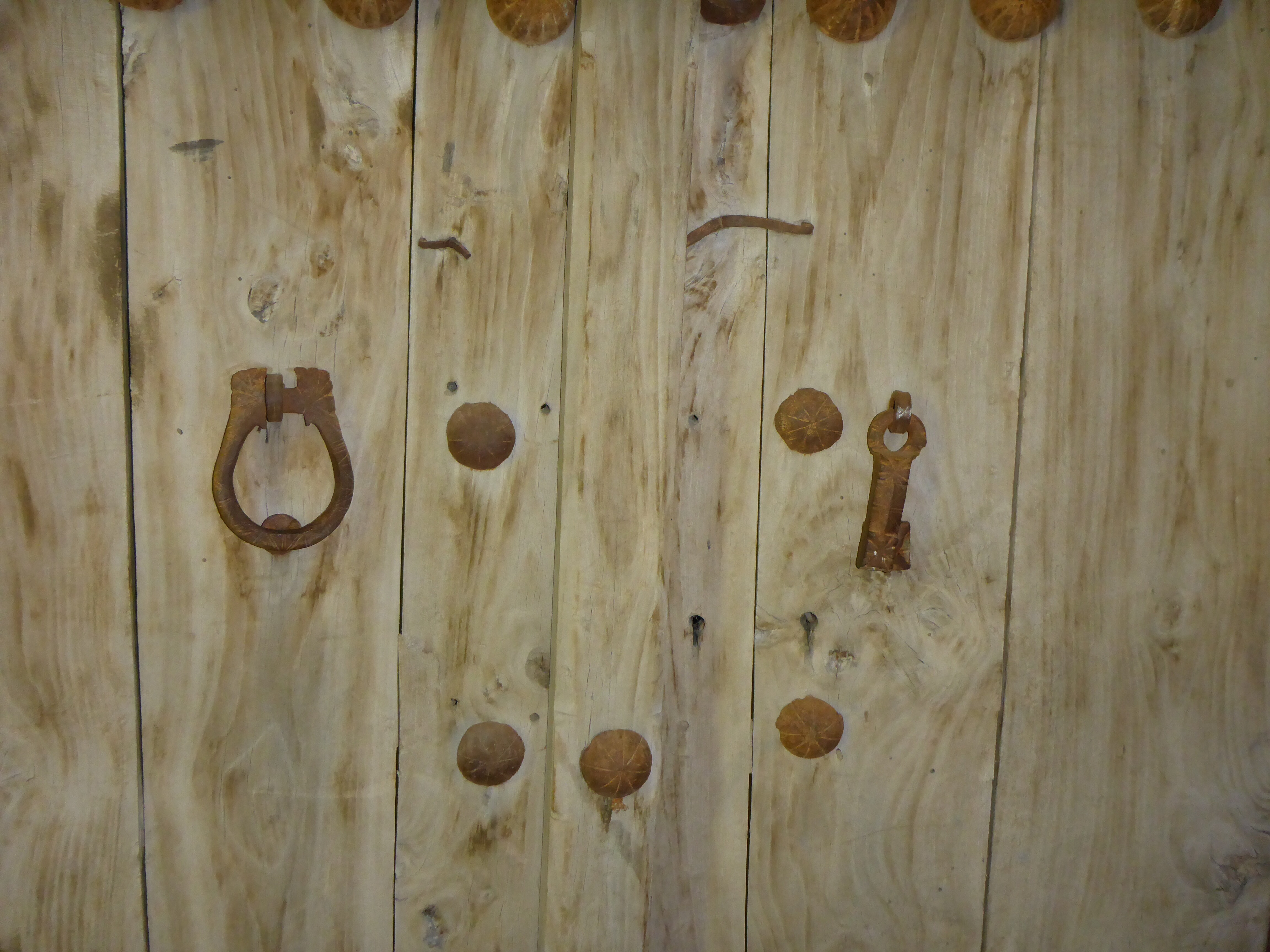
Female and male door knockers, Isfahan, Iran
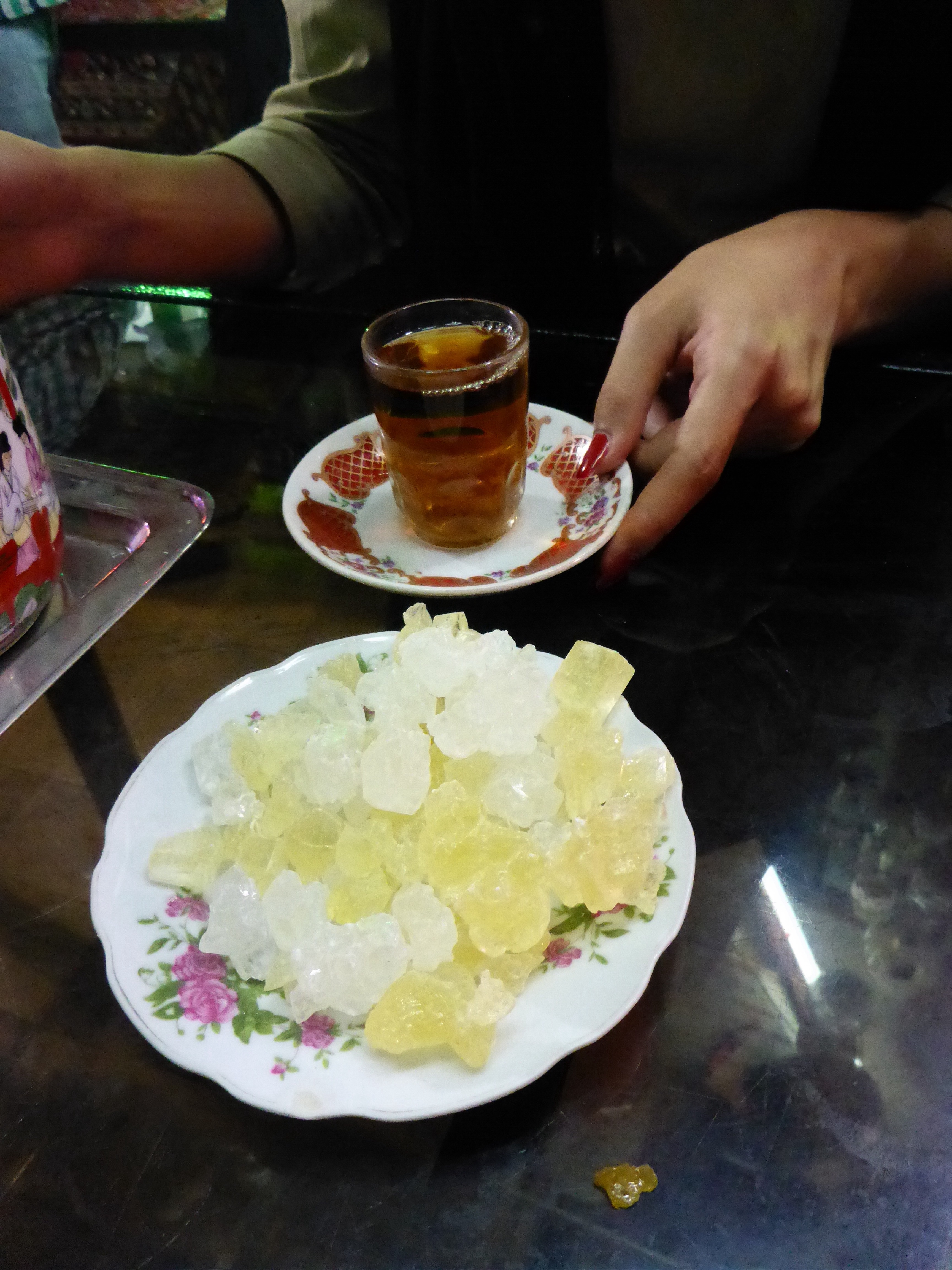
Want some tea with your sugar?
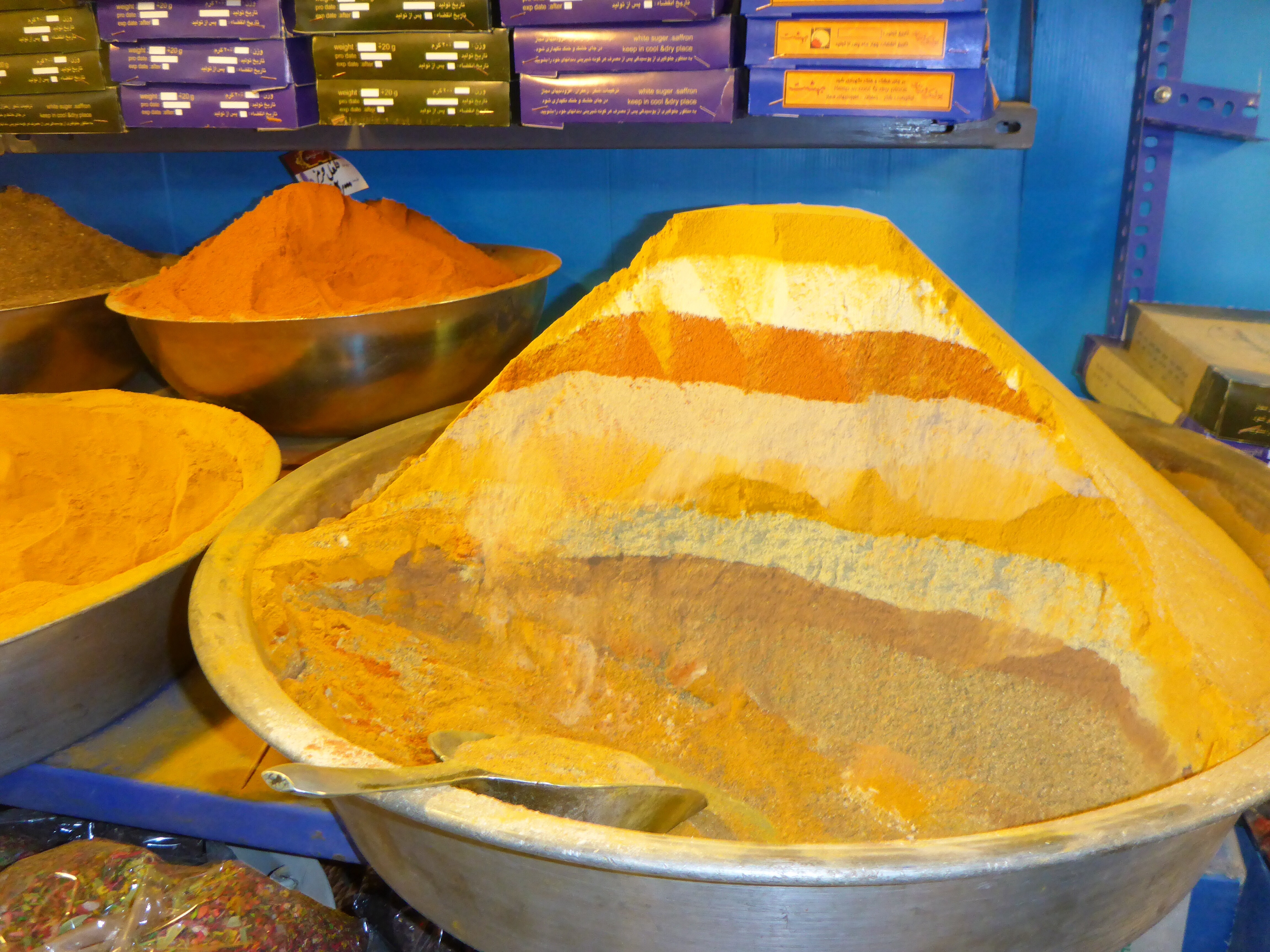
Chicken spices, Isfahan, Iran
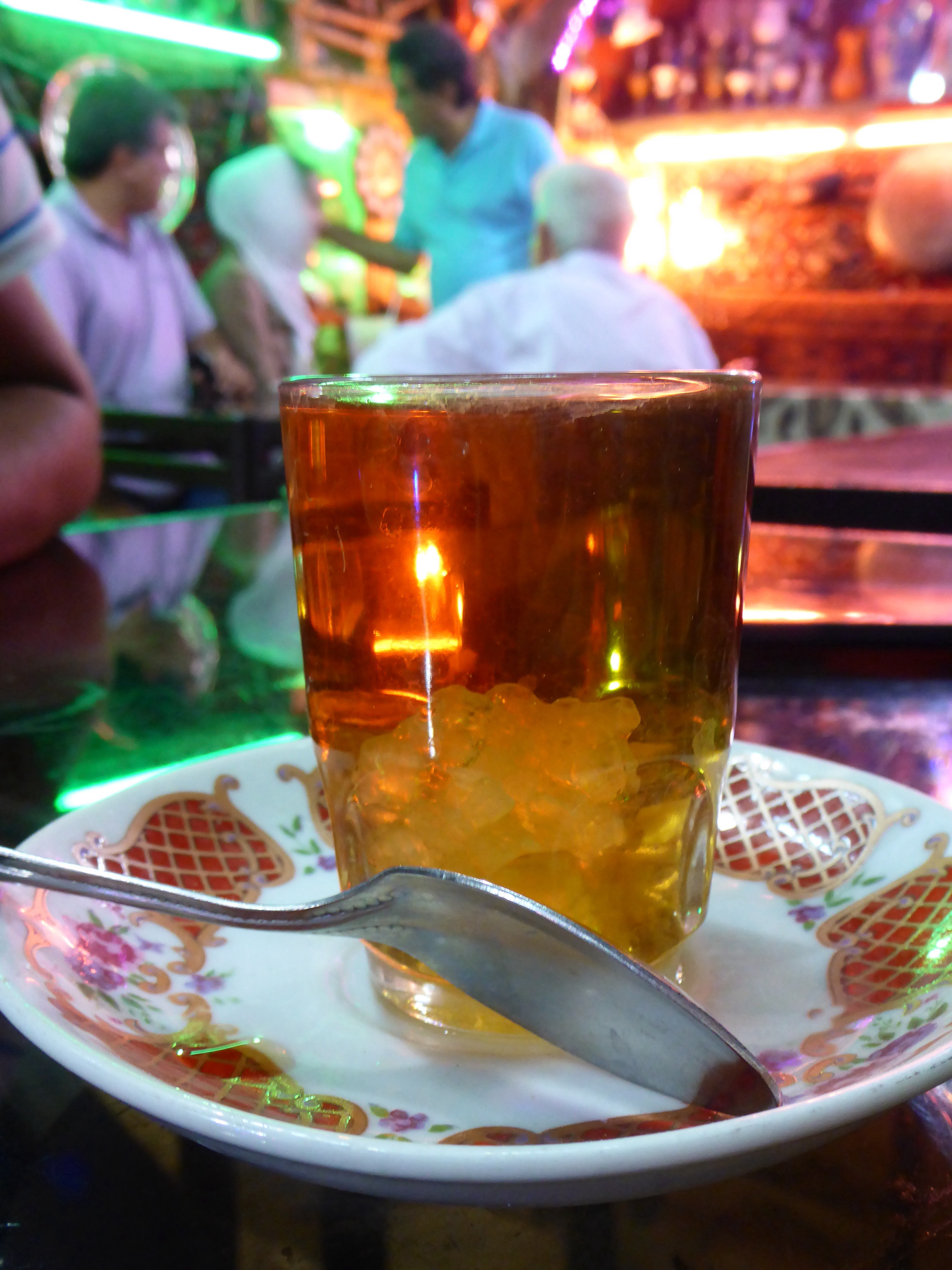
Iranian tea with just a bit of sugar
Over our two whole days in Isfahan, we meet several of Mohammad’s friends, several of Zoreh’s family members, we are invited to her parents’ house, an aunt’s home to see her most stunning home with mirrored walks and ceilings, like we’ve seen in palaces here. Once again, we are amazed at how people suddenly turn up, appear, join us for a while. Always so lovely, interested in us and life in Australia and interesting. I am quizzed once again on marriage and kids, why don’t we have kids, is it important what age you marry, is it important what age your husband is.
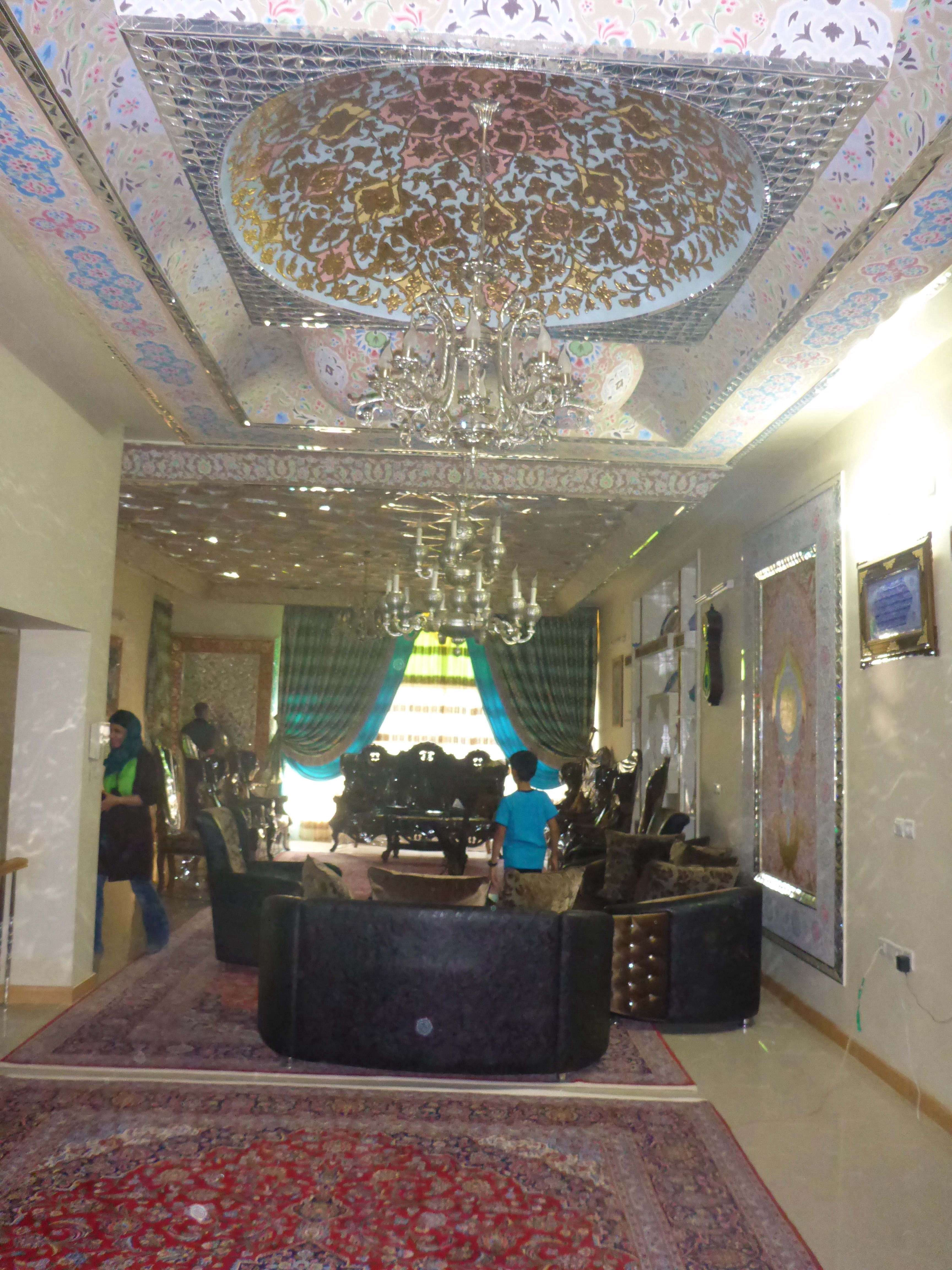
Zoreh’s aunt’s home with amazing mirrows and wall & ceiling decorations, Isfahan, Iran
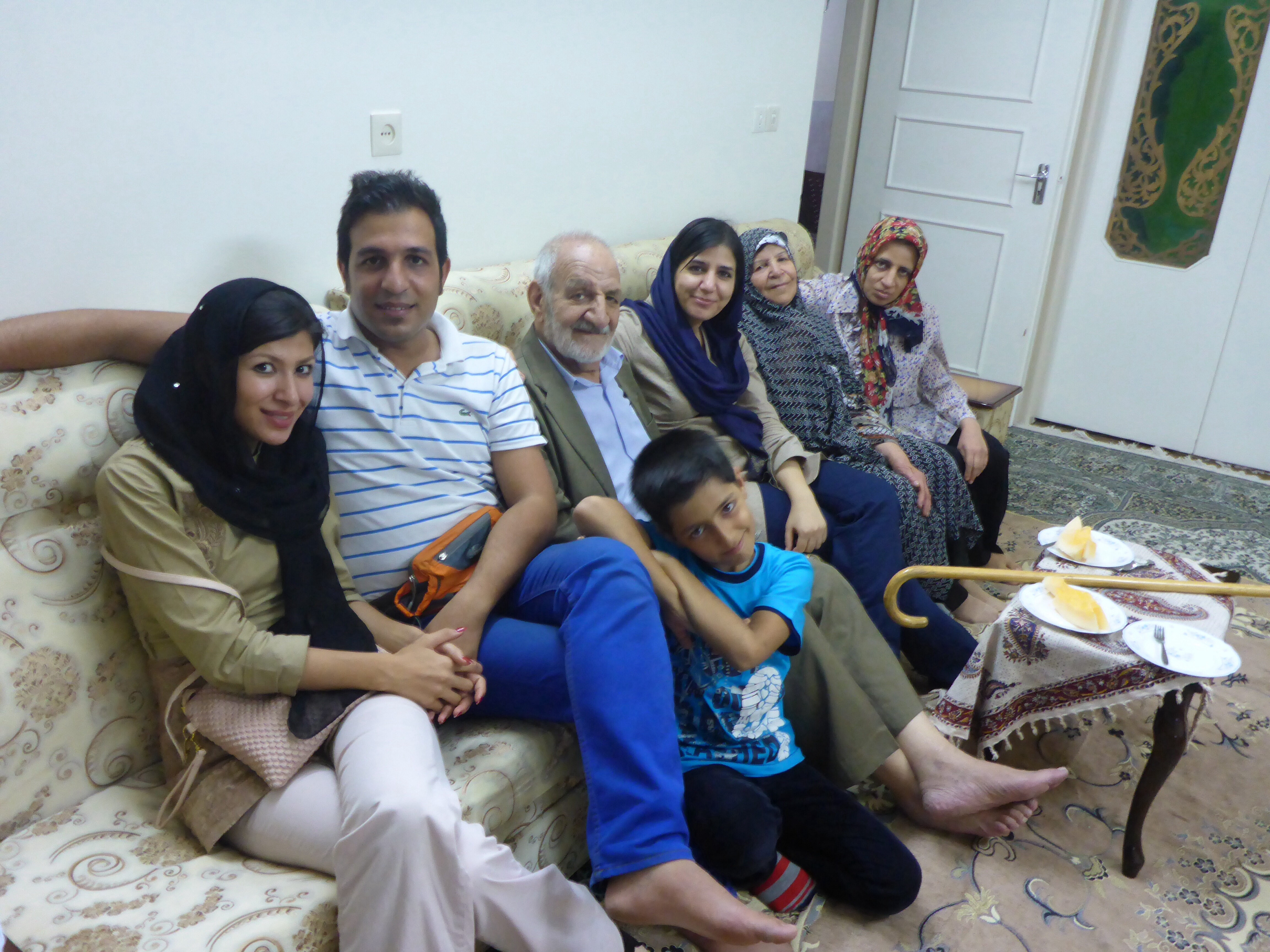
Zoreh with her parents
We are taken to restaurants, and some of the historical sights I was interested in such as: Chehel Sotun Palace, originally built as a pleasure pavilion (and was rebuilt in 1706 after a fire) is one of 300 palaces that were built when Isfahan was the capital of Iran. It’s name means 40 pillars and is derived from the 20 slender pillars that support a stunning wooden ceiling, and their reflection in the long pool in front of the palace. The palace’s great hall is adorned with magnificent historical frescoes. The palace gardens, covering an area of 67000sqm are stunning. I find that I am attracted to the vivid greens we’ve seen in gardens in Iran – probably because we’ve seen so much desert while riding.
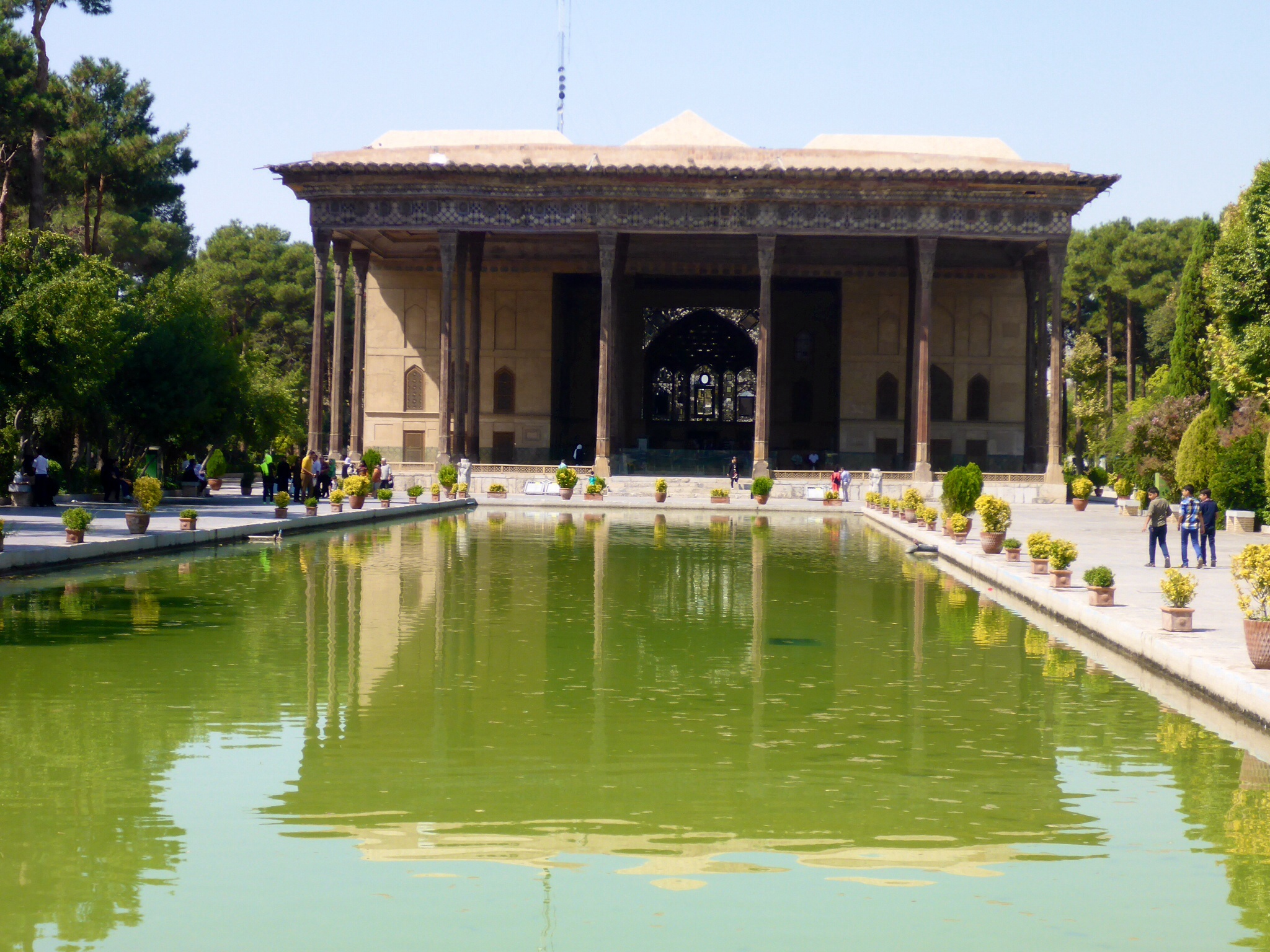
Chehel Sothun palace – Isfahan, Iran
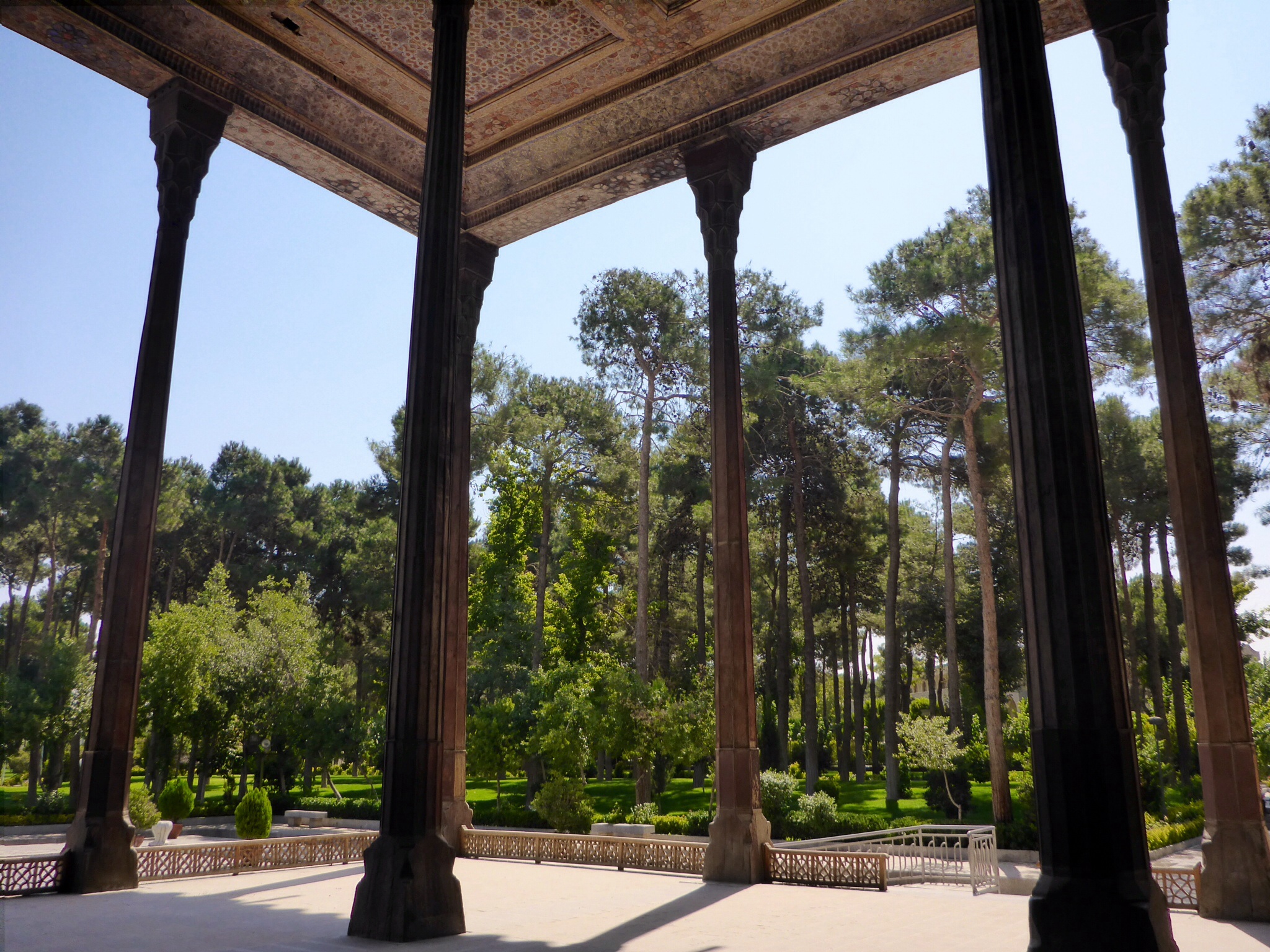
Some of the 20 slender column supporting the Chehel Sotun pavillion roof, Isfahan, Iran
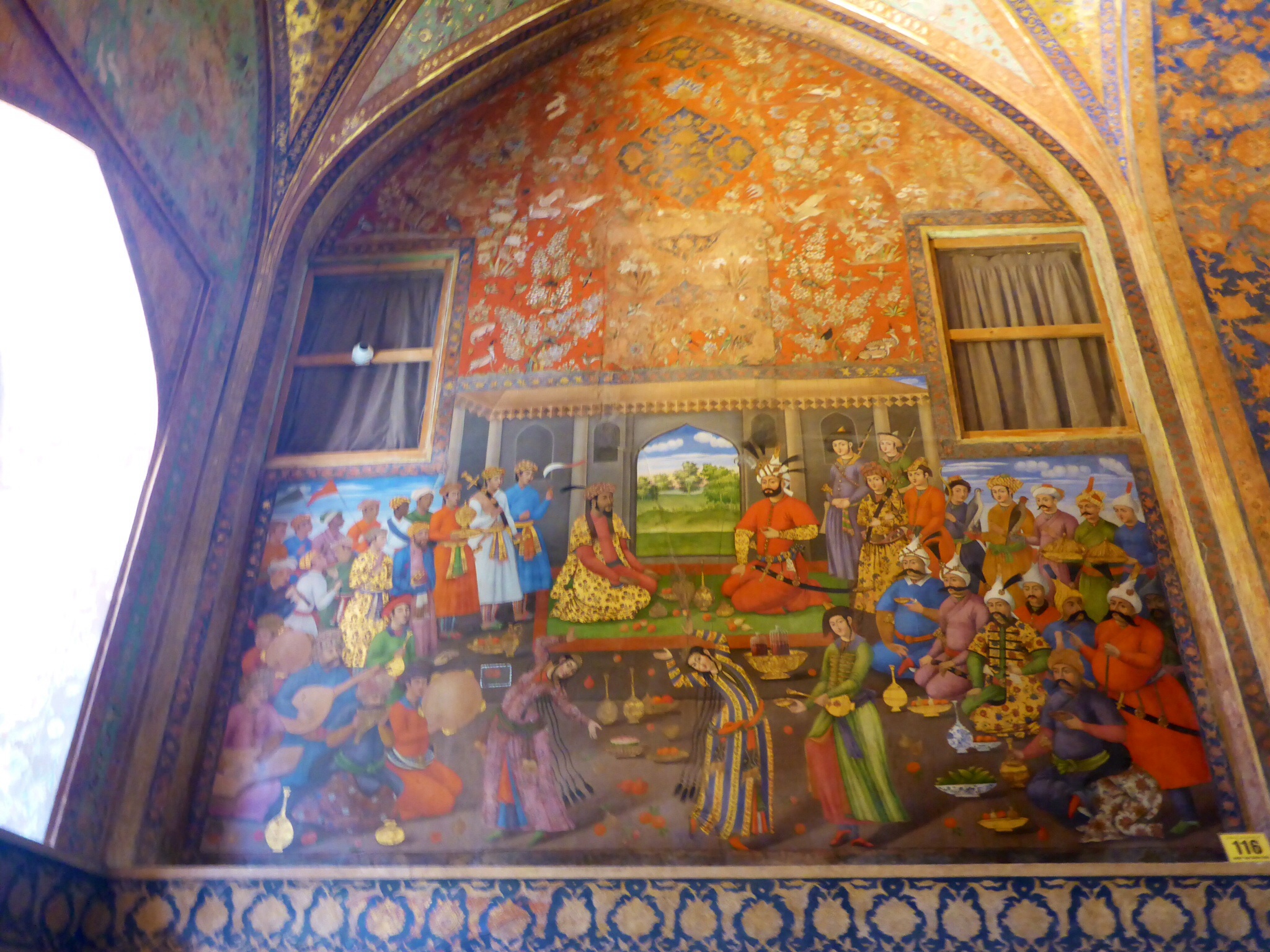
Fresco inside the Chehel Sotun pavillion, Isfahan, Iran
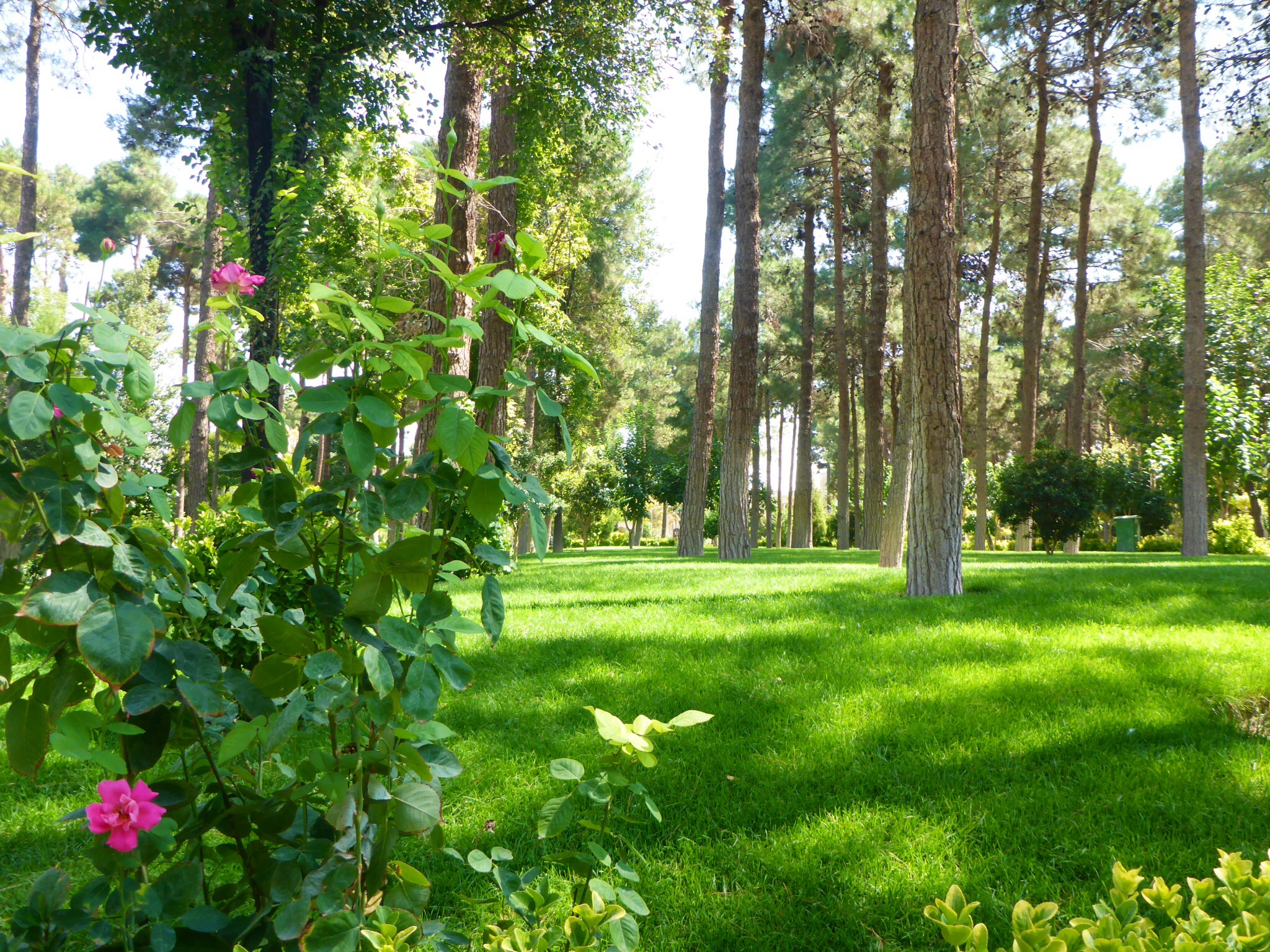
Park surrounding Chehel Sotun palace, Isfahan, Iran
I was interested in seeing the Armenian quarter called Jolfa. Back in 1604, Shah Abbas was so impressed in the Armenians’ skills as merchants, entrepreneurs and artists, he kidnapped the whole population of the original Jolfa near Tabriz, and sent them off to build him a new capital at Isfahan, ensuring them that their religious beliefs would be respected, although they would be kept at a certain distance away from the city’s islamic centre. It is a relatively small, compact quarter but has a very distinctive feel. It was interesting to visit Vank cathedral, which is richly decorated with old and new testament imagery, together with typically islamic tiles and designs below.
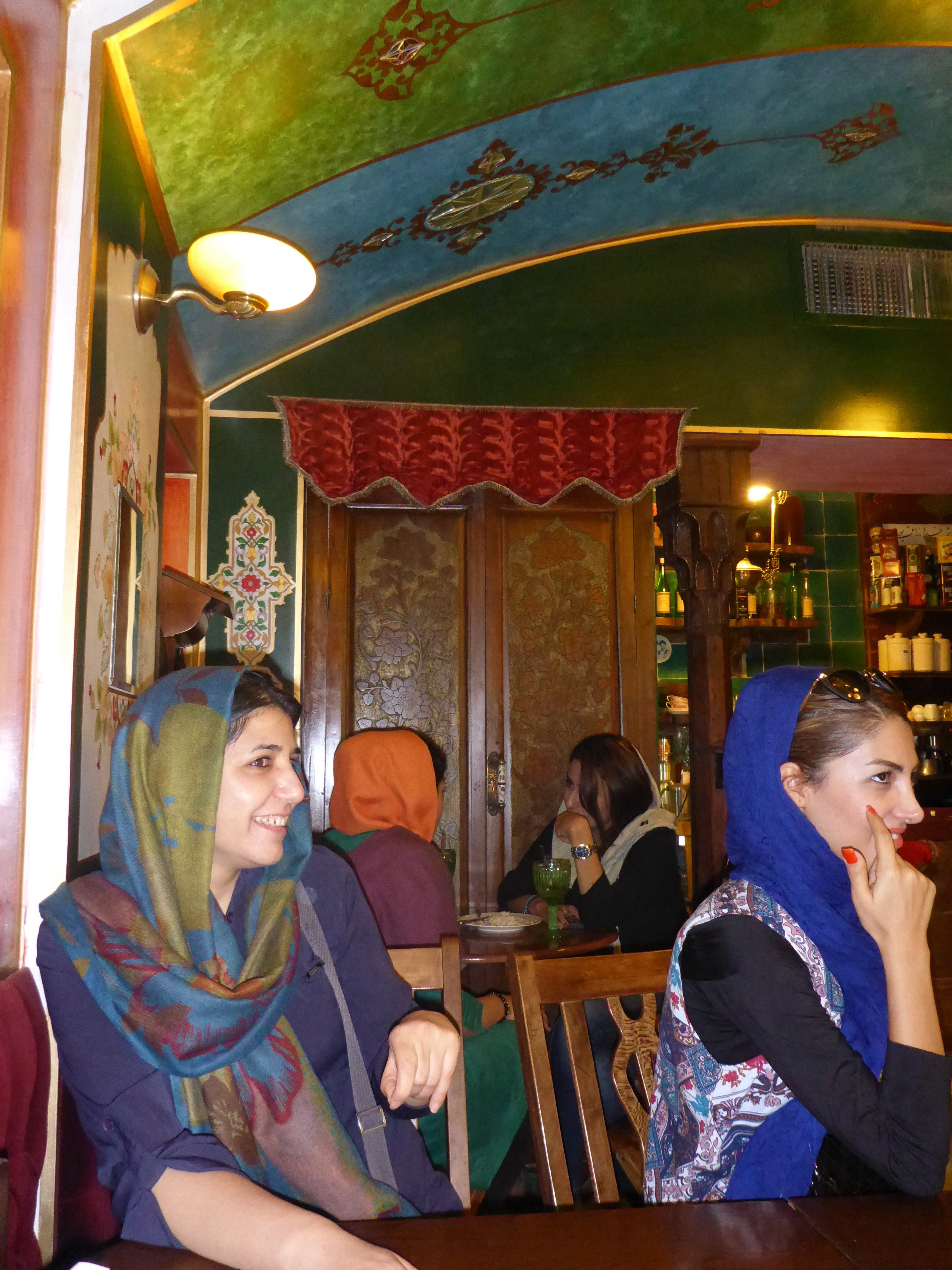
Typical Armenian teahouse in Jolfa district, Isfahan with Zoreh and friends
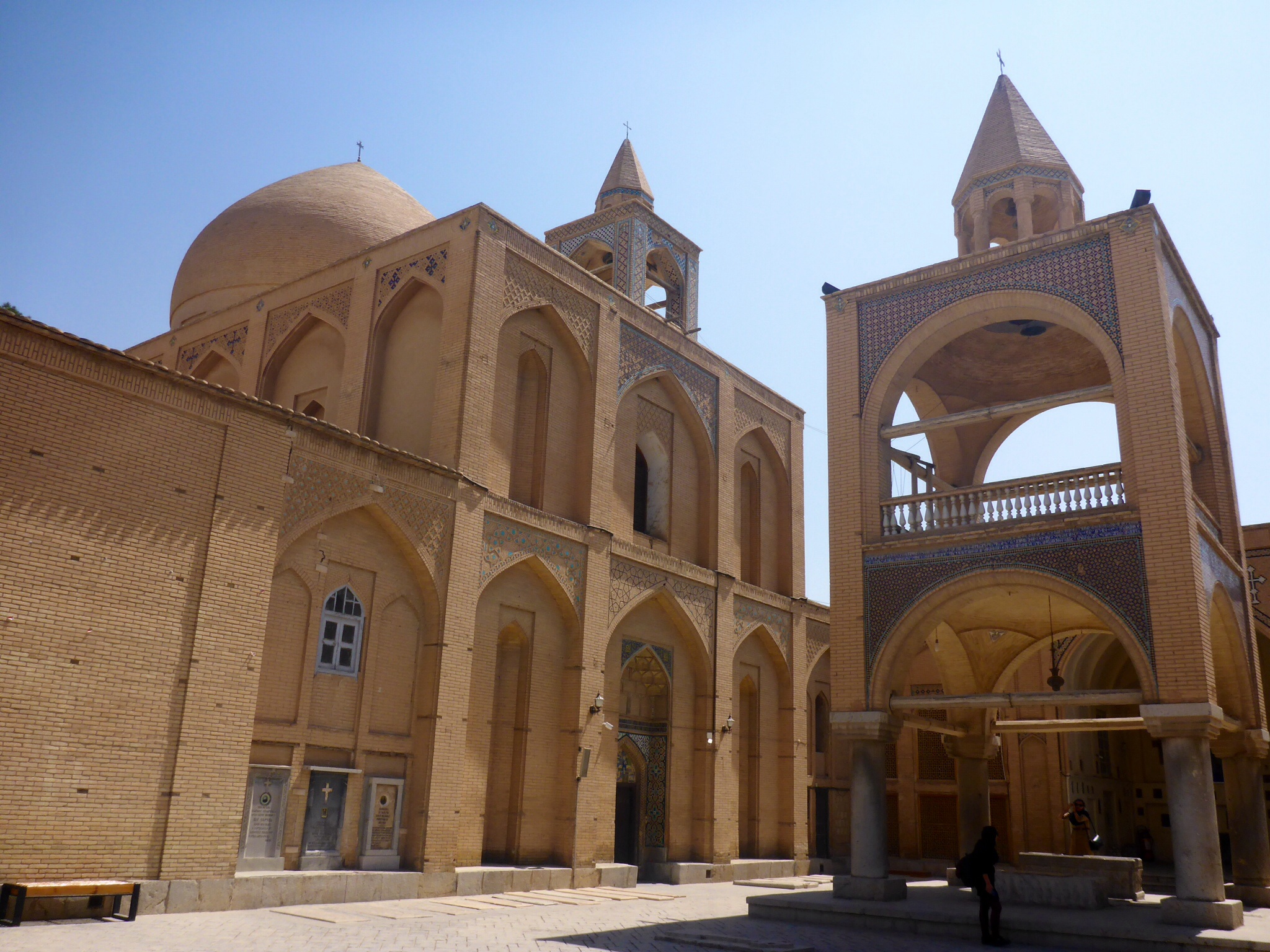
Vank cathedral in Jolfa district, Isfahan, Iran

Inside Vank cathedral, Isfahan, Iran
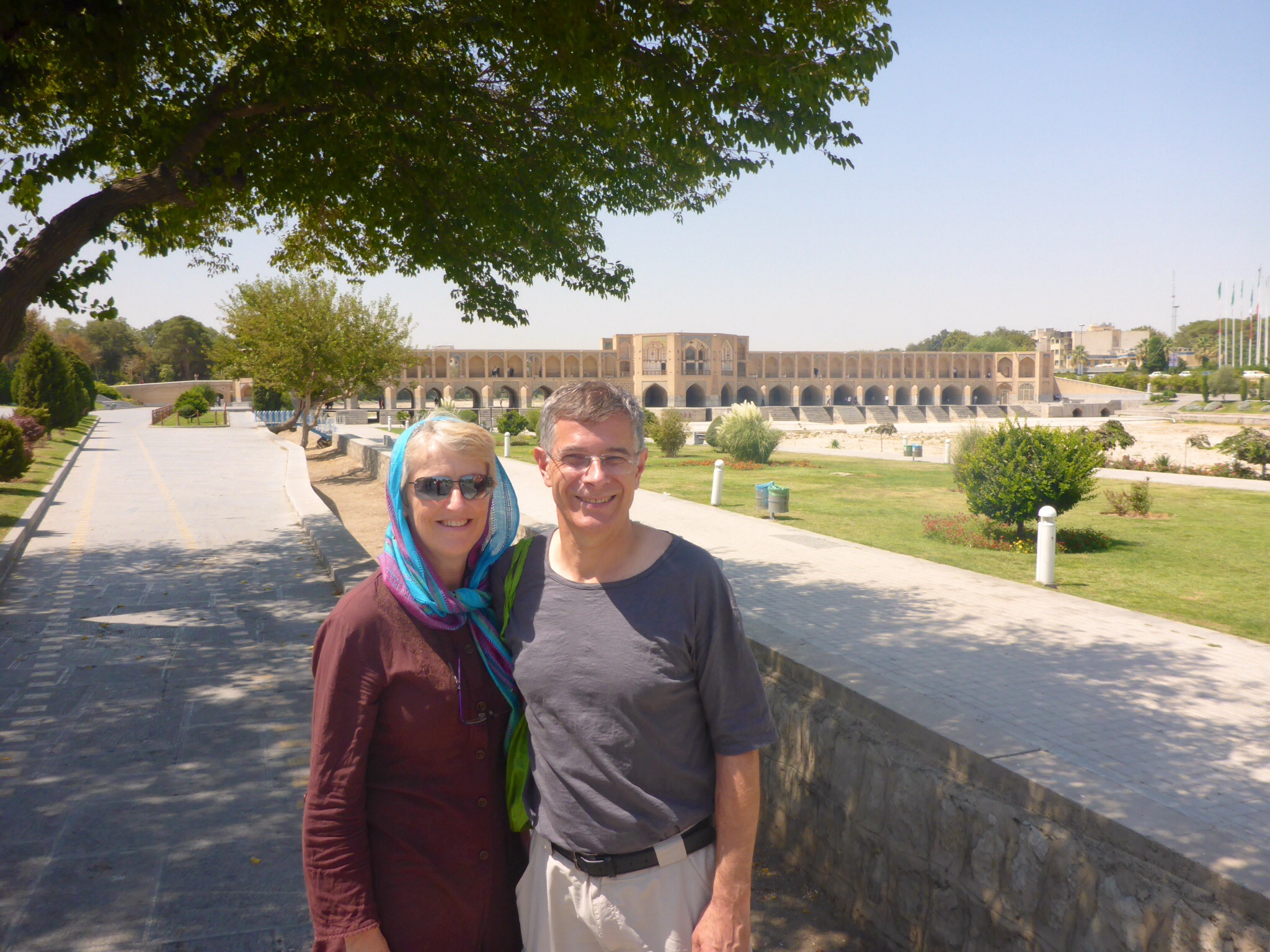
Khaju bridge, Isfahan, Iran
Finally, I was keen to visit the Sheikh Lotfollah mosque on the Naqsh-e Jahan squre, built between 1602 and 1619. It is unusual as it has no minaret or courtyard and but steps lead up to the entrance. That is because it was never designed for the public but for the women of the shah’s harem. They would enter their mosque via an underground passage under the square from the Shah’s palace.
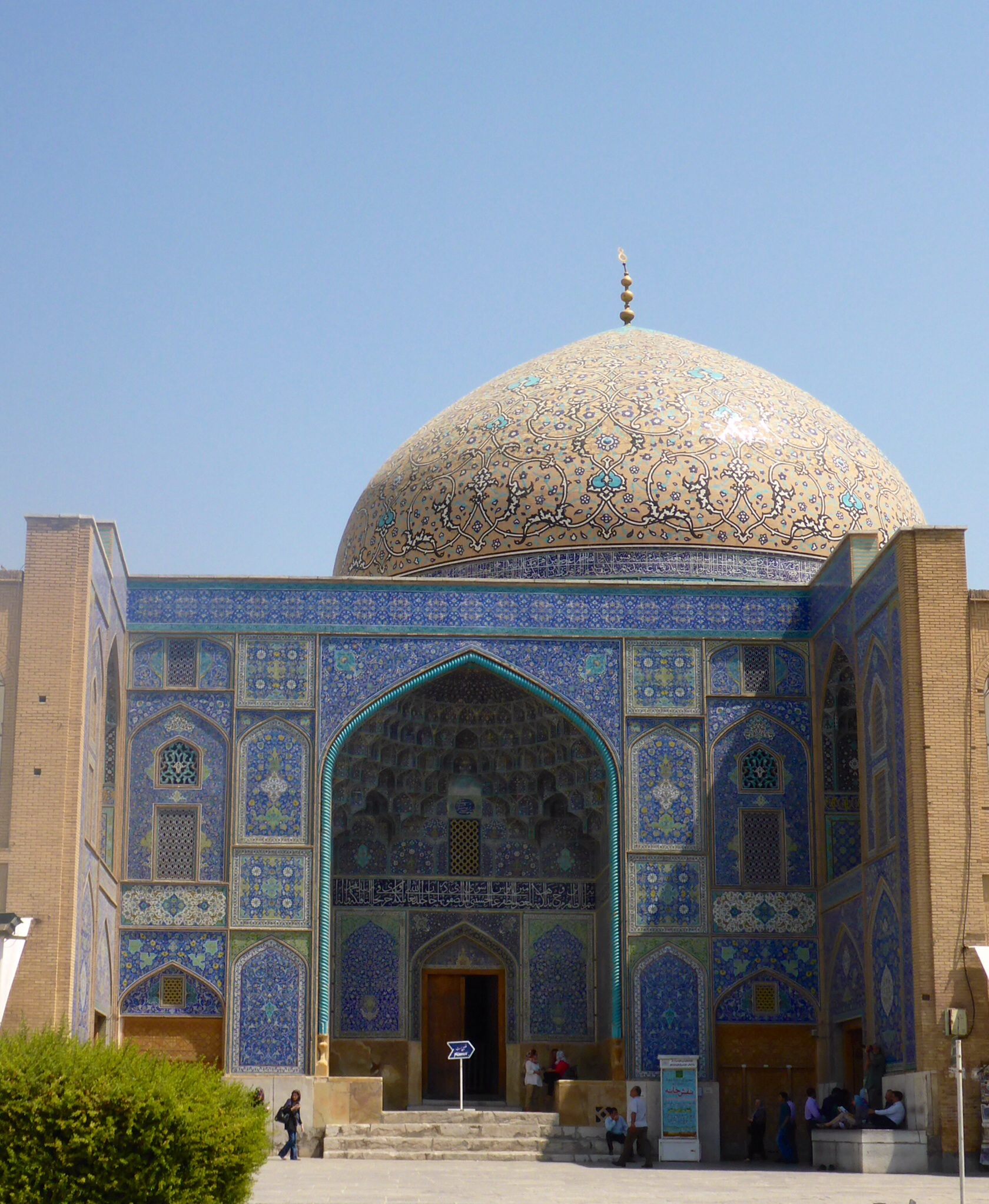
Sheikh Lotfollah mosque, with no minaret or courtyard, but entrance steps which were never used – Isfahan, Iran
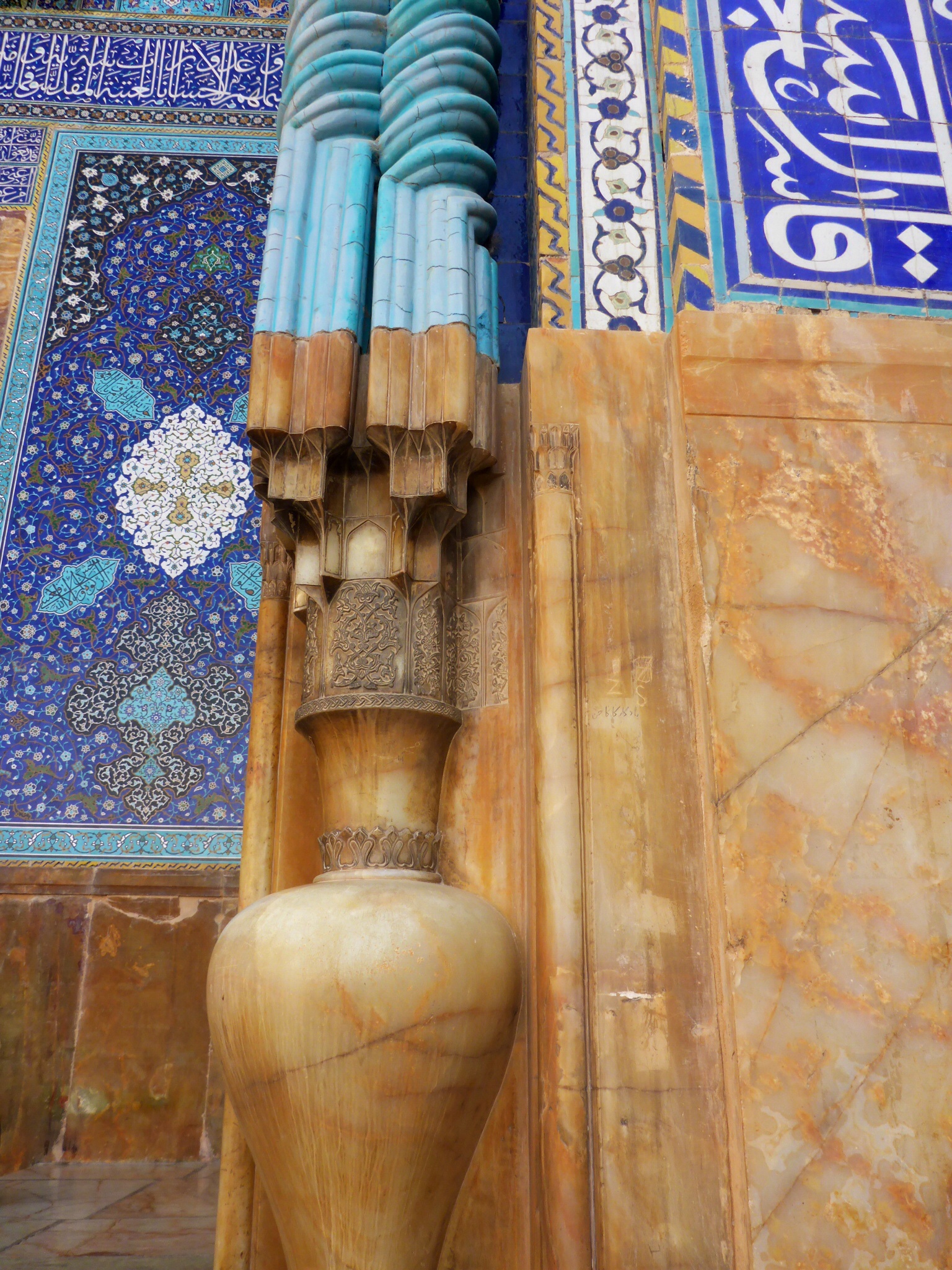
Alabaster surrounds the Shah or Imam (depending on your political views) mosque
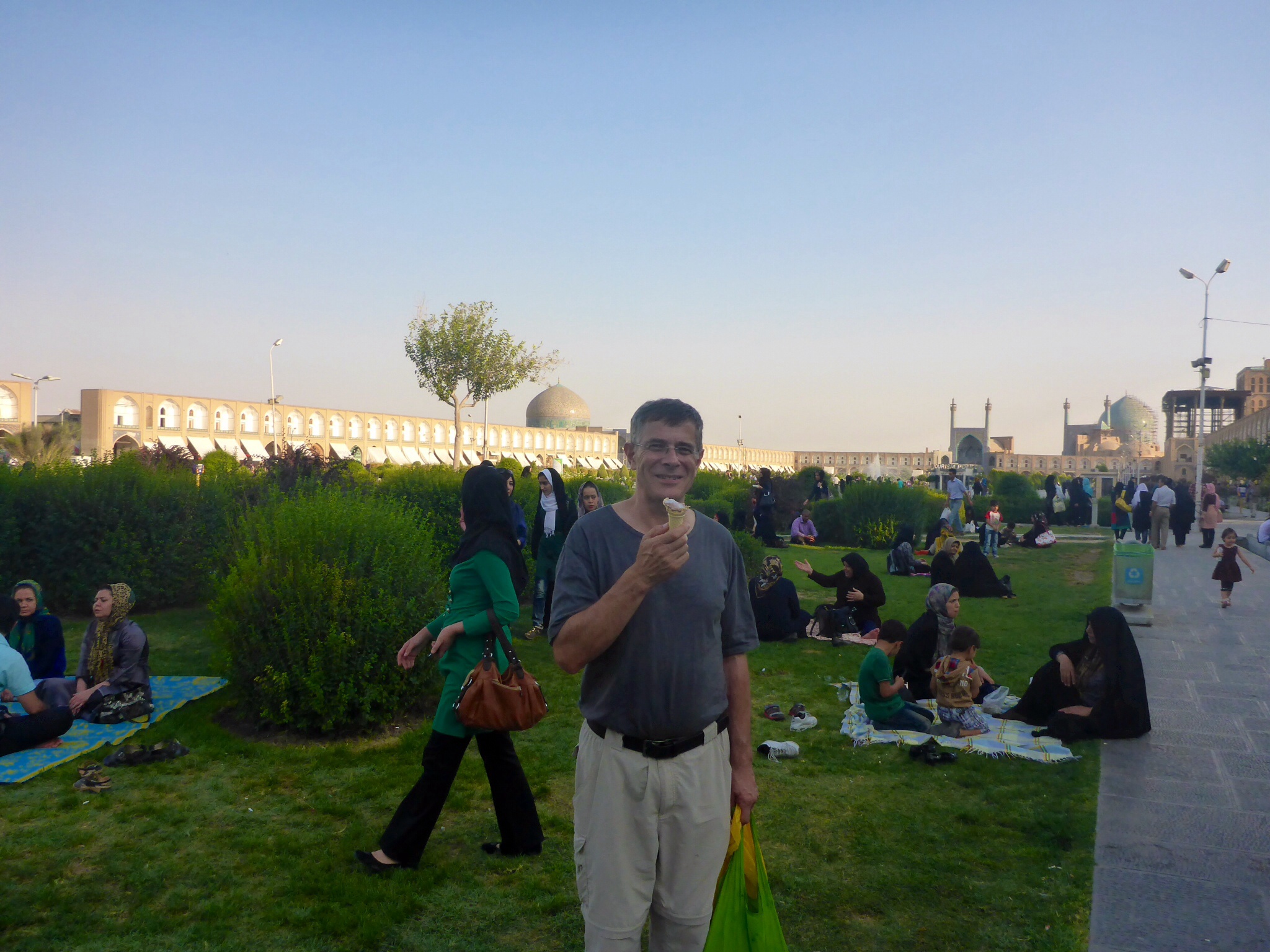
Naqsh-e Jahan Square (or Imam Square), with the Sheikh Lotfollah (harem) mosque on the left, the palace opposite, and the main mosque at the far end.
Zoreh’s sister prepared us a different breakfast every morning, delicious lunches, so many Iranian sweets, especially Yazd nougat which we both loved, and lots of home grown fruit. They were so lovely – we just wish we could have communicated with them better. And so incredibly generous. When we left, we gave them a large box of sweets (which we had heard was a traditional gift when you visit people for dinner). They were obviously offended, asking us why we gave them a gift. Anthony was quick thinking: so that you can remember us when you eat them. Insult avoided, just!
Zoreh was wonderful and so attentive. Despite her migraine, she joined us on our last day. She could not have done more for us. Her nephew and his family were so lovely too. Once again, we leave new friends behind. We know we’ll stay in touch…
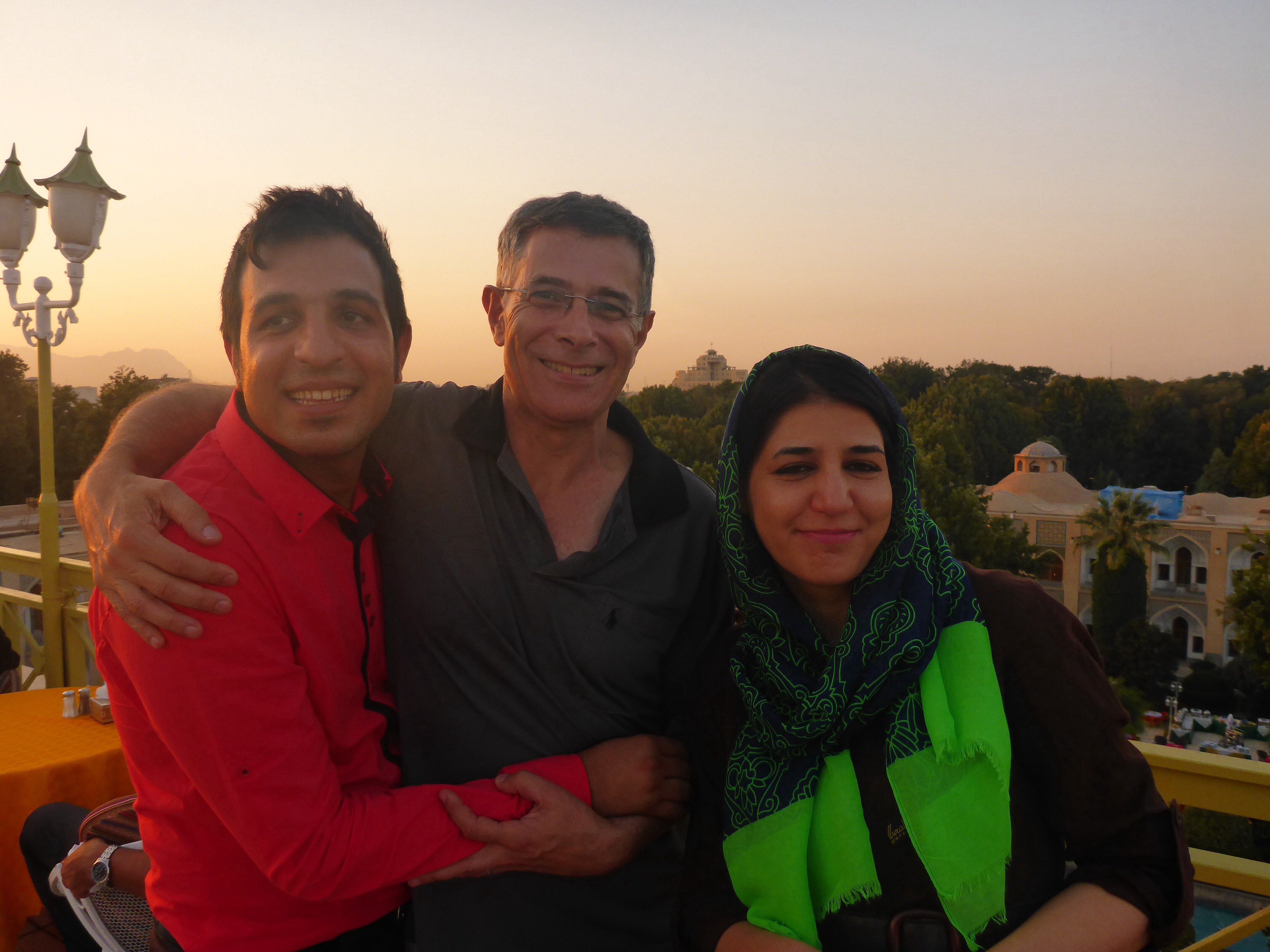
Mohammad, Anthony and Zoreh

With Zoreh, Isfahan, Iran

Zoreh’s sister and husband in the front, with their kids Sarah and Mohammad with his wife Shadi, who all showed us around Esfahan
After several photos and our final goodbyes, we set off for Yazd.
– Anne
Australia, Austria, where are you from ???????
From time to time, we consider and debate about the form of Government, Head of State and national flag that should represent Australia. While these are all worthwhile discussion points, we have missed the most important of all, our country’s name.
Anne and I have conducted extensive research in the last six weeks in Russia, Kazakhstan, Kyrgyzstan, Uzbekistan and Turkmenistan on these counties’ inhabitants’ understanding of where we are from. We have found that most people confuse us with Austria and Allemagne (Germany). However the use of “Kangaroo” accompanied by a hopping motion with the hand will have any local instantly aware of where we are from.
Changing our country’s name to ‘Kangaroo’ will provide much greater recognition for our country and therefore exposure to a large and hitherto untapped market. We will continue to research this phenomena on our RTW trip and provide a full report in July 2015.
Anthony
 2slowspeeds