A great day’s ride to Ronda
Our last day stationed conveniently in Algeciras before we start our journey north, we are off to Ronda. Although the quaint village of Ronda is now Andalucía’s fastest-growing town – it overtook Córdoba in the big three Andaluz tourist attractions, behind Sevilla and Granada – at least we have been promised one of the best motorcycling roads in Spain so we set off early on light bikes, having left all panniers behind. The road is good, the bends endless as we start the steep ascent to this historic town 2400ft/730m above sea level. We are glad we deliberately decided to go on Monday, suspecting this would be a popular biking road on week ends, like the Mount Glorious road outside Brisbane, where we live. It is such a perfect biking road, it attracts too many speeding bikers – so we avoid it at week ends. Interestingly, that evening, a local we chatted to referred it to a ‘racing track’ – our feeling exactly. No wonder we saw these signs all the way up to Ronda:
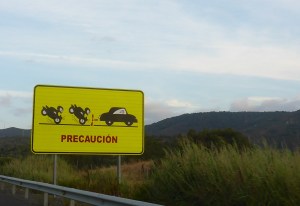
Found on all the twisty roads in Andalucia

Fantastic scenery along the A397 up to Ronda, Spain
Old Moorish Ronda sits atop a Jurassic limestone cliff, on the edge of a gorge carved by the Guadalevín river, the altitude providing great natural defenses. It saw turbulent times. The Arabs conquered Izna-Rand-Onda, today known as Ronda, (and most of Iberia) in the year 713 and the city eventually became a mini Moorish kingdom. The Moors divided southern Andalucía into five distinct districts. The Moors were continually fighting among themselves, and the volatile ethnic mix in the mountains resulted in much rebellion and conflict. The Christians eventually won it back in 1485. By then, frequent crossings of the city required a new bridge to be built.

Puente Nuevo, Ronda
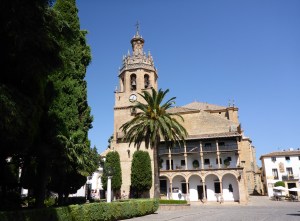
Plaza de la Duquesa de Parcent, Ronda, Spain

Ronda, Spain

Ronda, Spain
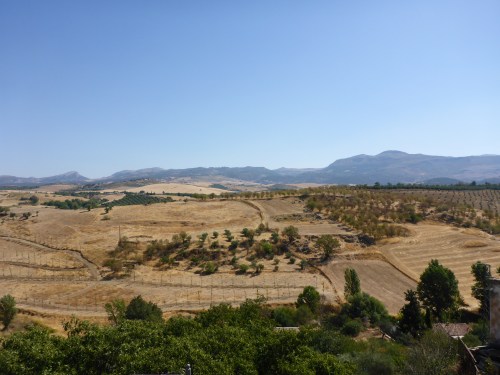
Around Ronda, Spain
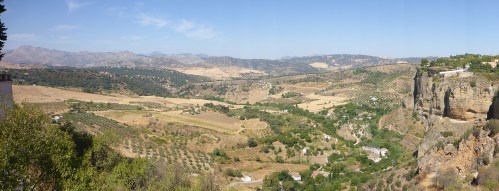
Around Ronda, Spain
Ronda is also famous as the birthplace of modern bullfighting, when in 1726 bullfighter Pedro Romero broke away from the prevailing Jerez school of horseback bullfighting and founded a new style in which matadores stood their ground against the bull on foot using a muleta We have come across many posters plastered in the streets of various cities advertising bull fighting. Not for us, even if it is a local cultural tradition.
We are usually quite ‘slack’ tourists, in that we do not make sure we visit every famous site in a place. I am the one who typically does the research before visiting a place and deciding where we’ll go, making a rough note of what I want to see or what would be of interest to Anthony. I often leave Anthony on a bench somewhere while I go off alone, and we usually just meander through a town or region seeing what we might stumble across and simply enjoy in the atmosphere of the place, people watching and often chatting with locals. And we always read up more on the region later! The history of Andalucia is certainly complex and fascinating.
I didn’t know that chapter 10 of Hemingway’s “For Whom The Bells Toll” novel drew on events that occurred in Ronda in 1936 during Spain’s civil war when a mob threw 500 people, allegedly fascist sympathisers, into the surrounding gorge from the bottom span that holds the main arch of the New Bridge.
Ronda is definitely a beautifully scenic town. And while the road up was scenic too, our return ride back to the coast on back roads, the A369, was simply divine. So many tiny white villages hugging mountain tops and cliffs such as Atajate, Benadalid, Algatocin and Gaucin. We make numerous stops. This is our kind of riding – stunning scenery, windy roads, no traffic and all that with the greatest riding and life partner – we are so lucky we enjoy and appreciate the same things in life.
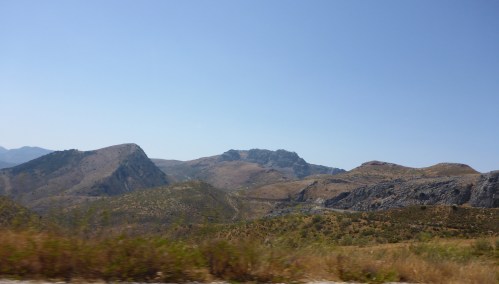
Stunning Andalucia, from the A369

Loving the road along the A369

Algatocin, Spain

Gaucin, Spain
We get so used to living wherever we are, we sometimes forget to mention the small things. It occurred to me today that we haven’t mentioned all the olive groves we have seen traveling through Spain and especially in Andalucia. We have walked through them, admiring their gnarled trunks and fruit laden branches. And we have been surprised at the steep terrain on which olive trees have been planted as shown on some of our landscape photos – way too steep for any automated or machine harvesting. We eventually saw people harvesting, up small ladders leaning against the tree. Olive harvesting is obviously an important source of income across Spain from seeing the number of old and new groves especially in Andalucia, it made me want to know about the industry. Spain has been cultivating olives since Roman times and is now the world leader, producing 44% of the world’s olive oil, twice as much as Italy and 4 times as much as Greece. It turns out that the Andalucia Regional government tracks every commercial tree with its own GPS coordinate and is monitored by regional officials for EU subsidies. These olive trees apparently produce better fruit and oil in poor rocky soil and craggy limestone cliffs than they do in rich, fertile earth.
And how could I not have mentioned food before?! The food in Spain has been fantastic. Always so fresh and tasty. The seafood and olive oil in particular. One tiny mussel and you taste the ocean. And the ham – I have been feasting on it for breakfast. We were lucky to find a very small local tapas bar in Algeciras which we went back to 3 times!! The first time, all 4 chosen dishes were new to us. The 2nd time, we chose our 2 preferred tapas from last time and 2 new ones, the 3rd time we did the same again. I am definitely getting a taste for those tapas. Loved the Pedro Xemenez reduction over the slices of tender beef – it tasted like a blend of thick sweet balsamic vinegar and port. And the Spanish olive oil is like nothing I have ever tasted! We’ve had some drizzled on a simple slice of toast, on roasted vegetables, on chips/crisps even!! This olive oil tastes of sunshine. I wish I could bottle-record it for us all to taste anytime! It was interesting to see what every table had in a small petrol station/cafe we stopped at recently.

On all the tables in roadside cafes in Andalucia
Seville and Cordoba next!
– Anne
Streak and Storm visit Gibraltar
An unexpected journey
Yes, I know, I may be accused of plagiarising part of a movie title, but there is an element of truth in this statement. If you recall the end of the Anne’s last blog, she mentioned we changed our travel route. When we made the original plans for southern Spain, I was sick and Anne had to make decisions on where to go, but sensibly made refundable hotel bookings. While in Granada, and after Toledo, we were looking for something a little different to yet another famous historic Spanish town teeming with tourists, so I suggested since we were so close, Gibraltar. This location would also allow us ride the A397 from San Pedro de Alcántara which we had been told was a great motorcycling road by a friend.
While accommodation in Gibraltar was prohibitively expensive by our standards, we found that Algeciras across the bay was very reasonably priced compared with all the holiday destinations along the coast from Malaga to Estepona. This is probably due to the unseasonably hot weather in early September which seemed to have attracted more tourists to the region.
So why Gibraltar some may ask? It just seemed an interesting location that we were close to, had never visited and seemed a little different to the historic places we had visited, or planed to visit in the region. Our first glimpse of Gibraltar came as we breasted a rise on the A-7 heading for Algeciras, towering over the surrounding low hills, an imposing sight.
While we are using Algeciras as a base for four nights, Anne felt we should travel on Saturday 10th to Gibraltar. No particular reason, it just seemed right. Over the years we have always followed our intuition even when we don’t know why. While Gibraltar is only 20 minutes by road we had heard of potentially long delays at the border, so we approached with no expectations of how long this crossing process would take. The approach, with the ‘Rock’ stands tall in the distance growing larger as we approached.

Approach to Gibraltar.
The border crossing was easy, see Borders and Crossings for details, the next step was to cross the runway! With the shortage of land in Gibraltar the only place to build a runway was across the access route to Gibraltar so both road and air transport share the same ground.

Ready for takeoff, Runway 09/27
The ‘Rock’ now towers almost vertically it seems from the motorbikes some 426 m (1,398 ft) above us as we head to the eastern side. One can understand the trepidation the various forces that besieged Gibraltar over time would see in their approach from sea level. For those interested in Gibraltar’s history I suggest looking at ‘History of Gibraltar’ on http://www.wikipedia.org.
The east side is sparsely populated and the only road winds between sea and soaring mountain, traffic is light and we glimpse the remains of fortifications and tunnel entrances that honeycomb the rock. We travel southwards and come across the Dudley Ward Way tunnel, which connects the east and south of Gibraltar. The tunnel was built by the Royal Engineers who built many of the 55km of tunnels that exist inside the ‘Rock’ that in WW2 were capable of supporting 16,000 troops. The Royal Engineers had been in Gibraltar for hundreds of years and a statue to them can be found off Main Street.
We emerge near Europa point to see the Ibrahim-al-Ibrahim Mosque. The only one in Gibraltar, built for the 1,000 muslims living here. They are part of such a diverse ethic history which includes Andalusian Spanish, Genoese, Maltese, Portuguese and British.
Europa point seems so close to Africa which is clearly visible, such a small gap for the Mediterranean Sea to be connected to rest of the world and why Gibraltar was such an important Naval base in its time. We see a memorial to WW2 Polish Prime minister Władysław Sikorski who died in air crash in Gibraltar on 4 July 1943. This was our second link to the Polish war effort in WW2 after our stay in Saint Jean de Luz with the evacuation of Polish soldiers after the fall of France in 1940. It has been interesting to read up on Polish involvement in WW2 after the fall of Poland in 1939. Sometimes we spend more time reading and researching on what we have seen after each visit than before!

Lighthouse at Europa Point with Africa in the background.
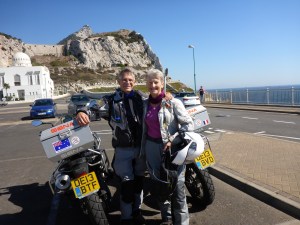
Two slow speeds at Europa point.
As we approach the centre of town, we start to notice people dressed in red and white, Gibraltar flags appear at windows in the apartment blocks we pass. Today, 10 September, is Gibraltar’s National Day commemorating Gibraltar’s first sovereignty referendum of 1967. We learn that in the past the day has had a more political focus, but nowadays there is more of a party atmosphere. Now we know the reason of Anne’s intuition for coming today.

Support your National day, wear red and white.
Spain still wants the return of Gibraltar to Spanish sovereignty after over 300 years. It is ironic that the original British/Dutch invasion in 1704 was on behalf of the Austrian claimant to the Spanish throne in the war of the Spanish Succession. It will be interesting to see where Brexit leaves Gibraltar, especially with the comments by Spain’s acting Foreign Minister Jose Manuel Garcia-Margallo recently on joint sovereignty.
We wander the streets in the older part of town where people and even their pets are dressed in Gibraltar’s colours of red and white. The main street meanders through the town, we notice an interesting mixture of UK names such as Marks and Spencer and other stores whose names reflect the diverse origin of the inhabitants.

British, Gibraltar and Chelsea FC flags.
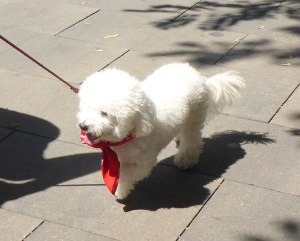
A patriotic Gibraltar inhabitant.
While being whisked up to the top of the ‘Rock’ by cablecar, one gets a new perspective that is not possible from sea level. There has been a large amount of development westwards with new apartment blocks, but no skyscrapers. A breathtaking series of views and a large number of Barbary macaques, monkeys to the uninformed, await us. We have been warned they like food and spectacles. So I walk around without mine as a precaution. I will have to look at the photos for a clear picture of what I saw!

Why we go to the top of the mountain.

Monkey business at the top of the rock.

We are on top of the world!
Our departure is delayed by waiting at traffic lights for a large jet to take off. Probably the only place where this occurs. We are glad we decided to come here to see and learn a little about Gibraltar.

Waiting at the traffic lights for a plane to takeoff!
– Anthony
 2slowspeeds