Drifting back to the coast.

Going back in time, completing our camper van trip on to Rockhampton…

We have travelled almost 1,600 km. / 1,000 ml. to get to Longreach, which will be the furthest west we will travel on this trip. There are almost another two folds of the map to the western Queensland border still to be explored.  Winton amongst many other places will be for another time perhaps.

As we head eastwards, I reflect that each town we go through has made an effort to shine and attract our interest, focusing on one or more attractions.  In Ilfracombe, just east of Longreach for example, it is industrial machinery, historic guns and bottles. Someone commented that it was unguarded but nothing gets stolen.

Anne with an old tractor in Ilfracombe.

Barcaldine is known for its Tree of Knowledge. This famous tree was the meeting place of the strikers during the 1891 Australian shearers strike and Barcaldine was significant in the birth of the Australian Labour Party.  The tree stood for over 120 years since those events until deliberately poisoned in 2006.  The subsequent sculpture that replaced the tree pays homage to the tree in a beautiful way.

One of Barcaldine’s many pubs
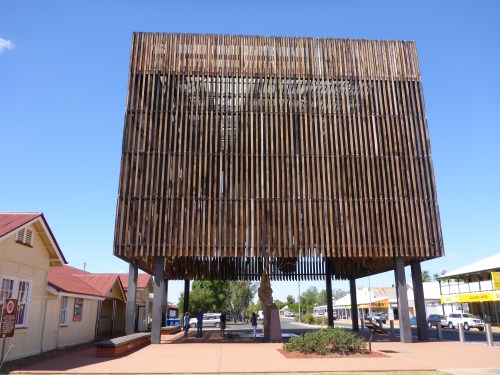
The “Tree of Knowledge” monument at Barcaldine.
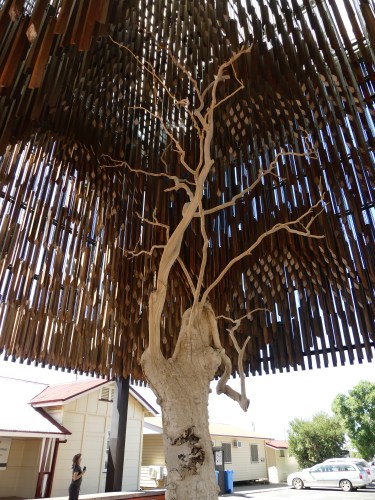
The Tree of Knowledge, Barcaldine Qld.

Monument to shearers strike of 1891 by Milynda Rogers

East of Barcaldine on the Capricorn highway we see little evidence of dead animals at the side of road leading us to believe that night driving by trucks on the main commercial routes, such as the Warrego Highway we came eastwards on, may be the cause. It gives us more confidence that we could ride our motorcycles out west if we limit our riding hours to avoid dawn and dusk.

For those of you who thought the names Emerald, Sapphire and Rubyvale were the gateway to untold fortunes, think again.  Only Sapphire is named after the semi precious stones found there.  The other two are probably wishful thinking on the part of the towns founding fathers, to attract settlers to their towns. Sapphire itself has a dilapidated air about it, probably because the miners focus on more important things and that a number of the businesses are up for sale. “Pat’s” can be had for 450,000 dollars including stock. We are not tempted to spend even AU $15 on a bucket of stone and sand in the hope of sifting a fortune.  However the date scones are another matter, and I think are a better deal. We meet Raylene and Jim, who we estimate are in their 70’s, who are travelling in a personally converted Land-rover Discovery 3. The interior is spartan but works.  They are also restoring a 12 bedroomed house they have lived in for years. That did not make sense until they mentioned they had 12 children!  Yet another lovely couple and another method of travel to digest.

At our next stop is Lake Theresa outside the town of Clermont, which is both the local water supply and boating spot for the locals. Here we meet George and Buff who are heading north to take part in the Southern Cross Annual 5 Day Poker Run for charity. They camp next to us with their motorbikes and trailers that have pop up tents with queen size mattresses inside.  Very impressive. Yet another mode of transport for us to consider. 

We are now entering coal country, this part of central Queensland has 24 mines whose coal output feeds into Queensland Rail’s Goonyella system that hauls the coal to the coast for export. As we travel along the Peak Downs highway the only evidence we see of this is the road signs pointing to the coal mines, the massive trains that haul up to 10,000 tonnes of coal at a time and innumerable power lines that provide the electricity to make this all work. 

We detour to Moranbah, a town which was built to house coal workers back in 1969.  Today it has a population of over 8,000 and a good range of amenities designed to attract workers and their families to live in the region rather than be FIFO workers.
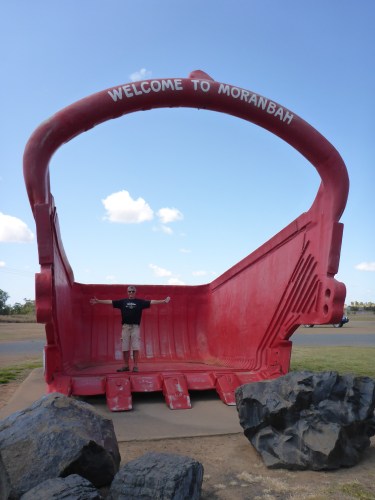
Now this is a coal bucket.
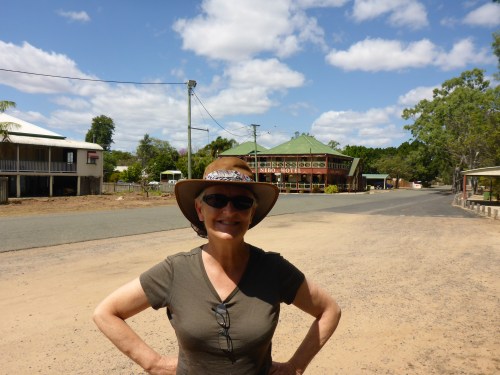
Anne in Nebo.

As we descend towards coast through the Clarke Range, which is part of the Great Dividing Range fields of green sugar greet us. We have left the brown landscape behind, we are back to the more familiar green and are closer to the sea.  While I enjoyed the inland, I think the coastal areas are where I prefer to be. Central Queensland has an interesting mix of industries, coal, cattle and cane.  All the “C”s.

Throughout the sugar growing region around Mackay, narrow gauge rail delivers sugar cane to the various mills,  While we crossed a number of tracks and did not see any trains, the white plumes from each of the stacks of the mills we passed showed that harvesting was in full swing.
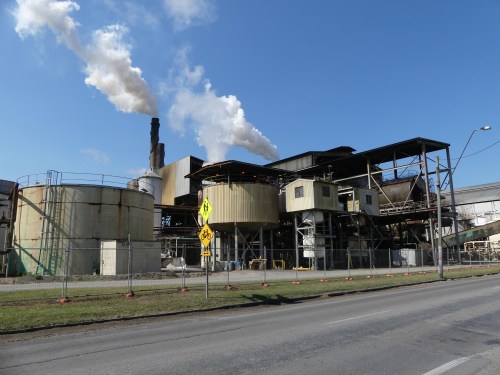
Mackay Sugar, Marion Mill.

I was surprised to find out that around region, Mackay Sugar have over 850 kilometres or 530 miles of narrow garage tracks that are used to bring the harvested sugar cane to the mills.  It is a very extensive network and keeps trucks off the road. This network extends more that 70km north of Mackay.

Main QR Line and Cane tracks crossing.
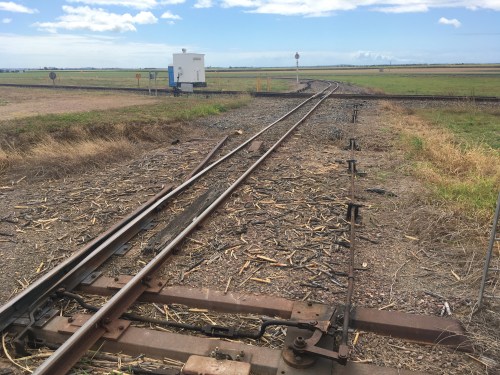
Derailing points on cane track crossing main QR line.

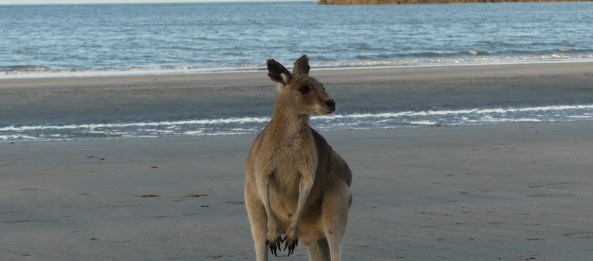
Our next stop, Cape Hillsborough National Park, sits across two rocky outcrops with a golden sandy beach connecting them. This park is famed for is beach kangaroos that feature in the latest Queensland tourist ads.The Coastal Eastern Grey Kangaroos – Macropus giganteus aquaticus  Anthony.  Stop this nonsense next you will be talking about drop bears!  These are just normal Kangaroos that live near the beach – Anne.
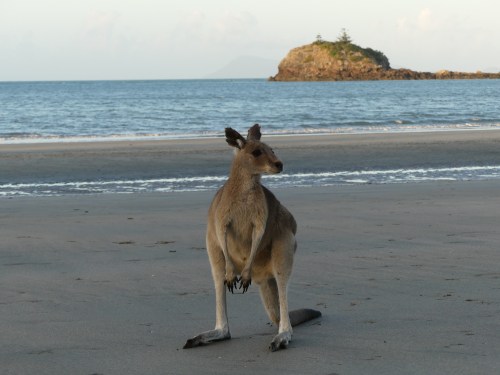
Eastern Grey Kangaroo at dusk on Cape Hillsborough National Park.
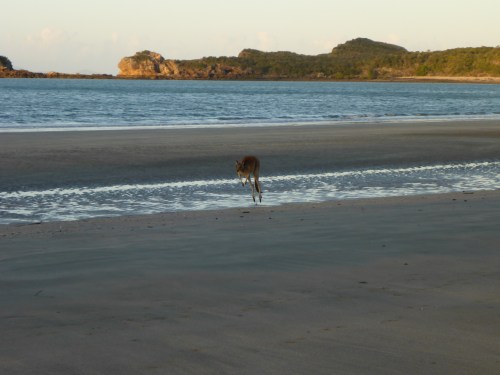
Kangaroo on the beach at Cape Hillsborough National Park.

PS: Drop Bears are a sub species of Koalas known for rather aggressive behaviour and the habit of dropping from the trees on foreign female backpackers who need protection from strong healthy young Aussie males in beer commercials – Anthony.  This it the sort of rubbish that gives Australians a bad name like hoarding toilet rolls. This is nothing but fake news – Anne

OK OK – Anthony

While the beach and adjoining headlands with their walking trails, one overlooking the ocean is where you can see turtles swimming, are beautiful, the caravan park is compact and too close together for us.  We have realised that while the camper van gives one all the comforts of home, in a hired vehicle one is restricted to tarred roads and an extension cord for the fridge.  We are much more comfortable in the open spaces that other forms of transport allow.
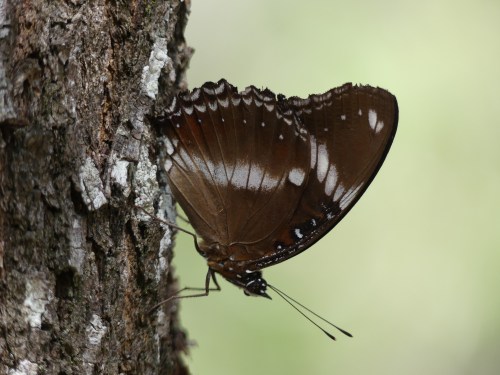
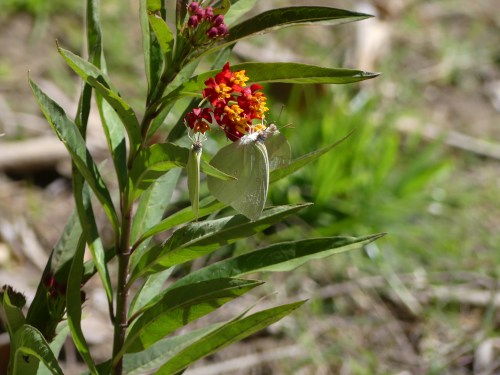
Butterfly at Cape Hillsborough.
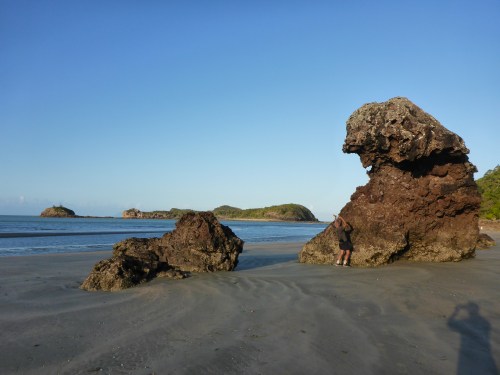
Wave like rocks at Cape Hillsborough.

Walking in Cape Hillsborough National Park.
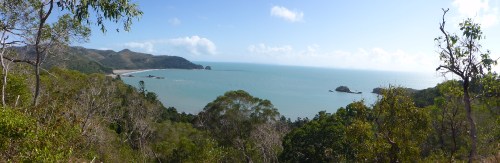
Looking North over Cape Hillsborough National Park.
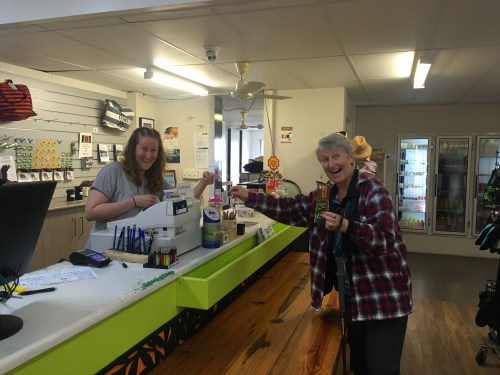
Anne can finally buy an ice cream to eat (she found a dairy free variety).

After Mackay we head to the coast to see where all the coal mined in central Queensland goes. Hay Point and Dalrymple Bay Coal Terminals.  These two terminals exported over 110 million tons of mostly metallurgical coal used in iron and steel making in 2019-20.  This is about three hundred thousand tons a day which is 30 fully loaded coal trains. Impressive statistics. Our photo does not justice to what is there, take a look on Google Earth.
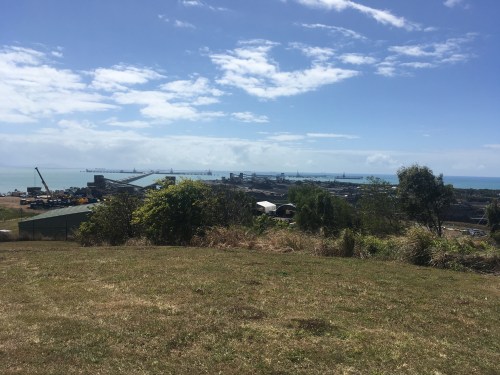
Hay Point and Dalrymple Bay Coal Terminals

The road to Rockhampton only touches the coast at Clairview. Here there are a few houses or beach shacks, no shopping facilities and a huge open beach. We enjoyed the open space and lack of people. No overnight camping is allowed outside the campground for vehicles such as ours keeping Clairview pristine.  It makes me wonder what other gems exist between Mackay and Rockhampton that are off the Bruce Highway. Another trip perhaps to explore the side-roads and see what lies there.

– Anthony
Central West Queensland explored

The Carnarvon experience will be with us in our memories forever, but there is so much more of Queensland to explore so we are heading back to Roma. We see the two motorcyclists that we had met at Takarakka Camp site and get a couple of good photos of them to pass on.

Roma is our last large town for about 10 days and the last in which we will have internet access with Vodaphone, our mobile provider. In the bush, Telstra is the only service provider as more than one telecom provider would not make economic sense. So for the next couple of weeks, we switch to our temporary Telstra sim card. Here also we meet a fellow traveller who has hired the same vehicle as us and could not work out how to open the fuel cover. We are used to a lever to pull in the car or just press the flap to open. He was stumped as we were initially. You have to open the passenger door to get the fuel flap open. He was grateful for our assistance. We also advise him the the ignition for the gas stove is linked to the range hood, go figure.

As we head west from Roma on the Warrego highway, we need to decide on a destination for tonight. Anne always picks a couple of options for our overnight stops to give us some flexibility depending on how we are travelling, where we have stopped and how many pictures Anne has taken. This allows us to be off the road by 3 to 3:30 pm to avoid adding to the carnage at the side of the road in the form of mostly dead kangaroos. On the main truck routes, which we assume run overnight, we see corpses probably every 100 m / 300 ft but have not seen any live animals in daylight. Great for the carnivorous birds that feast on the carcass. Fresh meat delivered nightly, what a service.

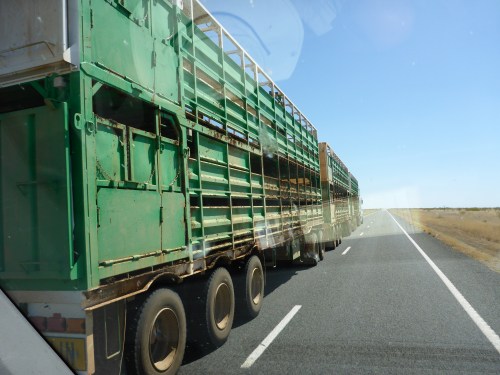
Overtaking a road train which can be  53 meters / 170 feet long.

Anne has picked Gidgee’s Bush Camp in Morven, a farm stay, as our next stop based on the good reviews she found online. We are met by Kylee the owner in the office that doubles as the showroom for another business, Gidgee Smith Bags, manufacturing high quality colourful bags and holdalls. We understand from another camper who buys them for promotional items for their off-road accessory business that the bags are tough and can be used for just about anything. Another ingenious bush business. In addition they run a coffee van and bar. Talk about hard working. So if you need bags, gidgeesmith.com.au and you will be supporting both Australian manufacturing and regional employment. Kylee also crafts wire sculptures in her spare time and organises workshops to bring remote communities together or help people at risk. Mick and Kylee were both very inspiring people.

Planning the next day’s travel at Gidgee’s Bush Camp, Morven.

Gidgee’s Bush Camp, Morven. A green oasis in the campsite.

Roasted jumbo marshmallows at sunset.

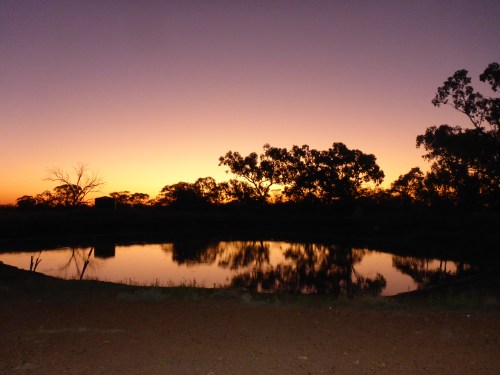
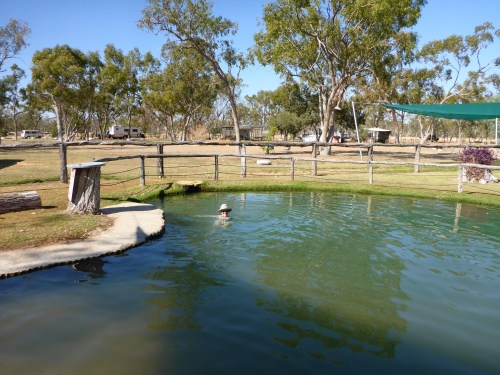
The waterhole at Gidgee’s Bush Camp.

Gidgee’s Bush Camp

Gidgee’s Bush Camp’s owner Mick.

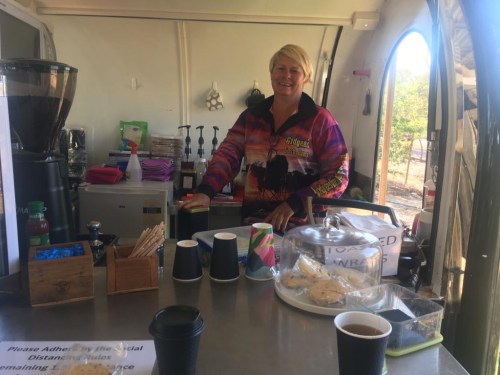
Kylee’s coffee van at Gidgee’s bush camp.

We are slowly visiting regions and towns that until now have been names in the news or a spot on the state weather map. Each one has a story to tell. The small town of Augathella is our next stop.

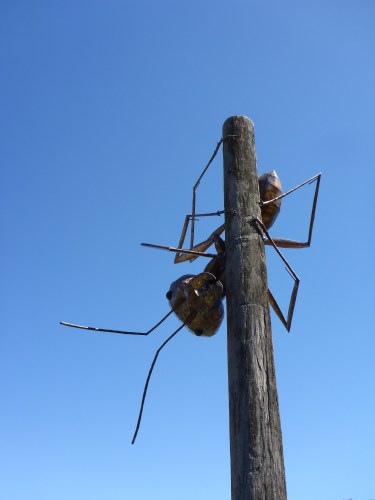
Amanda Feher’s Meat Ant sculpture, Augathella

Amanda Feher’s Meat Ant sculpture, Augathella

Augathella Public toilets with street art.

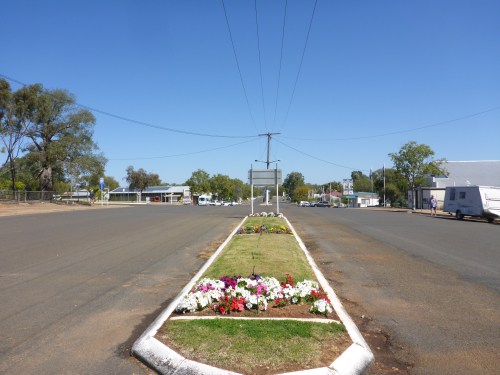
Typical wide country town streets, Augathella

Augathella Water tank

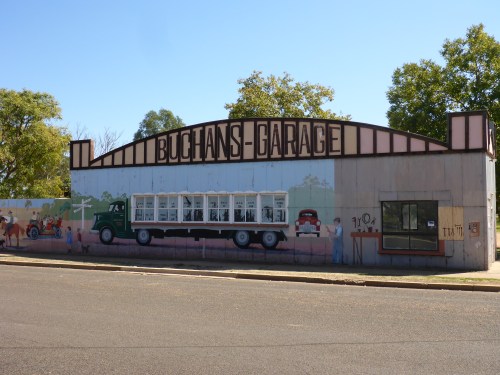
Buchans garage mural Augathella

Tambo is such a place of which I had no knowledge, but is famed for its Teddy Bears, “Tambo Teddies”, which the locals started producing from lambswool in 1993. Today, demand is such that four people work full time in Toowoomba making them in addition to the workers employed locally. For small babies they have a flat teddy that is easier to grasp. I had to ask the question, “did they put normal teddies in the road for passing trucks to run over?”, as we had seen in Asia for crops. NO I was told, they just did not fill them.

Slow down. Tambo teddies cross here.

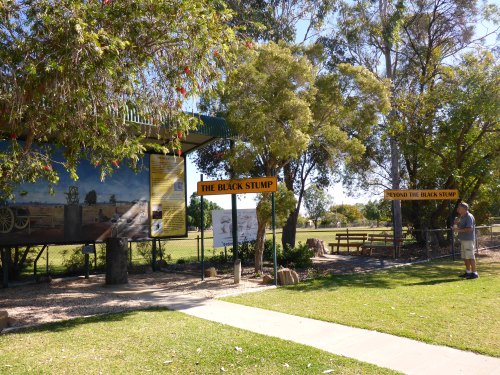
This is where the term “Beyond the black stump” comes from. Blackall Qld.

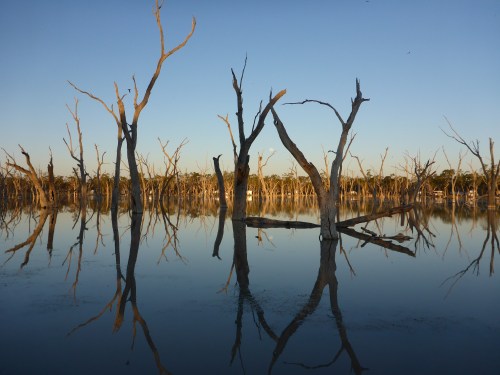
Lara Station south of Barcaldine is known for its birdlife with over 120 species recorded there. The waterhole which forms this bird oasis is a small clay depression that was first used in 1908 as the overflow for newly drilled bore. Water comes out of the ground at 69 degrees celsius and is drawn from the Great Artesian Basin, an amazing underground water source that covers much of Queensland and parts of NSW and the Northern Territory.

Lara Station lagoon, Qld

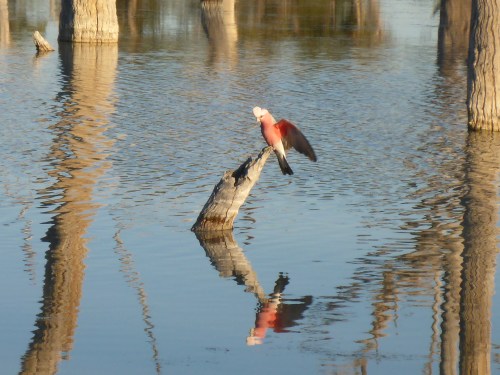
Gallahs at Lara station are much deeper pink than we’ve seen before

Pale headed rosella

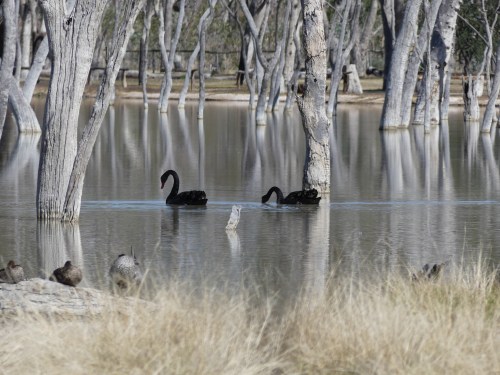
Black swans

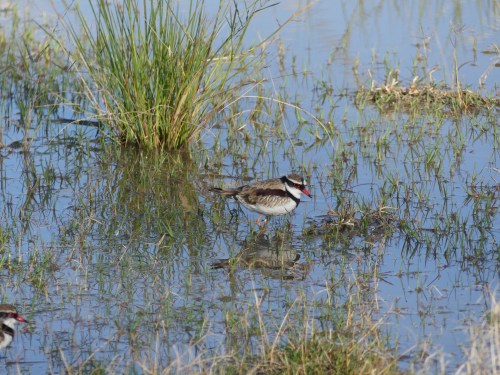
Black-fronted dotterel

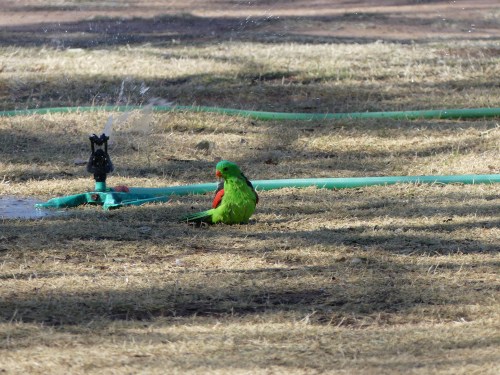
Red-winged parrot

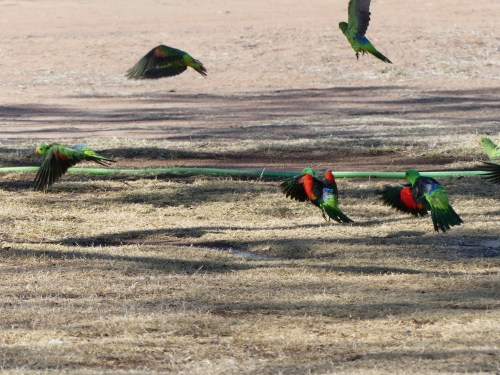
Red-winged parrots in flightsecond night. Perfect!

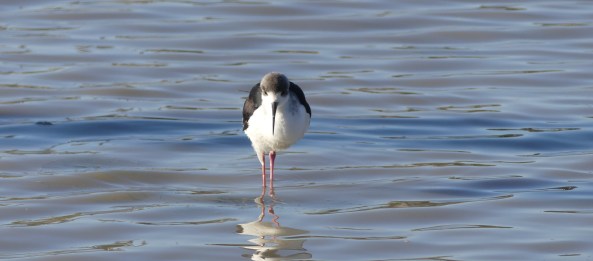
Black-winged stilt

Anne enjoying piping hot water at Lara Station.

We are meeting, by chance, friends Gary and Heather who are also roaming the west of Queensland. Together we celebrate Anne and I having known each other 46 years, having first met in August 1974. While only planning to spend a single night, the good company and the relaxed atmosphere around the waterhole enticed us to stay a second night. Perfect!

With Heather and Gary at Lara station.

Celebrating 46 years since we met in 1974.

We had noticed as we travelled fences that seemed sturdier than the usual four wire fences. At Lara we were told that these are designed to keep out packs of wild dogs from sheep farms. A pack of wild dogs can kill over 100 sheep in a night, for sport not food. Dingos generally kill enough for food. At AU$7,000 per km to install, it is not cheap to protect your sheep. An example of the damage that domestic animals gone feral can do.

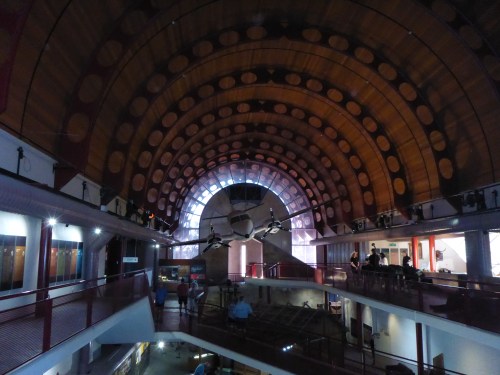
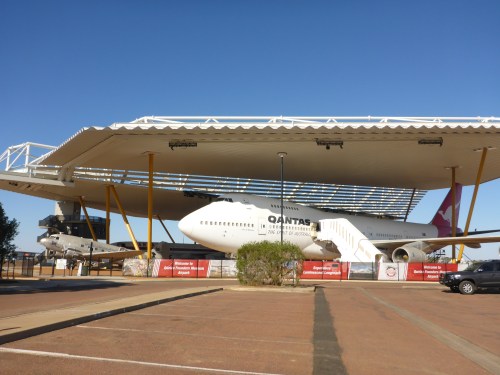
Anne wanted me to see the Q.A.N.T.A.S Founders’ Museum which tells the history of the founding and founders of Qantas in Longreach knowing of my interest in aviation. The museum hanger stands tall as we approach the outskirts of Longreach. It is big enough to cover a B747, B707, Lockheed Constellation and a DC3. The B747 is a 200 series VH-EBQ. It is one that I have flown on, way back in 1996. The museum provides a detailed history of the founders of QANTAS and the trials and tribulations that they encountered in starting and running an airline in the 1920’s and 30’s and beyond.

Qantas B747-238B and DC3 under the Airpark roof.

B747-238 VH-EBQ, B707-138B VH-EBA and a Lockheed Constellation representing VH-EAM

The delivery of each aircraft to the museum is a story in itself. The 747-200B had to land on a runway designed for B737. After landing it spent an hour doing a 57 point turn at the north end of the runway before taxiing to the final resting place. VH-EBQ was chosen as it has the most recent paint job of the B747’s to be retired in 2002 The first Qantas Boeing jet, a B707-138 VH-EBA had to be restored at Southend Airport in the UK, taking some six months and 15,000 man hours, before being flown back to Australia. Due to COVID-19, tours of the inside of the aircraft require social distancing and were fully booked. Next time. We did the night tour which is an audio visual experience that neatly draws together all the elements we had seen in the museum in a cohesive manner.

The original QANTAS hanger at Longreach.

There is also a Catalina used in WW2 by QANTAS to link Ceylon to Australia avoiding Japanese fighters based in S.E. Asia. These non stop commercial flights could last over 30 hours which is still a record today. The length of time in the air led to the awarding of the double sunrise certificates to those passengers who saw two sunrises en-route. A quick look inside showed that comfort was not the name of the game. This is a very interesting museum which is not funded by Qantas but relies on people like us making the trip out west.

A Catalina at QANTAS Founders Museum.

We also visit the Stockman’s Hall of Fame which charts the development of the cattle and sheep industries in the Australian outback. A combination of hardy European settlers and aboriginal local knowledge in the beginning laid the foundation of todays world class sheep and beef industry.

Stockman statue outside the Stockmans Hall of Fame.

Inside the Stockman’s Hall of Fame, Longreach.

Longreach is also the end of the line for Queensland Rail’s (QR) train “The Spirit of the Outback” that runs from Brisbane to Longreach twice a week taking over 24 hours. As an over 65 year old Queenslander I am entitled to a seat, free of charge, on a long distance train once a year. I have thought that it would be great if they would also take motorcycles so one would could both enjoy the train and then ride the other way. These wagons being unloaded looked like the perfect containers for motorcycles. So all you engineers out there get your thinking caps on and come up with a feasible plan to secure bikes in them and a way to load/unload. Sadly I suspect we will fall foul with QR because of “Dangerous Goods” due to petrol/gasoline in the tank. The same reason you cannot fly your motorbike into the USA, but you can to Canada.

QR “Spirit of the Outback Train”

Just need to fit motorcycles in here.

– Anthony

Canarvon Gorge walks

Visiting Canarvon Gorge, a national park 740kms north west of Brisbane,  had remained on our to-do list ever since we arrived in Queensland over 30 years ago as other places took priority.  What we got to see last week was out of this world but we would have like to have seen more with younger and fitter bodies!!  No need for regrets, just a good reminder that time is ticking and best do the physically demanding trips sooner rather than later.

Checking-in at Takarakka Bush Resort was efficiently adapted to Covid-19.  Spray bottles and a check-in area outside: find the envelope with your name on, complete the Covid-19 tracing information and head to your nominated campsite.

We were told by friends that 3 days there was plenty because each walk within the Gorge national park goes off the main 10km long track so you end up walking the same path a number of times.  We spent 5 nights there and are glad we did.  

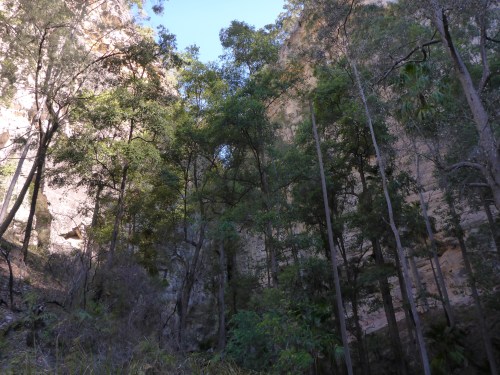
Canarvon Gorge, although situated within the dry environment of central Queensland, is lined with lush vegetation fed by the waters of numerous gorges.  The gorge provides permanent springwater, cooler temperatures and conditions has allowed rainforest and ancient ferns to survive. 

And as I aluded to, we did not get to do all the walks.  The first two days were spent walking from Takarakka campground to walks outside the national park, Mitchell Creek and the Rock Pool.  They were lovely walks and especially quiet as, apart from the odd car passing, we had the area to ourselves.  I am glad I brought my hiking sticks, especially as we walked beyond the formed path and balancing on some of those rocky boulders can be precarious.

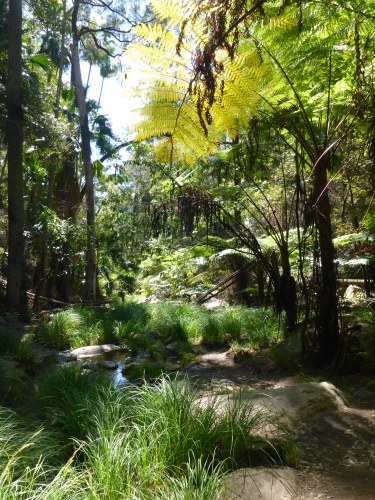
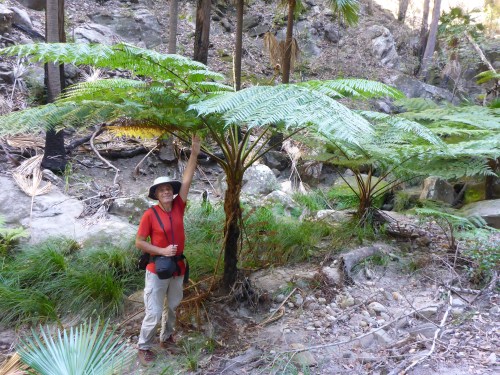
Tree ferns along Mickey Creek


Remnants of a once grand old tree

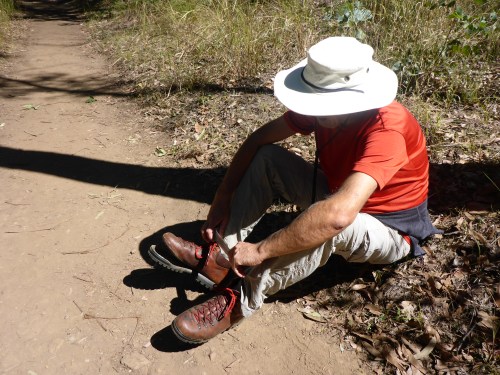
Oh dear, the recent reglueing of these 23 year old boots didn’t hold

Never leave home without Duct tape or cable ties!

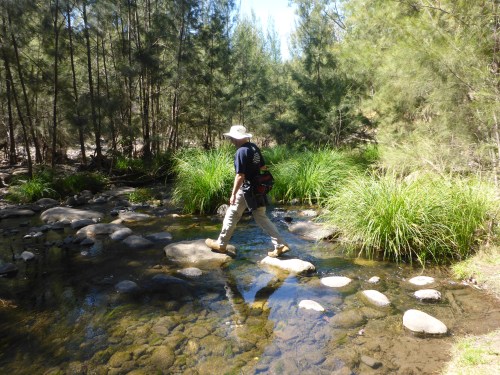
Enjoying boulder hopping in Mickey Creek gorge

A good spot to enjoy lunch in Mickey Creek

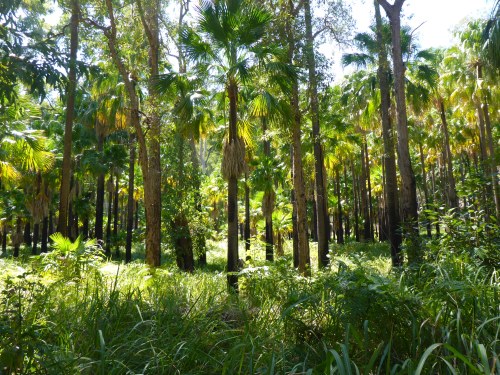
Majestic trees along Canarvon Creek

Silver Wattle tree bursting with scented yellow flowers

Day 3 was a short day as we both felt like we had lead bodies.  Maybe the long walk the day before from Takarakka to the Rock Pool and onto the visitor centre and back took too much out of us.  On our first day in the actual National Park, we only got to the Moss Garden.  Quite a magical walk.  Walking in nature such as this always takes ages with me as I keep stopping, listening to birds, looking around, looking back, looking up, listening to the wind, noticing different trees, flowers, enjoying the sweet smell of the odd wattle bush. And stopping to take in the hundreds of butterflies floating all around us.  Never have we seen so many!  We were bumping into them sometimes.  Anthony’s Lumix came into its own providing some great close up shots. 

Butterfly in Canarvon Gorge

3 butterflies on this flower

Oops, the other sole went at the back!

Anthony boulder hopping

Along Canarvon Creek

Canarvon Gorge towering cliff face

Canarvon Gorge walk

Prehistoric turtles maybe?!

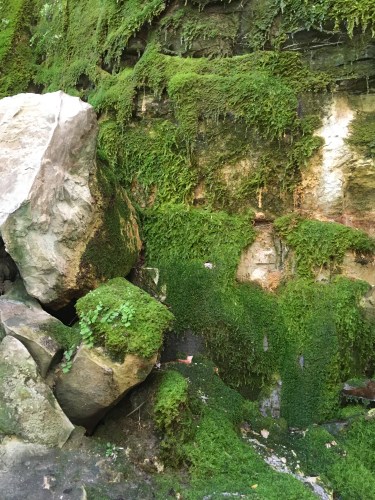
Moss garden on Canarvon sandstone

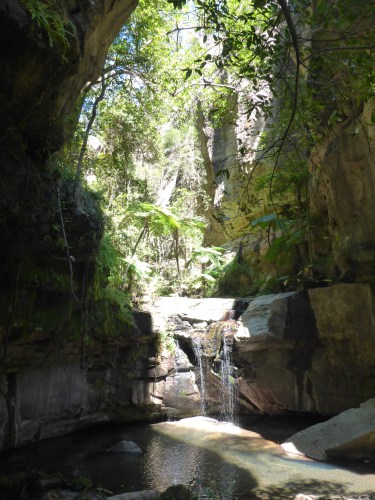
Waterfall at Moss Garden

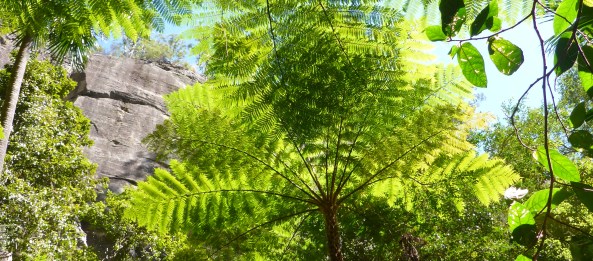
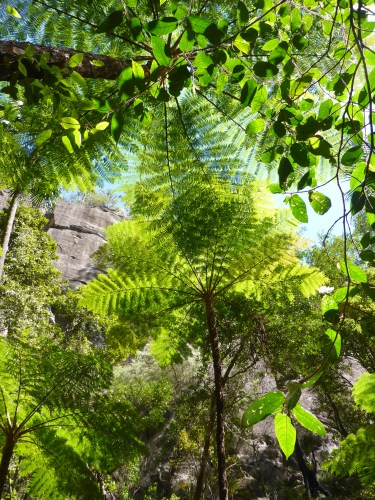
Looking up through the fern canopy, Moss Garden, Canarvon Gorge

Our lunch spot at Moss Garden

Most memorable is the symphony of birdsong along the Moss Garden walk – there are apparently 173 species of birds – where water constantly drips through the sandstone, and supports a lush and magical carpet of mosses and further down, huge tree ferns. 

Listen to the birdsong below.

The next day, our bodies felt rejuvenated and we enjoyed each side walk off the main track.

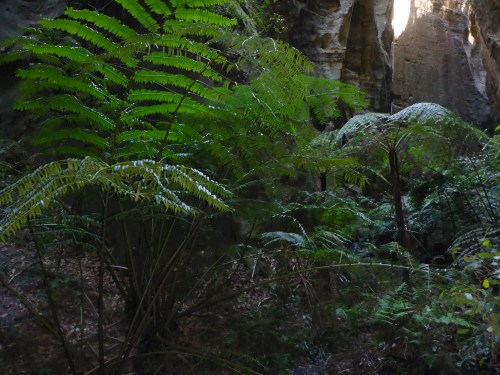
Ward’s canyon is home to the world’s largest fern, the king fern Angiopteris evecta.  These impressive dinosaurs of ferns have links with the ancient flora of Gondwanan origin! 

Wards Canyon ancient king ferns, Canarvon Gorge

Ward’s Canyon creek heading to a waterfall

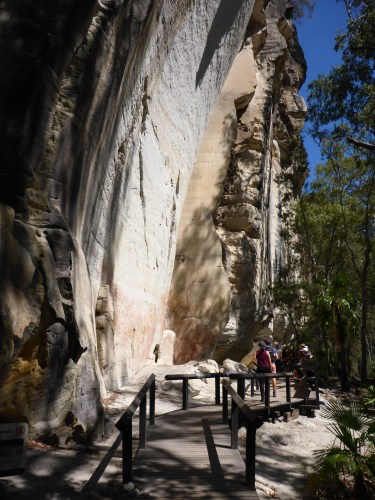
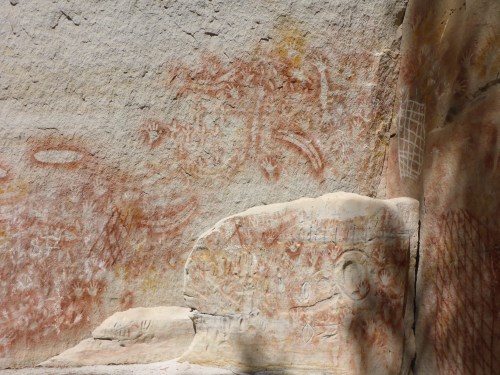
Aboriginal rock art on the sandstone cliffs and overhands reminds us of Aboriginal people’s long and continuing connection with the gorge.

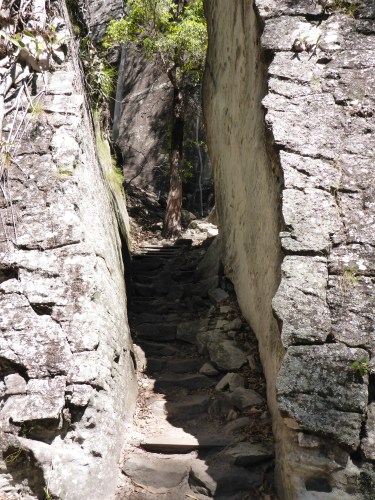
More steps to get to the Aboriginal art gallery

Aboriginal art gallery rock face, Canarvon Gorge

Aboriginal stencils and art

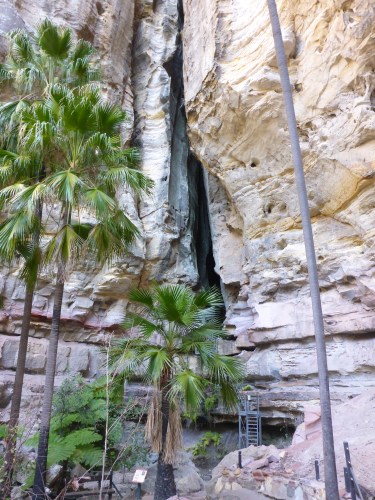
Entrance to the ampitheatre

Inside the Ampitheatre – photo does not do it justice

How did they ever find the entrance to the ampitheatre (at the far back of this photo)?!

Feeling silly 😄 on our last creek crossing in Canarvon Gorge

No walk up the 900 steps to the Bluff for a superb view for us – my knee problem which put an end to my lifelong favourite sport, skiing, some years back, has also put an end to such hikes with my current knee.  Anthony decided he would not do it alone.  This view from our campground was a “poor” second best so you can imagine what a view from the top would be like.

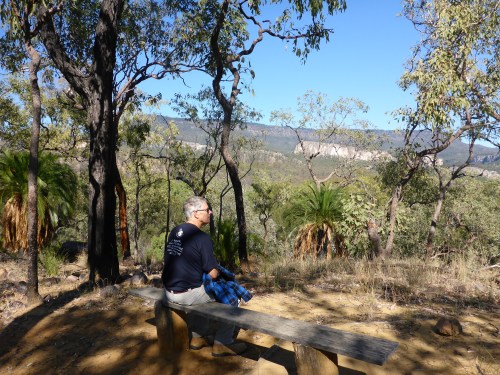
Enjoying the view of Canarvon Gorge from a walk at Takarakka camping

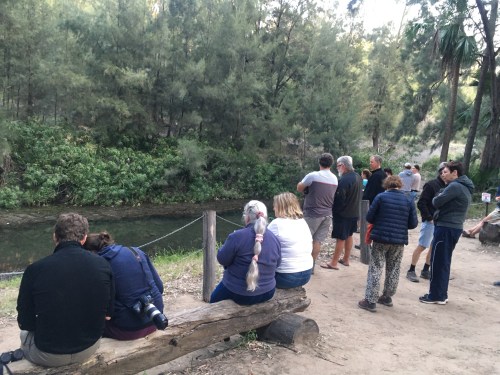
Takarakka has a little creek walk with a platypus viewing area.  My chance to finally see a platypus in the wild,  Dusk and dawn are the best times to spot them we’re told.  But it was not to be.  Not for us anyway, despite my daily attempts to spot one.  I even got up early once, walked down in my jimjams and padded fleecy bush shirt.  I haven’t mentioned how cold the nights were and how grateful we were to be able to push a button and get the heater going in our campervan first thing in the mornings.  Definitely one of the luxuries you don’t get in a tent.  

Campers patiently hoping to spot the elusive platypus

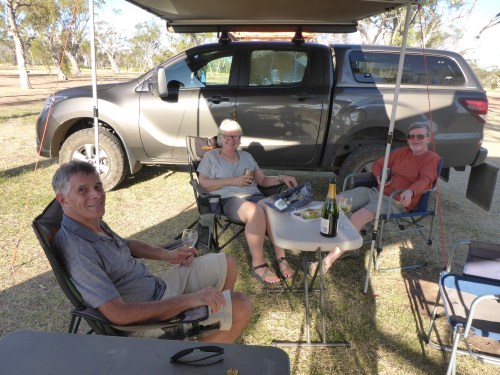
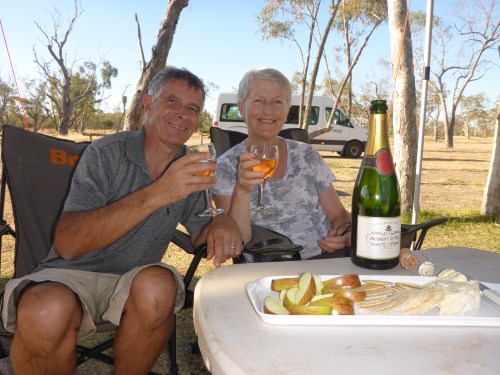
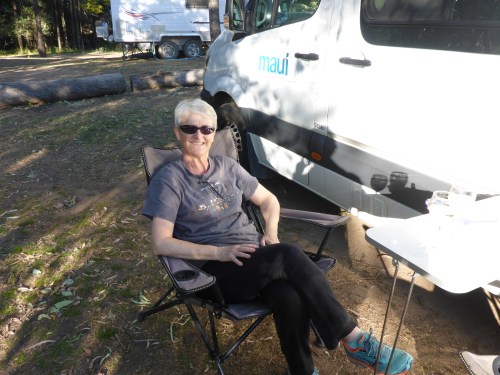
Enjoying a rest and an evening drink at Takarakka resort

By the time we left Canarvon Gorge, the days had already started to warm up.  Walking in warmer weather would require a much earlier start and lots of drinking water!

So, five nights after our arrival, we’re ready to head to Longreach, full of wonderful memories of a stunning park which we’d love to return to one day with a 4×4 to explore different parts.  And new connections with people we met at the campground and on the walks and shared sunset drinks with.  

Which way shall we take to get to Longreach from here?  North or south? This, we did not decide until the morning of our departure.

– Anne

Grey Nomads perhaps?

After last week’s two wheeled adventure, we are swapping motorcycle jackets for camping chairs and air-conditioning. We will become, for three weeks anyway, novice grey nomads. We have hired a self contained camper van to explore central Queensland.

Has the lure of the Grey Nomads lifestyle has finally drawn us in? Are we abandoning our two wheeled lifestyle forever?

Not really, Anne found an opportunity to rent a camper van at less than half the normal price, due to COVID-19 causing interstate and overseas travel restrictions. Why not try it out. We will have hot and cold running everything and are taking enough food, clothing and possessions to last us until Christmas.

We collect the vehicle, a little later than planned, as they wanted to change out a couple of tyres at the last minute. New tyres are always a bonus when you hire so worth the wait. Anne confidently navigates the 7+ meter long vehicle back to Manly keeping close behind me in the MX-5. It takes an hour to load the kitchen sink et al onboard, remembering that we need to ensure that we must put everything away properly to avoid a cacophony of sound at the first corner.

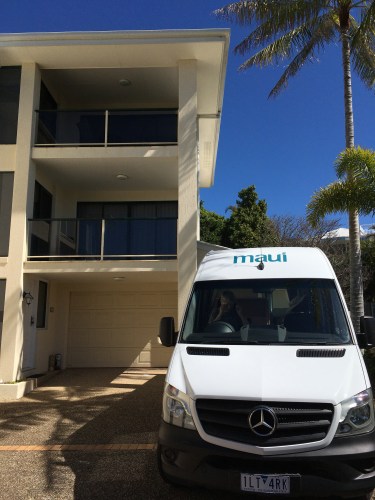
Our new Mercedes Benz parked outside home.

A COVID-19 outbreak in Brisbane is making news and there may be travel restrictions, usually with a couple of days’ notice, so since the outbreak is on the other side of Brisbane, we feel it is safe to travel and we are off. We have never had a Mercedes Benz before, and even though the model is a Sprinter Van we can tick off another of life’s “objectives” achieved.

Up past Toowoomba on dual highways and we are over the dividing range. Last week we did 800 km / 500 miles in three days and this is a small smudge mark in the bottom right hand corner of our detailed Queensland roadmap. At the end of day one we are half way across one of four panels of a map that only covers the bottom half of the state! Queensland is a very big state.

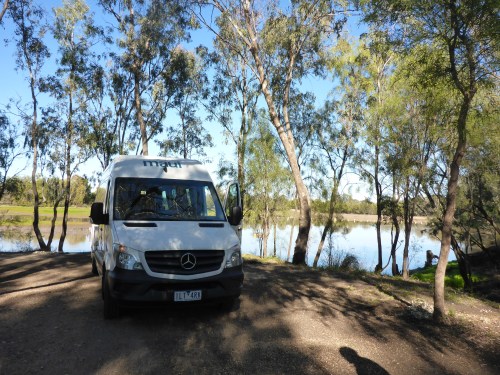
Our first night is spent at the Chinchilla weir. This is a free local council campsite, maximum two nights, and we score a great spot overlooking the weir and with the aid of another camper with an additional outdoor extension cord we are able to access mains power. First item on the camper van list – “add extra outdoor extension cord”. The camper van comes with one, but we have three more sitting at home. Proves that we have much to learn.

A happy camper on sunset first night out.

Great spot by the weir, pity about the lack of morning sun.

Smart Camper vans positioned for the morning sun.

We also learn that, in winter at least, it is a good idea to find a spot that will catch the morning sun to warm you up on a cool winter’s day. Luckily, thanks to our helpful fellow camper, we can switch the heater on in the morning! We may as well make the most of the luxuries this camper van provides.

Along the Warrego Highway, we see signs, a couple of large construction/maintenance camps, of the huge coal seam gas (CSG) industry that has grown up here in the last dozen years or so. As an industry and region that I last worked in more than fifteen years ago, it is amazing to see the changes on a scale that we could not have contemplated in our time. Out of sight from the main roads, thousands of wells now dot the landscape all suppling CSG via pipelines to Gladstone where it is cooled into Liquified Natural Gas (LNG) for export to Asia. Passing though Injune, we can see the new local businesses that have sprung up with the growth of CSG.

Injune Aerodrome. Unchanged in 15 years. This is the terminal.

For those that remember, the road to Fairview CSG field is now tarred.

As we head north of Injune we are watching the smoke from a bush fire move to the right and left as the road meanders towards the fire, near the Arcadia Valley. Finally around a corner and the fire flames are almost upon us. It is probably controlled burning, but as we pass some flames from a small grass fire near the road, for an instant we feel the radiated heat of the fire, through the windows. A small reminder of what many endured earlier in the year during the horrific bushfires, seemingly almost forgotten now by the onset of COVID-19.

Roadside grass fire north of Injune.

Close to Carnarvon George we come across a memorial to a WWII crash in which a US Army Air Corps C47 came down in an electrical storm on a flight from Darwin to Brisbane in 1943 killing all on board. It reminded me of the military graveyards in Malta where many of those who died were from disease, illness or accident, even in wartime.

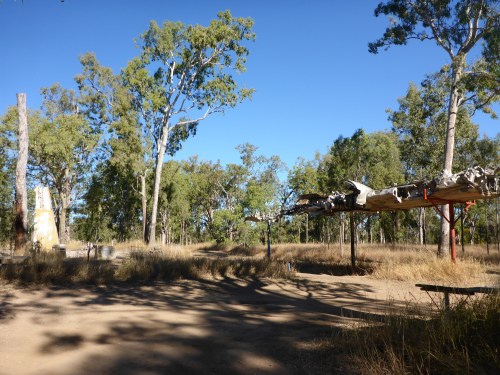
Memorial to the C-47A crash near Carnarvon Gorge.

We have never been to Carnarvon Gorge before, and a fully tarred road greets us, not 13km. / 8 ml. of dirt to cover. Dirt roads bring dust and as we and others have found in the past, dust tries and will find a way into your vehicle.

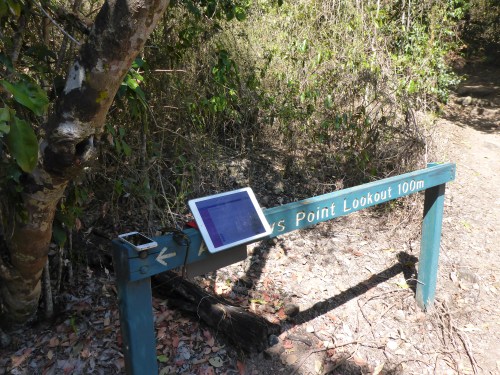
Walked two kilometres, climbed up over 100 meters just to get 4G connection for this blog entry.

– Anthony
Escape to the Country

The senses are heightened as we escape the confines of Brisbane and head south west towards Boonah. The colours seem brighter, yellows, greens and browns drift by, all offset against the deep blue sky and the intoxicating smell of wattle/mimosa.  We are escaping to the country for a few days. Queensland winter days are low 20’s Celsius and clear blue skies.  I cannot think of better motorcycle riding weather, even if the mornings are a little nippy.

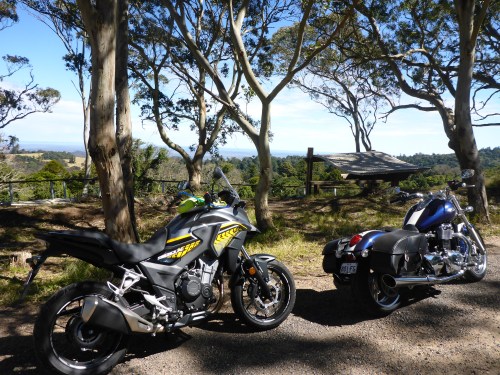
After a false start two weeks ago, when we woke with colds on the day of departure and ended up swapping the bikes, “Bee” aka Honda CB500X and “the Bird” aka Triumph Thunderbird for a slot in the COVID testing queue, we are finally away.  A negative COVID test result a couple of days later was expected, but in these times one always has a small question-mark over the outcome.  The all clear came via text and we were able to reschedule once we had thrown off the last remnants of our colds.

Unlike Streak and Storm, the Bird and the Bee are not equipped to take everything bar the kitchen sink. Space is limited but with some judicious packing we are able to fit everything we need for three days in the Bird’s not so cavernous panniers and we are off for our first road trip with these two bikes.  “Streak and Storm” our usual mounts are a world away and who knows when we will get to ride them again.

Leaving the city traffic behind, we wend our way to Boonah, a small country town about one and a half hours from Brisbane. A regular stop for us for coffee but instead of returning to Brisbane as we usually do on a day’s ride, we are heading west, up over Cunningham’s gap where the sound of bell birds ring in our ears.  We can feel like we are really away with the dividing range to our backs as we travel towards Clifton in the Toowoomba region for lunch and the air decidedly cooler.

Anne has a connection to this area as some 25 years ago she was member of a team that competed in a national innovation competition. Her team won the State (Qld) competition and then travelled to Perth for the national finals. They did not win but secured best national ‘Marketing’ prize which was the area Anne led. The product you ask?  The processing of pig waste! We’re not sure what happened to that product but Anne found it a fascinating experience, apart from the smell.

On the road again, north of Clifton Qld

As we like to take our time, and be off the road by 4pm at the latest, to avoid meeting wildlife head on, our first night is at Oakey.  We have not made a booking, with all the uncertainty, but head to the same motel we had booked a couple of weeks back and were allowed to cancel on the day with full refund because of our COVID hick-up.

As the local school finishes for the day, we hear pop music coming from the school speakers. The motel manager tells us that each month the best class gets to choose the song to be used instead of the school bell.  What a good motivational tool. As we walk to the local shop in our motorcycle gear the younger children wave and say hello. Not sure that you get that in the city.

The motel manager offers to run us up to the local club for dinner, which as always in the country serves up a hearty meal before a constitutional walk back to our motel.

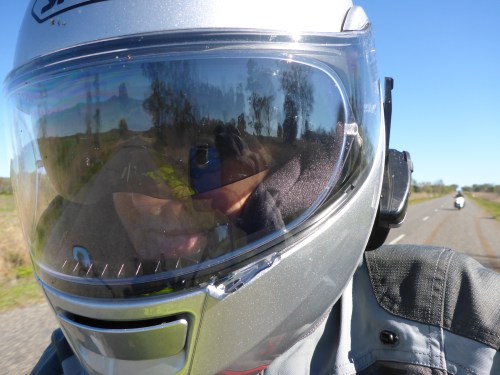
Wildlife is always a concern with country riding, but given that we avoid riding at the start and end of the the day as a rule, we see little wildlife close up which is a good thing. Very occasionally we are surprised and watching a pheasant rise up and fly within a wing’s length of my helmet was enough to increase my heart rate in spite of the medication I take. I was just envisioning what a pheasant emblem would look like embedded on my jacket when it veered away.  Minutes later a large eagle glided a couple of meters above our heads and then a really large goanna decided to cross in front of us, and immediately turn across the road again in the opposite direction, all in the space of 10 minutes.  They say things happen in threes so that’s enough excitement for one day.

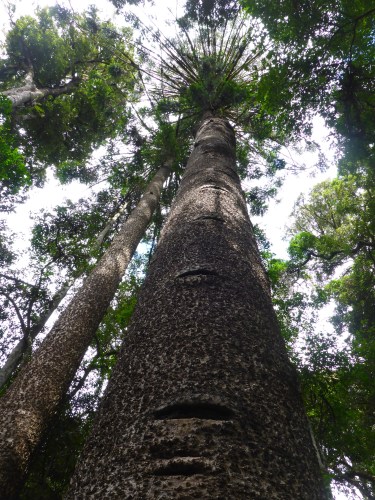
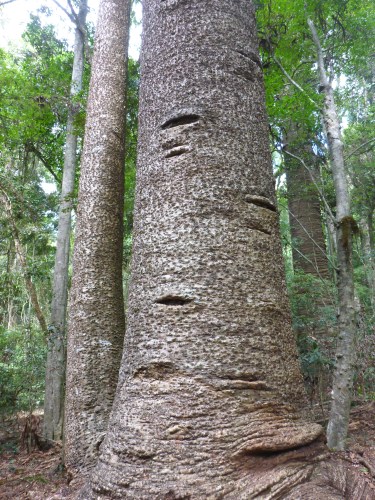
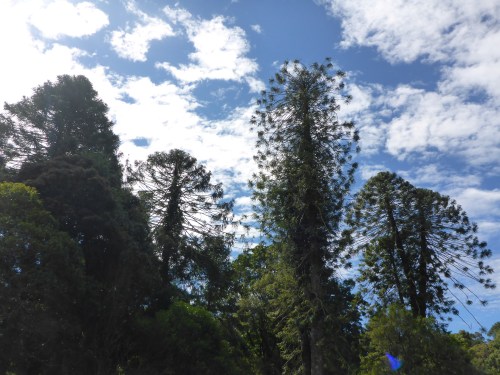
We have not been to the Bunya Mountains for 20 years, so what will have changed – not much I hope. The mountains rise up to over 1000m / 3000 ft. from the surrounding plains providing great TV and mobile phone coverage for the locals. The Bunya Mountains National Park, which covers some 19,000 hectares, is the second oldest National Park in Queensland. It is named after the Bunya tree which is famous for nuts that saw Australian Aboriginal people travel from hundreds of kms to harvest the nuts every three years until European expansion into the region in the 1840’s and the subsequent farming and logging in the region curtailed this practice.

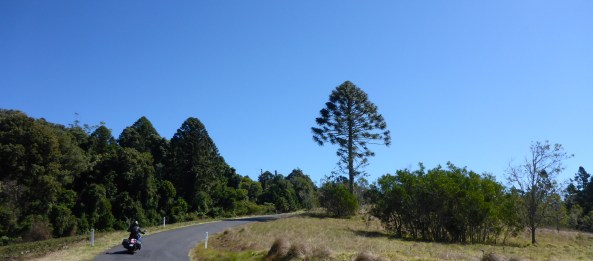
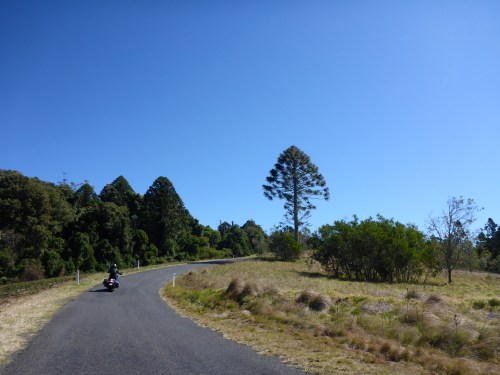
The road from Jondaryan to the Bunya’s still has a section of dirt that we remember from our previous visit. Some things do not change.  A twisty single lane road with hairpin bends takes us up from the open plains east of the Bunya mountains to in the cool and quiet of the magnificent Bunya and Hoop pine trees that surround us. We were lucky not to come across any vehicles making the decent. It really is a single lane road. We will be coming back a different way.
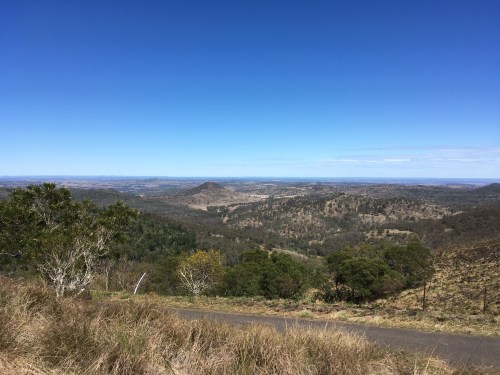
Looking south from Bunya Mountains
Heading towards the Bunya Mts from Jondaryan.
The Bird and Bee resting after a strenuous climb to the top of the Bunya Mts

One of the great pleasures we have riding is meeting other motorcyclists. This time we meet those from 2 years old to over 70. The two year old was not talkative but just loved motorcycles and was enthused just by seen our helmets. The parents were at a loss to explain his love of motorcycles as neither rode although his mother had ridden dirt bikes on the farm as a child, so maybe it’s in their DNA.

Bunya trees heading for the sky
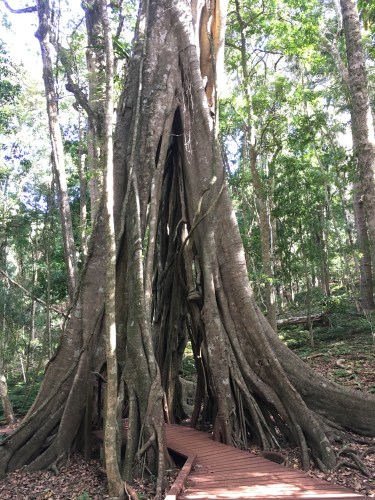
Footholds in a Bunya tree trunk
Bunya and Hoop pines
A walk though tree, room for a motorbike?

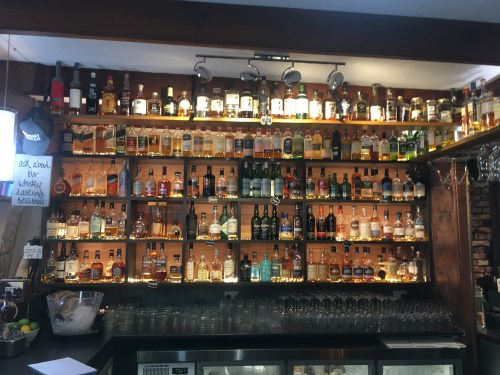
The restaurant at the start of the national park allows us to leave all our motorcycling gear on a table between our coffee and lunch bookings while we meander between the impressive pines.  They also have the Shackleton scotch bar with over 100 Scotches on offer.  We will have to make a return trip and spend a night in front of the log fire sipping single malts.

Shackleton’s Whisky Bar, Australia’s highest in the Bunya Mts.

Onward to Kingaroy the peanut capital of Queensland and original home of our former state premier Sir Jo Bjelke-Peterson. Before our time I hasten to add. When he was premier, Queensland was sometimes known as “Jo’s Place” and he was famous amongst other things for deflecting questions from reporters with “don’t you worry about all that”. His wife Flo was famous for her pumpkin scones and also became a Queensland state senator. An interesting couple.

Warmer weather greets us on our third and last day on the road,  heading home on our wedding anniversary. We celebrate with coffee and cake at the Goomeri Bakery. We had learnt that the owner while spending time in France offered the local baker her time for free to learn the baking trade.  The result a wonderful french bakery in central Queensland. 

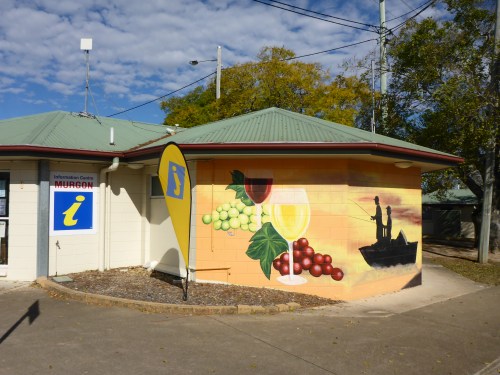
Street art in Murgon
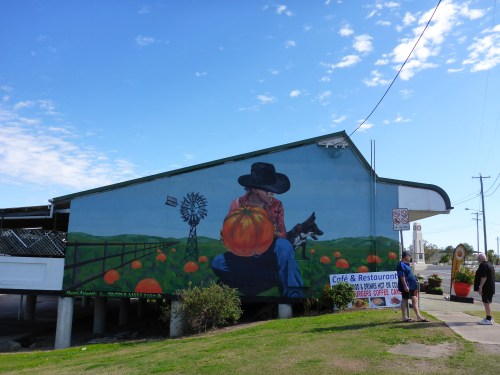
Street Art in Goomeri
Now there is a water saving idea.

We always enjoy travelling down new roads and the Goomeri to Gympie will be worth riding again. We stick to the back roads up from Gympie via Kenilworth and Maleny to Woodford and finally a twisty ride up over Mt Mee.  Three days of good weather and riding over 830km and we are home. A wonderful experience, the riding, the people we met and the weather and one that we will repeat.

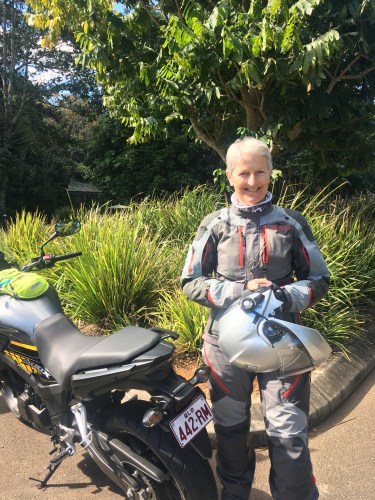
Happy Anne near the end of this trip
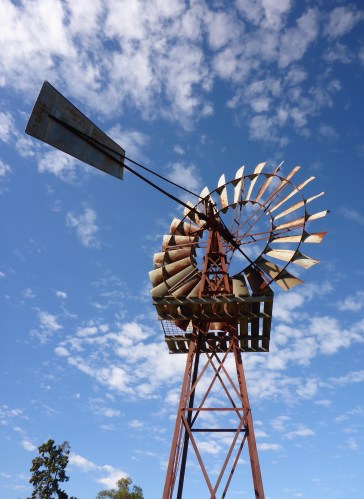
Old Windmill in Goomeri

The thirst for adventure has been rekindled and we are lucky to be in Queensland. Our state is seven times the size of the UK and two and a half times the size of Texas so there is much to explore, so next week we swap two wheels for four and our adventures continue.

– Anthony