Category General
Tashkent
Tashkent, or Toshkent, a large sprawling city with both a new centre and old heart and a silk route city. As we have ridden through this region following sections of the silk route we can only wonder at the courage and fortitude of those who travelled this way centuries ago linking the diverse cultures of east and west bringing trade and ideas to other cultures.
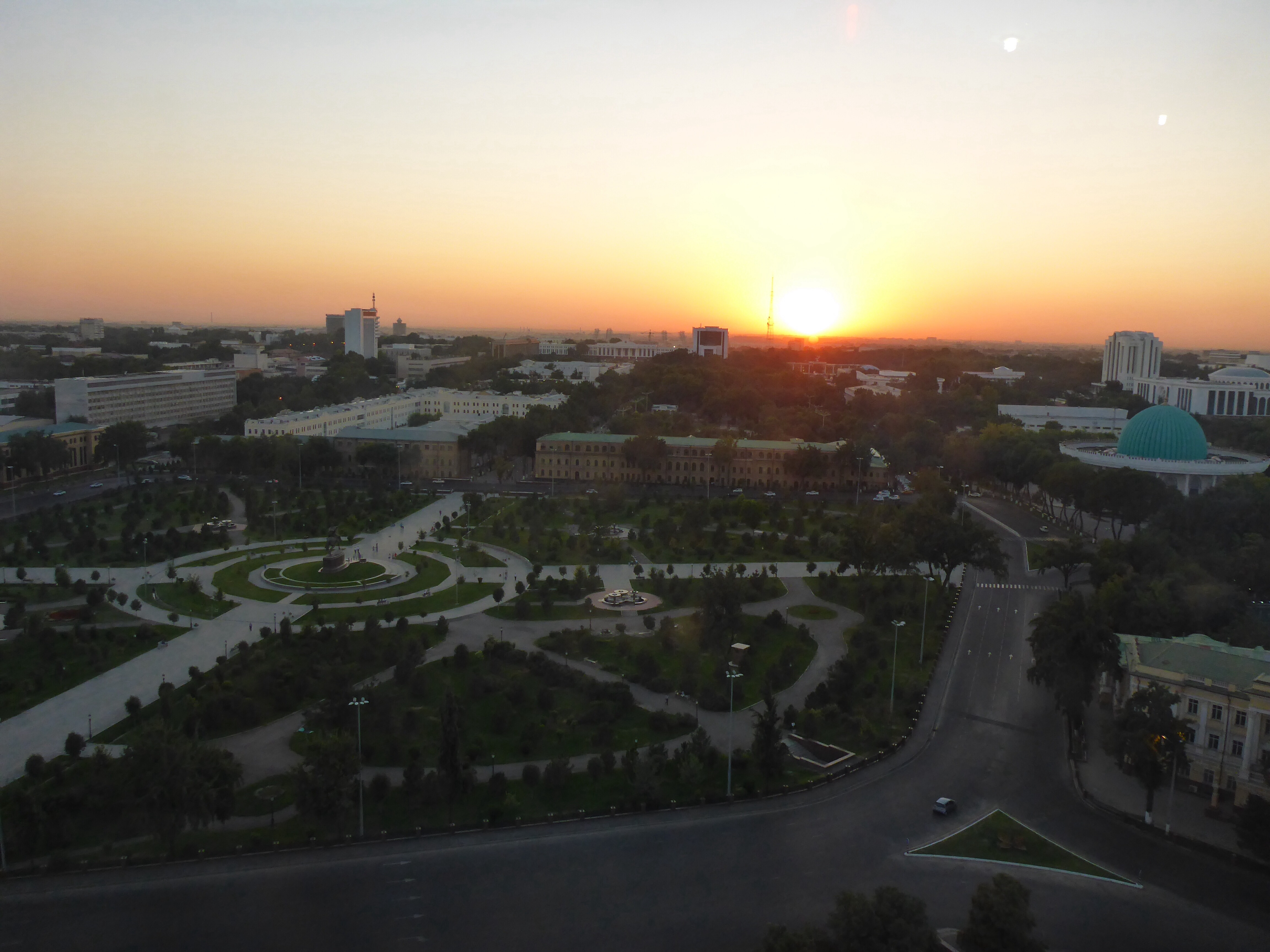
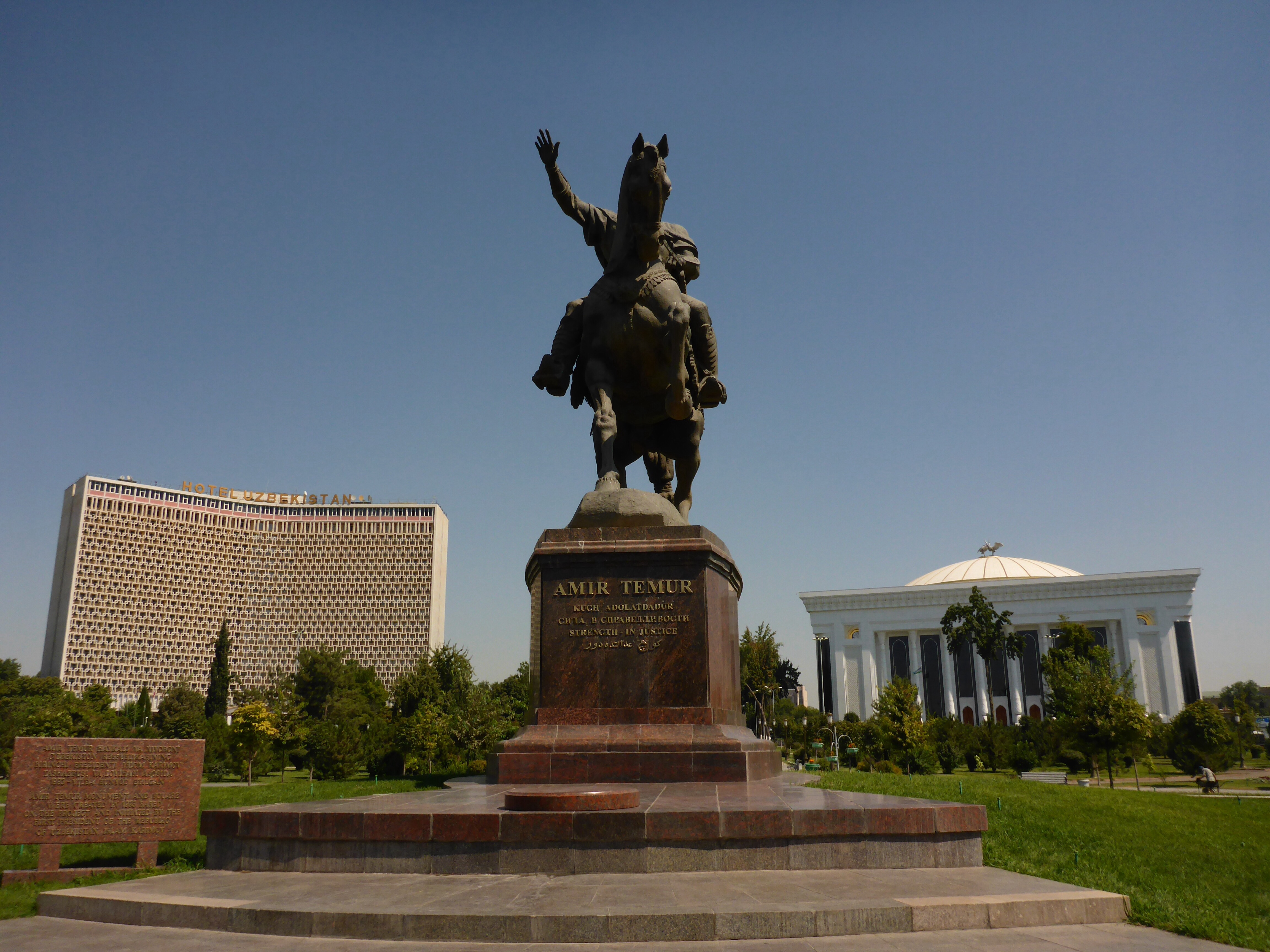
We have been lucky enough to choose the Uzbekistan Hotel, which turns out to be situated on Amir Temur square. We gain a large room overlooking the square,
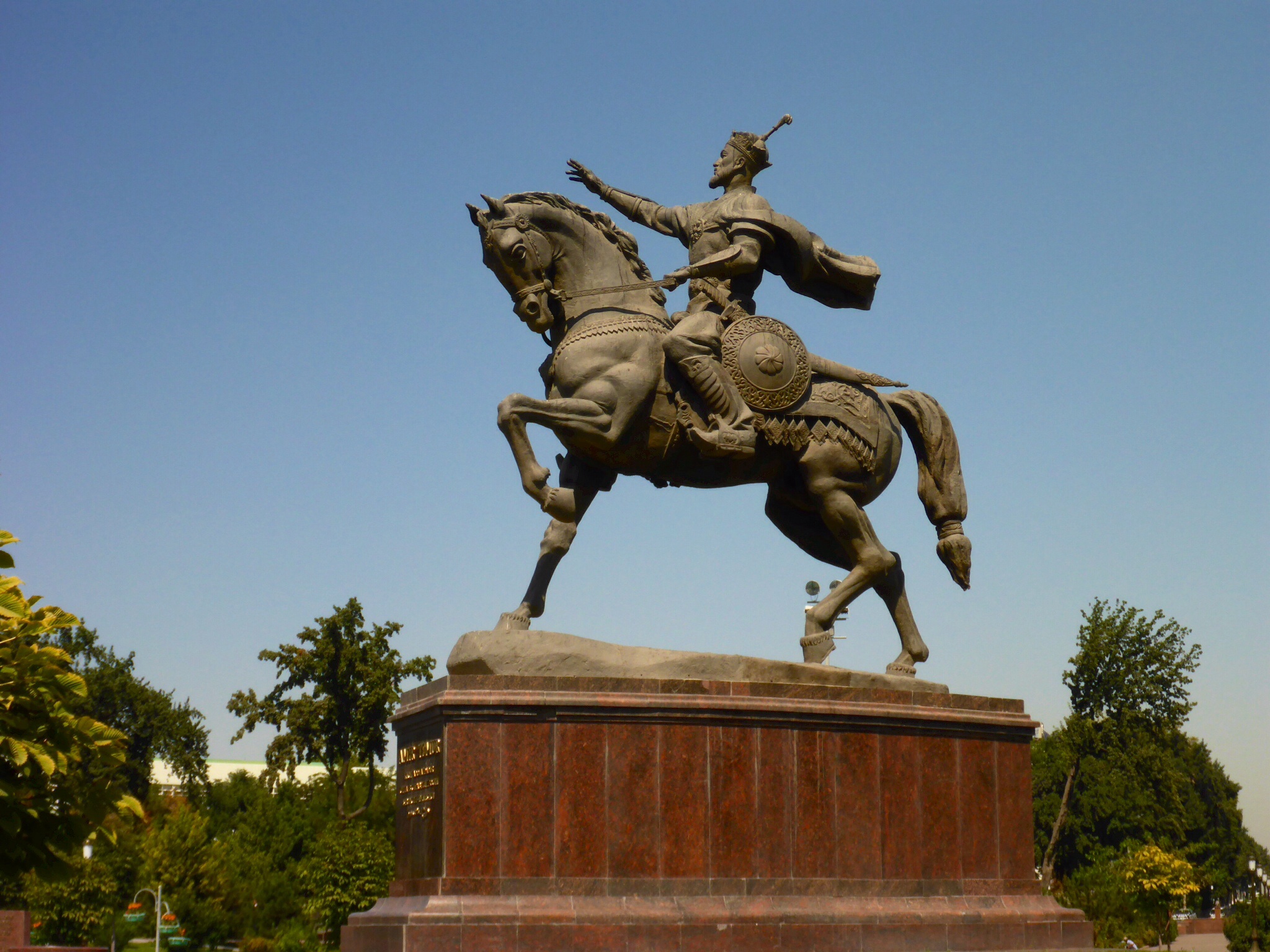
named in honour of Amir Temur, also known as ‘Tamerlane’, who founded the Timurid dynasty. This soviet era building towers over the surrounding low level buildings, probably as it was intended to do for visiting dignitaries from Moscow. The park was remodeled in 1993, a couple of years after independence. Given the focus of statues on historic Uzbek rulers and leaders before the Russian invasion in 1865, we wonder what the landscape in Tashent looked like prior to 1991 from a sculpture and statue perspective.A surprise to us is the number of large trees and gardens that line the avenues here. In what is a fairly dry environment, the grass, trees and plants seem to be continually watered. It creates a lush and cooler environment, which we see is not reflective of the whole city when we explore further afield. The size of the trees indicates this must have been done many, many years ago.
Visas are our priority here, we must get the Turkmenistan visa, which we need to submit the paperwork for and we have an appointment at the Indian Embassy after Anne made an online submission from Bishkek. At the Indian Embassy, we are informed that they only issue one month visas valid for one month from date of issue. This does not work for us, they offer two months but that still does not work. Anne’s six hours of work is for nothing, we will have to try again later in the journey, probably Teheran. We are discussing this with an Uzbek guy who works for a German company, and he explains that for him to visit head office in the European Union, he needs to provide documentary proof of employment for his parents, and all his siblings! We should not complain about visa requirements, given what we ask of these countries’ citizens.
The taxi system in Uzbekistan cities is based on a fleet of official yellow taxis and every other car as well. Put your arm out, cars stop, check if they are going in your direction, you negotiate a fee and off you go. Probably never wait more than 30 seconds for a vehicle to stop. Of course they may lack seat belts and airbags which we are used to back home. We have also seen that the drivers do not check the amount of money you give them, they accept you will deal honestly with them.
On by taxi to the Turkmenistan Embassy, but it’s closed half an hour early, back tomorrow. To get on the list to enter, we are advised to arrive at about 6am as the numbers of people seeking visas can be large.
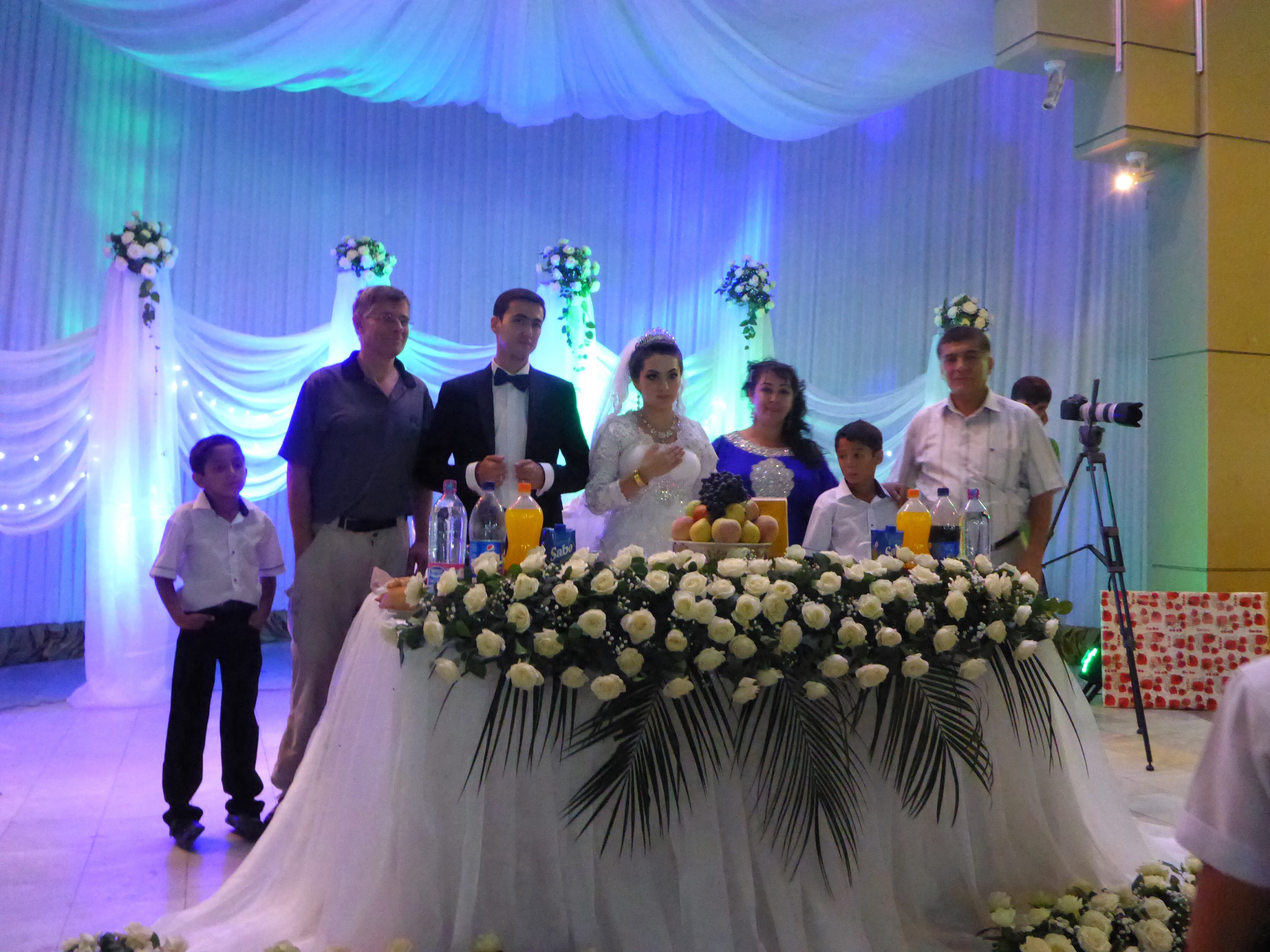
We return to the hotel to find three wedding parties in the lobby, with the attendant video and still cameramen. We are puzzled that there seem to be few guests. It turns out that while the hotel is popular for weddings, many couples come here for their video and photos, then go on to their reception elsewhere. Yes they pay for the privilege of having the photo shoot. Uzbek weddings at the hotel’s banquet hall can run up to 650 guests.
The heat has made us glad we have an air-conditioned room to retreat to in the middle of the day, we have found that in 35 degree plus temperatures we lose interest in tourist activities. What is nice though is that we have not seen large numbers of tourists as this is a low season due to the heat.
We arrive at the Turkmen embassy at 6am and there are already 3 people ahead of us! Our Turkmenistan visa application process started with our application form, downloaded from the embassy website, is one year out of date. Luckily the helpful staff provided new forms, helped us with the additional Russian language form. We ask for an express processing and are told to come back in one week, it’s two weeks for standard processing.
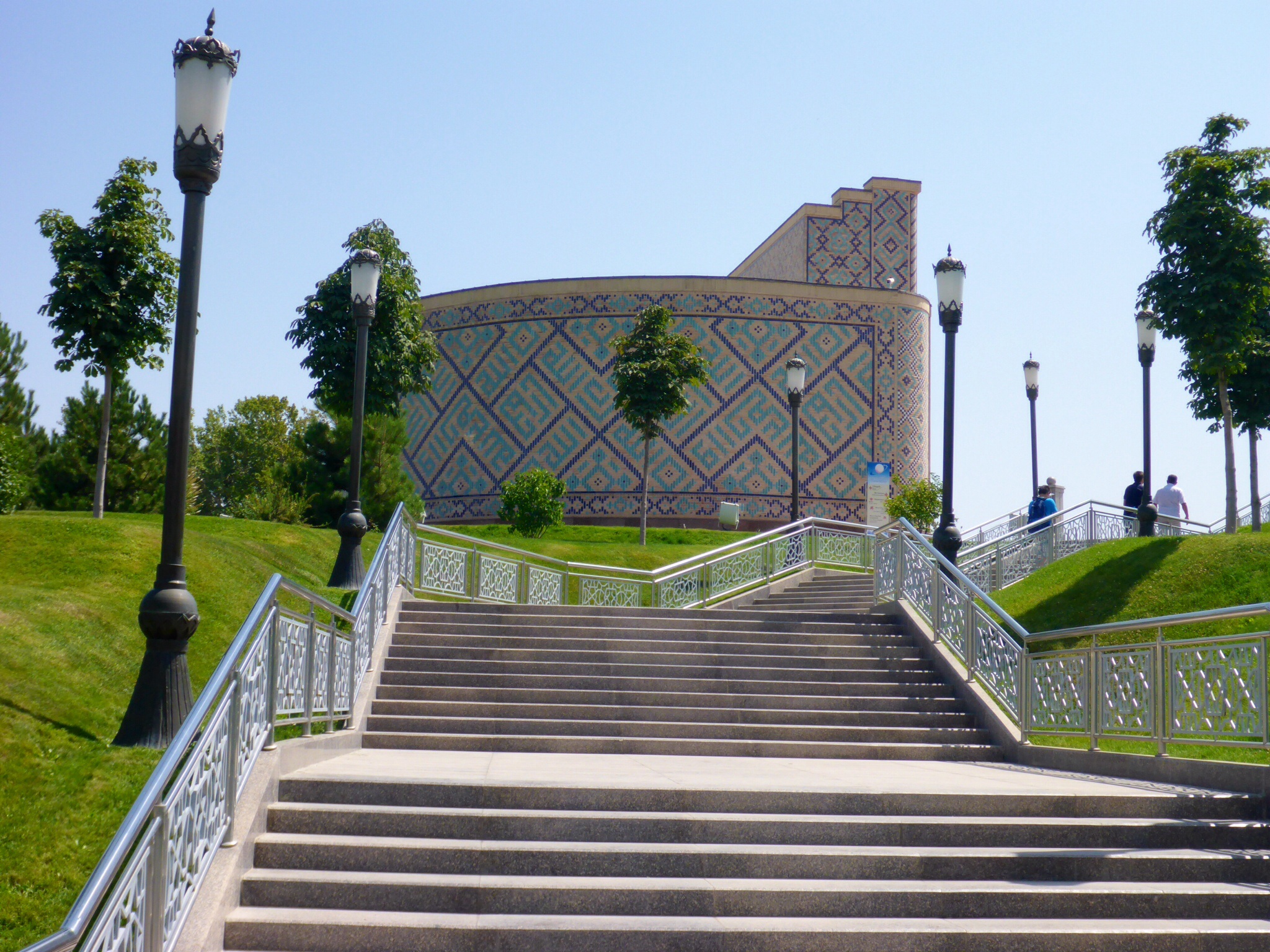
We have decided that since we have a week to wait, we will go to Samarkand for four days by train rather than wait for a week in Tashkent. We travel on the metro for the first time to go and buy the tickets. Opened in 1977, it features themed stations with high ceilings, wide platforms and amazing chandeliers. Not like the cramped Paris metro or London underground stations. One station is themed on Soviet space flight, unfortunately no photos are allowed and policemen can be seen at every station and on every platform, but Anne’s camera went off accidentally a couple of times, see the results below.
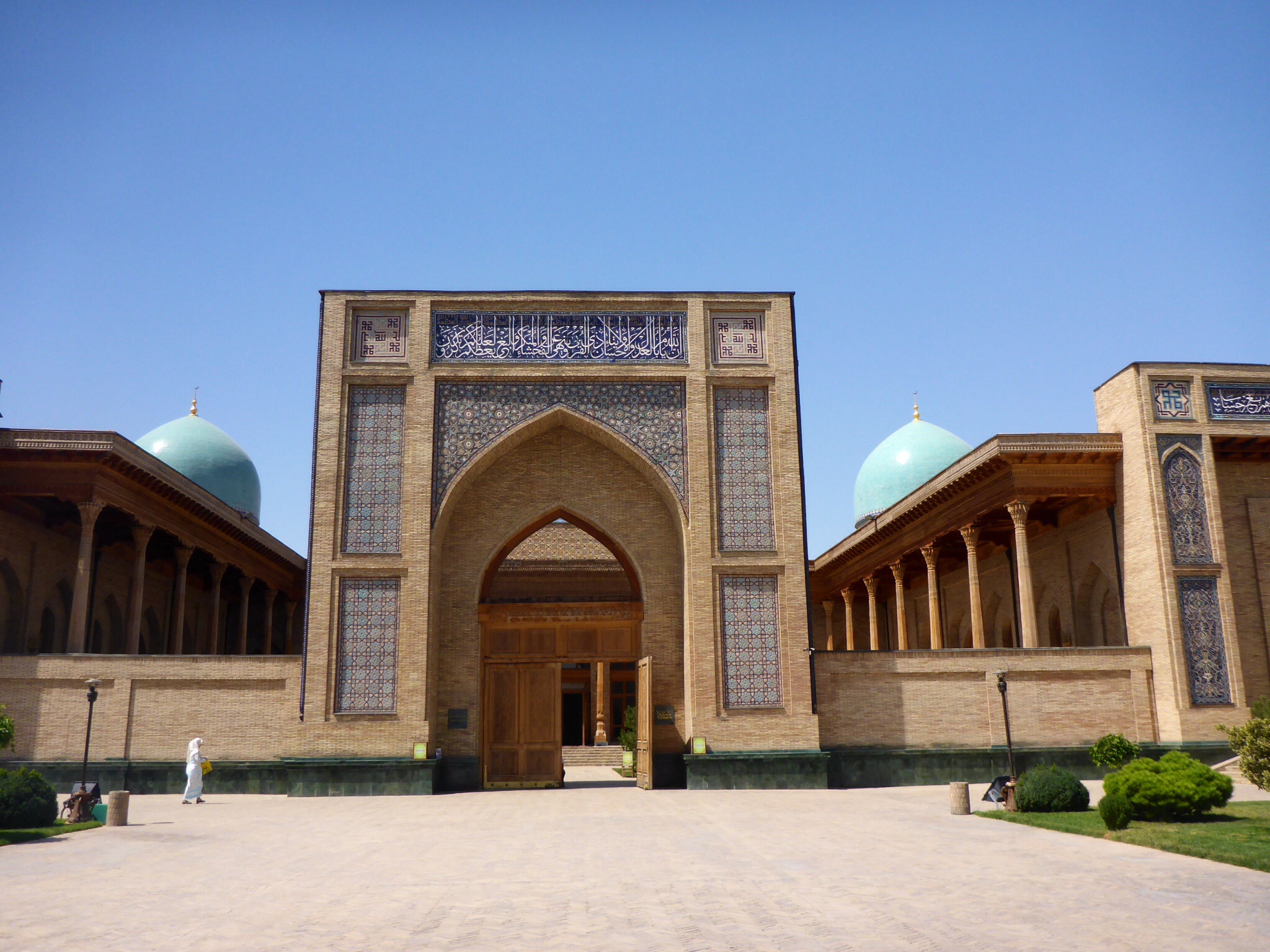
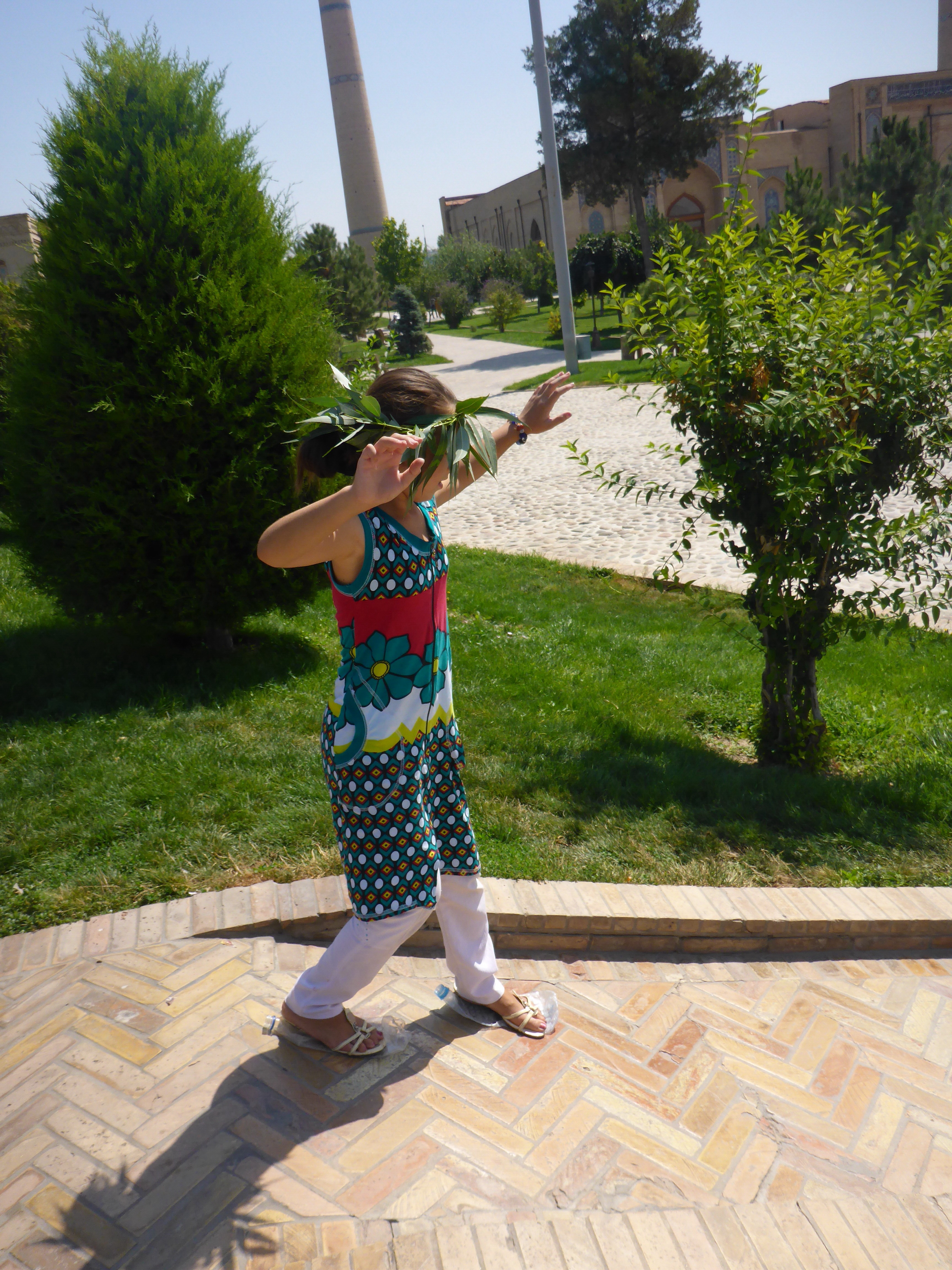
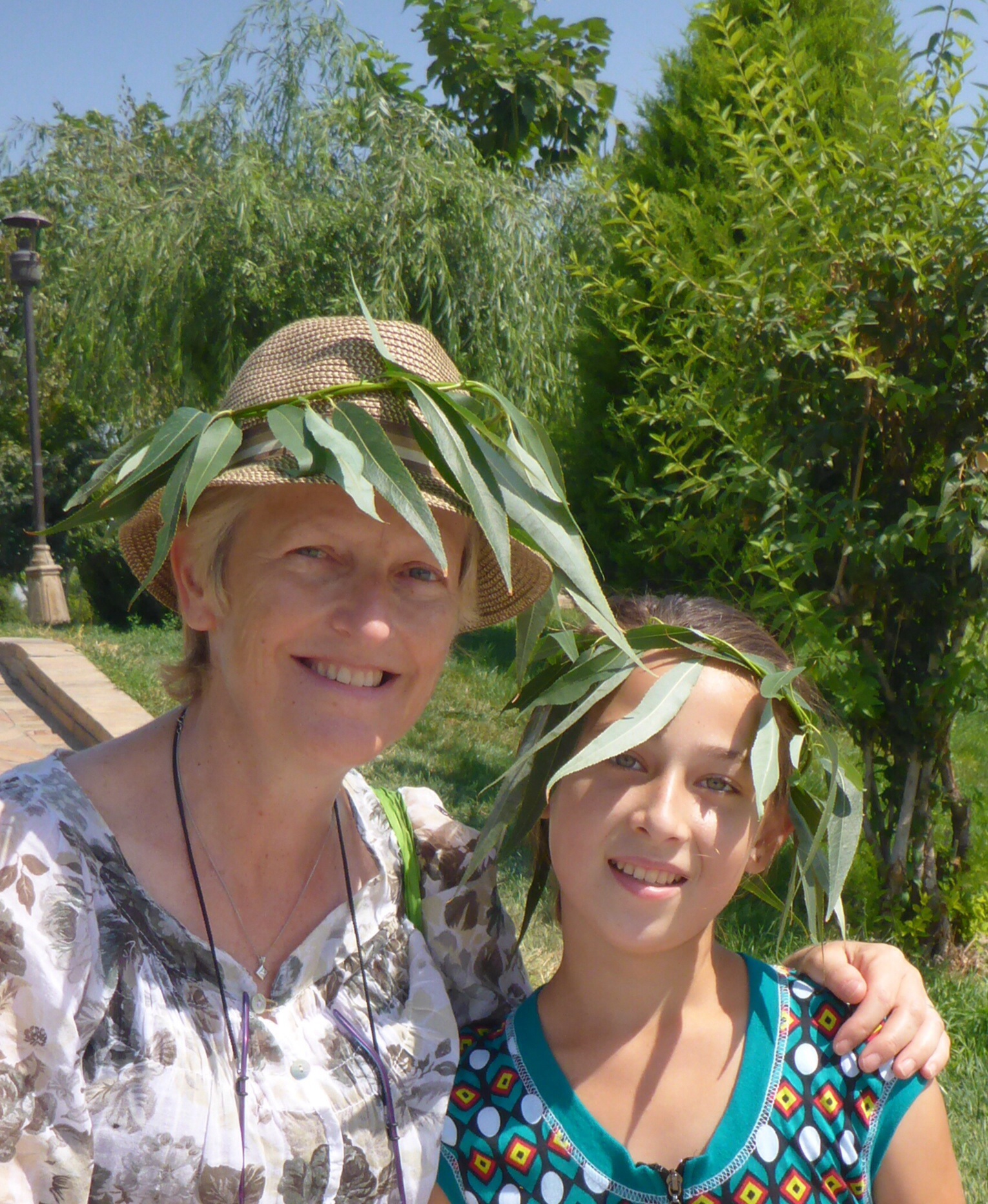
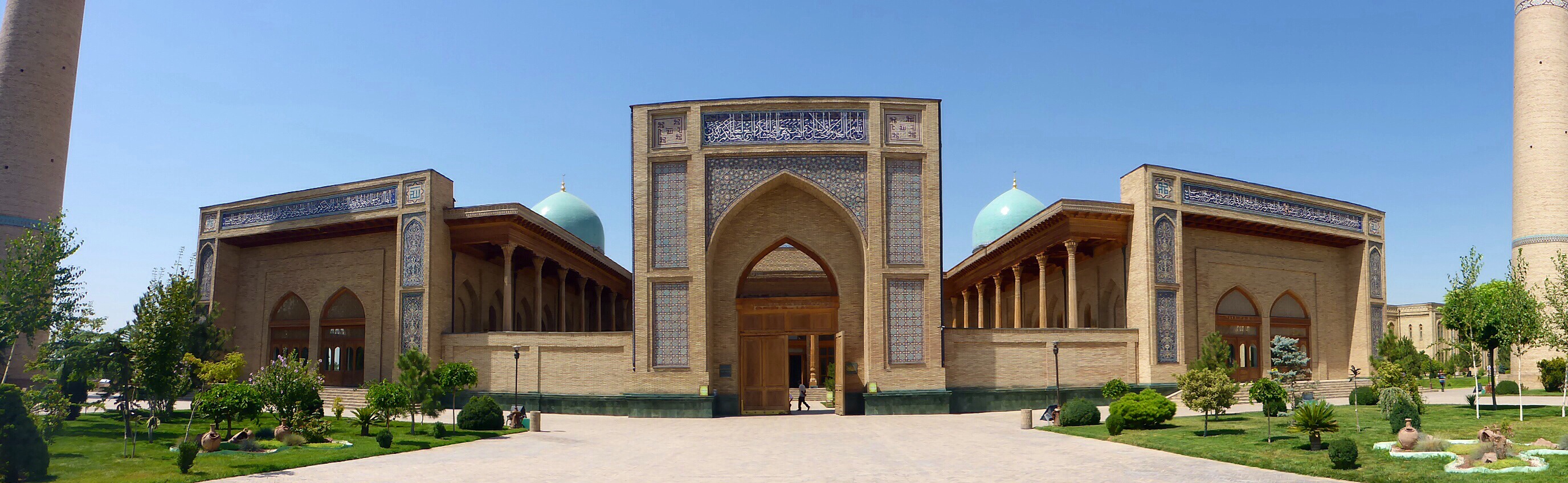
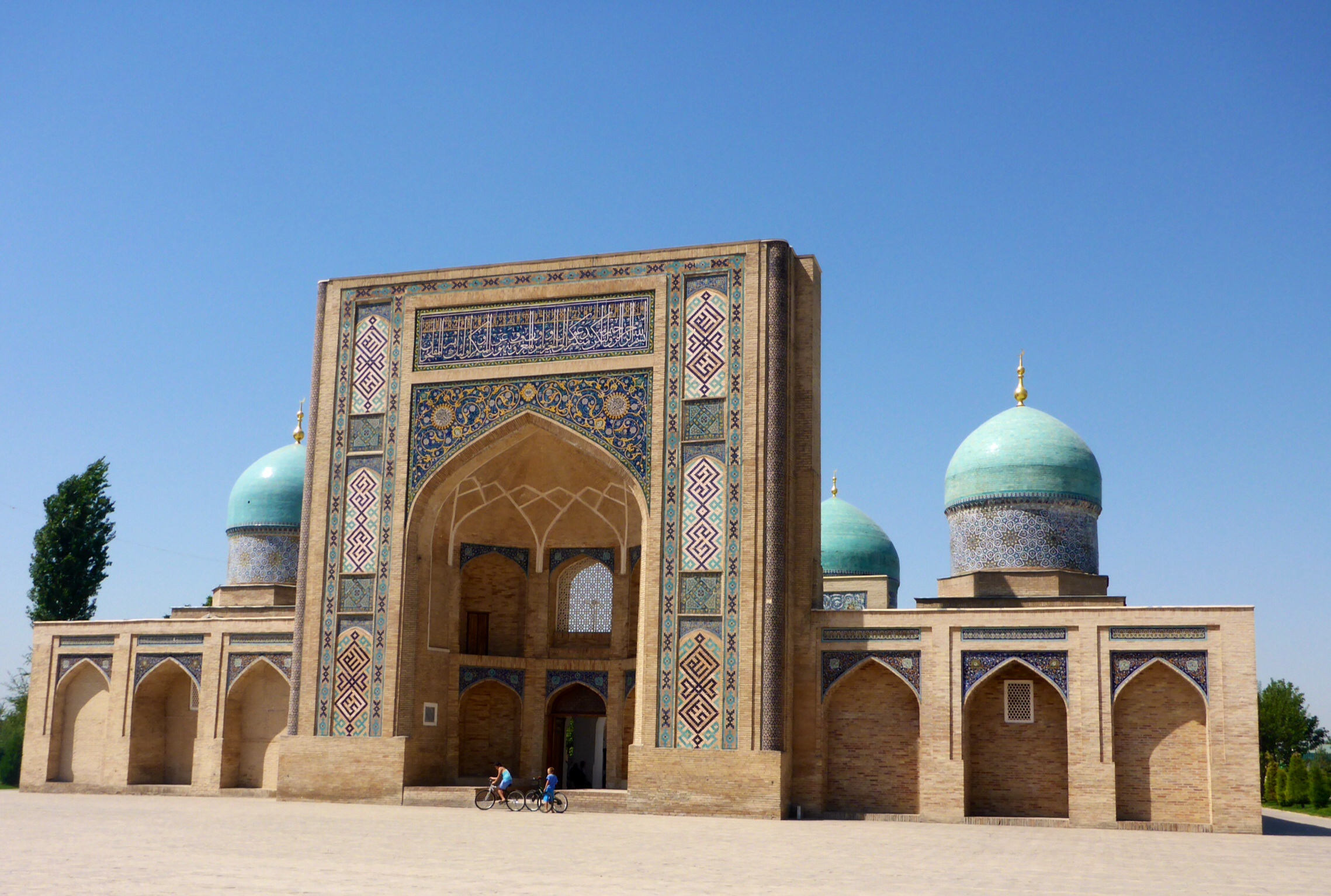
Visiting the Barak-Khan madrassah gives us our first view of Tashkent history. We find it down little back streets not on a main street as the new buildings are. We meet a few children skateboarding on plastic bottles, the eldest gives Anne a wreath of leaves to wear.

Who needs expensive skates or skateboards when flattened water bottles do the trick? Barak-Khan madrassah, Toshent, Uzbekistan

After I asked whether I could take a photo of her skating, she offered me one of her head bands – too sweet. In Toshkent, Uzbekistan
We had not made it to a market so far on this trip, but decided that we would in Tashkent. The biggest market is the Chorsu. The section of the market we explored is primarily foodstuffs and we were able to stroll down rows of spices, vegetables and fruit. We were however given fruit to try, and handfuls of vegetables from friendly stall holders.

This vendor and her son were so sweet – I loved her eyes and gold teeth too. Chorsu market, Toshkent, Uzbekistan
As you will have seen from previous photos, money comes in big bundles, with approx 2300 cym to the US $ and mostly only 1,000 cym notes everyone carries large wads of money. Supermarkets and shops have counting machines, you hand a wad over and then deal with the discrepancy. No idea why the country does not have more of the larger 5,000 cym notes except that they only started printing them in 2013. This picture shows 2.7 million, the payment for a wedding reception.
Official process here is very important: to get a Uzbek SIM card for my phone, to upload photos to the blog, hotel WiFi is useless, I needed no only my original passport, but my specific hotel registration card. Let’s just say that not being used to such specific requirements and not being able to use copies resulted in a number of trips back to the mobile phone store.
Off to Samarkand next where Anne is looking forward to a cultural and visual feast.
– Anthony
Uzbekistan traffic light lesson
Riding into Tashkent
Before I forget, I want you to know that we too anxiously look out for your comments and emails!! They are our connection back to you because although where we are and what we are doing might sound all very exciting or exotic, hearing from our family and friends means so much to us. So thank you!!!
As soon as we leave our friendly customs post into Uzbekistan, we instantly feel the difference between Kyrgyzstan and Uzbekistan. Every one we drive past waves, give us huge smiles, thumbs up and says hello. We pretty much ride with one hand. I don’t think I’ve laughed ever as much while riding. Our pace is slower as our rush is now over. It feels wonderful. We arrive at the first little town, Uchqorghan 15kms from the border and decide to pull over and get a bite to eat, especially as we didn’t have breakfast before leaving the guest house and our dinner the night before was minimal once I realised the bits of ‘meat’ in the very fatty noodles was tripe – hmmm…
As soon as we pull over and park the bikes, we are approached by a very friendly young man who suggests we should go across the road for lunch. Why not?! So off we go. A cheerful vendor offers us either cheese or vegetable pasties cooked in his oven. What an ingenious way of cooking such pasties!! They cook and remain against the oven (metal drum) wall until they are wanted and he just scrapes off the number ordered – no need to reheat. Brilliant. So we order a couple of vegetarian ones with a couple of cool drinks. Another friendly local, Abduvohid, joins us and we chat. Luckily, he spoke great English as he’d just studied in London to get a marketing degree and had just recently returned to Uzbekistan. Soon his mates and other yound men join us. We ordered more of the delicious pastries and just enjoyed the company and banter. Abduvohid then told us he would love it if we could attend his wedding in 3 weeks’ time. What hospitality!!!!! One of the young men brings us ice cream for desert. Even though Anthony shouldn’t have it, he has some as he felt we couldn’t both decline. After an hour and a half, we decide we should move on and get ready to pay in Kyrgyz Som which our Kyrgyz vendor had agreed. One of the locals, Mohamid, would not allow us to pay, he would pay for us, it would be a priviledge for him he says. Such generosity and hospitality.

Our Uzbek friends after our amazing lunch stop in Uchqorghan – Abduvohid on my right and Mohamid on my left
As we head back to the bikes, a huge crowd follows us. Photos of course!! Some get on the bikes, more photos. Swap phones, more photos. Another gets onto Anthony’s bike and wants to hear the engine. Then, quick as a flash, he’s off revving like a lunatic and takes off!! Eeek. Don’t worry says Abduvohid, he’ll come back.
We look ahead in the direction he rode off and we see a bigger and bigger crowd gather. Hmmmm, doesn’t look good. So Anthony walks over to investigate. Luckily the guy had stalled and couldn’t start if up again or drive further, but unfortunately, he must have driven into something or fell against someting as there were marks all over one side of Storm. Nothing broken, no dammage done, just a few scratches and one rear view mirror loosened (not an easy feat) but it enabled Anthony to reposition it better anyway. Back to the original crowd, and we say our final goodbyes.
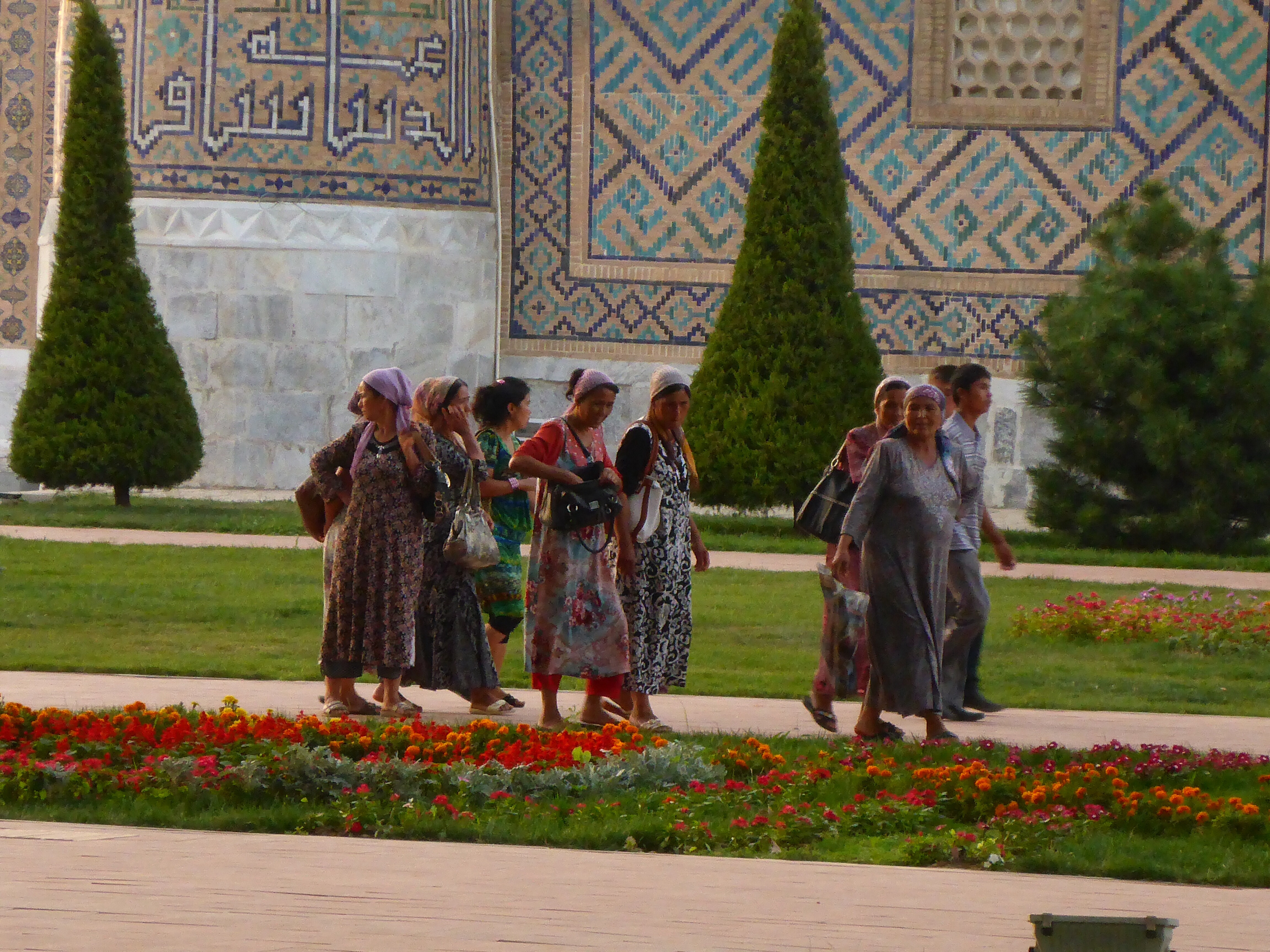
We ride off a kilometer or so and pull over as the mirror really needed fixing properly and was going to need us to get the tools out. So we pull over again. And yes, you guessed it, another crowd gathered. All the workers at a work site stopped work and came over. Such friendly people!!!! Since we’ve arrived in Uzbekistan, we are greetly differently ‘asalam malekum’. Women have colourful headscarves tied behind their heads, longer skirts, men’s heads are covered too.
Eventually, we head off again for Andijan. Waving constantly, answering questions as cars overtook us. The driving style is so different to Kyrgyzstan, thankfully. There is none of the impatience of the previous country. The hooting of cars was no longer from impatient drivers but for friendly waves and chats. The pace is slower. The cars are smaller and due to the lack of trucks in the area, the roads are in good condition. There is also a distinct lack of police on the roads. I think we forgot to mention how many police were on the side of the roads in Kyrgyzstan. And the number of times we got pulled over, just because. They were everywhere. Here in Uzbekistan so far, not a single cop.
We arrive in Andijan and drive down what looks like a movie set row of houses. If feels strange. All we see are new houses and modern buildings – most of the. Empty shells.
We eventually spot a hotel, pull over and check if they have a room for us. The guy only speaks Russian or … German. So now we chat for ages in German!! And he shows us to our enormous room. Anthony feels better than last night! We shower, do some washing and get ready to find a restaurant. Thought we’d check out the roof top terrace first. Wow, what a view!!! And again, a surreal surrounding. After dinner, we decide to go for a walk to the mosque. We now see what’s behind the new facades: the real Andijan of tiny homes, tin roofs, twisty lanes.
Andijan has an interesting history. It is one of the oldest cities in the Fergana Valley, archeologists having found items dating back to the 7th century and was an important city on the Silk Road. It was the capital of the region until the 18th century when it moved to Qo’qon (Qoqand or Kokand). Then in 1876, the Russians conquered the Khanate of Qoqond and the city of Andijan along with it.
Divided into three subdivisions by the former Soviet Union, the Ferghana Valley is ethnically diverse, and while the borders did not make much difference during the Soviet period as the entire region was developed to grow crops, it has been the scene of ethnic conflict since the early 21st century. After independence in 1991, Andijan became part of the Uzbek SSR. A large triangular valley in what is an often dry part of Central Asia, the Fergana owes its fertility to two rivers, the (stunningly blue) Naryn and the Kara Darya and the many dams constucted along them, many of which are now in Kyrgyzstan. There are still many enclaves along the Kyrgyzstan, Uzbekistan and Tajikistan borders, and the problems these create don’t look like they will be resolved soon. See the little circles on the map below and red dotted arrows.

Map of Fergana Valley, Uzbekistan, showing some of the enclaves whose access is disputed -see the red arrows
Andijan is home to the area’s only car assembly plant, previously Daewoo and now Chevrolet. We had never seen small Chevrolets before, and they are everywhere here. Obviously, a lot of recent money has been poured into Andijan. We wonder whether any money will be invested into maintenance down the track and fear that it might be like what we saw in Kyrgyzstan where money had been spent some time ago, but things had got into disrepair due to lack of maintenance funds.
We had to chose our route carefully as some roads pass through some of these enclaves and we only had single entry visas into Uzbekistan.
As we ride through the fertile Fergana Valley to Qo’qon, the air smells sweet with melons. The Fergana Valley is the most densely populated area in central asia. Roadside vendors sell different products as we ride along the valley: from watermelons to pale yellow honey dew (ultra sweet), pumpkins, then apples. We saw crops of corn, rice, wheat, cotton, various vegetables and fruit trees. As we leave the valley and are about to head up the mountains towards Tashkent, the last stands sell just bread, beautiful golden flat round loaves with different pattens in the centre.
In Qo’qon, our hotel kindly get us to park our bikes inside the back of the hotel. Our room is a bit querky: we have our own bathroom, the wash-hand basin
/shower/bath are all in one and a massive cow hide covers the floor and threatens to trip us up with its curled corners. We cool down before visiting the stunning Qo’qonPalace.
The next morning, we get up early to admire the Palace in more gentle light then get to the bank for it’s opening at 9am. It is a slow process because of all the forms that they need to complete and get signed and stamped along the way. It is not because we are foreigners, it is the same for anyone wanting to change even the smallest amount. It took us and hour and a quarter. We changed £200 and got half a kilo of notes!!! All in 1000 cym notes.
We are ready to head to Tashkent. I feel a sense of excitement at the thought of getting there. As we head towards the Kamchi Pass, there is suddenly a police and massive queue. When we get to the front of the queue, we are told to park our bikes and go over to a little hut. We show our passports, they make note of them, and we’re on our way. Another similar but, this time, quicker queue a few kilometers down the road. Why? Because this stretch of road is along the border of one of Tajikistan’s exclaves.
The ride up and down Kamchi Pass is stunning. We stop at the top for a mandatory photo opportunity, a drink and some local dried apricots and almonds.
The road is being upgraded, and once again, we fail to understand the logic in how they build and open the different sections to traffic. We constantly swap from good to old, single lane to double, and swap from sharing our side of the road to driving on the other side. All in all, a good road and mostly good drivers. And much waving!!
We finally arrive into Tashkent. Our hotel is very well situated and it should be easy to find. Suddenly, Anthony tells me he has been pulled over by a cop. What have we done wrong? We knew we weren’t speeding so it couldn’t be that and it didn’t seem like the sort of place to pull us over just for a chat. Had we gone through a red light we’d missed? Traffic lights were awfully difficult to see here and they didn’t all work but maybe we’d missed one. We both stop and get off our bikes. The cop tells us that motorcycles are not allowed on this road! What?! He shows us a road rule book. Where is the sign we ask?? He looks frustrated and calls someone on his walkie-talkie. Eventually, he waves us off in disgust. Very strange. Once we’d checked in, Anthony did a search on the internet: motorcycles are indeed banned in Tashkent because there had been a attempt against the president by someone on a motorbike a couple of years back. No wonder we hadn’t seen a single motorbike!!! Oops…
Eventually, we arrive at our hotel – an old Soviet era montser of a building in a fabulous location.
– Anne
Through the mountains of Kyrgyzstan
Aug 7th, 2014 – Now with photos and video!!
Two days on the road, on the way to Uzbekistan and what wonderful scenery and people have filled our days. Leaving Bishkek was a good feeling, with both the Iran and Uzbek visas safely in our passports. We are off to Uzbekistan with a chance to ride some of the mountain passes that seem to dot the Kyrgyzstan map. We head west, which will be our general direction for the next three weeks, back along the route we entered the country from. We need to keep our eyes open, because here, unlike Russia and Kazakhstan, route directions are almost non existent. We find it and are now heading towards the snow capped peaks that have beckoned us since we arrived. Higher and higher we ride, hairpin bends, cooler air and breathtaking views towards the top of the Tuz-Ashu pass at over 3,500m.
A photo stop sees us meet a couple from Moscow, a local guy who now lives in Putney in London, and Patrick a swiss guy here for a few weeks who seems to have ridden just about everywhere. The bikes seem to have to work harder as we climb up to 3,150 meters, as more throttle is required: our first thoughts had been dirty fuel, but no altitude was the culprit. How do the cyclists we see from time to time manage?Near the top of the Tuz-Ashu pass is a tunnel of some 4km, not the nice well lit tunnels we are used to, but a Soviet era model, poor lights, rough walls and floors. Single tunnel for both directions that requires whatever illumination you bring, and in some cases for the locals, not much.
We descended to the valley floor and turned west again following the river that bisects the valley. If you are a horse lover or rider, this 150km by 24km long green flat Suusamyr valley surrounded by high mountains with a fast flowing river bisecting it has to be a must visit place if you have not done so. Watching the horse herds grazing and being herded as they must have done for centuries leads you to imagine a simpler way of life from our complex world.
We had decided we wanted to camp, not stay in a yurt, which a number of the camps close to the road were offering. While a great experience for many, not for us this time. As we climbed up to the Ala-Bel Pass the temperature dropped down to 11 degrees celsius at 3,184 meters. Wish the ventilation zips were easier to close while riding.
A winding decent brought the temperature up and yet a third change of scenery as we descended towards Toktogul.

Still looking for a spot for the night and the sun is starting to set, down from Ala-Bel Pass, Kyrgyzstan
At the side of the road we observed buckets filled with red fruit for sale. A quick stop revealed buckets of raspberries, Anne’s favorite fruit, but where do you put a bucket of raspberries on a motorcycle, so sadly no purchase possible (our top box was full of vital drinking water).
The mountain passes take their toll on the trucks – often we see trucks at the side the road undergoing repairs. It is not unusual to see other trucks stopped to help and the repairs are quite major judging from the parts being removed. No recovery service here. Occasionally a truck will be parked where it broke down, marked by a couple of warning rocks with a rear axle at 90 degrees to normal. It had taken us a little while to realise that European companies are not transporting goods in Kyrgyzstan, but that second hand trucks from Europe are not repainted.
Finally, at 8pm, we chose a campsite, next to the road, with a great view across our valley to the Toktogul reservoir. Once the sun goes down the traffic will stop and we could sleep. Wrong! Second hand cars break down more in the heat of the day going up the passes, so they travel at night. Only a couple of hours sleep for us, then our morning truck horn wake up at 7am.

The largest wasp we’ve ever seen, 3cm long : it dug this hole in no time when we couldn’t even get our tent pegs into the ground
We both agreed as we travelled along the south side of the Toktogul reservoir, that we would do this road again, the variety of views, scenery, mountain passes, lakes and the condition of the road make this a great route to travel. We will come back to this region one day to ride again to explore all we have not seen.
We meet a young french couple from Bordeaux, who have spent 400 Euros in Bishkek on a 1979 Ural motorcycle with sidecar. The only problem is that it breaks down daily and they are spending more time sleeping at garages than hotels. Today’s problem is an oil leak from the rear wheel drive assembly. Luckily our BMW toolkit has an adjustable spanner than fixes, for now, the problem. I am glad it was not the broken piston suffered a couple of days ago. What a great way to travel and a different set of fantastic experiences. Each to their own, but not for us (although Anne has said that traveling with a single bike and side car could be a fun way to travel one day, but on a more reliable model than this French couple’s). Good luck to them as they set off up the mountain pass.
We decide that a good night’s sleep before we cross the border is in order. With the help of some locals in Tash-Kömür we find a guest house. It seems to hold about four generations of the family and assorted other. We get a small room without the promised bathroom, which we seem to have got used to over time and especially the last month’s travel. Am I getting soft in my middle age? We had much rougher in Africa, Asia and the Americas in the past and I just accepted the conditions, now I think that if I am not camping, at the end of the day, an en-suite bathroom and good fans or air conditioning, especially in these temperatures, is very desirable. Maybe really roughing it in one star or less is going to become a thing of the past for me, time will tell.
– Anthony