The Kangaroo Route Reimagined

As we enter the Qantas lounge at Brisbane International and our boarding passes are scanned by the friendly staff, I realise that this is almost the first person we have interacted with since our friend Jane dropped us off at the airport. Baggage tags printed by a kiosk, luggage whisked away by an automated bag drop, boarding passes sent electronically to our phones, through Immigration via a kiosk and no interaction with anyone apart from the one person getting us to come forward into the body scanner at the security check. At least we still have crew on the aircraft!, Times they are a changing…

Outbound heading for Singapore on the first leg of our journey to the UK. Previously this has been a one stop 24 hour trip for us in economy with the attendant jet lag, but over the years, we have found this journey harder and harder. Time for a change.

In the 1930’s, Qantas Empire Airways and Imperial Airways, great names, started a 12 day service between Australia and the UK. The service had over 30 stops, some just to refuel, and passengers flew in small noisy aeroplanes with inflight service being sandwiches distributed by the pilots during the day. Nights were spent on the ground with dinner and sleeping in what I hope was a comfortable bed. We plan to emulate the better aspects of this, daytime flights, although only 2 stops over four days in modern aircraft and comfortable hotels. We realise that this will cost more but provides more measured time changes and the opportunity for a little sightseeing en-route. We will have one night in Singapore and two in Doha. Travelling from Australia to Europe the route opportunities are endless and perhaps some of the smaller airlines could work together to create such options for people like us, rather than the one airline through journey, at a reasonable price.

Out for dinner in Singapore: we thought Thai restaurants would be good for gluten free food, but a number of places we tried said no, or just offered plain rice. Possibly because they were not set up for tourists. We settled on grilled fish at an Indonesian restaurant followed by a comfortable night’s sleep.
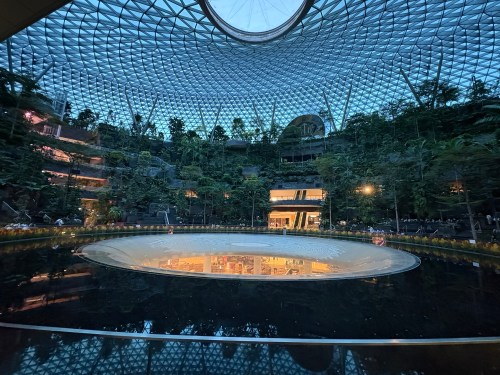
The “Jewel” at Changi Airport sans water
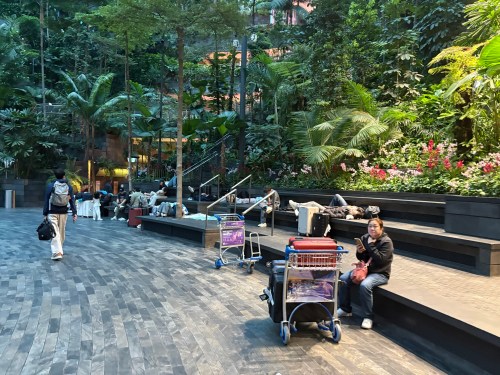
Free overnight accommodation at Changi Airport

Singapore Passport control outbound does not require any use of a passport as my attempts to find a place to insert the passport are to no avail. I am assuming facial recognition in use similar to Hong Kong airport flight boarding last year. How many copies of my face exist on computers around the world now?

Our Qatar Airways flight to Doha is not full and we have a spare seat next to us, great. Free Starlink provides connectivity to the internet en-route, a first for us. We can see and connect to the world, apart from over India where the service was suspended, for web, emails, messages. I used to enjoy the long haul flights for work without the distractions of emails and messages. No such luck today. Although Anne is happy to continue chatting via Whatsapp or Messenger while flying.

Even the “2slowspeeds”, supposedly experienced travellers, get it wrong: as we pass through Doha customs, an alarm goes off and we are called aside. We have a bottle of Finnish Liqueur that Anne brought for her sister last year and we were taking to England. Confiscated, no alcohol allowed into Qatar: all luggage must have been scanned before getting to us on the luggage carousel and they even x-ray hand luggage on arrival. What a waste and disappointment.

Why I ask myself am I holding 9.75 kg. / 21.5 lb. of dates when we only went out for 50 grams of saffron? Well, as we walked to the Souq Waqif, there was the “4th Souk Waqif International Dates Exhibition”, no not “Dating”, “Dates” the eating kind. Now Anne is partial to these small tasty fruits so we had to go in. Saudi Arabia, Qatar, Algeria, Sudan, Palestine and a host of other countries were showing their wares. Tasting opportunities abound and we take full advantage, hence the packages in my hands. An unexpected opportunity as the exhibition only opened in the afternoon and some stands were still setting up.
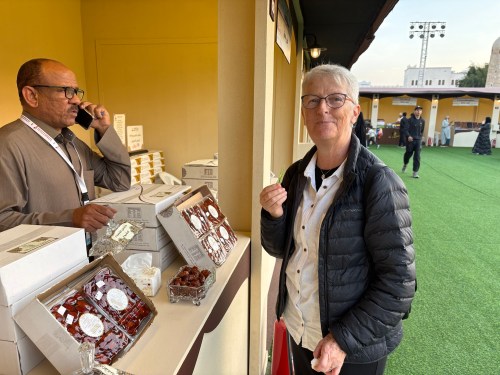
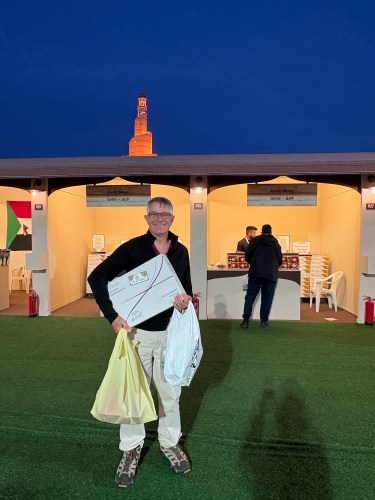
Mmm tasty dates. 45 more stands to try.
You brought how many boxes of dates?

Being Friday our second day starts late. Nothing is open until 12:30 at the earliest so no rush to get out, plus the temperature is a cool 19 degrees celsius. Anne has noticed that Art Basel Doha opens to the public today. An opportunity to see what is happening in the art world here in Qatar. Anne spends a couple of hours there.
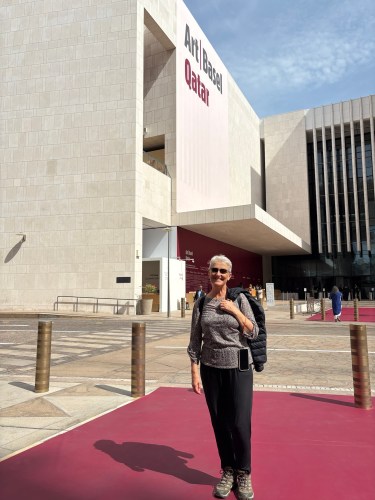
Looking the part on the red carpet.

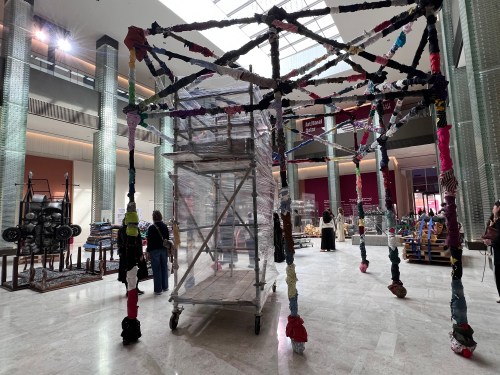
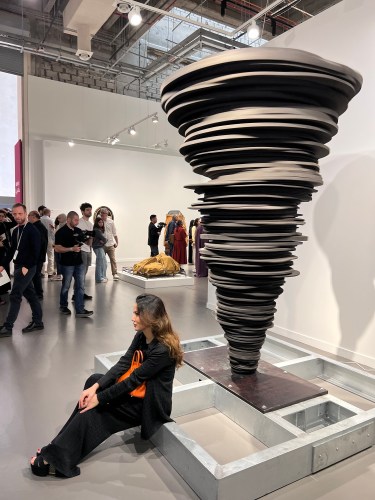
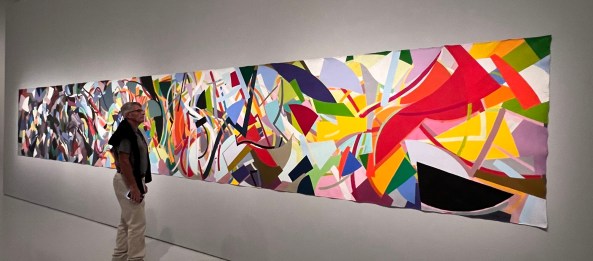
In today’s of world of instability and wars, it is not surprising that there is an overwhelming message and representation of environmental and political pressures and human displacement embedded in many artworks.
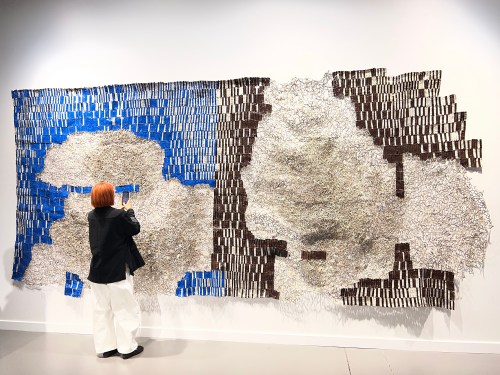
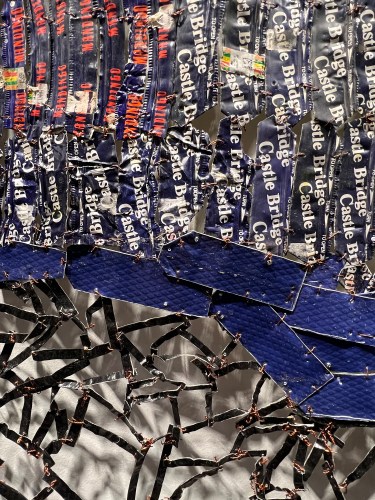
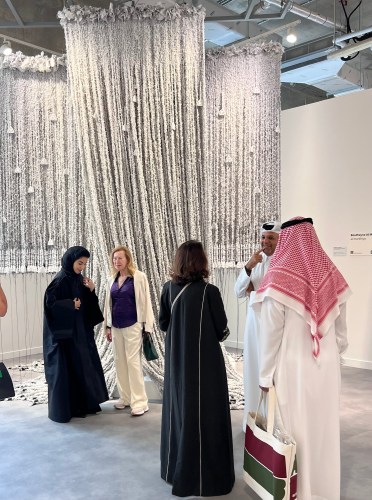
Continents in Gestation (2024) is a large-scale, shimmering tapestry by acclaimed Ghanaian sculptor El Anatsui, crafted from repurposed aluminum bottle caps and copper wire.
Fascinating detail of El Anatsui’s artwork
Khalil Rabah – Transition, among other things
Beautiful people posing in front of artworks
Bouthayna Al Muftah
Living: Architectures of Memory

And the finally some colour to lift the mood …
Perfect photo bomb as Anne was about to take a photo

We had previously been to both The National Museum of Qatar and the Museum of Islamic Art in 2025 but had not been to the Heshrap Modern Art Museum. Time to remedy that. The museum is accessible by Metro and Tram some 16km from our location. The Tram here was likely built to transport fans to the World Cup football matches at the 44,000 seat Education City stadium. Today we are the only passengers apart from the Kenyan security guard with whom we talk about Nairobi, where we lived back for a couple of months in 1982/3, Mandazi (Kenyan doughnut), Matatu Kenyan minibus/taxi and Mzuntu (foreigner), some of words we all know come flooding back. We had a good time in living in Nairobi. Each of the Kenyans we met asked when we were going back. Good question. After so much time has elapsed, would anything we knew still be the same?

Coming out of one gallery, we are greated with this intriguing display:
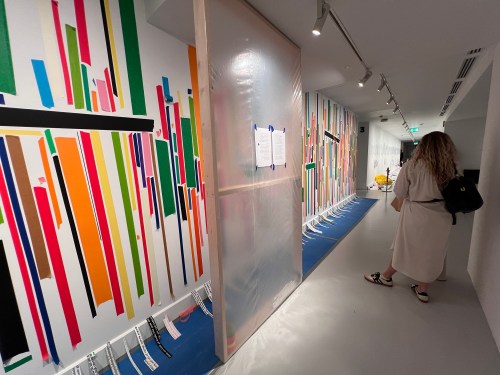
Walid Raad and Pierre Hughebaert installation

In the middle of it is a notice with the following:

“Commissioned by Mathaf, we (Walid Raad and Pierre Hughebaert) set out to create a mixed media installation for this corridor, assembling headlines and statements by artists, curators, and others working in the arts about the wars in Palestine-phrases we wish were ours, and ones we would never claim. After shipping our materials to Doha, we arrived six weeks ago to find our assigned corridor arranged in an odd way. It quickly became clear that someone, most likely a technician or staff member, simply aiming to be helpful, had organized our materials to make installation easier. We abandoned our plans and decided to leave space as it was. Needless to say, we spent weeks trying to identify the culprits who had freely yet fastidiously laid these “facts on the ground.” But to no avail.”
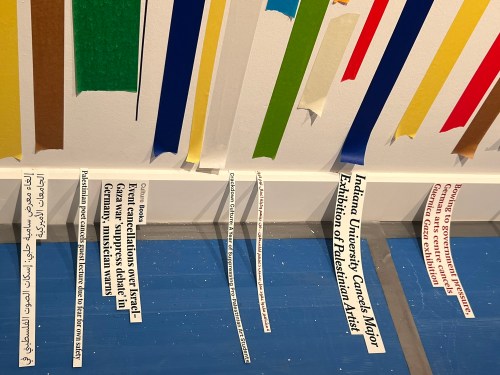
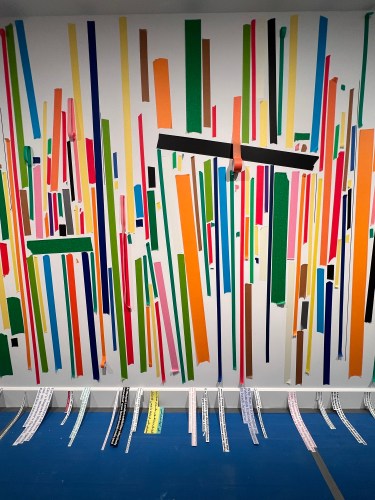
We wonder what the artists’ original intention was
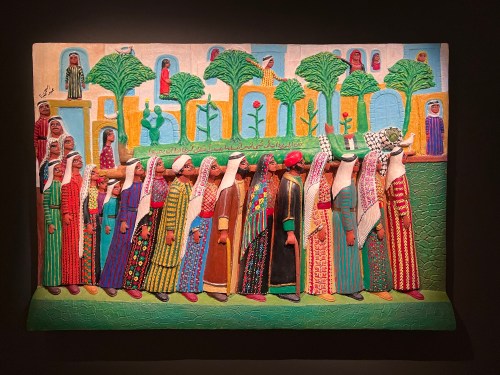
Palestinian Abdul Hay Mosallam Zarara depicts massacres and family displacement

Using the Metro and Trams is easy and cheap. A day pass for six dirhams (AU$2.5) allows unlimited travel on both. Very good value and need to be brought from the staff at offices at each station, not the machines I think.
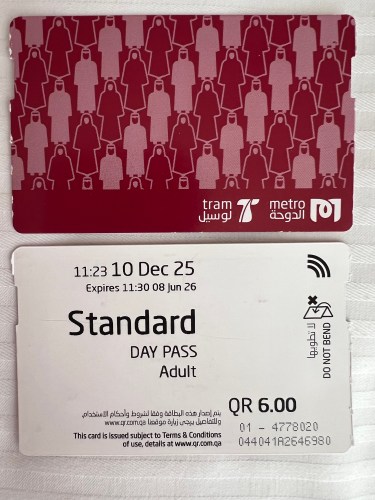
Cheap public transport in Doha

For dinner we are back to our favourite Philippino restaurant Shore Time where they do a grilled chicken and steamed vegetables for the troublesome coeliac. Nice to have eating places I can return to. One more night’s sleep and we will be heading to London.
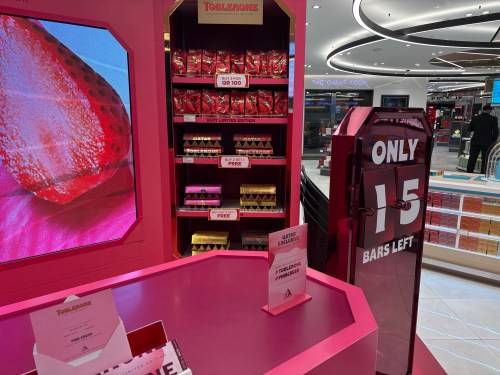
Quick they will all be gone soon.

Spend US$40 on a limited edition strawberry flavoured Toblerone, only 15 left “even comes with a numbered certificate to remind you of what you ate” the salesman espouses. Much as I love Toblerone, gluten free and all, I will pass on this one. Smoked salmon for brunch with a glass of bubbly in one of the many Qatar Airways lounges will have to suffice.
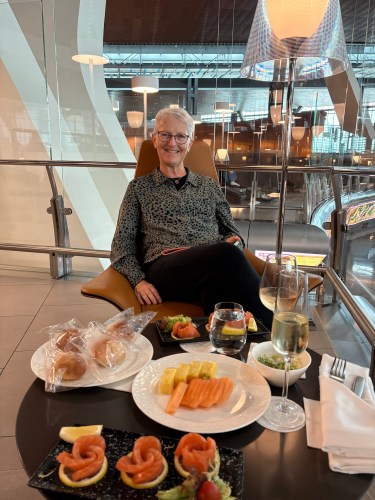
Relaxing in the Qatar Platinum/Gold lounge in Doha

Seems that the days of wearing masks on plane is over. We appear to be the only people wearing masks. While waiting to board our flight to London, the coughing around us sounds to me like an orchestra tuning. Never heard so many people coughing, but no one seems to care, we are keeping masks on and bugs out! We will let you know how that turn out.
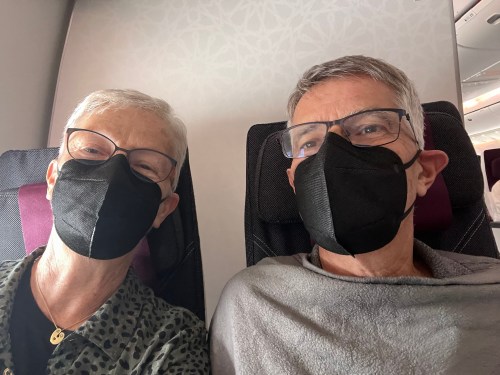
London in 3 hours but no planned motorcycling on this trip, too cold and wet amongst other things. We have enjoyed taking this travel approach, only daytime flights and spending time sightseeing en-route: I think this will form the basis of our travel to Europe going forward.

– Anthony
2 days in Doha

Doha, a city less than on tenth the size of Ho Chi Minh City where we have just come from is a perfect mid point stop over to London. But it is much more than a convenient stop over point to avoid jetlag before we get to our family in the UK.

First, our journey over to Doha. With Anthony’s judicious use of points, and my Virgin status thanks to my flying up to Cairns for the past 19 months, we are sitting at the pointy end of this HCMC-Doha Qatar flight. The food menu, the selection of wines and the service are all impressive. We both particularly enjoyed the French 2016 Chateau Cantermerle red. What a contrast arriving in Doha to our Ho Chi Minh experience. No queuing for 2 hours to get through immigration but a swift pass through a private lounge and we’re out in the taxi just 30’ after landing!!  

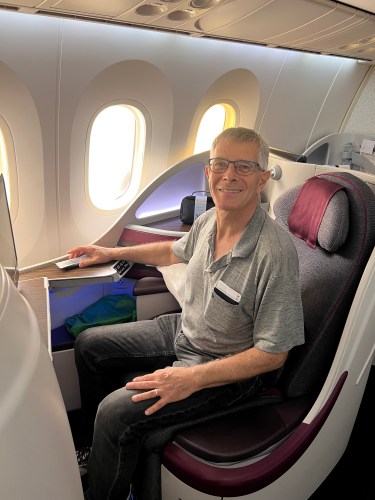
Qatar Airways business class – very nice!

Doha has metamorphasised since I was first there in 2005!  There was one international hotel back then – the Sheraton, with its funky design. The Sheraton was widely recognized as a symbol of the Doha Corniche’s development.  It also catalyzed the creation of a new central business district called Al Dafna built on dredged land in the 1980s. It is still there, but totally surrounded now by much taller modern buildings and apparently refurbished inside.  

We get to our hotel which I picked for its location close to a number of cultural museums I have been looking forward to visiting. We get the usual super friendly Arabic welcome and an added surprise – we have been upgraded to a studio for the next three nights!  The bathroom is 3 times the size of ours at home!!  Very nice!  

Another welcome hotel upgrade

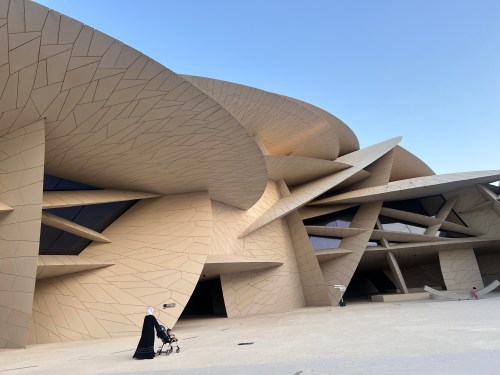
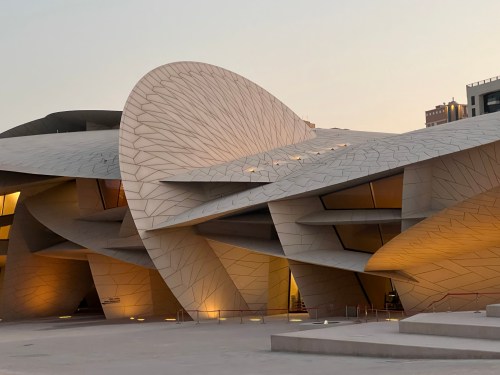
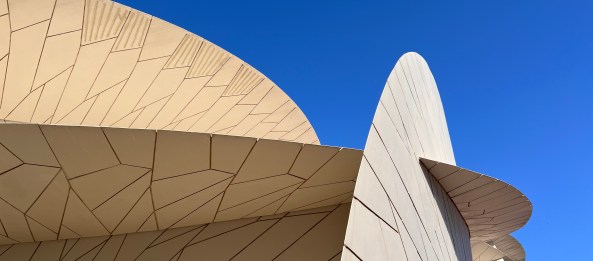
I cannot wait to discover the National Museum of Qatar close by, affectionately known as the Desert Rose for obvious reasons when you see it.   In the words of the architect Jean Nouvel:

“The National Museum of Qatar is dedicated to the history of Qatar. Symbolically, its architecture evokes the desert, its silent and eternal dimension, but also the spirit of modernity and daring that have come along and shaken up what seemed unshakeable. So, it’s the contradictions in that history that I’ve sought to evoke here. I wanted to create a structure that evoked the local geography and, in keeping with the tradition of the place, to ensure that it offers maximum protection from the sun.”

The sun is going to be setting in an hour so no time to linger in our luxury appartment right now and perfect to admire Jean Nouvel’s creation in changing light. It is closed today but we’ll be visiting it tomorrow. We’ll just enjoy the outside architectuee for now. 

National Museum of Qatar

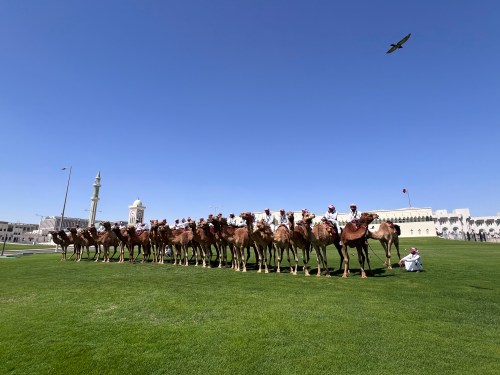
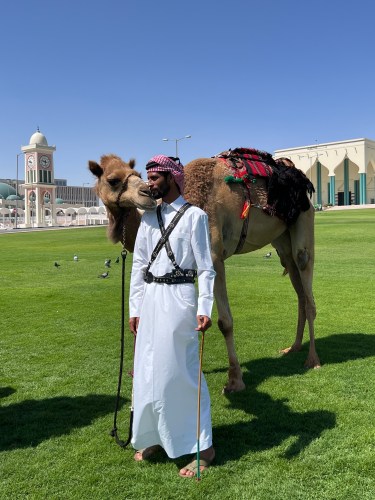
After a leisurely breakfast and a washing load (the apartment has a washer/dryer!) we decide to walk to the Falcon Souq (market).  There are very few pedestrians out as it is hot already!!  We wend our way to the souq, through the Souq Wakif Park first, and after first stopping for an unexpected sight.   The Palace Guard is out, lined up outside Amiri Diwan, which is the administrative office of the Ruler of Qatar. The Amiri Diwan is the seat of rule of the State of Qatar. It is the sovereign body and the administrative office of HH The Amir. It acts as a nexus between His Highness and all governmental and non-governmental bodies internally and externally.  The Palace Guard used to ride the most special and majestic camels, patrolling the area in order to protect their Emir (ruler).  Today, they are all lined up, happy enough for us and the 3 other visitors around to take photos. The guards eventually dismount, the guard nearest me and his camel exchange a kiss, and the whole group eventually leave the park and make their way back to the royal stables, a man diligently following behind, sweeping the road of any camel “gift”.

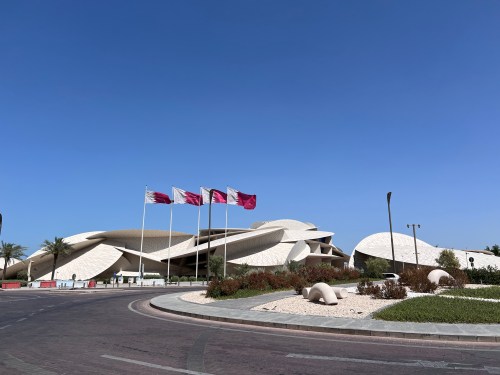
Qatari flags outside the National Museum of Qatar
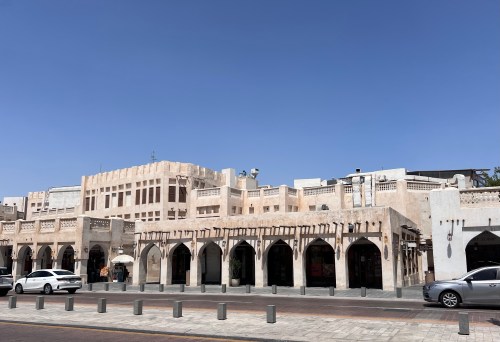
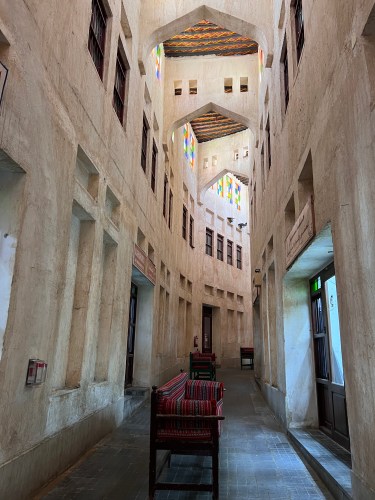
Souq Waqif
Qatar Royal Guard
“Give me a kiss” – Qatar Royal Guard
Doha business centre skyline

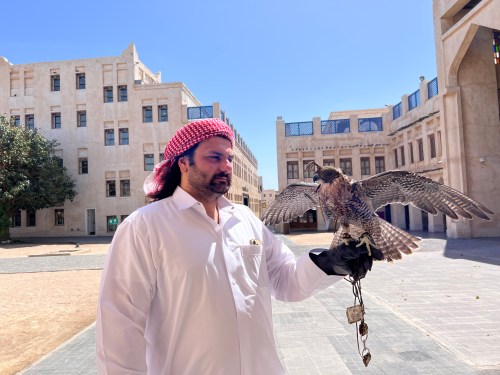
After this unexpected spectacle, we continue our way to the Falcon hospital and falcon souq.  We know we are in the right area when we come across two men each holding their falcons. We approach each one and they kindly accept we ask questions about their birds and ask whether we can take photos. They have just come from the falcon hospital, one Qatari actually holding syringes of medication for his 15 year old falcon.  

Just back from the falcon hospital
Qatari with his falcon

The falcon is the national bird of Qatar. With almost 8 times better vision than the sharpest of human eyesight, falcons silently swoop down as soon as they’ve spotted their prey. The qualities of this wild bird launched the tradition of hunting fresh meat to augment the nutrition of desert nomads, over 5000 years ago in Iran and was spread across the Middle Eastern countries over centuries. The bond created between the bird and its trainer always results in a great hunting partnership. This solitary bird educates patience, endurance, self-reliance, and valour among other things to its falconers. associated with wealth and nobility, for owning a healthy falcon is an affluent and time-consuming proposition. These formidable hunters generally have a lifespan of 12-15 years. 

The Peregrine falcon is the fastest recorded animal in the world with a flight speed of up to 389km/242 miles per hour. 

We make our way to the falcon  hospital next – the reception has one falcon waiting its turn, perched on one of the many perches. Behind reception is an xray on some poorly falcon being examined. 

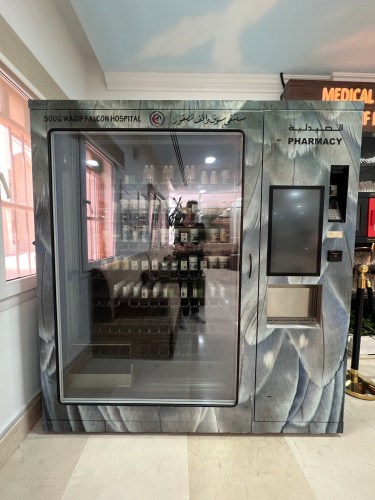
There is small museum which visit and try and learn as much as we can.  Walking around the reception area, we notice the pharmacy area and and automatic falcon medication vending machine. 

Flow the falcon foot prints to the hospital
Doha Falcon Hospital Reception
Falcon hospital medicine vending machine

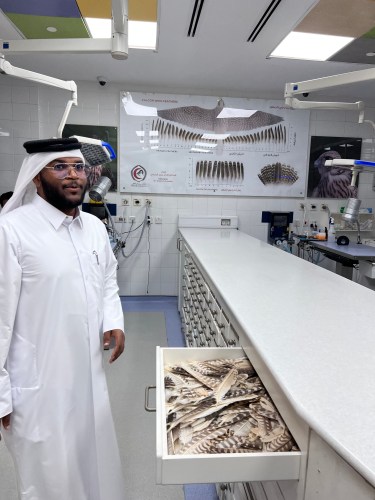
One of the receptionists notice our keen interest and asks if we’d like to visit the hospital and takes us around.   It is the low season so there are no falcon being operated on right now but he takes around all the rooms, explains the history and physical capabilities of these magnificient birds and explains how they replace feathers.  Fascinating.

Doha Falcon Hospital
Analysing xrays and specimens
Doha Falcon Hospital – each feather is numbered

This falcon hospital is run by the government, which tends and cures injured falcons.  There are also more expensive private falcon hospitals. It is like our medical health, pay more if you want your bird seen to sooner. 

After our wonderful private tour, we head off to the souq. I am not sure how many stores there are in the area but easily a couple of dozen stores dedicated to falconery parafanalia, falconery camping equipment and even falcon sales. As it is the off season, the sale is on and you can buy an older falcon for just a few thousand dollars. The new season with younger fresher birds starts up again in August. It was interesting to hear that most birds come from Germany, a cooler and better climate for breeding. We are told some birds easily reach US$275000. 

Doha Falcon Souq

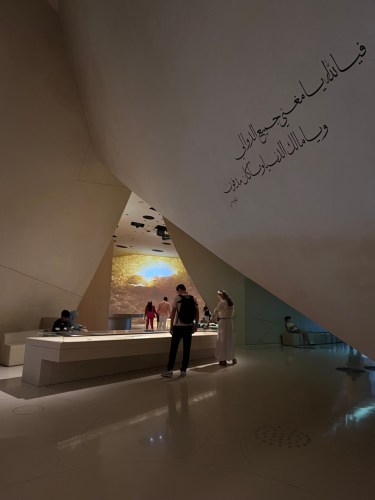
After returning to our hotel for a rest, we head out again around 5pm to visit the National museum. The inside architecture does not disappoint. 

Inside the National Museum of Qatar

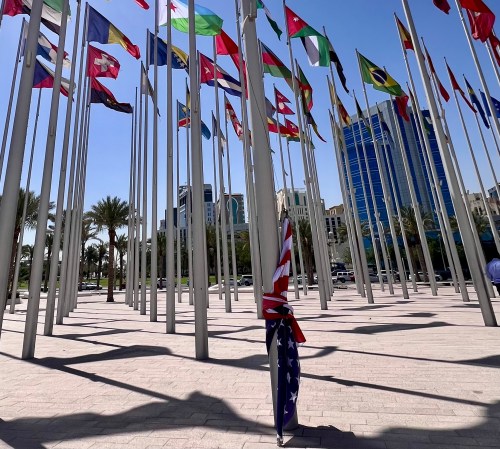
On our 2nd day, we head to the Islamic Art Museum, via the flag plaza. Interesting to notice someone obviously removed the US flag and tied it up close to the ground…. No doubt a reaction to the recent political events…

Who removed the US flag?…

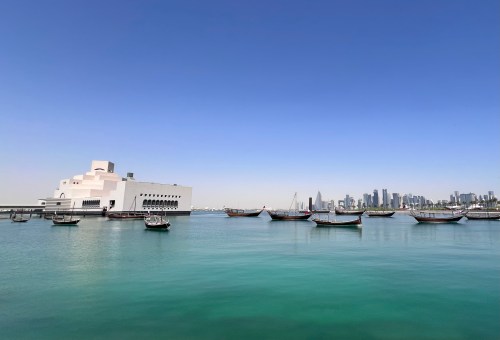
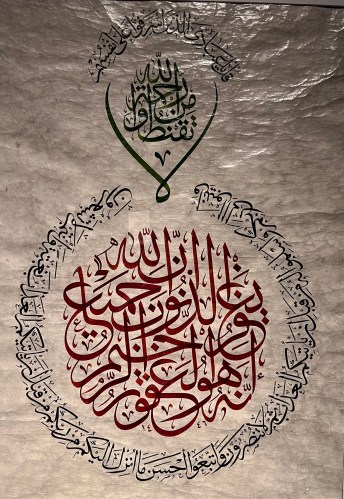
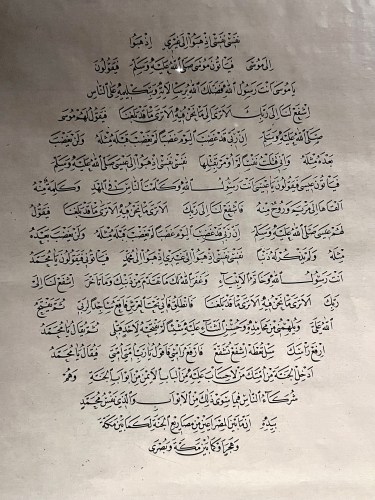
We are lucky that the Islamic Art museum is currently showing the results of the Al-Ragim International Calligraphy Competition, an international event organized by the Qatar Ministry of Endowments (Awqaf) and Islamic Affairs, in collaboration with the Museum of Islamic Art. The competition was designed to feature five distinct Arabic calligraphy scripts: Thumuth, Naskh, Nastaliq, Kufic and Diwani, each one with a jeli, or larger and decorative version. 

Museum of Islamic Art, Doha

The Thuluth script, developed in the 10th century, is celebrated for its graceful, flowing form with curved and oblique lines, earning it the title “mother of all scripts.” Its name, meaning “one-third” in Arabic, refers to the slanted proportion of each letter. This scripts versatility enabled calligraphers to craft intricate compositions, particularly in Jali Thuluth, which was widely used in architectural inscriptions.  

Thuluth script

The Naskh script, developed in the 10th century, is renowned for its legibility and balanced proportions. Its clarity made it ideal for transcribing the Qur’an and various manuscripts.

Naskh script

The Nastaliq script, developed in the late 14th century, is attributed to Mir ‘Ali Tabrizi (active circa 1370-1410). He refined existing scripts to create a fluid and elegant style, becoming the standard for Persian calligraphy. As Persian became the official court language of the Persianate world, Nastalia flourished as the primary script for chancery documents as well as poetry, embodying the beauty of Persian literature.

Nast’liq script

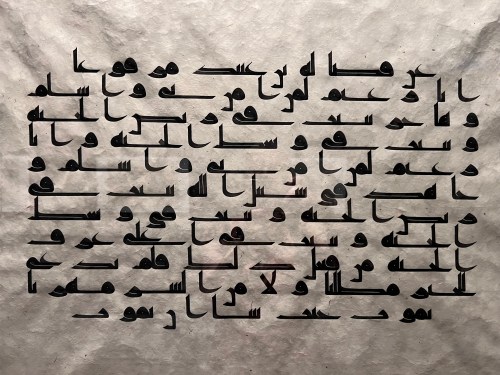
The Kufic script, one of the earliest forms of Arabic calligraphy, emerged in the 8th century, deriving its name from the city of Kufa in Iraq. Characterized by its angular, geometric letterforms with straight lines and sharp angles, as well as the absence of diacritical marks, it was extensively used for transcribing Quranic manuscripts and adorning architectural monuments. Over time, Kufic evolved into various styles, including foliated, knotted, and square Kufic, each distinguished by unique decorative elements. The oldest known inscription in an Islamic monument, using this script, adorns the interior of the Dome of the Rock in Jerusalem, dating to 691-692. 

Kufic script

The Diwani script, developed during the early Ottoman period, was used for official state documents and valued for its intricate features and confidentiality. It reached its peak under Sultan Süleyman the Magnificent (r. 1520-1566). In the 16th century, the embellished Diwani Jali variant emerged, known for its dense, ornate style, making it difficult to read and preventing forgery. Only specialized calligraphers could decipher it.

Diwani script
Diwani script

I wonder which is your fabourite. 

I was particularly taken by the Diwani script. 

What a fabulous and informative exhibition. 

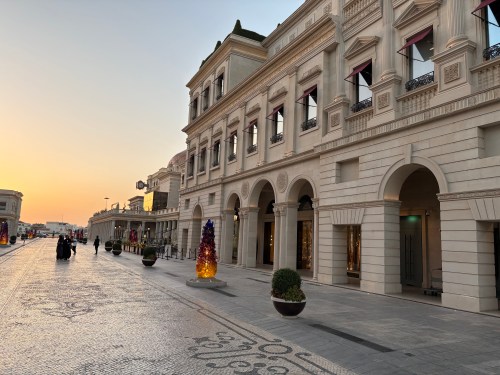
In the evening, we head to the Katara Cultural village. Maybe we did not give it the time it deserves, but I felt it was one huge fantasy luxury area. Not our thing but it was impressive to be able to sit outside for a well deserved drink in the high 30 degrees and feeling cool from the outside airconditioning coming through vents in the ground!!  

Katara Cultural village
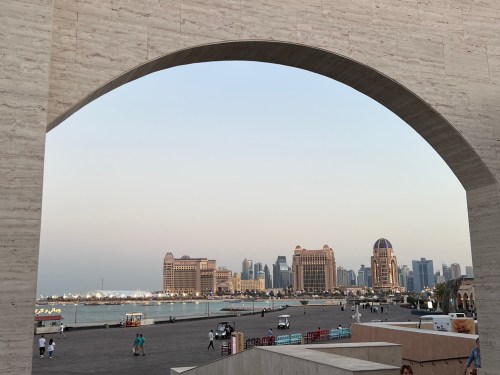
View from Katara amphitheatre towards Doha

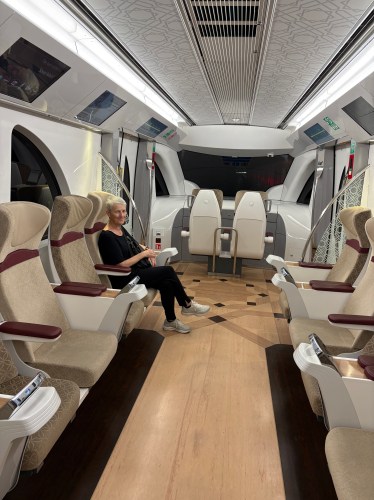
We took the metro there and back and accidentally ended up in the gold class section – once in, we couldn’t get out and move to the normal class!!

Oops – didn’t mean to be in the Gold Class section

As you can tell, we had a fabulous time in Doha. These hops since Brisbane have been great to slowly deal with jetlag. Now for one last flight before we get to see family!!  

– Anne