We arrive at London Gatwick quite refreshed after our slow 3 hop journey from Brisbane, my sister and brother-in-law there to welcome us back which is always lovely. Luckily, our 3 suitcases, suitbag, one helmet and 2 on-board wheely bags fit in their car. Yes that is a ridiculously huge amount of luggage – in our defense (maybe) is the fact that we are away over spring, summer and autumn, have a 2.5 month motorcycle trip and a 2 day wedding mid June – one large suitcase is full of just our motorcycle gear.
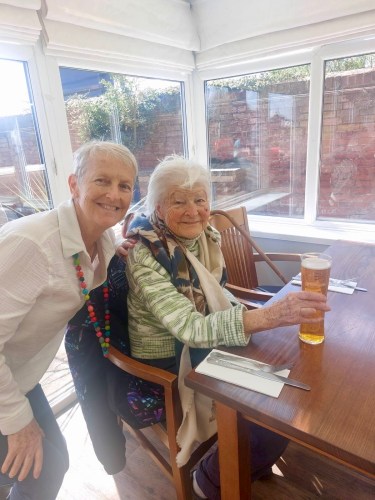
The priority for this trip is family and in particular seeing and spending time with my 95 year old mother. We saw her every day over 7 days. Ageing can be tough and cruel but at least everyday is a welcome surprise seeing us…
Out with my mum
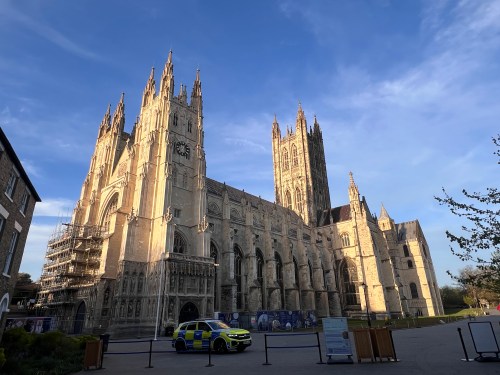
We are fortunate to have spent time with both our sisters and husbands, all my nephews and nieces (Anthony’s will be when we return hopefully). Lots of chats, games indoors and outdoors, lots of good food, plenty of champagne and a short trip to Paris to see my stepmother. Even saw our grand-nephews singing in the Salisbury Cathedral choir (No photos allowed).
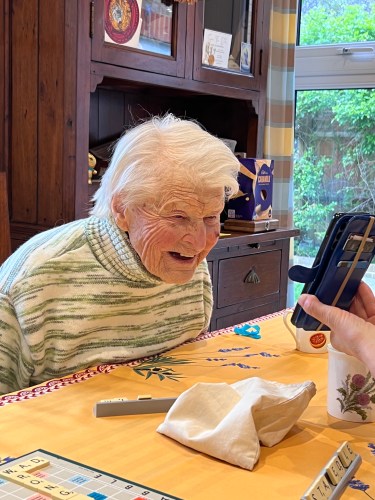
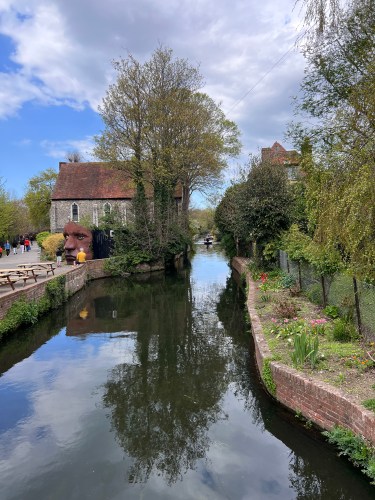
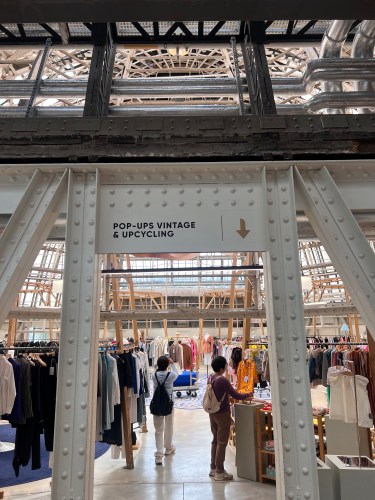
Family Easter gatheringMum enjoying a call from the missing grandson and familyPlaying Kubb in RochesterCanterbury canalSalisbury cathedral
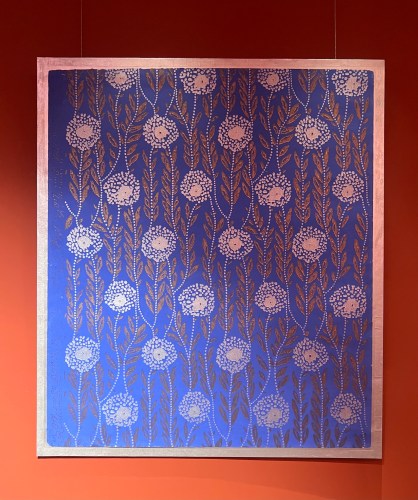
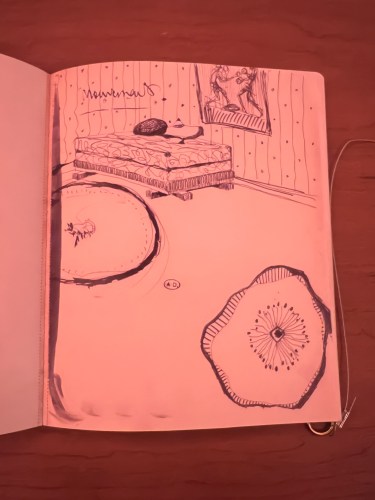
Our trip to Paris to see my stepmother Marie-Laure is short and, as always, filled with exhibitions and of course good food and champagne. The first ones are at the Musée des Arts Décoratifs, starting with an exhibition of Jacques-Émile Ruhlmann, an icon of Art Deco, who triumphed at the 1925 Exhibition. Although he is famous for his luxurious furniture, his passion for decorative motifs is less known. This exhibition only covered his textile design, no furniture. Due to the small intimate size of the exhibition, we spent longer admiring each item. Unlike when one visits places like the Louvre or the Hermitage where the sheer size of the rooms and the number of artworks can become overwhelming and you end up glancing or walking past the majority. One surprising addition were 2 sketch books of Jacques-Emile Ruhlmann’s which we could flick through.
With Marie-Laure Novel section at the Printemps, ParisJacques-Emile Ruhlmann’s Danderlion wallpaperJacques-Emile Ruhlmann’s sketch book
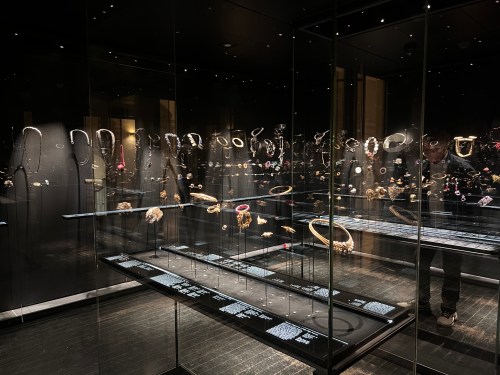
We made the most to admire some early 20th century jewellery in another exhibition next door and especially some art deco masterpieces.
Lalique combLalique brooch
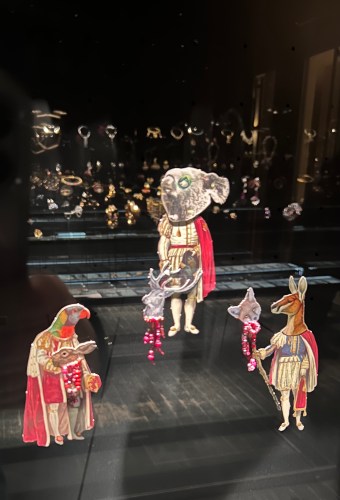
The only Australian one displayed was this…
Anna Darven’s 3 brooches
I get Anna Darven’s message relating to British colonisation and Australia’s iconic indigenous animals holding decapitated heads of introduced species – I was surprised that this was the only Australian inclusion in this display, so different to all the rest.
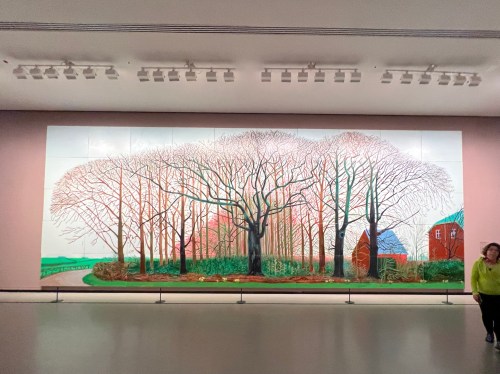
And finally, David Hockney, 25 – David Hockney’s largest ever exhibition, taking over the entire Louis Vuitton exhibition space, concentrates on his past 25 years, spent mainly in Yorkshire, Normandy, and London.
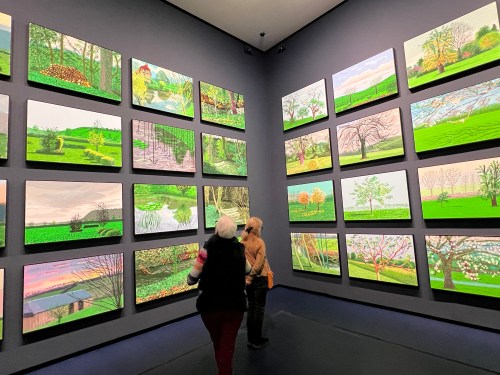
A huge room is dedicated to 220 small iPad paintings he made for friends during Covid to lift their spirits, telling them “Remember, they can’t cancel spring”.
David Hockney’s largest piece in 50 canvasses – Bigger trees near WarterDavid Hockney’s 220 for 2020 iPad paintings
As you may know, I recently finished my last project a few weeks ago. Coincidentally, one of my colleagues Mon was going to be in Paris at the same time as us so we just had to meet up in front of the Eiffel Tower and take a photo for our team, followed by a glass of champagne of course.
We were both glad we finished the project but also grateful we did it with the team we had and the dear friends they became.
Our time in Paris flew by. It was good to return to my father’s grave for the first time since his funeral exactly a year ago and help my stepmother plant some fresh flowers. A good way to end our Paris trip.
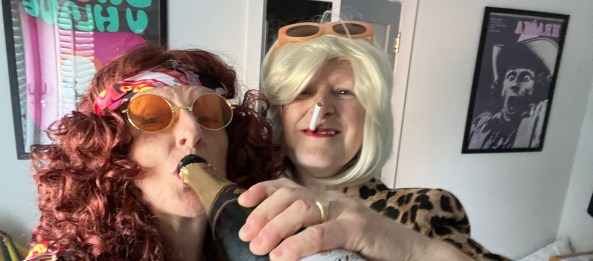
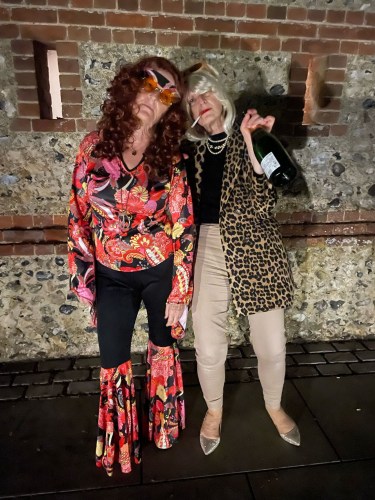
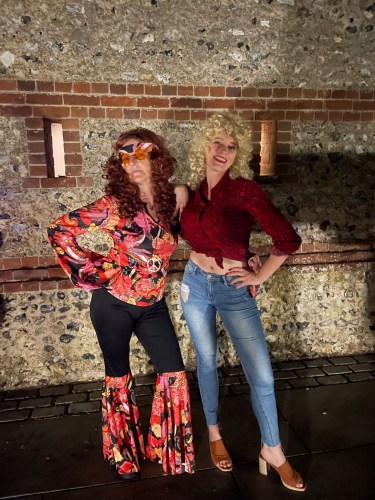
Back to my sister overnight for a quick repack for niece-to-be’s hen do. A hosted murder mystery is planned and we are each given our roles a week before the event. So much thought and planning had gone into that week end, held in a massive stunning converted barn in Kent, it was worthy of quietly making the effort into finding the right outfit. But didn’t anyone about it. I couldn’t wait to see my sister and nieces reaction! It was worth it from their screams:
How it started and continued all eveningEddie and PatsyEddie and DollyEddie, Patsy, Cruella, Dolly and Emma
What a fantastic week end! The best hen do I have ever been to. With so many fun and also thoughtful activities.
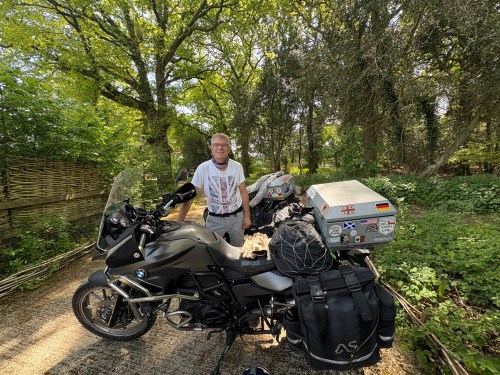
Visited my mum again then headed to Anthony’s sister Tansy for a few days and lots more chats and meals together. Streak and Storm are stored nearby and we waste no time in collecting them. What do we have in all those bags?! Packing always takes ages as we sort and cull and fix.
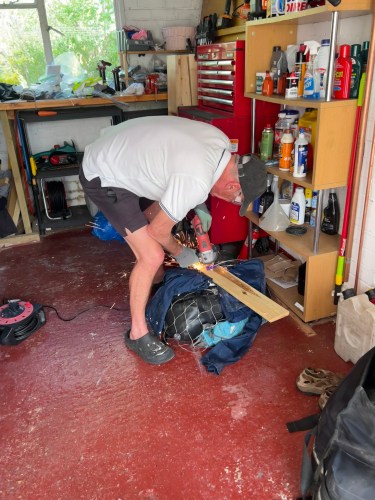
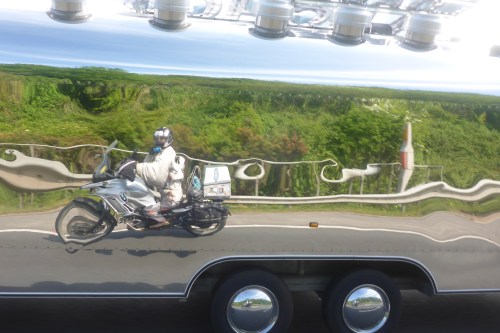
Seized lock is being dealt withHaving fun overtaking a gleaming Airstream
What an amazing time we’ve had with everyone, lucky with superb warm weather and our tight timeframe seeing everyone working out perfectly.
And just like that, with time flying by, it was time to say goodbye until we meet up again mid June for the most anticipated wedding and we set off on Streak and Storm loaded and ready for our next road trip, heading for Portsmouth and a ferry to Bilbao.
Doha, a city less than on tenth the size of Ho Chi Minh City where we have just come from is a perfect mid point stop over to London. But it is much more than a convenient stop over point to avoid jetlag before we get to our family in the UK.
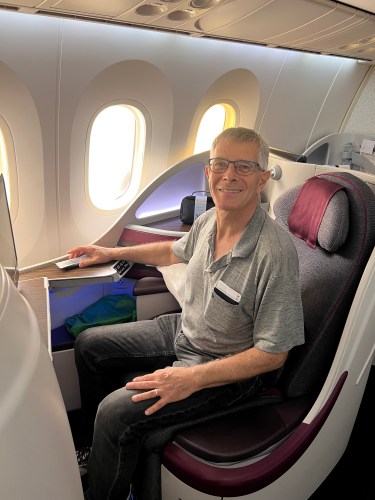
First, our journey over to Doha. With Anthony’s judicious use of points, and my Virgin status thanks to my flying up to Cairns for the past 19 months, we are sitting at the pointy end of this HCMC-Doha Qatar flight. The food menu, the selection of wines and the service are all impressive. We both particularly enjoyed the French 2016 Chateau Cantermerle red. What a contrast arriving in Doha to our Ho Chi Minh experience. No queuing for 2 hours to get through immigration but a swift pass through a private lounge and we’re out in the taxi just 30’ after landing!!
Qatar Airways business class – very nice!
Doha has metamorphasised since I was first there in 2005! There was one international hotel back then – the Sheraton, with its funky design. The Sheraton was widely recognized as a symbol of the Doha Corniche’s development. It also catalyzed the creation of a new central business district called Al Dafna built on dredged land in the 1980s. It is still there, but totally surrounded now by much taller modern buildings and apparently refurbished inside.
We get to our hotel which I picked for its location close to a number of cultural museums I have been looking forward to visiting. We get the usual super friendly Arabic welcome and an added surprise – we have been upgraded to a studio for the next three nights! The bathroom is 3 times the size of ours at home!! Very nice!
Another welcome hotel upgrade
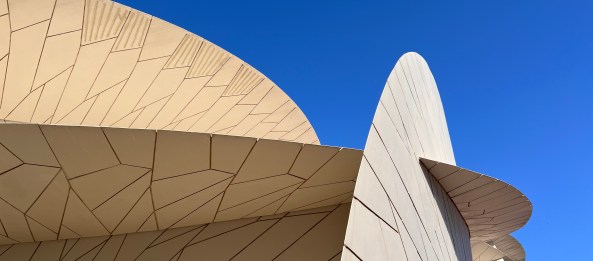
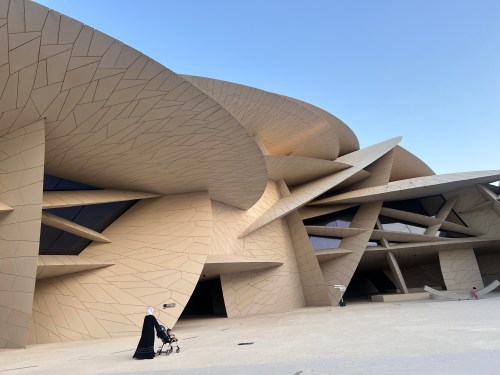
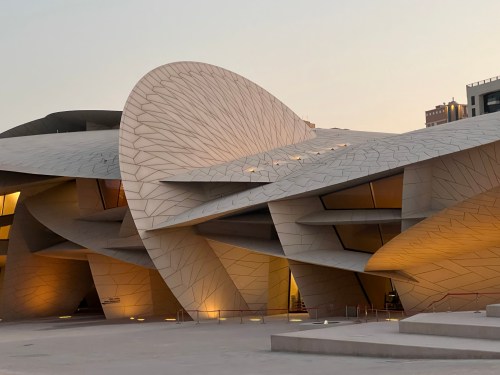
I cannot wait to discover the National Museum of Qatar close by, affectionately known as the Desert Rose for obvious reasons when you see it. In the words of the architect Jean Nouvel:
“The National Museum of Qatar is dedicated to the history of Qatar. Symbolically, its architecture evokes the desert, its silent and eternal dimension, but also the spirit of modernity and daring that have come along and shaken up what seemed unshakeable. So, it’s the contradictions in that history that I’ve sought to evoke here. I wanted to create a structure that evoked the local geography and, in keeping with the tradition of the place, to ensure that it offers maximum protection from the sun.”
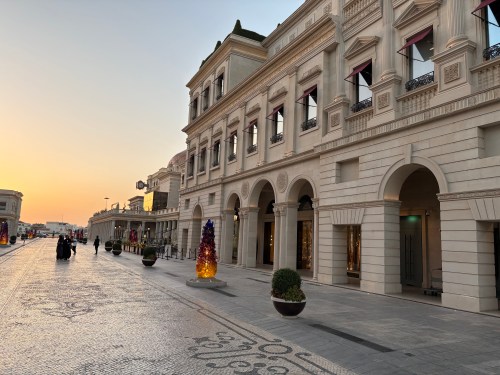
The sun is going to be setting in an hour so no time to linger in our luxury appartment right now and perfect to admire Jean Nouvel’s creation in changing light. It is closed today but we’ll be visiting it tomorrow. We’ll just enjoy the outside architectuee for now.
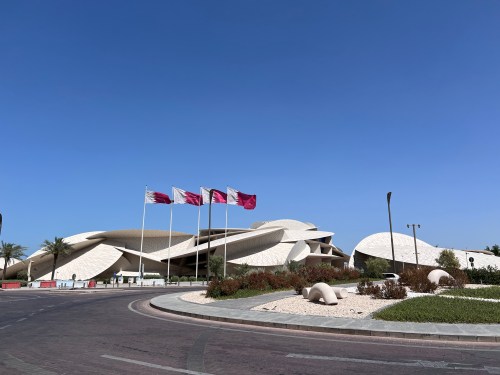
National Museum of QatarNational Museum of QatarNational Museum of QatarNational Museum of QatarNational Museum of QatarNational Museum of Qatar
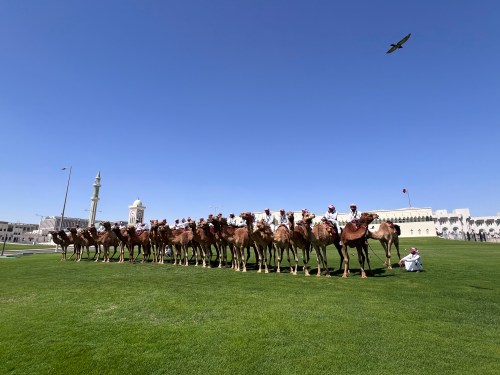
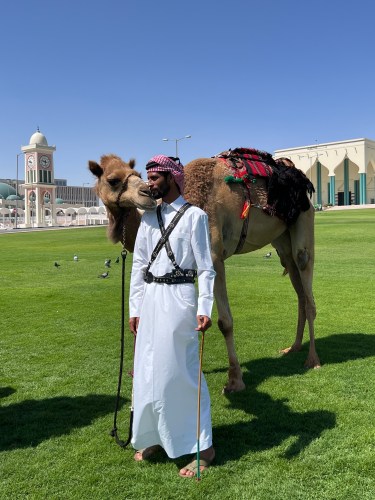
After a leisurely breakfast and a washing load (the apartment has a washer/dryer!) we decide to walk to the Falcon Souq (market). There are very few pedestrians out as it is hot already!! We wend our way to the souq, through the Souq Wakif Park first, and after first stopping for an unexpected sight. The Palace Guard is out, lined up outside Amiri Diwan, which is the administrative office of the Ruler of Qatar.The Amiri Diwan is the seat of rule of the State of Qatar. It is the sovereign body and the administrative office of HH The Amir. It acts as a nexus between His Highness and all governmental and non-governmental bodies internally and externally. The Palace Guard used to ride the most special and majestic camels, patrolling the area in order to protect their Emir (ruler). Today, they are all lined up, happy enough for us and the 3 other visitors around to take photos. The guards eventually dismount, the guard nearest me and his camel exchange a kiss, and the whole group eventually leave the park and make their way back to the royal stables, a man diligently following behind, sweeping the road of any camel “gift”.
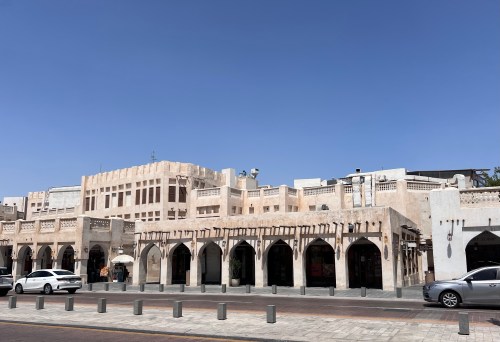
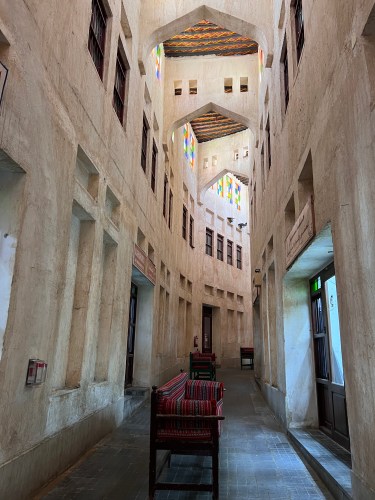
Qatari flags outside the National Museum of QatarSouq WaqifQatar Royal Guard“Give me a kiss” – Qatar Royal GuardDoha business centre skyline
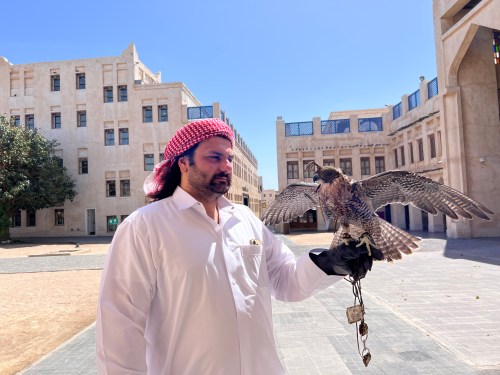
After this unexpected spectacle, we continue our way to the Falcon hospital and falcon souq. We know we are in the right area when we come across two men each holding their falcons. We approach each one and they kindly accept we ask questions about their birds and ask whether we can take photos. They have just come from the falcon hospital, one Qatari actually holding syringes of medication for his 15 year old falcon.
Just back from the falcon hospital Qatari with his falcon
The falcon is the national bird of Qatar. With almost 8 times better vision than the sharpest of human eyesight, falcons silently swoop down as soon as they’ve spotted their prey. The qualities of this wild bird launched the tradition of hunting fresh meat to augment the nutrition of desert nomads, over 5000 years ago in Iran and was spread across the Middle Eastern countries over centuries. The bond created between the bird and its trainer always results in a great hunting partnership. This solitary bird educates patience, endurance, self-reliance, and valour among other things to its falconers. associated with wealth and nobility, for owning a healthy falcon is an affluent and time-consuming proposition. These formidable hunters generally have a lifespan of 12-15 years.
The Peregrine falcon is the fastest recorded animal in the world with a flight speed of up to 389km/242 miles per hour.
We make our way to the falcon hospital next – the reception has one falcon waiting its turn, perched on one of the many perches. Behind reception is an xray on some poorly falcon being examined.
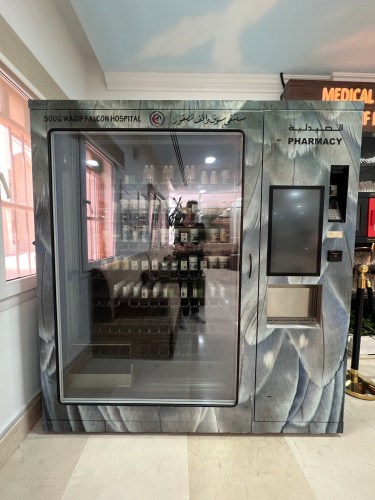
There is small museum which visit and try and learn as much as we can. Walking around the reception area, we notice the pharmacy area and and automatic falcon medication vending machine.
Flow the falcon foot prints to the hospitalDoha Falcon Hospital ReceptionFalcon hospital medicine vending machine
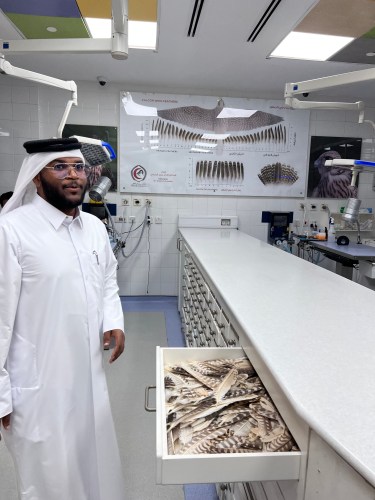
One of the receptionists notice our keen interest and asks if we’d like to visit the hospital and takes us around. It is the low season so there are no falcon being operated on right now but he takes around all the rooms, explains the history and physical capabilities of these magnificient birds and explains how they replace feathers. Fascinating.
Analysing xrays and specimensDoha Falcon Hospital – each feather is numbered
This falcon hospital is run by the government, which tends and cures injured falcons. There are also more expensive private falcon hospitals. It is like our medical health, pay more if you want your bird seen to sooner.
After our wonderful private tour, we head off to the souq. I am not sure how many stores there are in the area but easily a couple of dozen stores dedicated to falconery parafanalia, falconery camping equipment and even falcon sales. As it is the off season, the sale is on and you can buy an older falcon for just a few thousand dollars. The new season with younger fresher birds starts up again in August. It was interesting to hear that most birds come from Germany, a cooler and better climate for breeding. We are told some birds easily reach US$275000.
Doha Falcon Souq
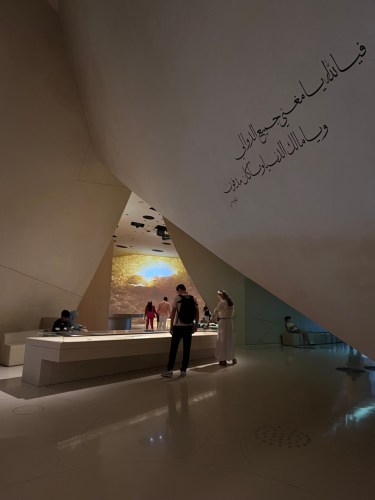
After returning to our hotel for a rest, we head out again around 5pm to visit the National museum. The inside architecture does not disappoint.
Inside the National Museum of QatarInside the National Museum of Qatar
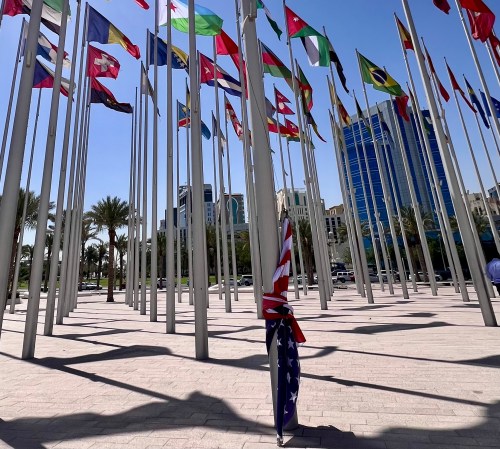
On our 2nd day, we head to the Islamic Art Museum, via the flag plaza. Interesting to notice someone obviously removed the US flag and tied it up close to the ground…. No doubt a reaction to the recent political events…
Who removed the US flag?…
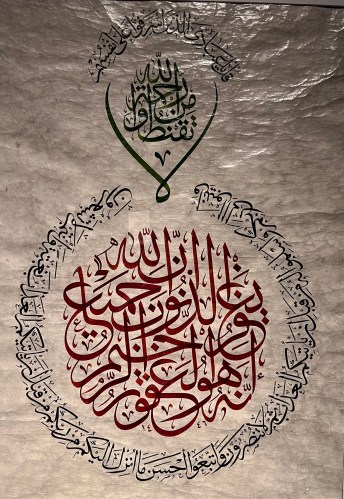
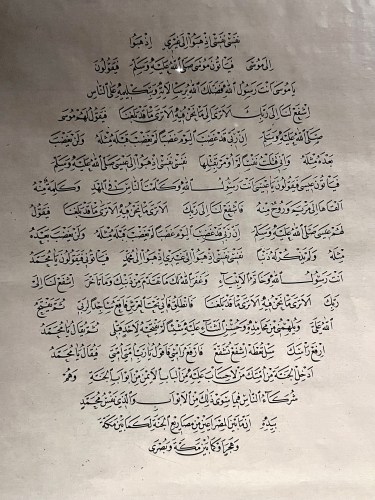
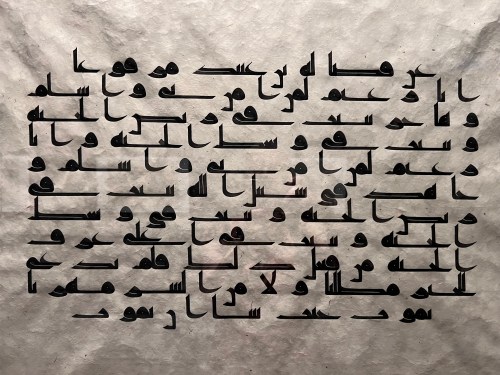
We are lucky that the Islamic Art museum is currently showing the results of the Al-Ragim International Calligraphy Competition, an international event organized by the Qatar Ministry of Endowments (Awqaf) and Islamic Affairs, in collaboration with the Museum of Islamic Art. The competition was designed to feature five distinct Arabic calligraphy scripts: Thumuth, Naskh, Nastaliq, Kufic and Diwani, each one with a jeli, or larger and decorative version.
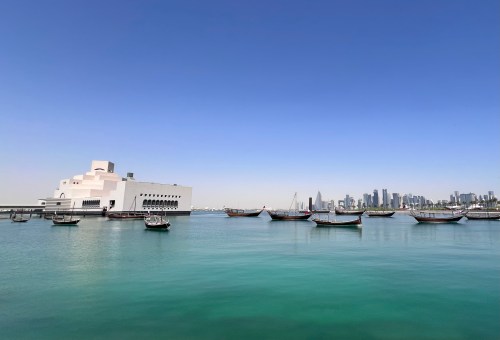
Museum of Islamic Art, Doha
The Thuluth script, developed in the 10th century, is celebrated for its graceful, flowing form with curved and oblique lines, earning it the title “mother of all scripts.” Its name, meaning “one-third” in Arabic, refers to the slanted proportion of each letter. This scripts versatility enabled calligraphers to craft intricate compositions, particularly in Jali Thuluth, which was widely used in architectural inscriptions.
Thuluth script
The Naskh script, developed in the 10th century, is renowned for its legibility and balanced proportions. Its clarity made it ideal for transcribing the Qur’an and various manuscripts.
Naskh script
The Nastaliq script, developed in the late 14th century, is attributed to Mir ‘Ali Tabrizi (active circa 1370-1410). He refined existing scripts to create a fluid and elegant style, becoming the standard for Persian calligraphy. As Persian became the official court language of the Persianate world, Nastalia flourished as the primary script for chancery documents as well as poetry, embodying the beauty of Persian literature.
Nast’liq script
The Kufic script, one of the earliest forms of Arabic calligraphy, emerged in the 8th century, deriving its name from the city of Kufa in Iraq. Characterized by its angular, geometric letterforms with straight lines and sharp angles, as well as the absence of diacritical marks, it was extensively used for transcribing Quranic manuscripts and adorning architectural monuments. Over time, Kufic evolved into various styles, including foliated, knotted, and square Kufic, each distinguished by unique decorative elements. The oldest known inscription in an Islamic monument, using this script, adorns the interior of the Dome of the Rock in Jerusalem, dating to 691-692.
Kufic script
The Diwani script, developed during the early Ottoman period, was used for official state documents and valued for its intricate features and confidentiality. It reached its peak under Sultan Süleyman the Magnificent (r. 1520-1566). In the 16th century, the embellished Diwani Jali variant emerged, known for its dense, ornate style, making it difficult to read and preventing forgery. Only specialized calligraphers could decipher it.
Diwani scriptDiwani script
I wonder which is your fabourite.
I was particularly taken by the Diwani script.
What a fabulous and informative exhibition.
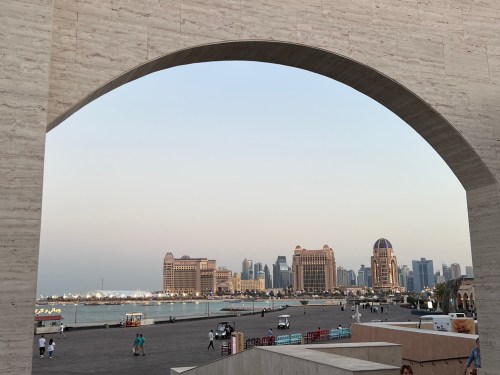
In the evening, we head to the Katara Cultural village. Maybe we did not give it the time it deserves, but I felt it was one huge fantasy luxury area. Not our thing but it was impressive to be able to sit outside for a well deserved drink in the high 30 degrees and feeling cool from the outside airconditioning coming through vents in the ground!!
Katara Cultural villageView from Katara amphitheatre towards Doha
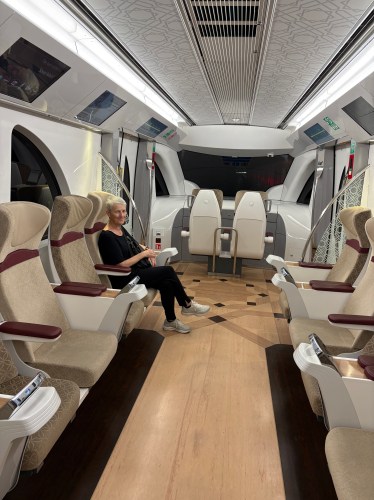
We took the metro there and back and accidentally ended up in the gold class section – once in, we couldn’t get out and move to the normal class!!
Oops – didn’t mean to be in the Gold Class section
As you can tell, we had a fabulous time in Doha. These hops since Brisbane have been great to slowly deal with jetlag. Now for one last flight before we get to see family!!
While we tend to shy away from organised tours and do our own thing (the last time we tried this, we got off the bus on a city tour at the second stop!), we have decided to take a day tour down to the Mekong Delta. This will give us an opportunity to see a little beyond the centre of Ho Chi Min City in the short time we are here.
Anne has chosen a more up market tour (smaller number of tourists), costing only AUD 75 each for the whole day. Our mini bus reflects this with business class type seats. As usual, I have no idea where we are going, Anne does the excellent organising in country, my job is the flights getting us there, but it will give us a glimpse of the countryside outside Ho Chi Min.
An early start at 07:30 and we are off. We are a group of 9, us from Australia and two parties from the Philippines. So luckily for me English is a common language so our guide can talk to all of us more easily.
An hour and a half later after passing many rice fields looking to being close to harvesting, we arrive in My Tho, a small town on the banks of the Mekong delta. After the narrow, broken and moped covered pavements/sidewalks we notice those in My Tho are wide, paved and moped free.
Farmers wish to be buried on their own land.
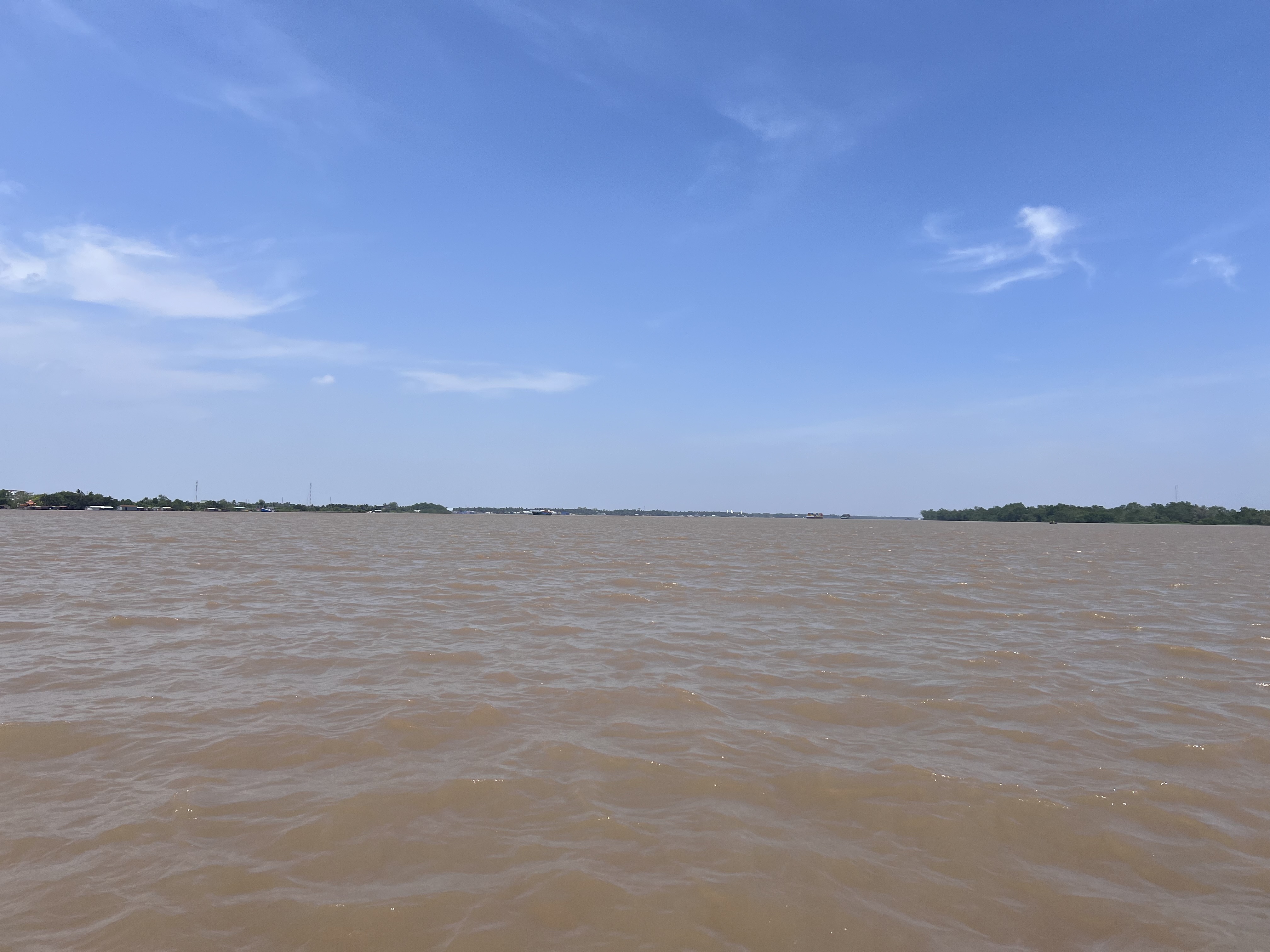
We arrive at the tourist ferry terminal. Here, a procession of small ferries whisk tour groups away across the one of the five arms of the Mekong Delta. The river’s colour is a muddy brown caused by all the sediment that washes down the river and provides the nutrients for each year’s crops. We join No. 11 which will be our boat for the day. Assuming the numbering of the boats is sequential then based on numbers we have seen 86 being the highest, there may be literally dozens and dozens of these boats out on the river. How crowded with tourists will the places we visit be?
That is a lot of boats. Pushing the boat out.The mighty Mekong river, very muddy.
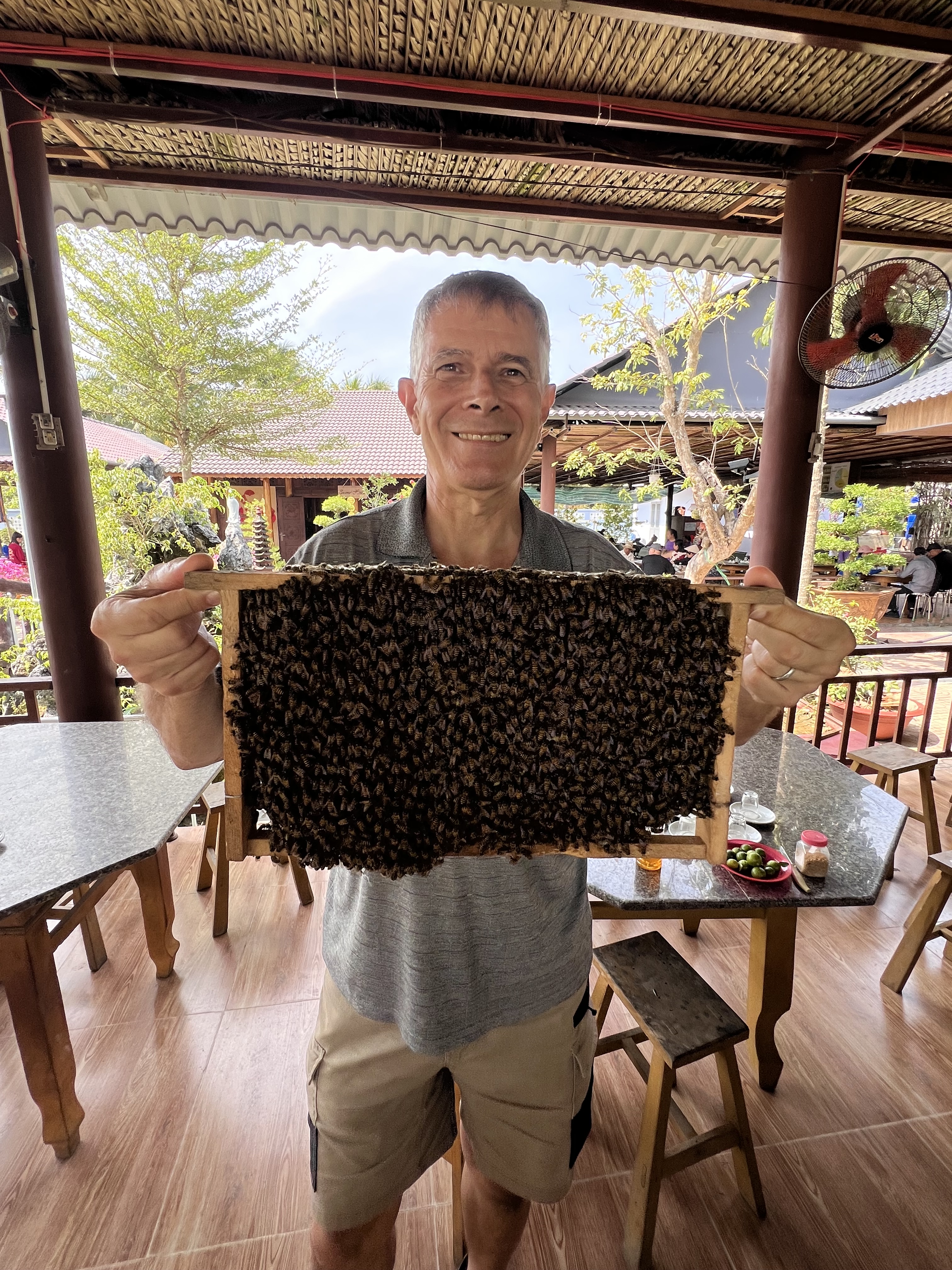
Our first stop on Thoi Son island introduces us to locally made honey and royal jelly which tastes delicious and while happy to hold a swarm of docile bees on a frame, when later offered a very fat and rather shabby and well worn looking python to wear, we say “No Thanks”. Cannot be good for the snake to be handled that often by so many people. As we walk around the village, I realise that there are multiple paths that allow the tour guides to avoid each other which answers my previous question on crowding. The houses seem very plain, but we are told that, because of typhoons, some people are reluctant to spend money on something that may be destroyed.
Anyone for bee keeping?
Off again across the river passing large barges, waiting for the high tide to proceed further upriver our guide tells us. We arrive a Tan Thach and get shown how they produce coconut milk, well for tourists anyway. Saw an interesting technique for getting coconut out of the shell what looks easy but is probably quite hard.
Making coconut milk and shredded coconut.
Now us three men are offered snake wine, no not the same snake from our last stop, but a smaller and really dead one. I plan to decline, but the healing properties mentioned may assist in the recovery from prostate surgery, so here goes. Not going to become my favourite drink but we will see on the other matter.
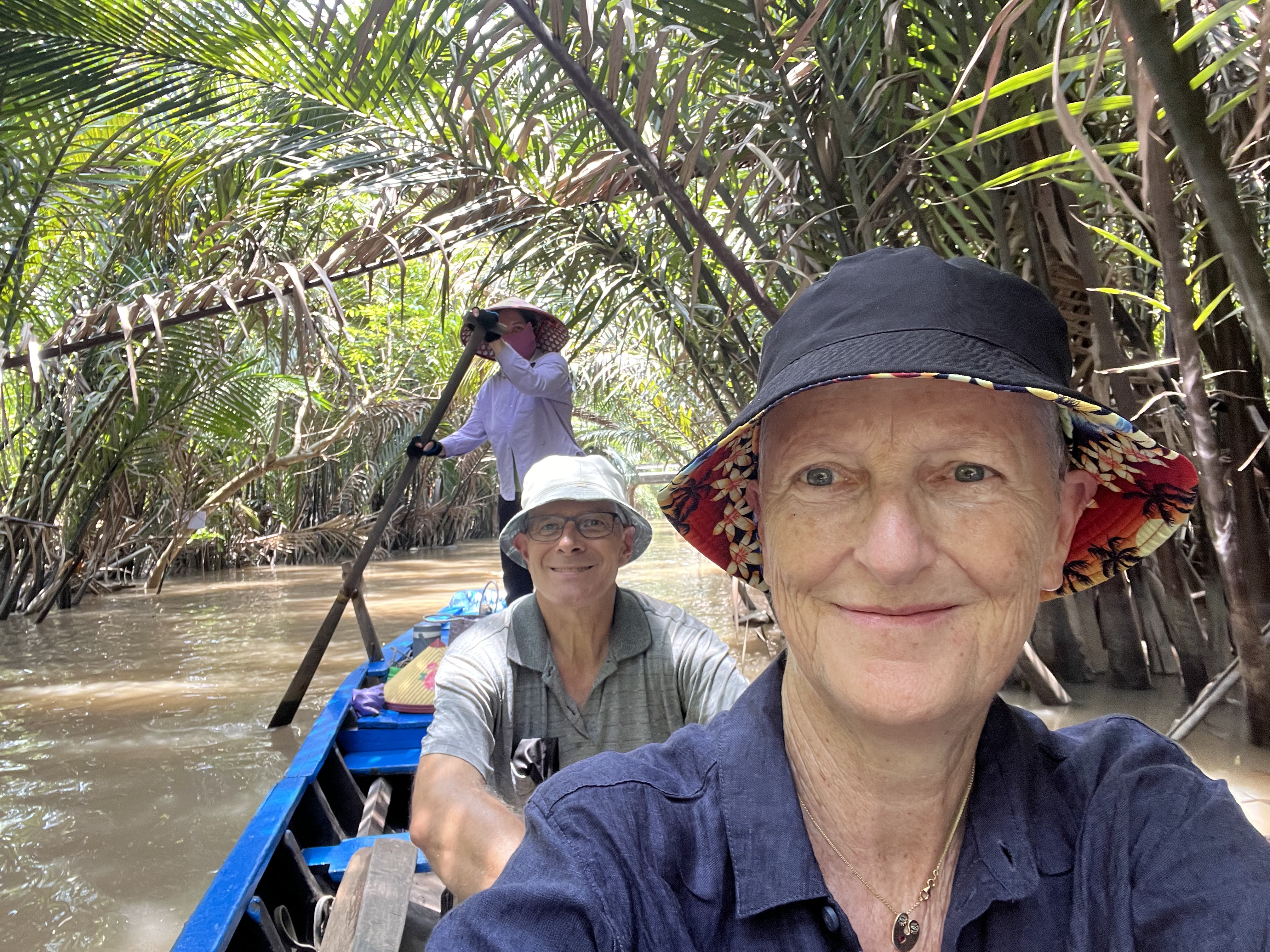
Into the back of a tuk tuk type vehicle and we are whisked off to a copious lunch, but first we are going on a punt amongst the trees. Anne and I have our own punt and are gently propelled upstream amongst the bamboo and other green leafy trees hanging over the water.
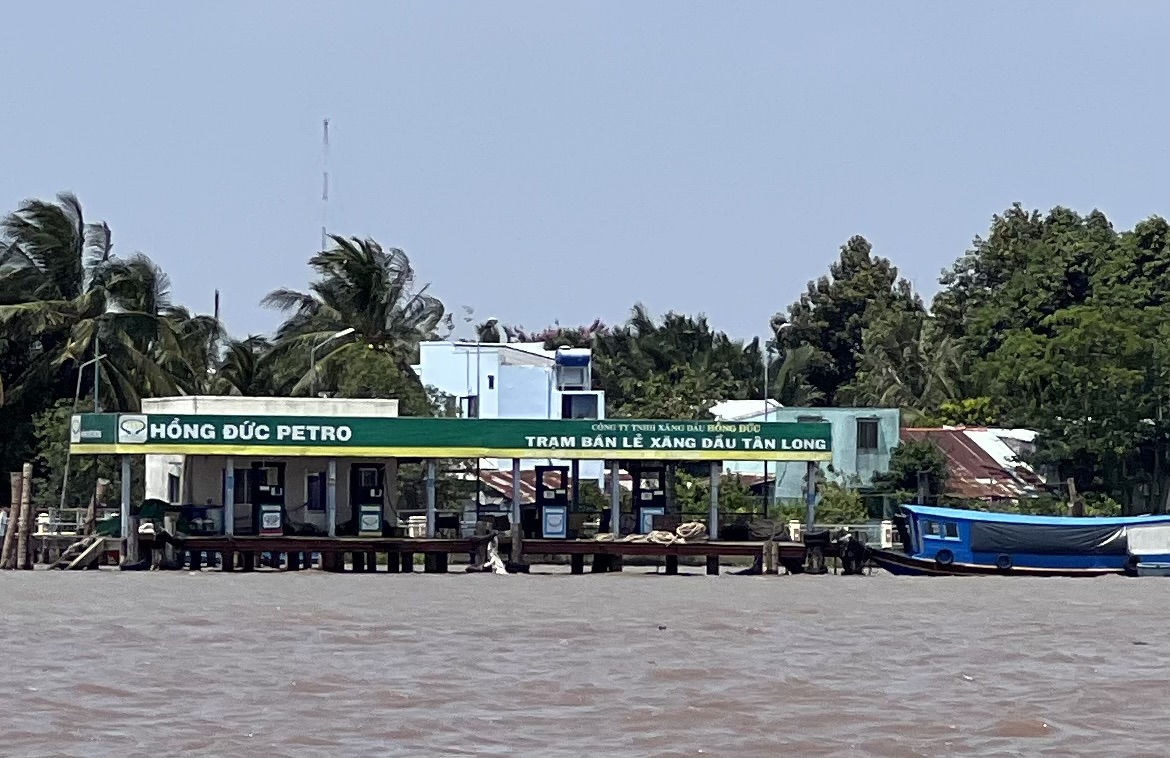
Heading up river on a punt.The local filling station for boats.
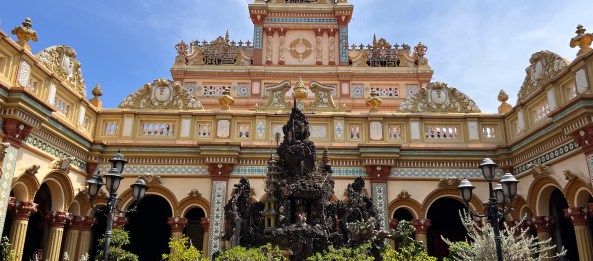
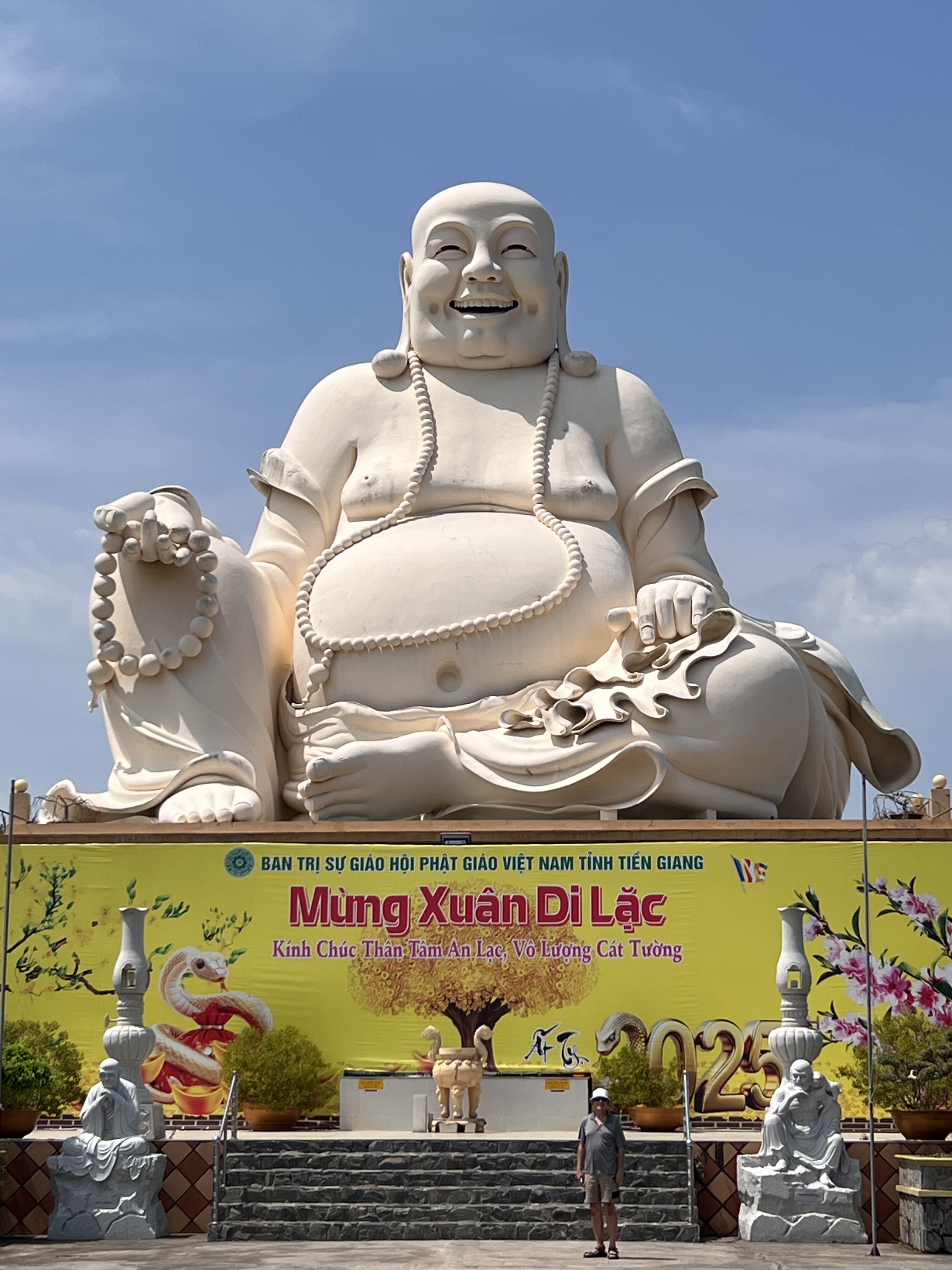
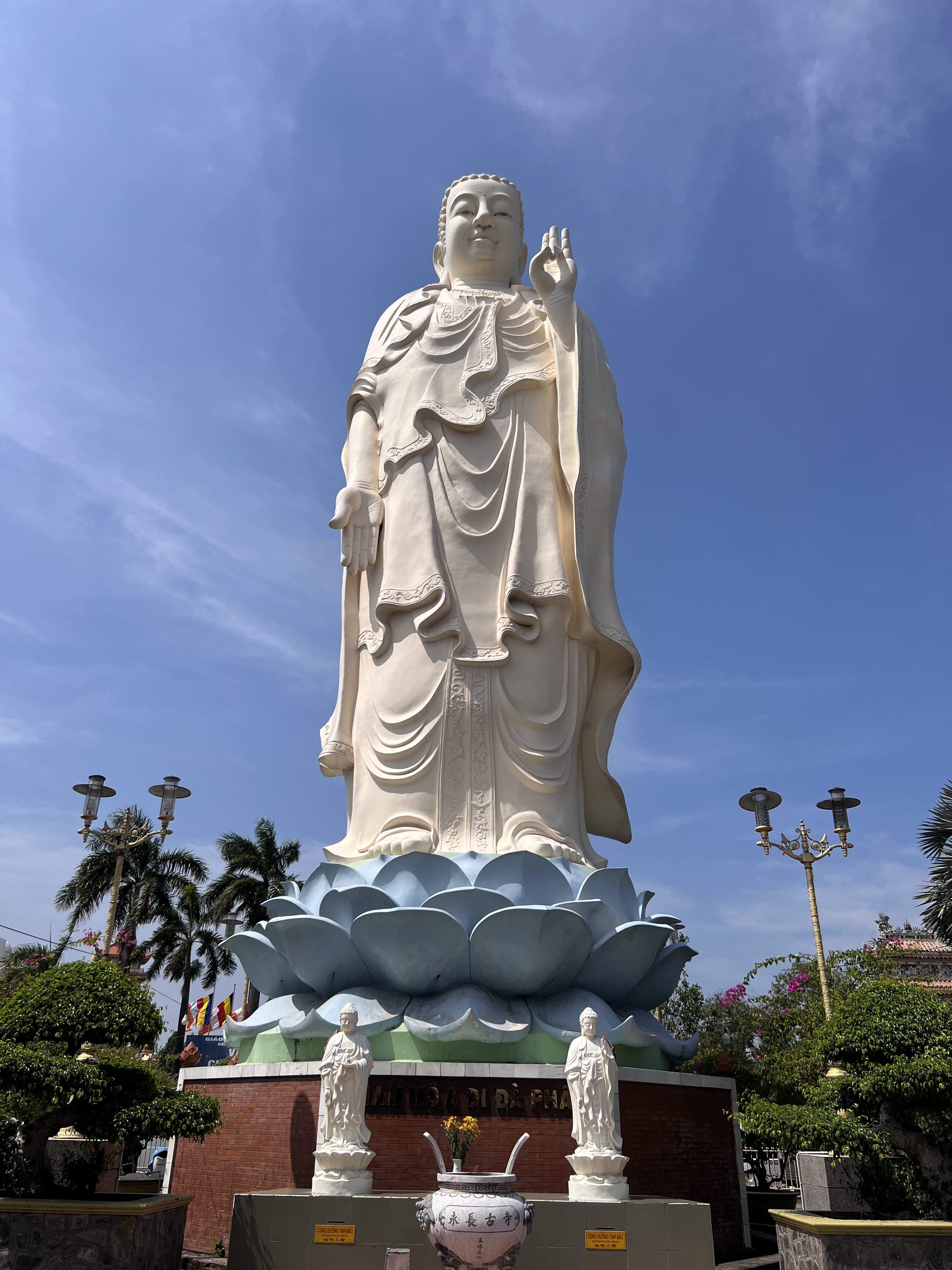
Back to our No. 11 boat by motorised punt and we have had our fifth form of transport today. We return to the tourist ferry terminal at My Tho and then get to go to the Vĩnh Tràng Pagoda to see the three large Buddha statues. The Buddha statues tower over the pagoda complex which was built in the 1850’s. Inside the the temple, it is very peaceful with worshipers moving quietly from statue to statue bowing in front of each one paying their respects. One does not want to take photographs and we quietly leave the temple.
It is fascinating when we do a little research to try and understand what we have seen or gather the history for a site we have visited. Take Buddhism, I know little about the subject but just looking up information on the three Buddha statues, seated standing and lying down it seems that the position of the hands can have different meanings. I could keep reading but would never get this blog finished. Research in my childhood was much simpler. Find the encyclopaedia Britannica and copy the information out. The world wide web has made research more interesting, varied but time consuming to understand, collate and distill.
My limited research has led me to believe that the seated Buddha symbolises the Buddha’s enlightenment, as he attained enlightenment while sitting under the Bodhi tree , or the past. The standing Buddha indicates the Buddha’s readiness to assist all sentient beings – representing the present, and the reclining Buddha symbolises the Buddha’s final moments before passing away into Nirvana, the future.
On our return to Ho Chi Min City, we find a nearby vegetarian restaurant with an interesting history and excellent food. It was started by a couple who had made hundreds of meals a day at home for doctors and nurses during the COVID pandemic and the food was so well received that they were encouraged into the restaurant industry. Its a great story and even better food, so give it a go – Rau Oi Cuisine.
Delicious vegetarian meal at Rau Oi. Alfred, co owner of Rai Oi
Tomorrow, we fly to Doha for three nights. We have enjoyed our stay in Ho Chi Min city even though we were taking it easy and saw a fraction of what the city has to offer.
Flying from Brisbane to London normally sees one go through an Asian or Middle Eastern airline hub and takes around 24 hours, with one long leg of up to 14 hours. As soon as you look into breaking that long leg into two more manageable sectors you add additional airlines and the cost climbs significantly. We have found that the long sectors in economy, especially overnight do knock us about more than they used to.
For this journey we are using our frequent flyer points acquired over the last few years which has allowed us to create a route with three breaks for a day or two each time. We will take eight days to get from Brisbane to London.
After our overnight stop in Singapore we are whisked to Ho Chi Min City in just two hours. While we have visited other parts of Vietnam before, it is our first time in Ho Chi Min City.
A steady passage through immigration over 1.5 hours (luckily short of the 3 hours some have experienced) and we are heading for baggage claim: the bags have long since arrived and our three are neatly lined up together in a special area. A very nice touch , thank you whoever put them together for us.
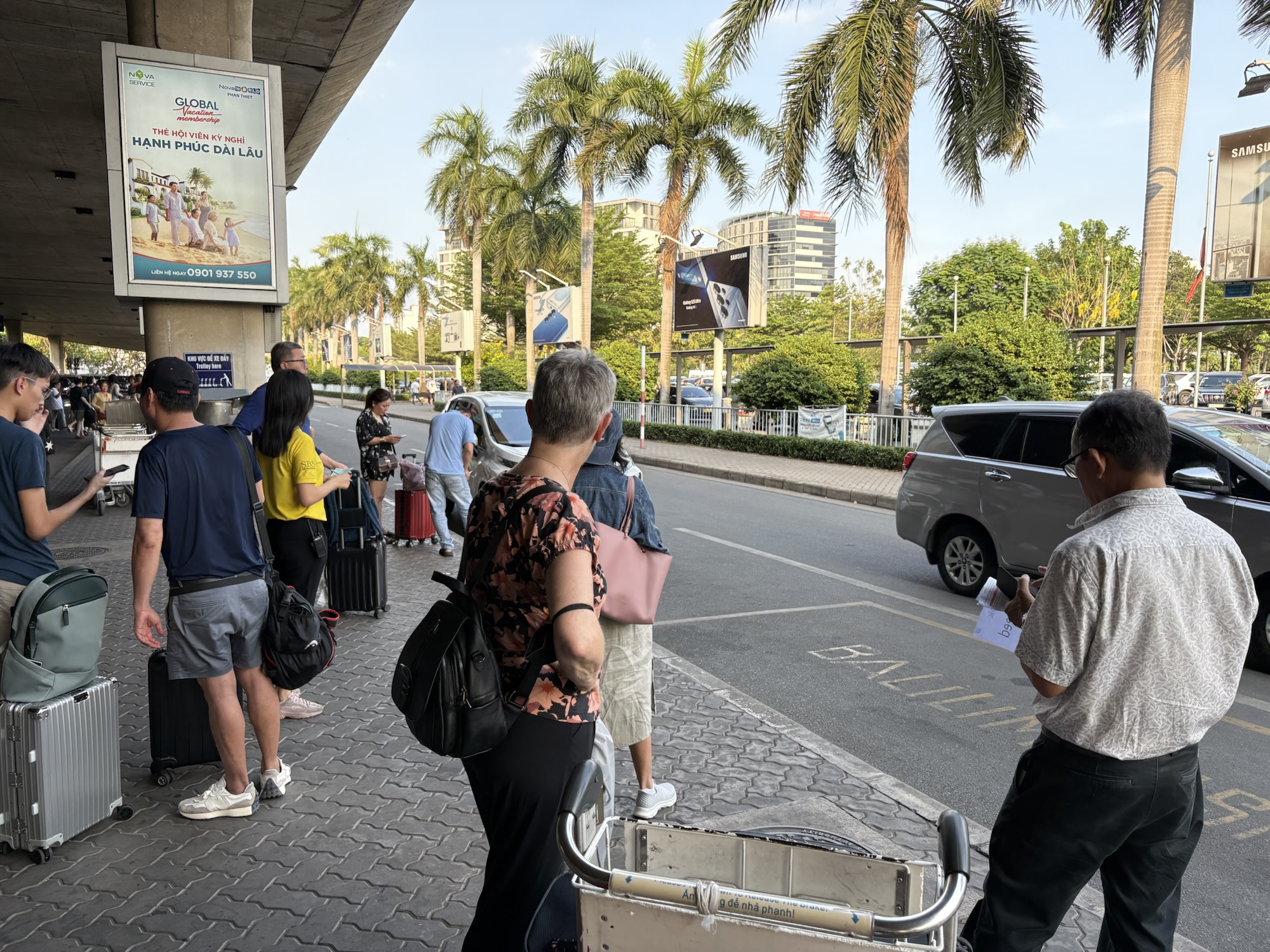
We have read the usual bad taxi stories and booked ahead, with Anne getting the Klook app which also proved useful for booking lunches and tours. I must admit that we had no problems when we exited the terminal. I guess it is down to perceptions and with all our decades of travel experiences, we are probably more laid back than most.
Waiting for our ride from the airport
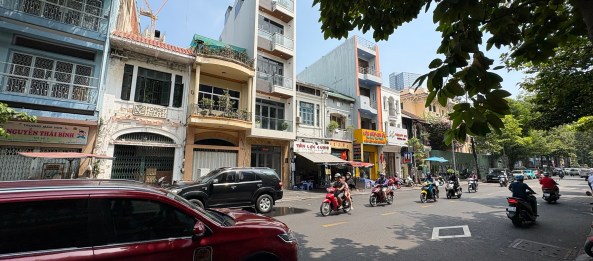
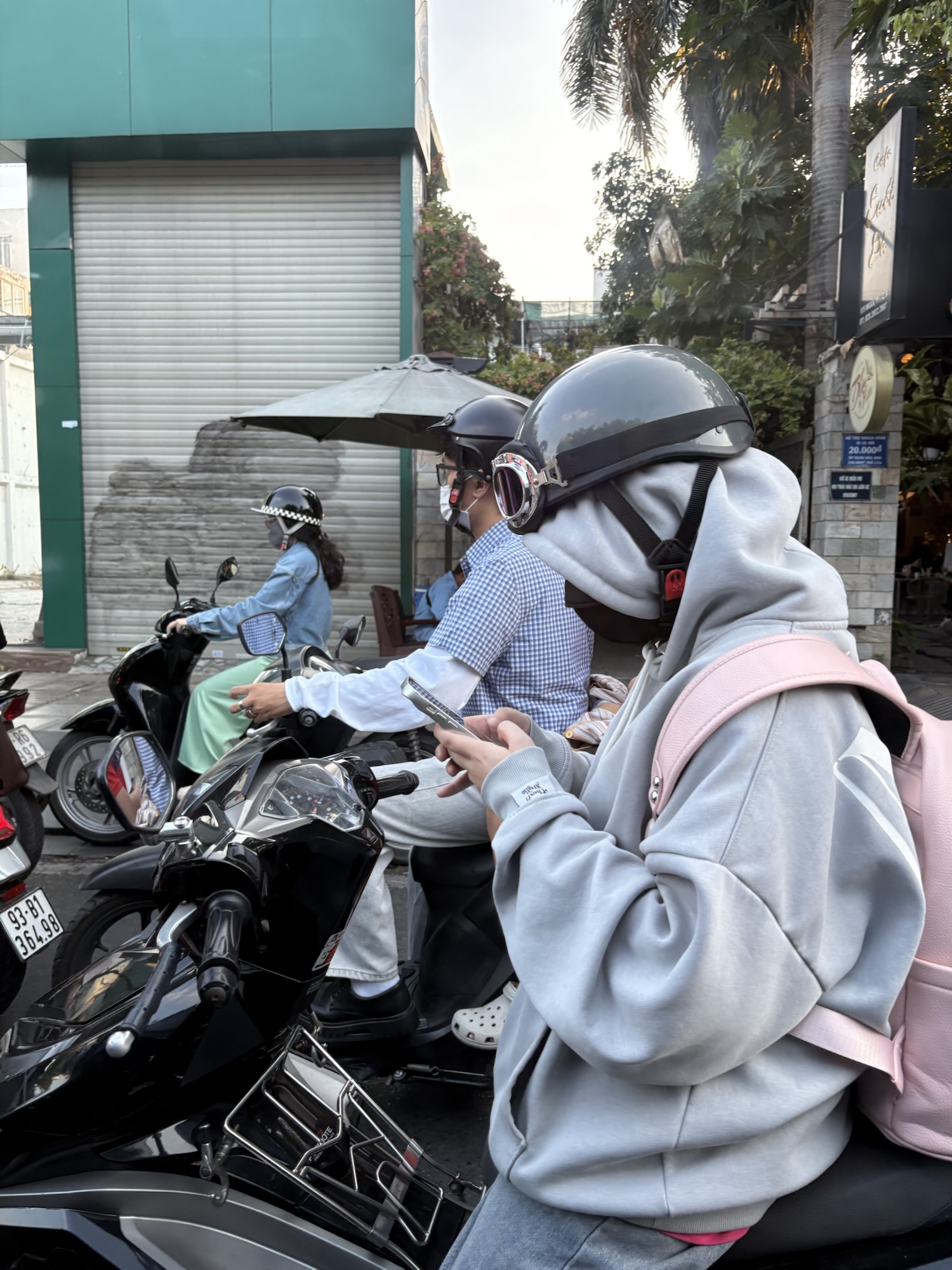
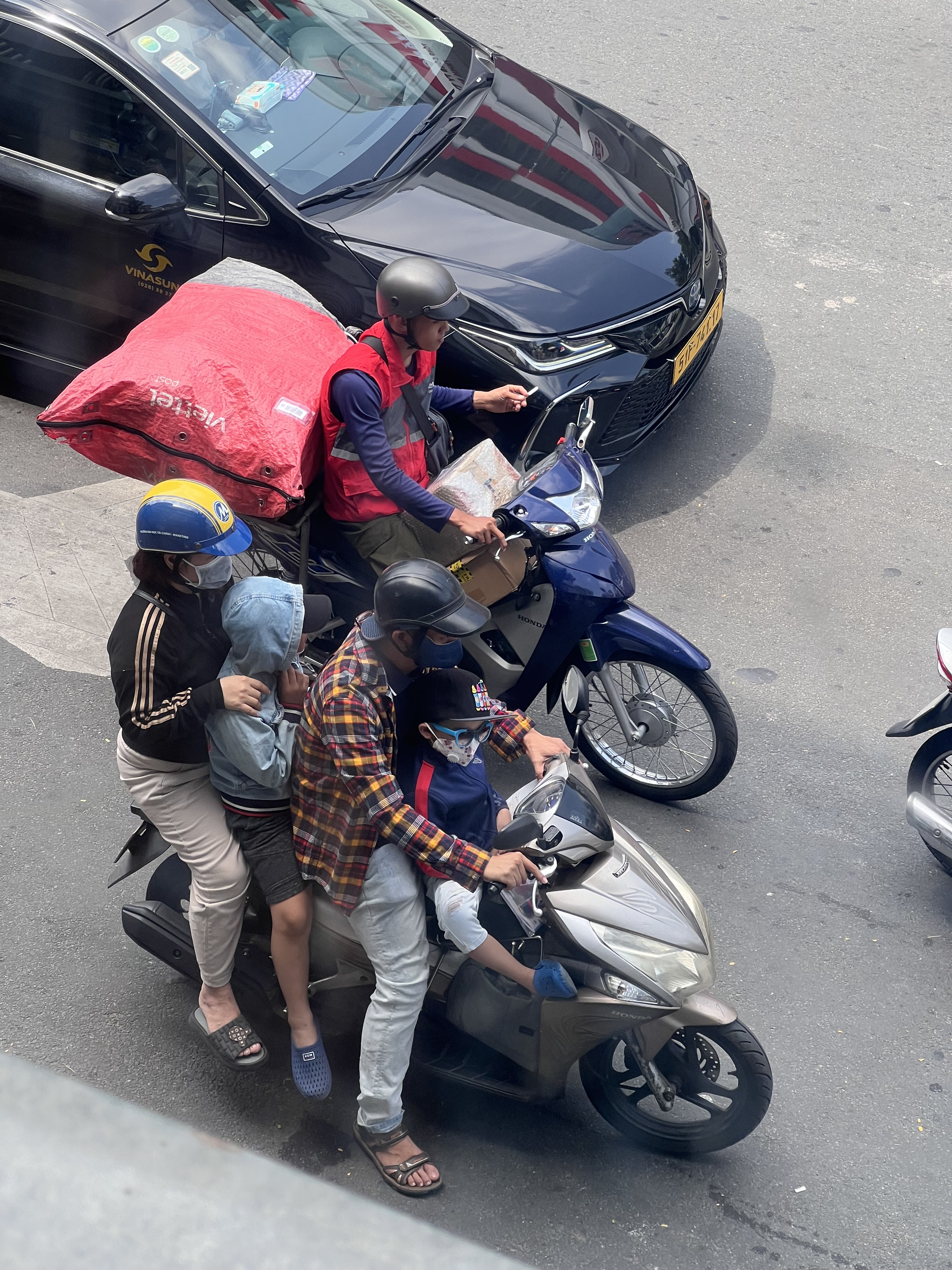
As we are whisked, at times what seems to be walking pace, to our hotel, we get to understand how the traffic flows work in Ho Chi Min City. I am reminded of an experiment I saw once where a scientist progressively filled a container with rocks, sand and water and how at each stage the container appeared full, you could add another layer. The cars are rocks and the mopeds sand. The mopeds seem to flow between the cars like sand between the rocks, I am assuming that drones one day will fill the gaps between the mopeds. Given the ingenious carrying capacity of a moped, why do we in the west require cars in warmer climes? A nifty parcel rack and dual hook combination below the handlebars will carry all one’s shopping and parcels. Three up is not uncommon and four at a pinch. Given the packed pavements, one wonders how a move to motorcars would be catered for, however it has happened in China where the move has been from bicycles to cars in two decades. How was that done?
Texting and moped riding go hand in hand.A four person family vehicle passes a delivery moped.Even the traffic police ride two up.
After arriving at the hotel which is in the centre of the city in District 1, we realise that yesterday I went 23 hours without sleep. While wonderful local food is all around us, I succumb to getting chips and dip from a western supermarket and sleep overcomes me.
On our first full day, Anne sensibly books a decent lunch at the Lotte Hotel Saigon on the river to recharge our batteries. This gives us an opportunity to walk across the centre of Ho Chi Min city. En-route, we discover an excellent patisserie, Bến Thành Market Station on the first new metro line, opened in December 2024, of fourteen planned and learn to walk across streets in harmony with the ever flowing streams of mopeds crossing our path.
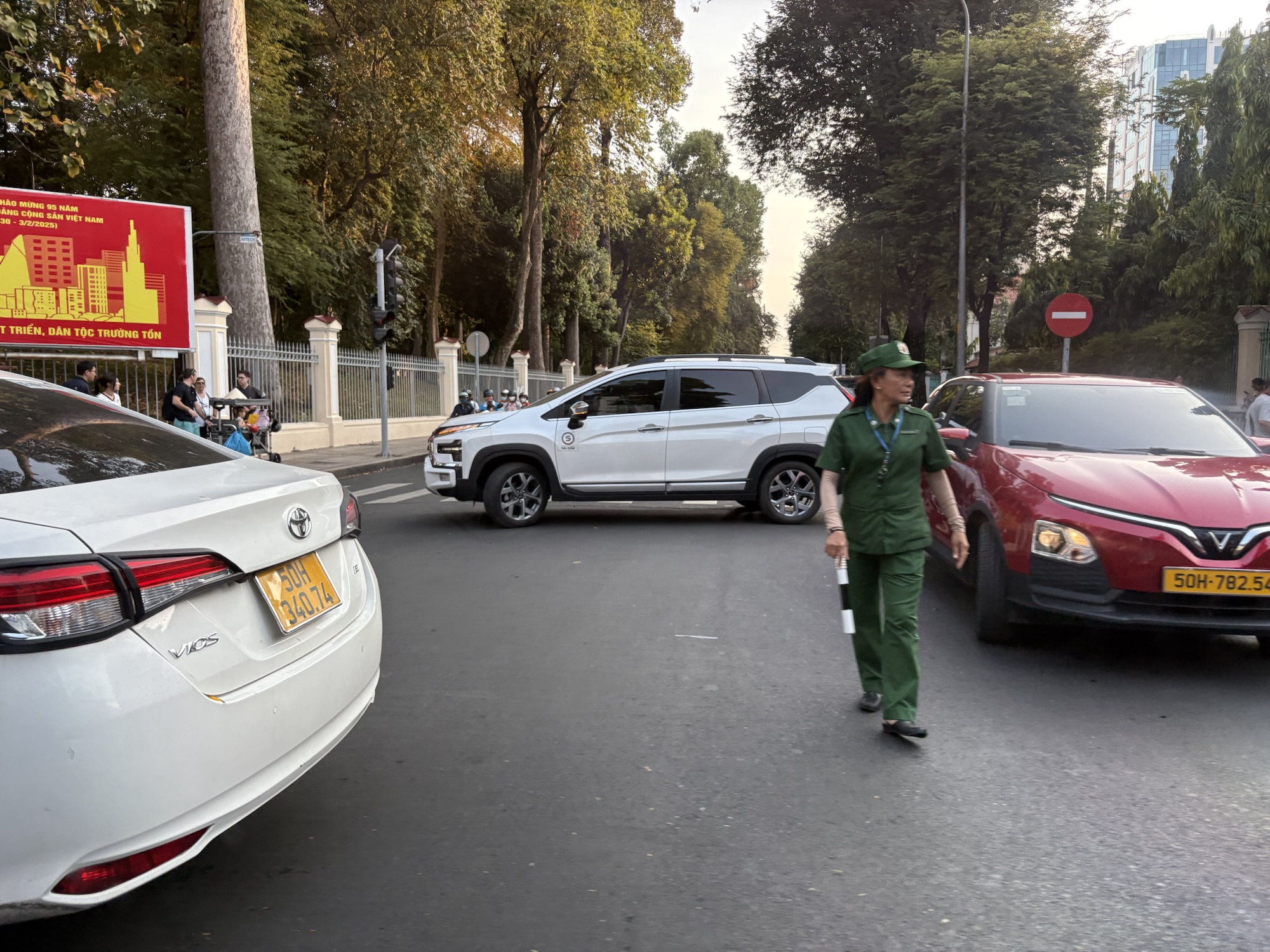
Coffee holder for moped handlebars. These croissant are really delicious. First Metro line in Ho Chi Min City, station. Bến Thành Market Station.Need eyes in the back of your head to be a traffic police officer here.Well ordered parking in Ho Chi Min City
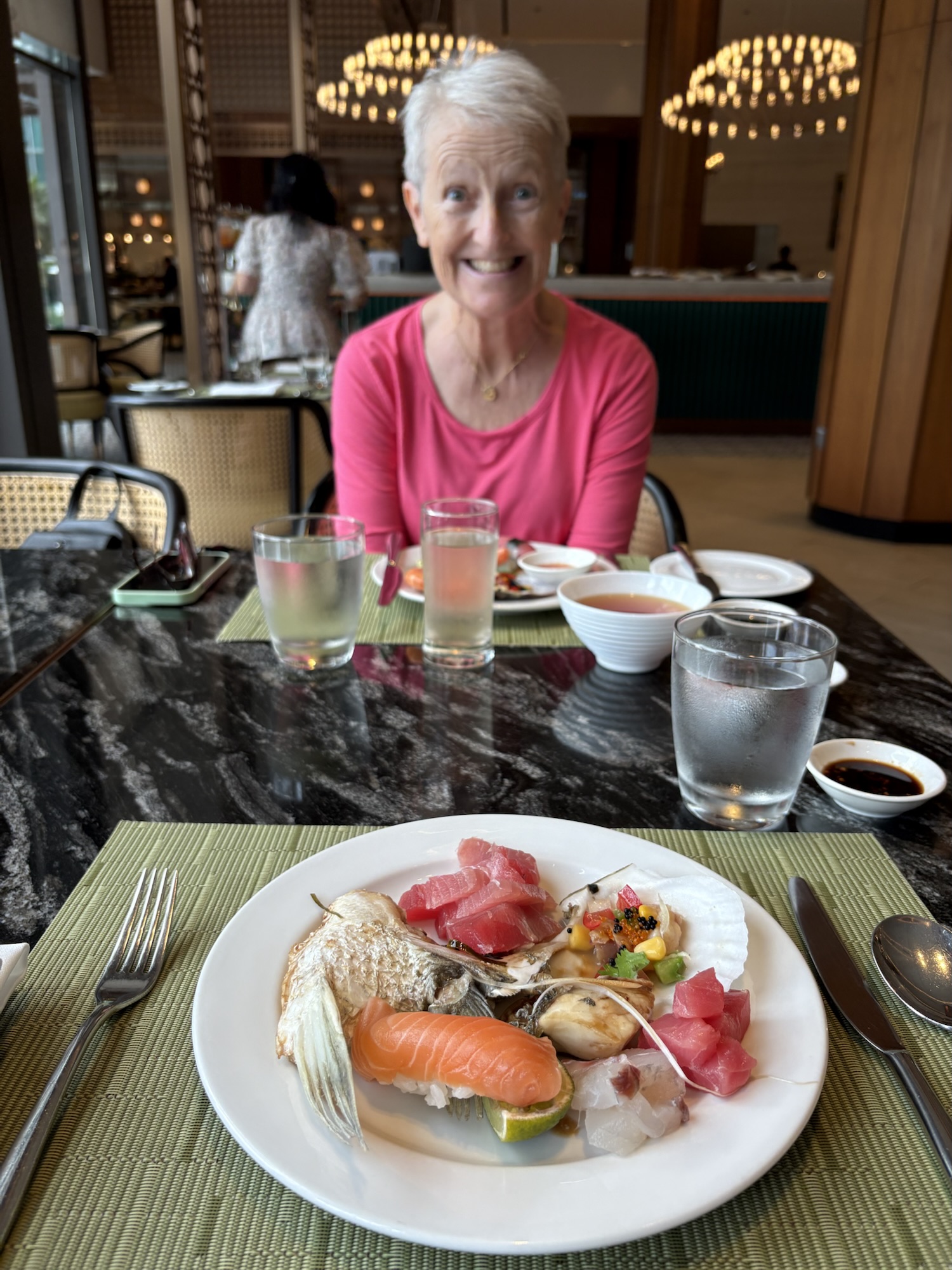
The Lotte Hotel Saigon buffet exceeds all expectations, we are overwhelmed with the choices and the service was exceptional. We had advised one of the managers of our food requirements, no lactose for Anne and coeliac for me. As we head to the buffet to load up, a member of staff follows us, he has been informed of our intolerances and is there to advise us on what we can eat – what service! Anne has rated them highly on TripAdvisor, well deserved.
Ready for a feast.
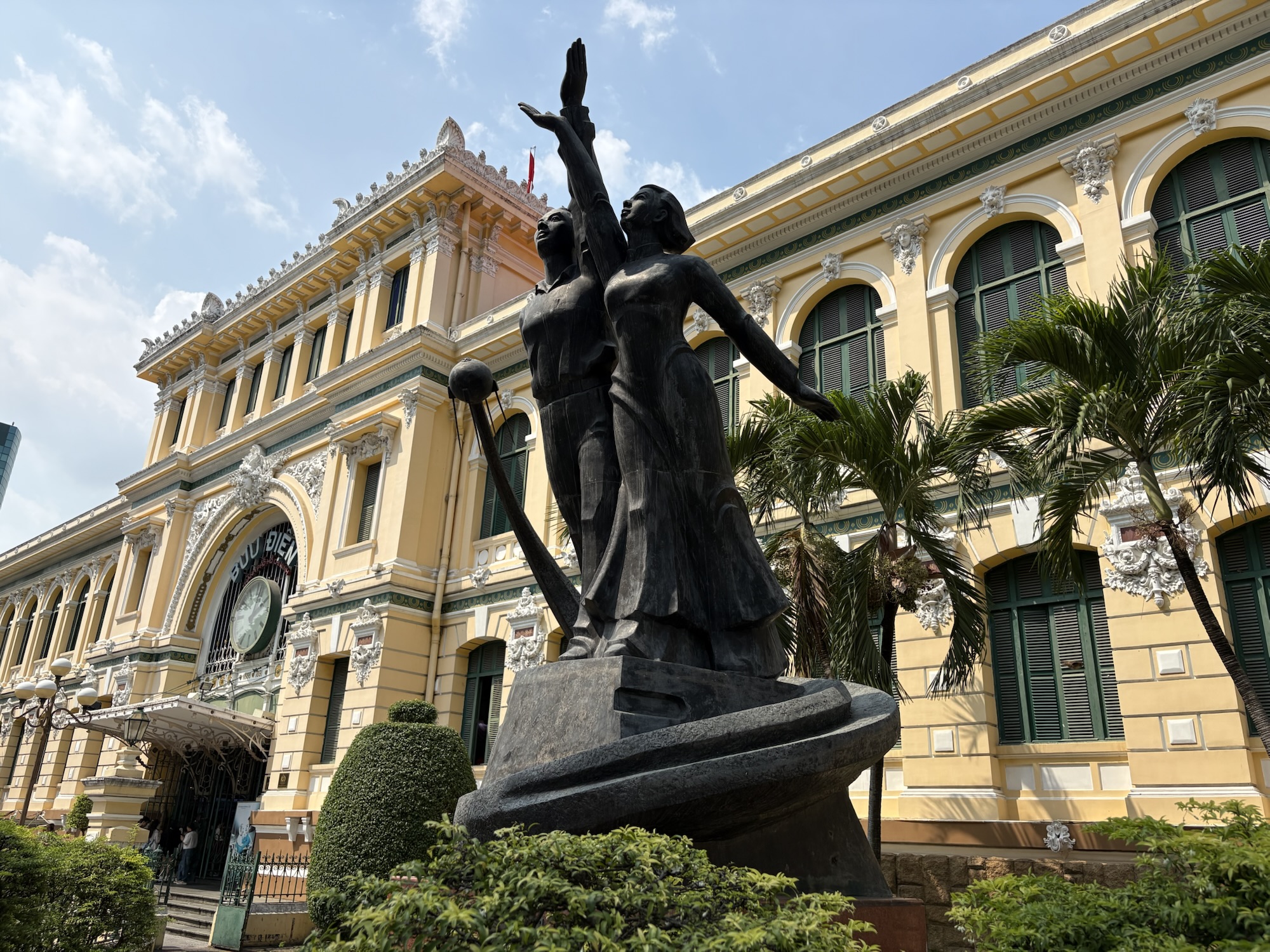
We return via the Saigon Central Post Office, built in the French Colonial times is described as “French Colonial” style. It was the centre of an extensive telegraph network and today attracts tourists from around the world who queue to send postcards home.
Central Post Office with statues in “Socialist Realism” style.Map of Telegraph lines in the Mekong delta.
The adjacent Cathedral was closed and we return to our hotel for a well deserved rest. We realise that it will take a few days to adjust to travelling again and for Anne to relax after the project closeout.
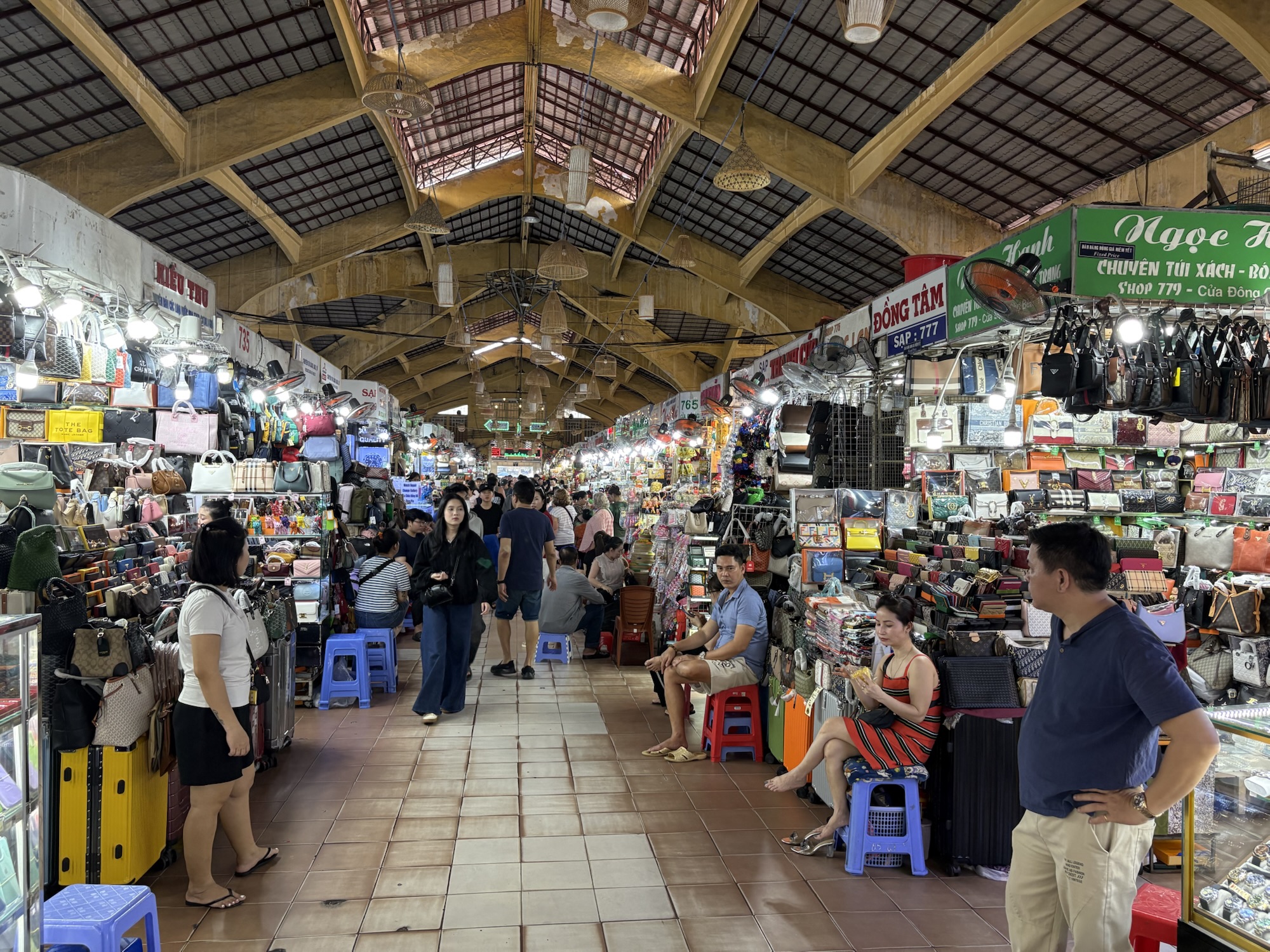
Day three, now we will really explore starting with a visit to the Independence Palace. Completed in 1967 and only in use till 1975 it is now a museum. We go via the Bến Thành Market one of the oldest remaining buildings in Ho Chi Min City. Completed in 1914 is now home to some 1,500 stalls selling an amazing array of goods from food to luxury items.
It is somewhat of a tourist mecca, but after being grabbed by a over zealous store-holder, to look at who knows what, we leave. Not our thing, but Anne did purchase 500g of dried mango for a reasonable price, very tasty.
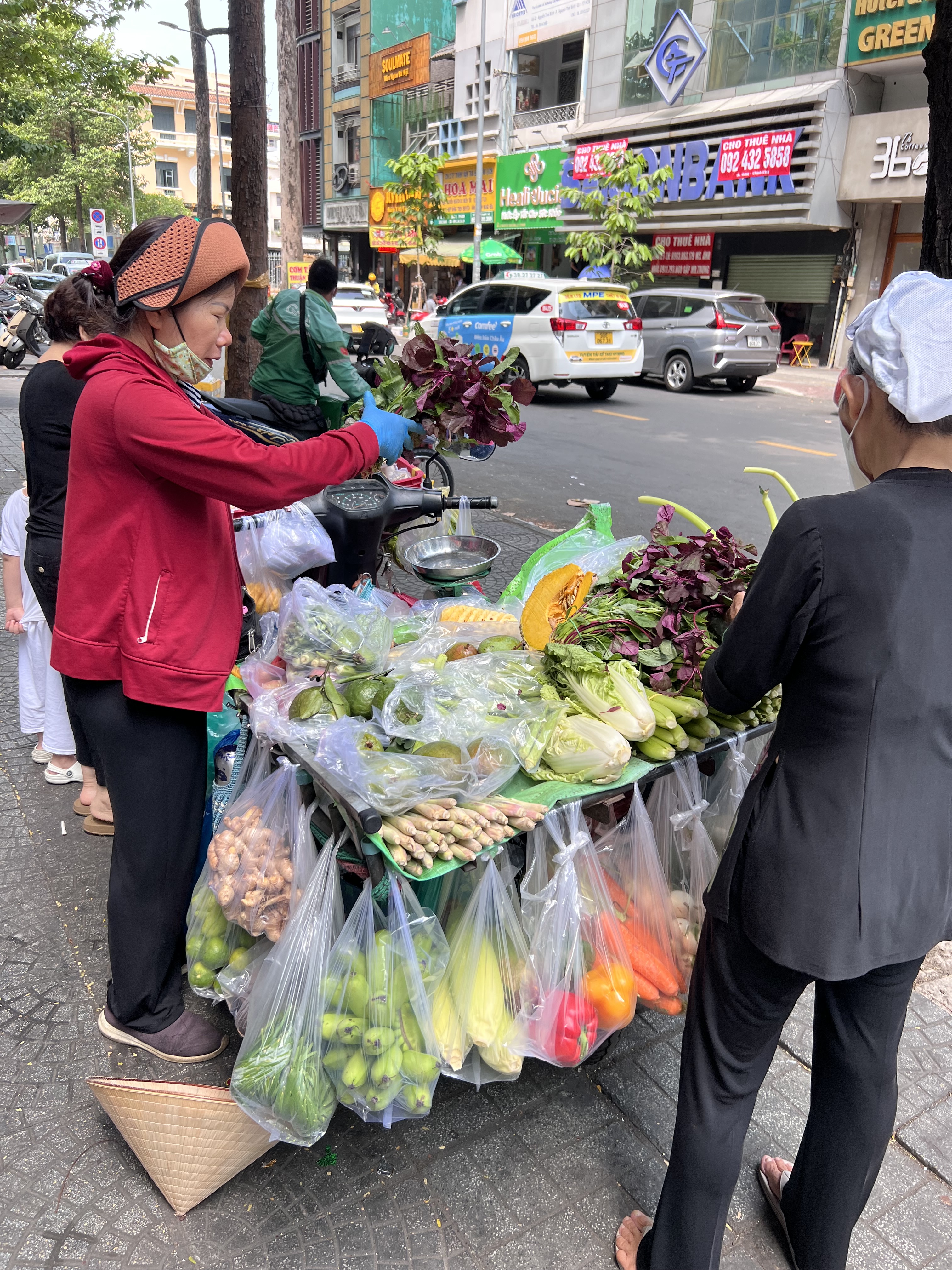
Inside Bến Thành MarketMobile vegetable shop on the back of a moped.
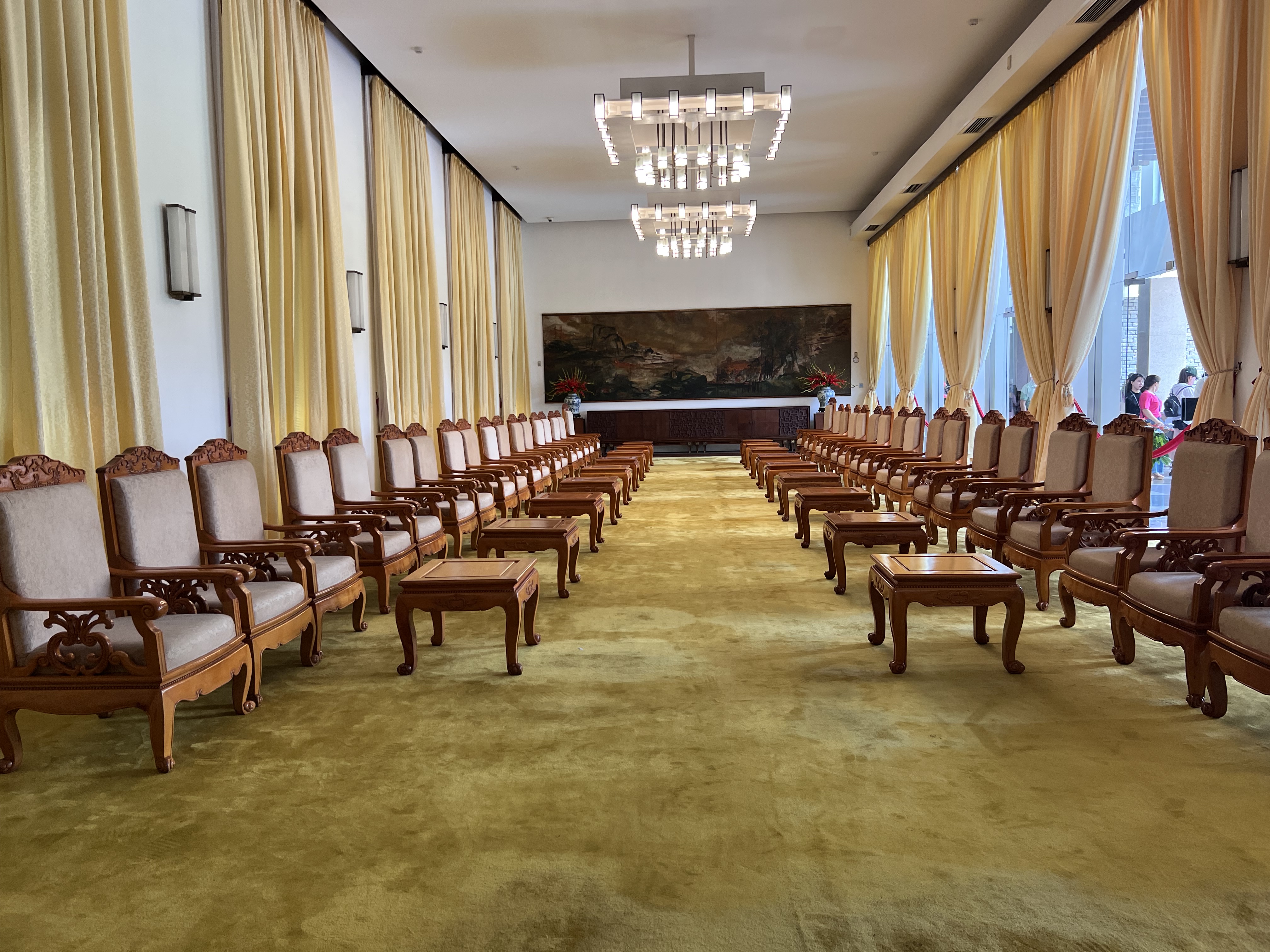
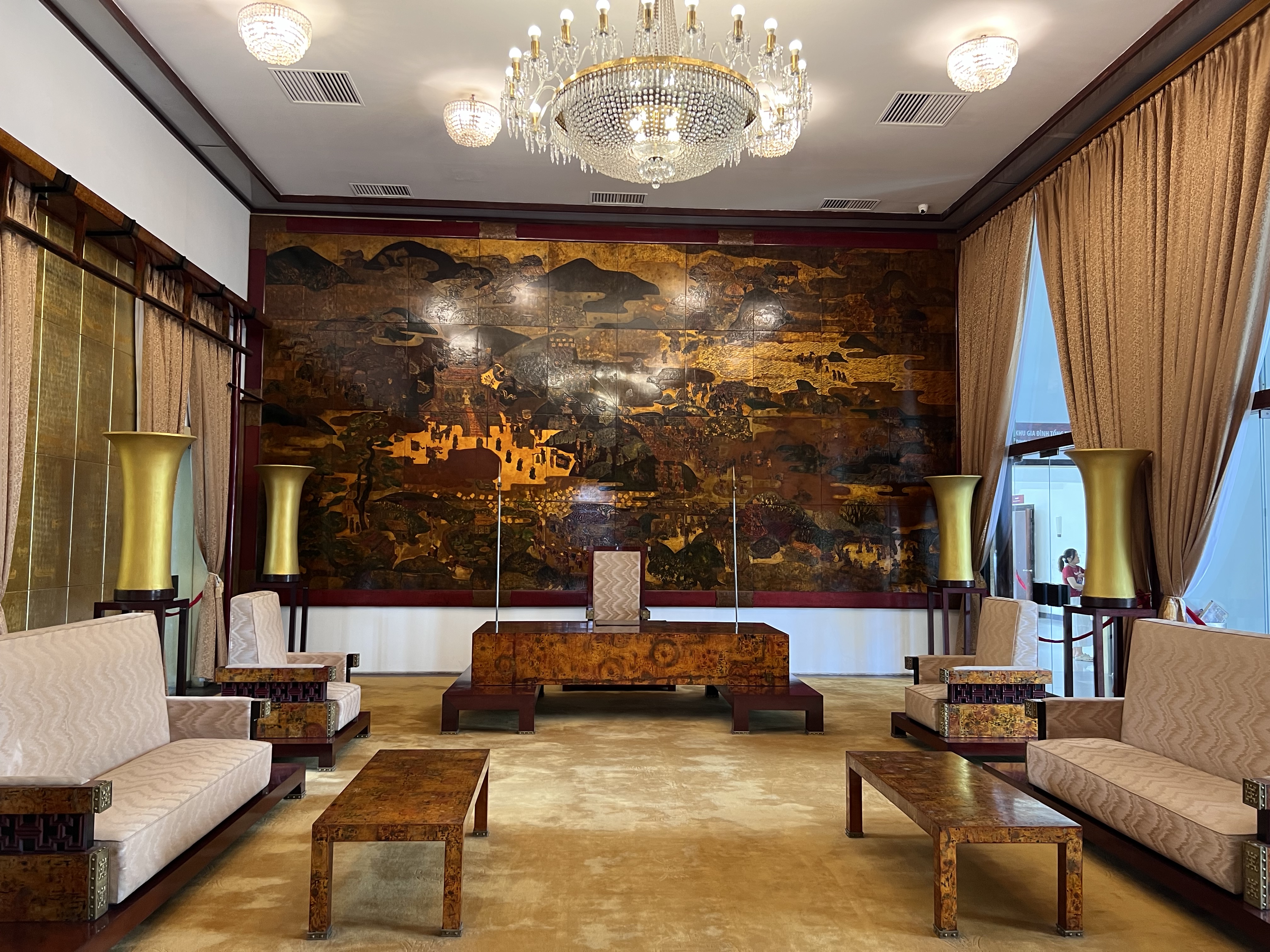
The Independence palace has a very 60’s appearance. It was the presidential palace before reunification in 1975. With Vietnam’s capital in Hanoi, it has been converted to a museum. Interesting to see a 1960’s architecture preserved with all the period furniture. The building is still used from time to time for meeting foreign dignitaries. We are seeing a historical building but from our lifetimes. We must be getting older! We pass two army tanks on display in the grounds, identical models to those that broke through the gates in the famous photograph from 30 Apr 1975. We exit through those same gates.
Independence Palace the day before Hung King’s Commemoration Day.Meeting room for visitors in the Independence Palace Lacquer wall art in the Independence Palace.
By now we have adapted to crossing roads at a steady pace with the mostly moped traffic deftly weaving around us. It is still a little unnerving as a swarm of mopeds sweeps up the road towards you: do not to turn, look or panic. Remember, do not hesitate, your path has been factored in by the riders. Coming from wearing full face motorcycle helmets, the small half helmets seem more like cyclists headgear and the words “Style and Fashion” emblazoned on one pink helmet do not give me confidence as to the safety features of said helmet.
Lunch is taken nearby at Quán Nhon 138, as we see it is full of locals, which is always an indication to us of good food. We try a couple of new dishes and are not disappointed although a little spicy by our standards, probably considered mild by locals.
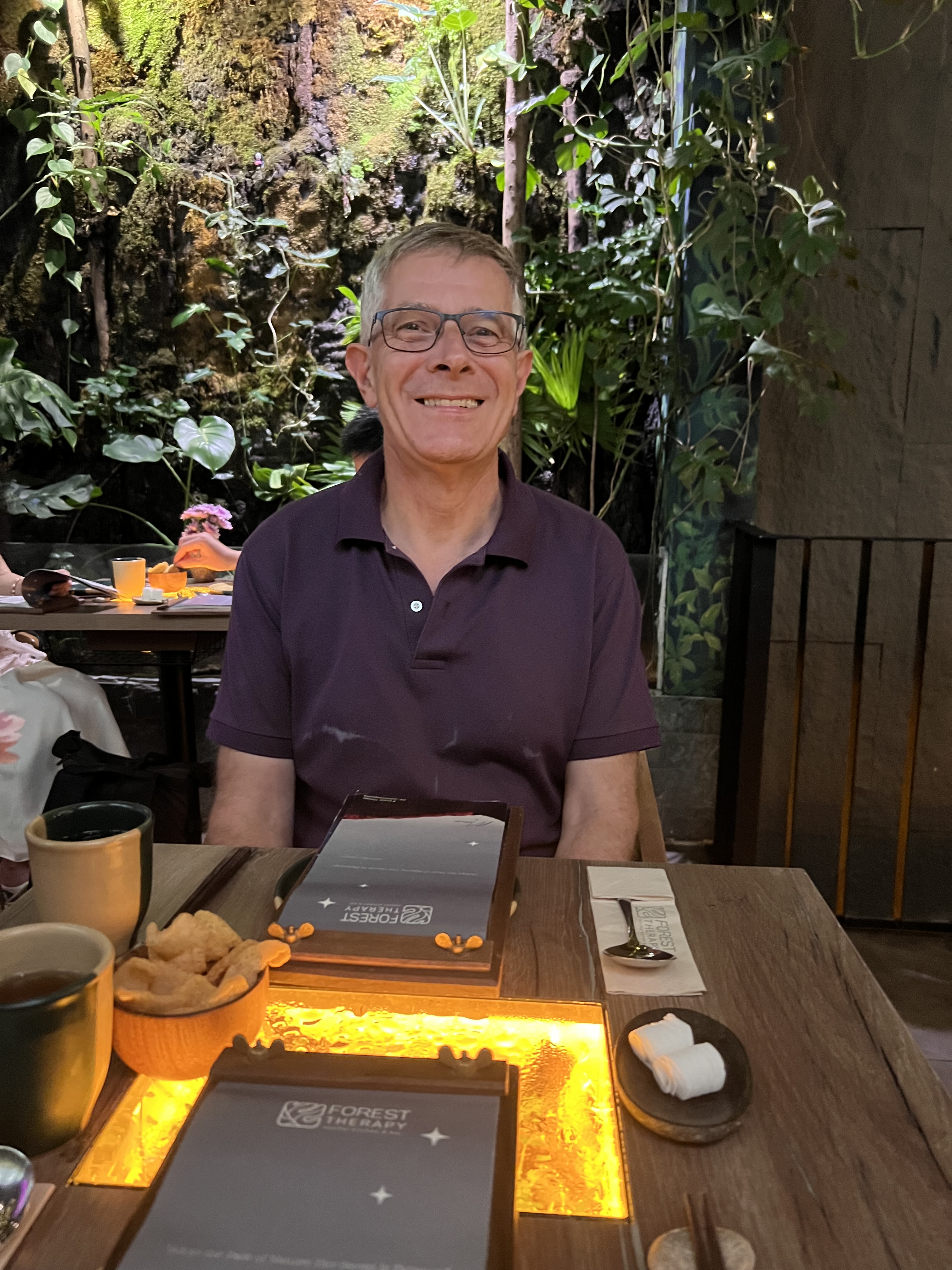
For dinner, we try something different and head to a local bar and eatery intriguingly named Forest Therapy. They have created a jungle like environment in the centre of the city. A couple of cocktails, which is unusual for us and good food made for an enjoyable evening.
Dinner in the Forest Therapy.
I have to confess that we have not tried the street eateries that seem to occupy store fronts in every street in District 1. Am not sure if it is because of the low tables and chairs that I may never get up from, the fact that gluten free may be an impossibility or just we are looking for the easier albeit more expensive option for food. When we are on the road next month on Streak and Storm, such places will be the norm and I am looking forward to those experiences.
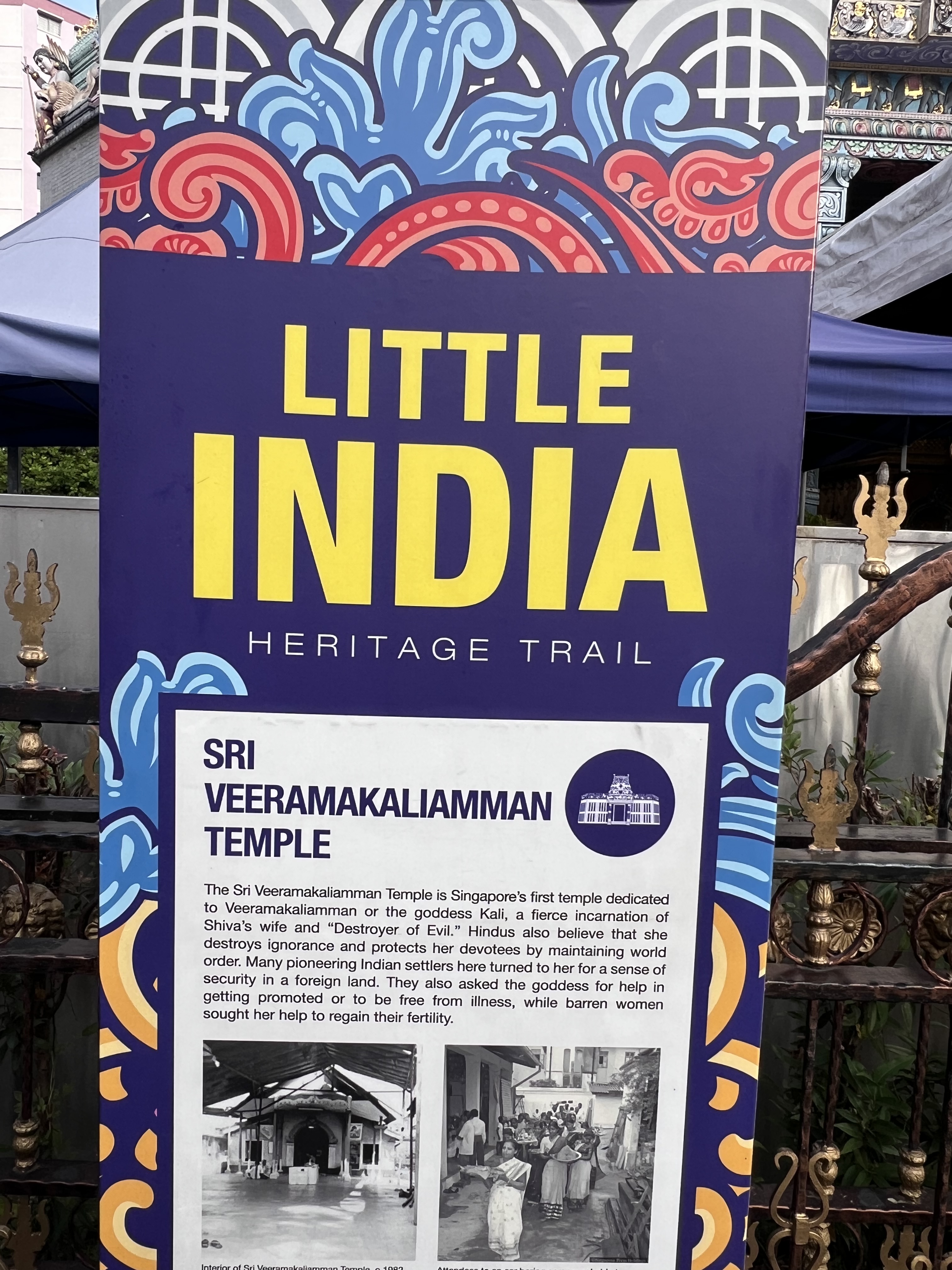
At 7:30 am the quiet of the morning is broken by the tolling of the bell and the nearby Hindu Sri Veeramakaliamman Temple. We are staying at the Hilton Garden Inn Serangoon in the heart of Little India in Singapore. While Singapore is known for its modern architecture, fabulous gardens and attractions, we both enjoy the more historic areas such as Little India. The buildings here seldom exceed a couple of stories and it can feel as if the surrounding skyscrapers are crowding in on this small quaint area.
An early morning stroll takes us past the temple with rows of shoes carefully placed outside the entrances attest to those who have answered the bells’ call. Shops close by are festooned with garlands of flowers and limes, to be purchased by those attending the temple. The smell of spices waft from the now open restaurants as we walk past, tempting but we have already eaten so not this time. Many types of regional Indian cuisine seem to be represented.
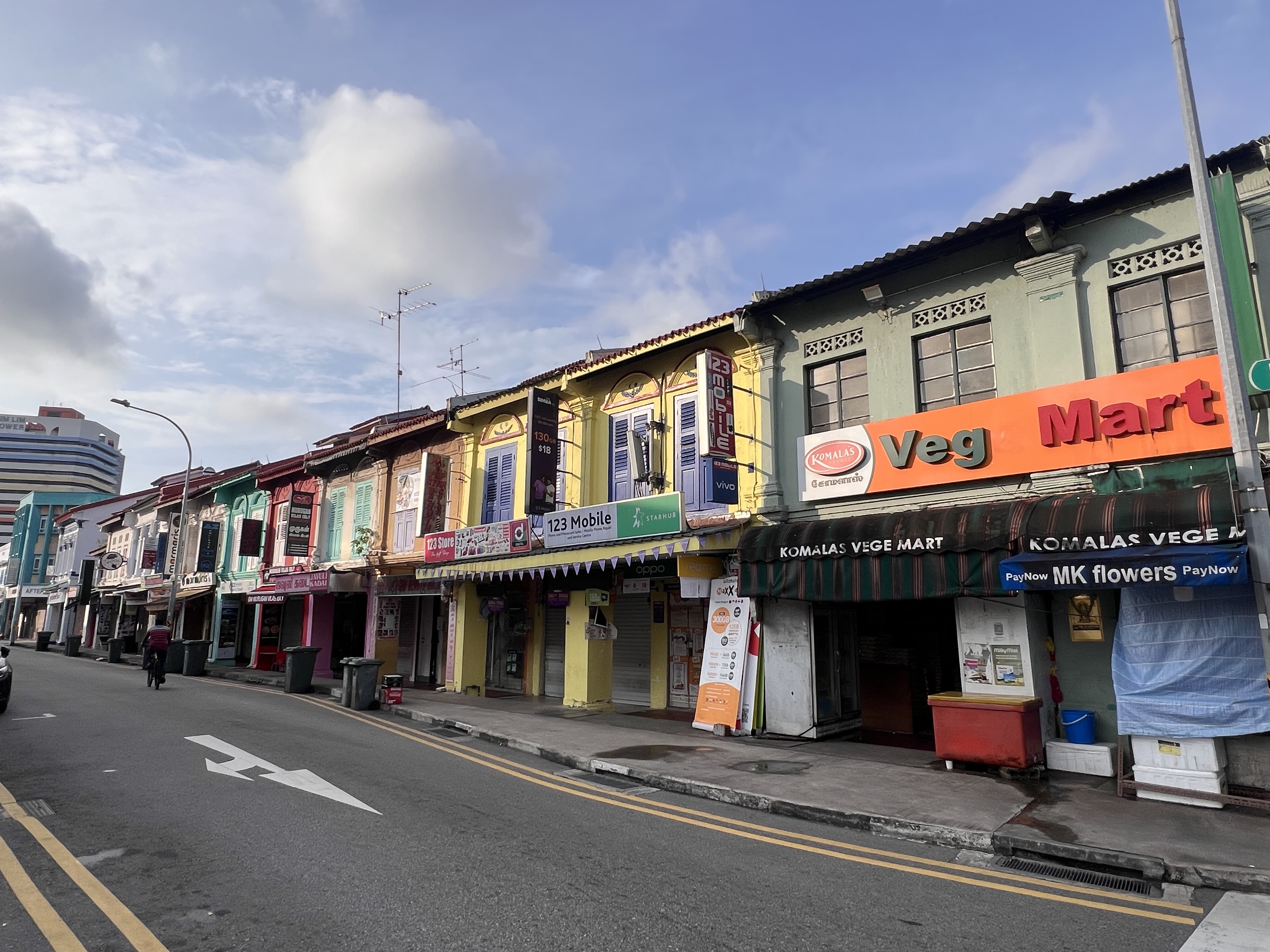
While the Serangoon Road seems to be the home of gold and jewellery stores selling everything up to 23.999 carrot bars, each side street seems to have groupings of business, export to India, clothing, pc repair, even dentists are all neatly grouped together. I guess it makes it easier to compare, no driving from store to store. Anyway a picture tells a thousand words so enjoy as we did.
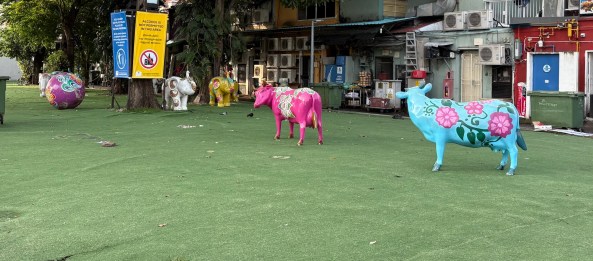
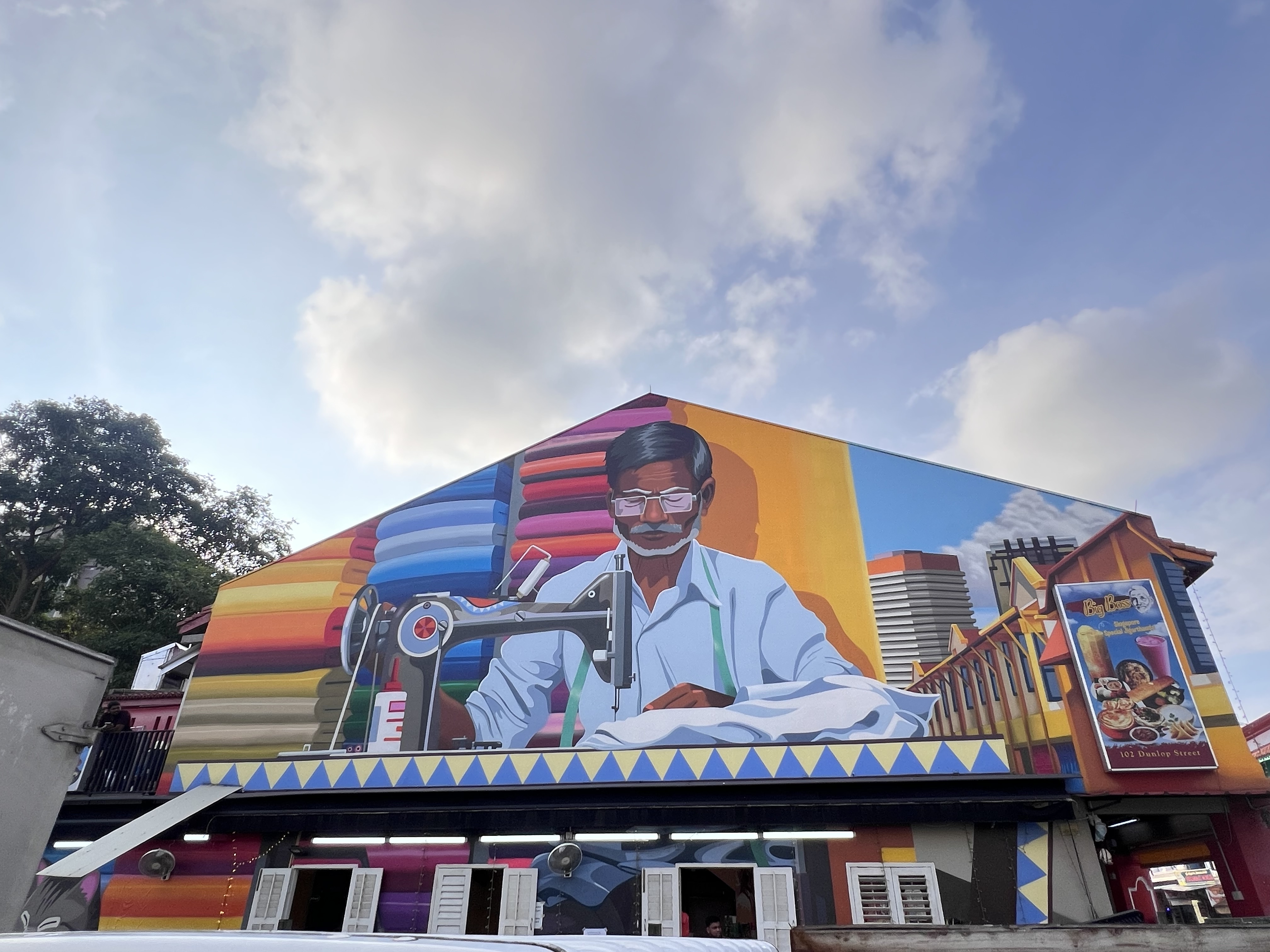
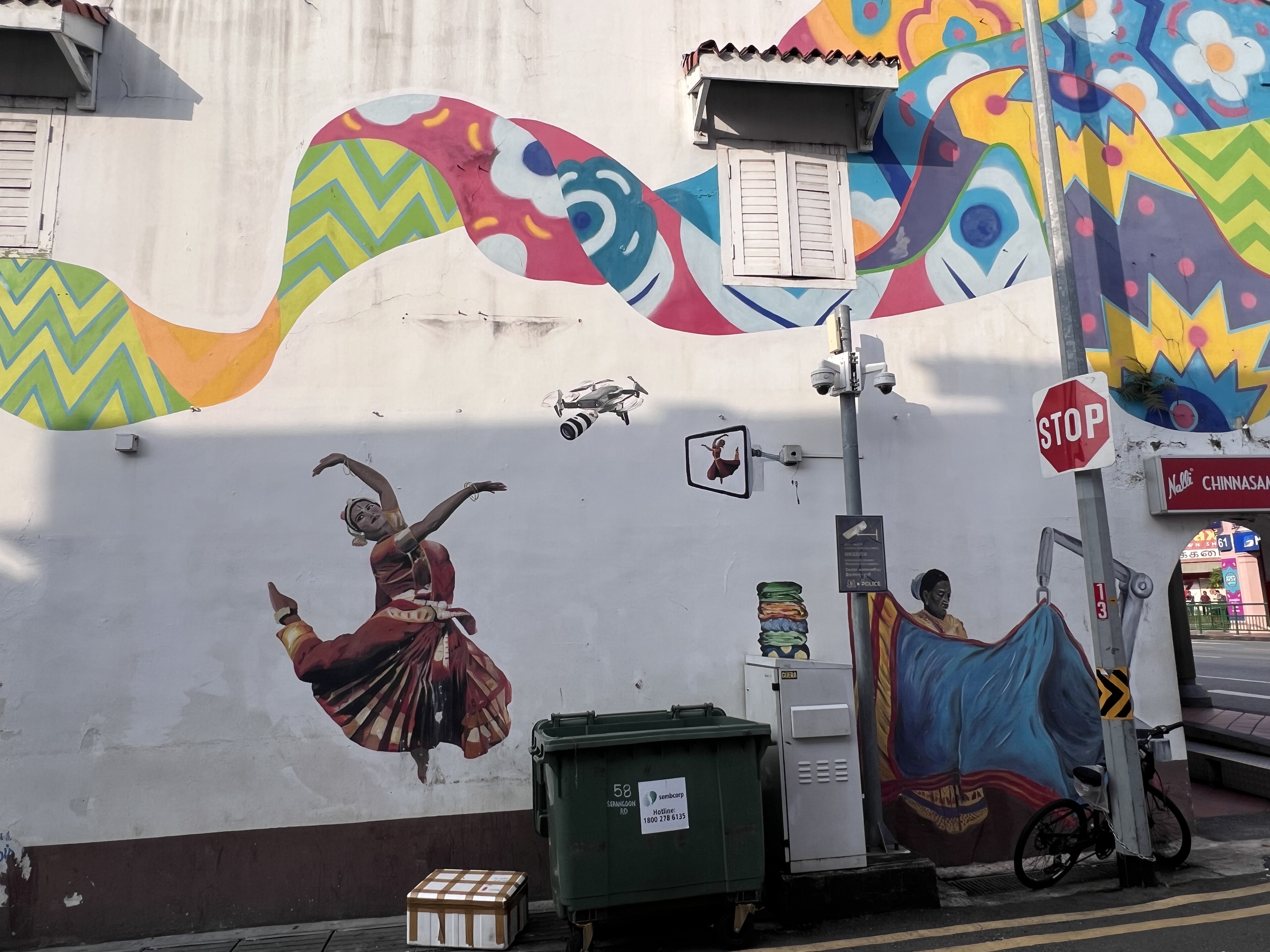
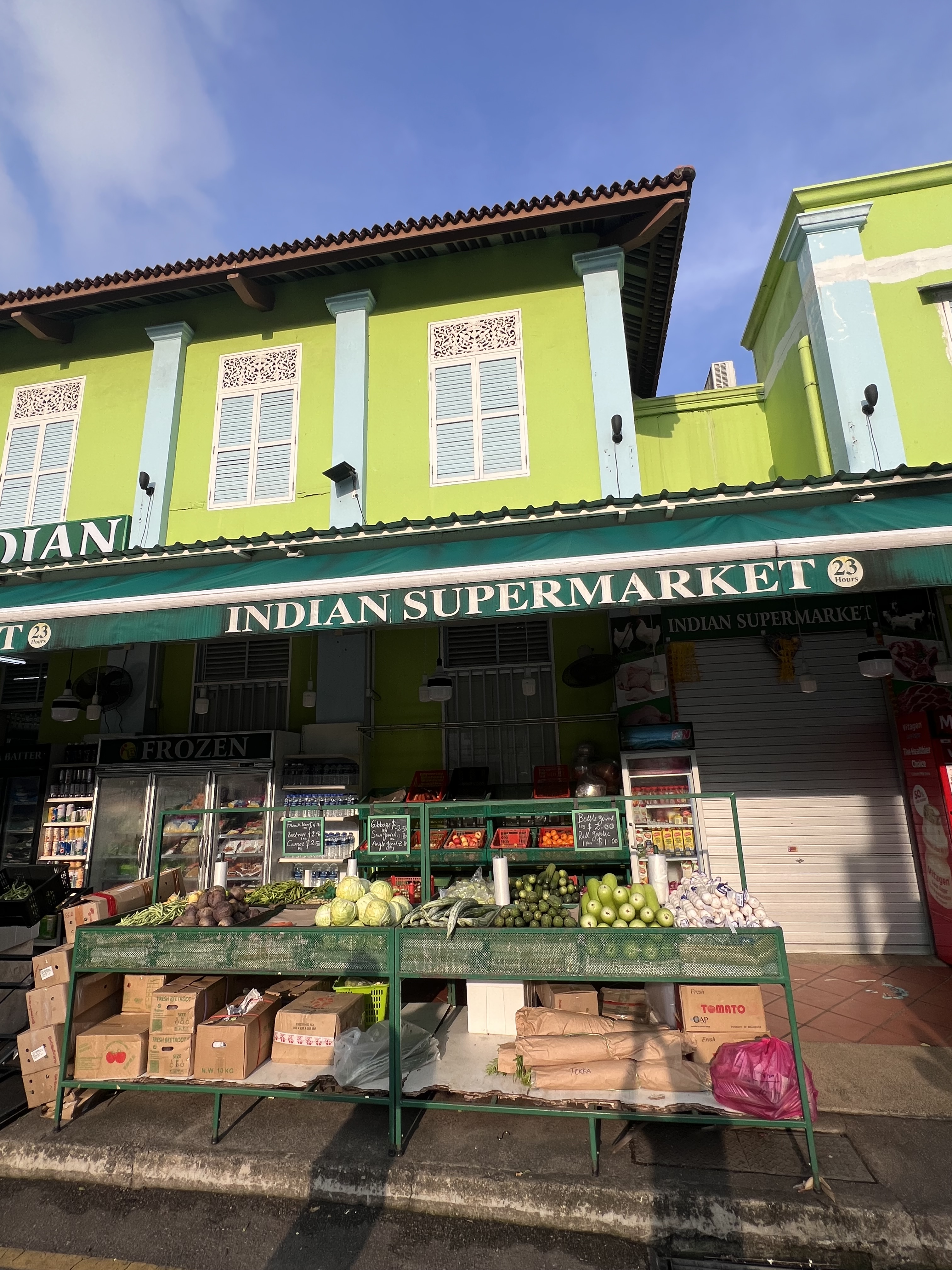
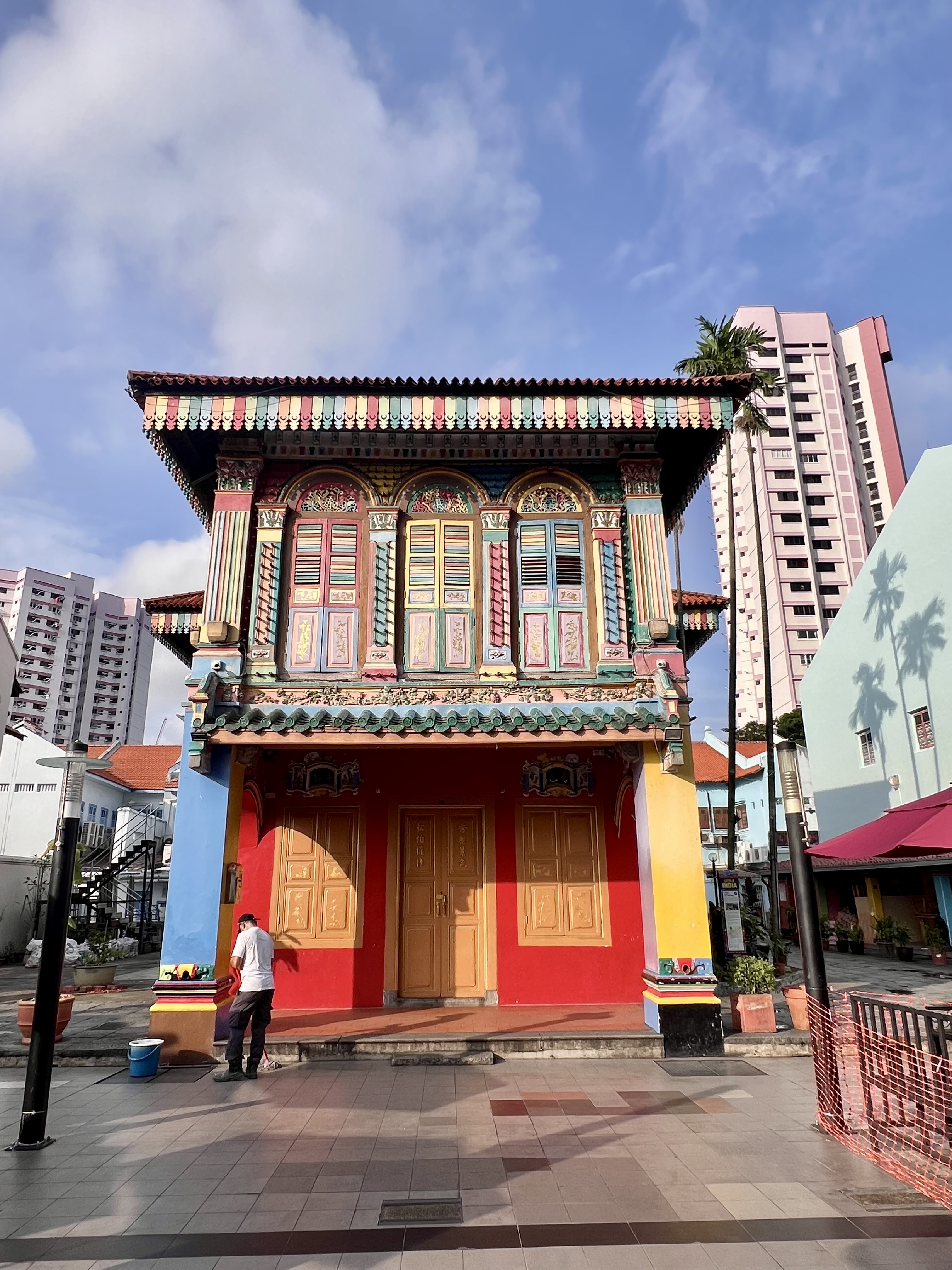
Eating out at a Nepalese restaurant in Little India Traditional sewing as we saw in India in 2014 The Sri Veeramakaliammama TempleFollow the heritage trail for more information. Not yet open for business on Dunlop Street.Traditional street art, modern imagery. Only open 23 hours a day.Last Chinese Villa in Little India, formally owned by Tan Teng Niah
We are here in Singapore after a few whirlwind days in Brisbane after our return from Cairns, unpacking and repacking, catching up with friends and even buying a new iPhone for me to replace my SE series 2 which was on its last legs. A 6am departure and we are off.

































 2slowspeeds