Constantine, Annaba and more Algerian welcome
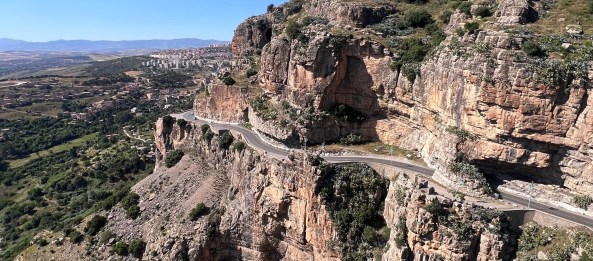
Constantine, often referred to as the “City of Bridges”, connecting the various hills, valleys and ravines which also means steep meandering roads, and stunning views, certainly did not disappoint!!! On so many levels.


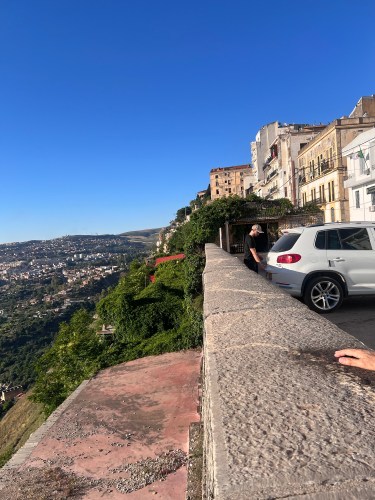
Founded by the Phoenicians in 203BC, Constantine was the capital of the Numidian Kingdom (a Berber empire) under the name Cirta. It was totally destroyed by Maxentius in 311CE then shortly thereafter rebuilt by Roman Emperor Constantine the Great in 313 CE, who named it after himself.
After an eventful arrival (long traffic jam down the steepest slippery road where 3 official lanes become 6 with everyone jockeying to get ahead) and crazy roundabout traffic, Streak and Storm are staying stored for the next couple of days!!

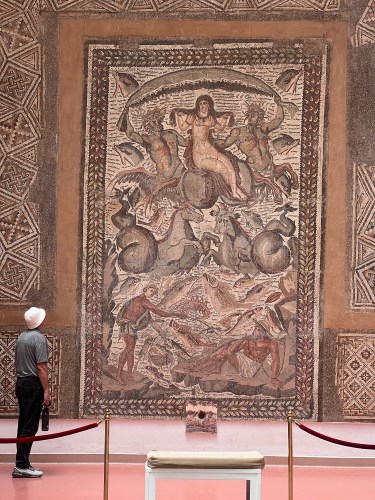
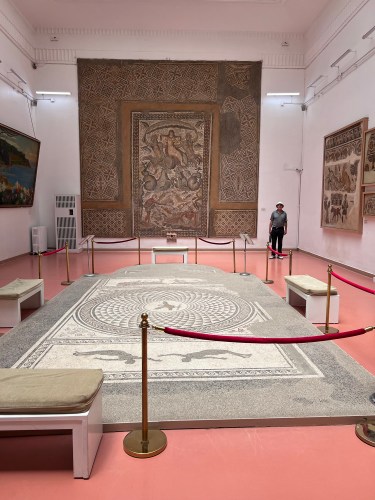
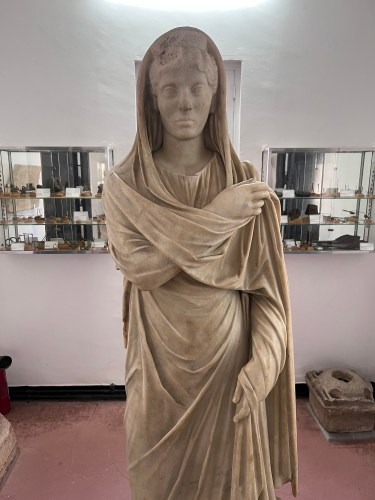
First on my agenda is the Cirta Museum with more Roman treasures.

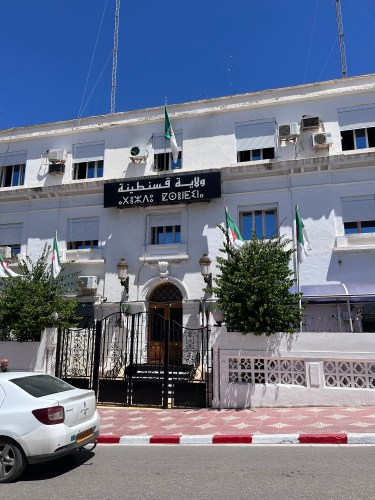
Anthony is running low on gluten free crackers/bread and we have used up all our tins of tuna and sardines so time to replenish. I find a supermarket that sells gluten free foods 2.5kms away from our hotel so we decide to walk there. We finally get away from the bustle of Constantine with its uneven broken pavements, into the quieter residential suburbs past some stunning old houses and STEPS of course.

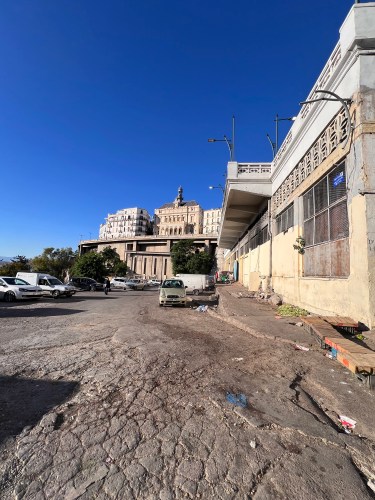
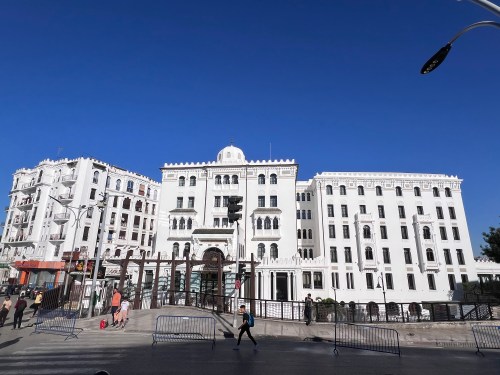

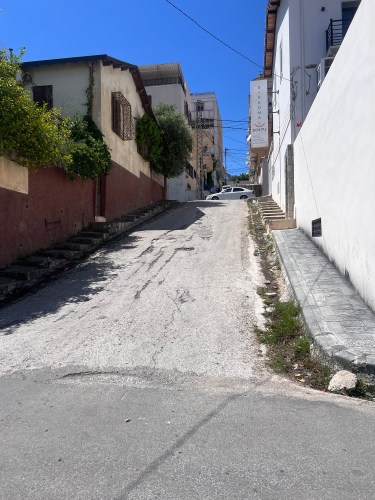

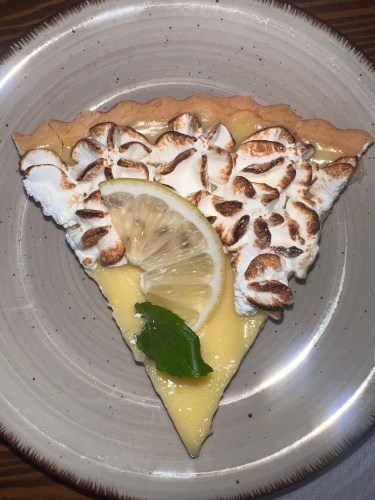
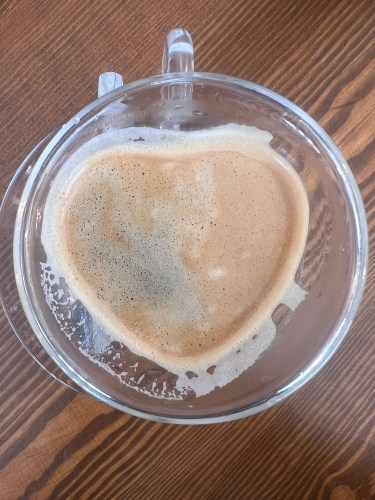
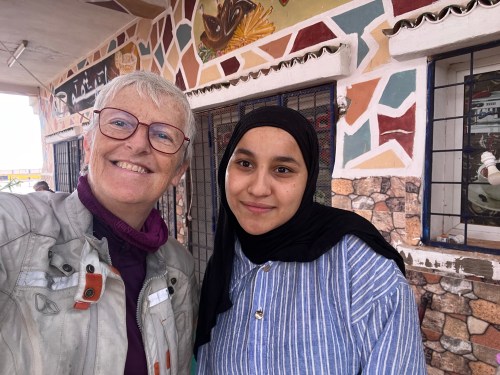
Canstantine is afterall built on a rocky cliff face. We didn’t expect to come across a modern looking coffee shop and decide to walk in. Every single head turns to look at us as we enter. They are all women. One table left just for us. With pastries calling my name. Sadly nothing for Anthony.
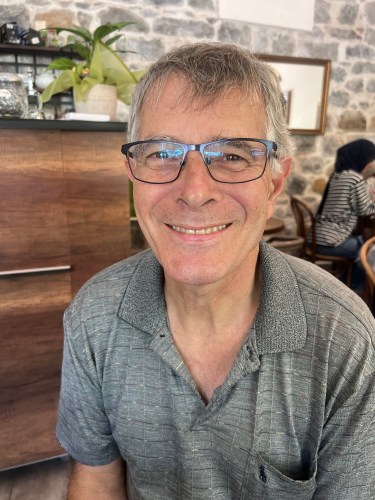
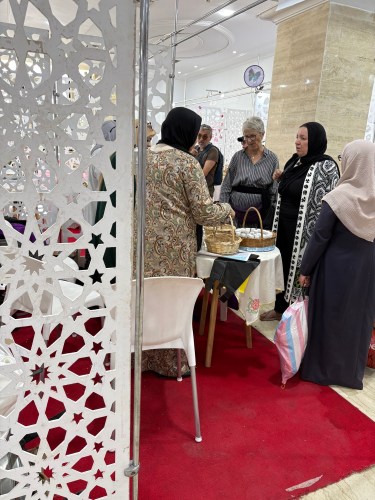
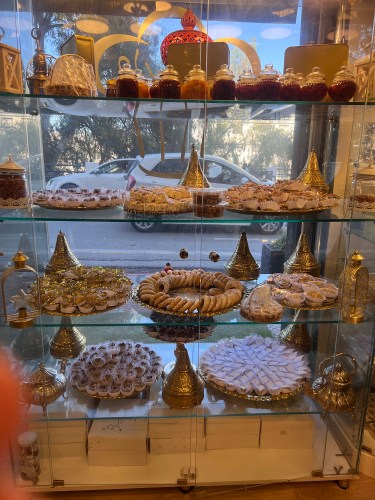
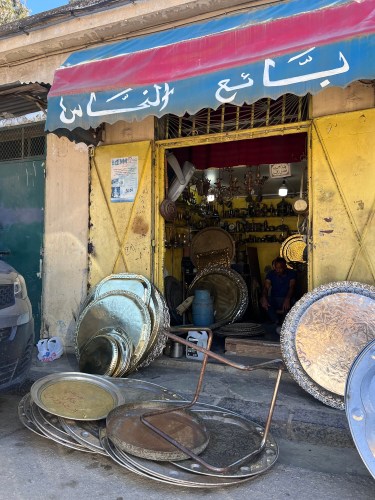
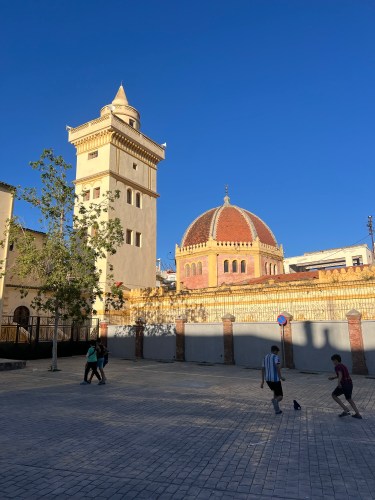
We get to the supermarket – closed. The small store opposite tells us it’s been closed for 3 years! Google doesn’t always have the latest information. As he tries to explain where the nearest supermarket is, a car stops, asks us if he can help and offers to take us. And there started a new friendship. We ended up spending 4 hours with Nourrédine and later his wife Nina (who was busy earlier which enabled him to drive us to the hypermarket, then the Grand Mosque). As we get literally 100m from our hotel, Nina decides we need to hop out of the car to go to a rose water fair where I try rose and orange water at every stand while Nourrédine drove around the crazy roundabout!! Our hotel is literally across the road but Nina calls him to collect us to drive us to the Ahmed Bey Palace asap as it is due to close soon. It just closed when we got there but is open tomorrow which is great news. Back in the car to take us to see the suspension bridge, then we drive around the copper artisan area, then we stop off at an amazing cake shop. We invited them to have a tea or cold drink somewhere but they instead invite is to their home, 35kms away. Realising how tired Anthony was they then offered to invite us to Friday lunch instead.




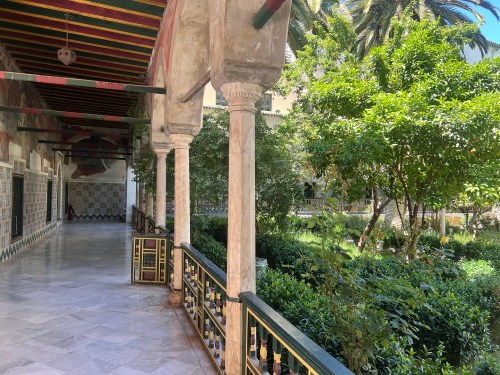
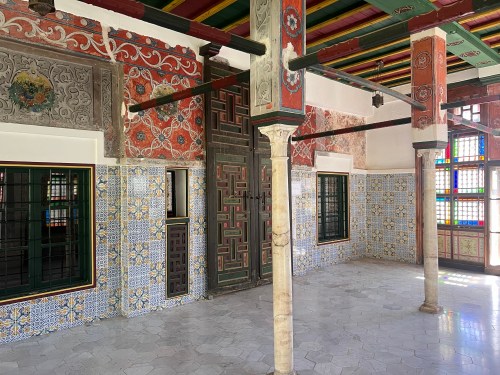
Friday morning we return to the Palace for a visit.


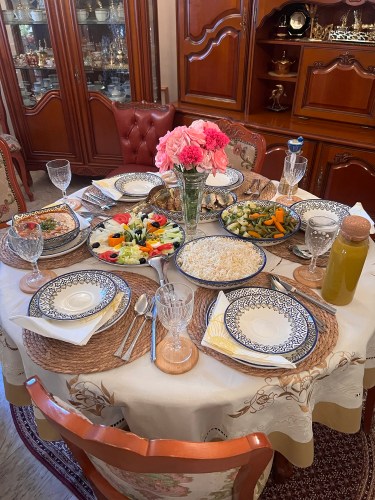
Friday is family day. Towns and cities are dead on a Friday because everyone is home with their families. So to be invited to their home on a Friday was very special. Nourrédine came to collect us while Nina was preparing a special gluten free/dairy free meal for us. What a beautiful table and delicious meal. We were totally spoiled with fresh salads, grilled sardines and tuna, steamed veggies and amazing juice and fresh fruit. The conversation was very fluid and interesting, mostly in French with some English with their daughter-in-law who spoke perfect English.
Time flew by, we all wished we’d had more time together, so we exchanged emails and connected on social media. What a beautiful family we will want to remain in contact with.

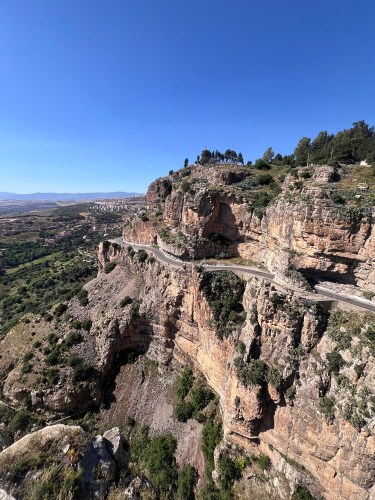
Saturday morning we decide to leave earlyish to beat the traffic. We rode the stunning cliff cutting we had driven with Nourrédine and Nina the other day. What a view. The otherside of the suspension bridge took is down various narrow, one way streets – one wrong turn and I tell Anthony to cross the pavement to the other side. The trick is to keep moving and get out of situations.
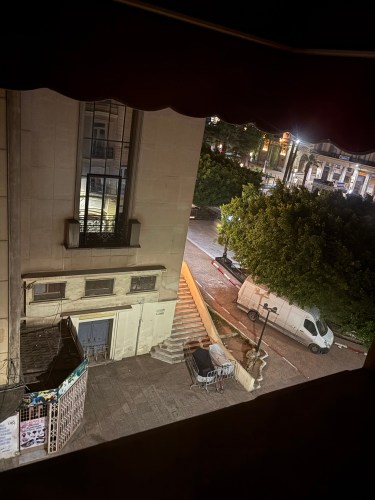
Annaba’s hotel secure parking turns out to be on the pavement near the hotel with a security guard 24/24!! Worked fine but we did feel bad for the poor guy seeing him there at 3am still watching Streak and Storm.
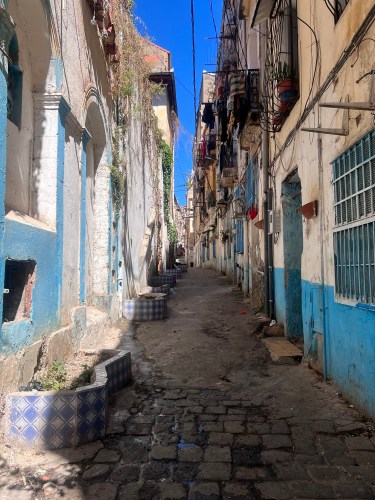
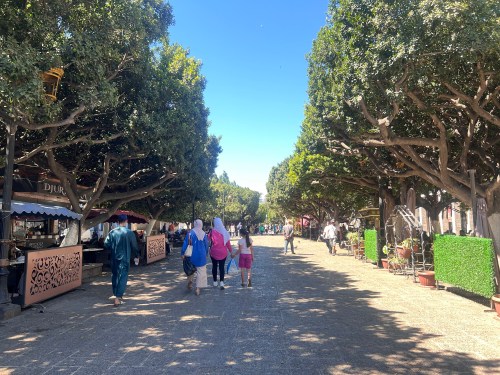
After a great lunch, it’s time to get a bit of exercise and explore the old city. I eye a tiny coffee shop but as usual, it is full of men smoking. As we are just about to continue on our way, two men call us in, come in, sit down. As usual in Algeria, we get the best welcome and smiles. And great coffee. We continue our walk and I notice the most deliciously caramelised palmiers!!! (They’re French palm tree leaf shaped puff pastry coated with sugar – they’re delicious). Could not resist to buy one. Only one? Not two? No, only one…. 5’ later, I could not resist. Yes, one more would be great, it was too good. Anthony returns to the shop and gets me … 2 more!!!




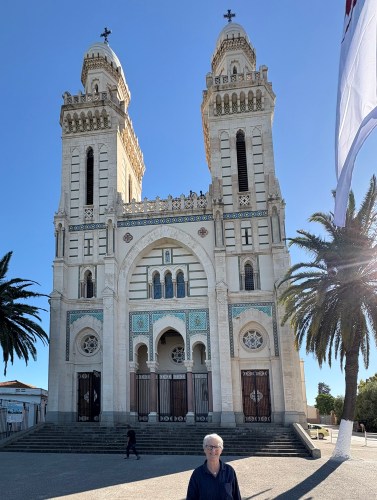

While in Algeria, I never hid my French origins and invariably, whenever we’ve had the opportunity to have longer conversations than niceties, the long lasting hurt from the French colonial days is always brought up. Whether it is the fact that their father or grandfather died of torture in 1954, or had their past eradicated by being given new French names or that the stunning building were occupied by the French army or colonialists. The deep feeling of hurt, grief and displacement is long lasting and still felt, especially as there was never an apology – it often reminded me of our Stolen Generation. It is heartbreaking to hear first hand of this hurt and know that so few people experience the genuine warm welcome Algerians we have received from so many in our short time in Algeria due to incorrect media bias.
Our last night in Algeria could not have been more perfect. We met Laidi and Anis, a surgeon and a pharmacist, in a smoke filled cafe showing the Paris Saint-Germain- Inter-Milan European Cup Final. We spent hours chatting and being once again spoilt by their generosity. We could not pay for a thing. What a night!
Our trip to Algeria would not have been anywhere near as enjoyable and memorable had it not been for the generous and welcoming Algerians we met. Thank you to all of you. We have left a bit of our hearts in Algeria thanks to you.

We leave in the morning for the Oum T’Boul border crossing into Tunisia.
Anne
Touggourt to Constantine
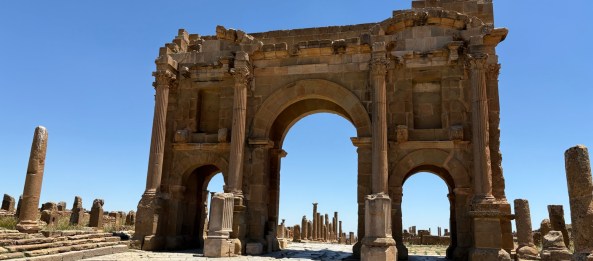
Timgad: Preserved Roman city
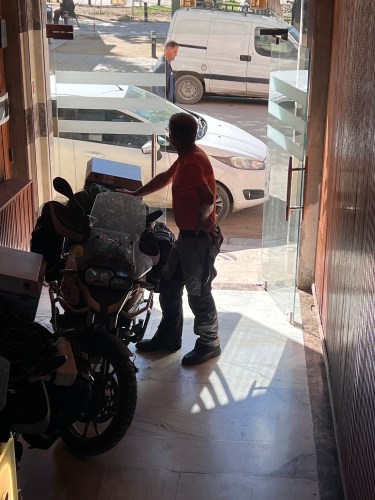
After three days’ riding, we will not be donning motorcycle gear today. After yesterday’s effort to get the bikes into the hotel entrance, Anne cleverly thought that we should get a driver to take us to Timgad, the complete ruins of a Roman city some 30km from Batna. We will be able to dress for the weather, leave the helmets behind and not have to ride motorbikes up steps!
We continue to be blessed with more temperate mid 20 Celsius weather. A 40 minute drive and we have arrived. After purchasing tickets we ask if we can hire a guide, none are available although we are asked if an Italian speaking guide would do. They must have many Italian visitors. As we do not know the area a guide would help identify one pile of stones from another.
We head to the museum first and are impressed by the scale and quality of the recovered mosaics on display. The detail on some including shadows and 3D are amazing.
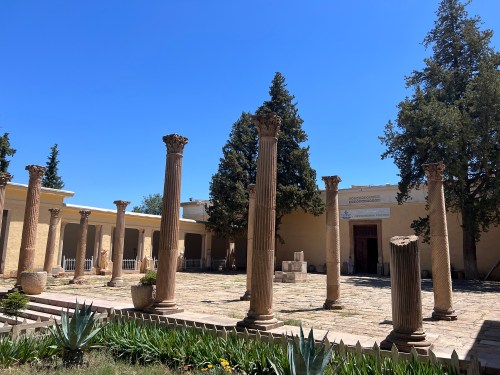
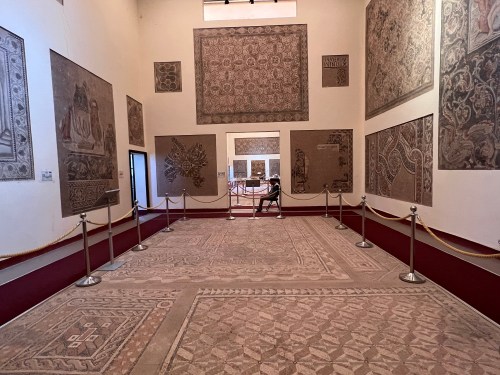
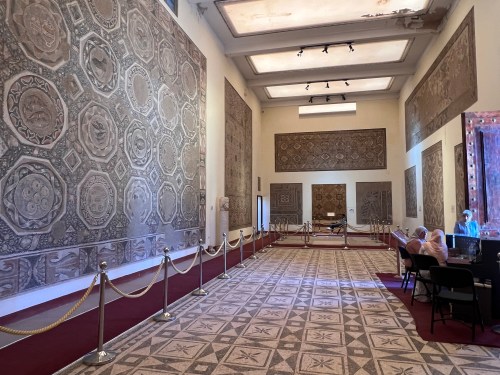


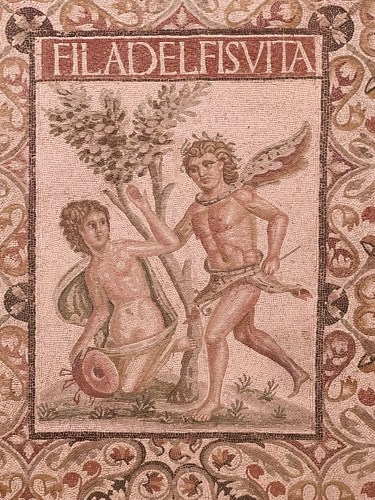
On leaving the museum we are approached by a guide. Museum staff members had been searching for one on our behalf and now we are good to go.
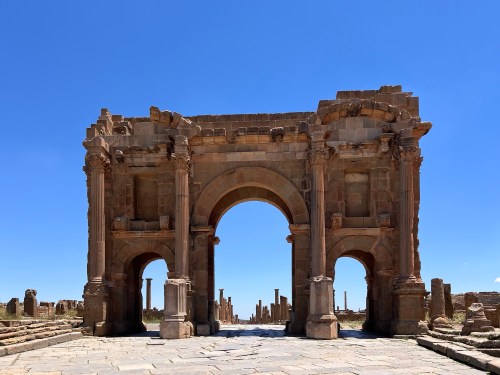
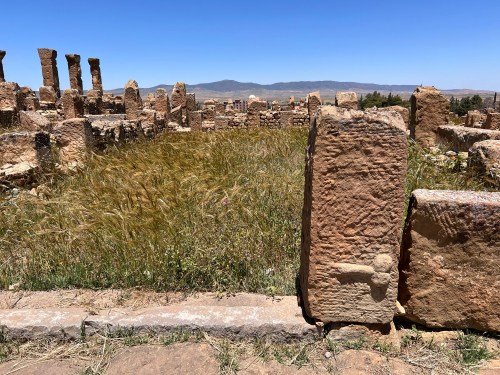
Timgad, or to give it it’s full name “Colonia Marciana Ulpia Traiana Thamugadi” was founded around 100AD by the Roman Emperor Trajan in the Aurès mountains. The city was initially populated by Roman veterans and settlers. Timgad today is one of the best preserved Roman grid pattern cities mostly due to fact that after it ceased to be inhabited in the 8th century, sand covered the site protecting the remains until Archaeological exploration in the 1880’s. Today one can wander the main streets, sit in the amphitheatre, look into bathhouses and generally as our guide showed us get a good understanding of the different sections of the city and their functions that the population of around 14,000 went about on a daily basis.
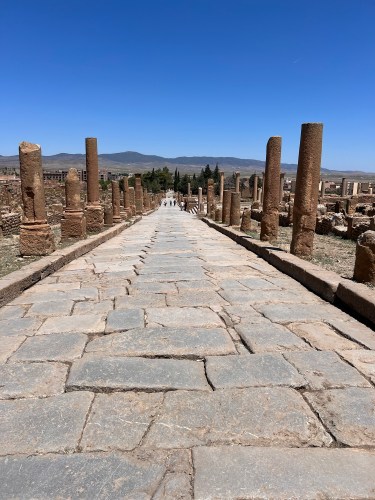
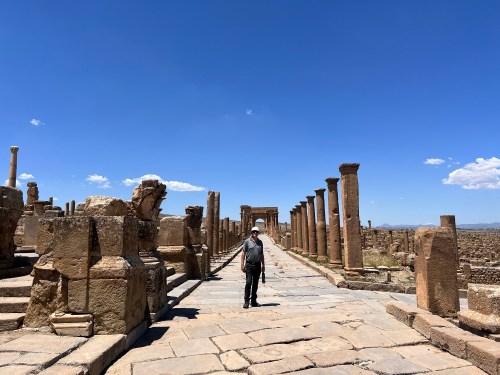
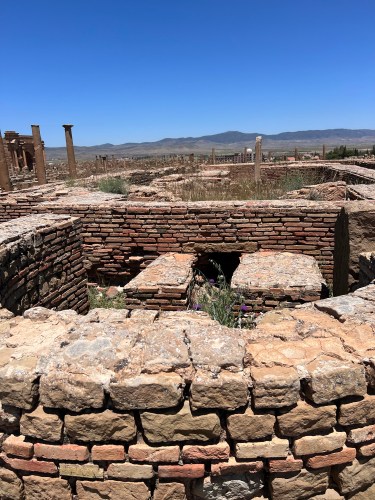
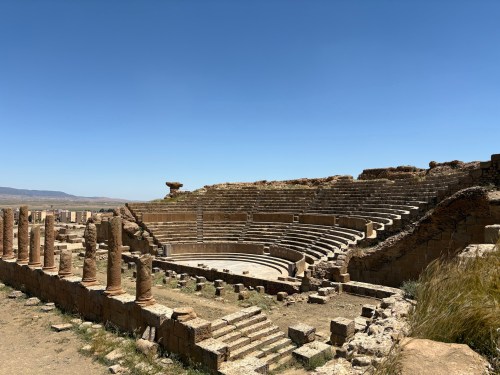

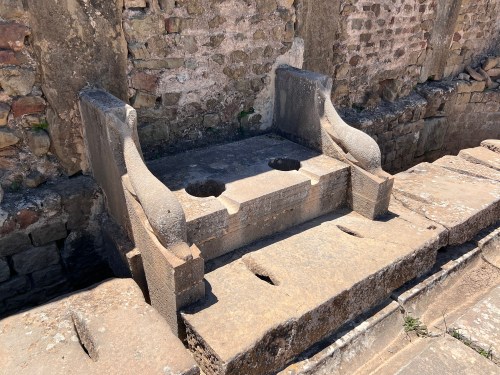
While at lunch at a local hotel we see a small Italian tour group, hence the Italian speaking guides. It must be a popular destination for Italians.
Our route from Batna to Constantine will take us on a back roads rather than the main RN 3 as our future route will be on major highways. Back past Timgad and we turn north with the sun at our back rising through open countryside. We approach Constantine but are delayed by our first traffic jam. Three lanes have become 5 as cars squeeze further forward. We find the road surface very slippery as we head down a very steep hill towards what turns out to be an accident. Our final approach to the hotel takes us through a mixture of cars and people attempting to use the same roundabout concurrently and in different directions. This is next level people /vehicle interface, there were even three guys carrying on a conversation in the middle of the road on a roundabout! Luckily we avoid mowing down any pedestrians and safely reach our hotel.
We can definitely use the two days here in Constantine for a little bit of R&R. The concentration required when riding in unfamiliar circumstances does take it out of one. This also gives us time for a little reflection on what we have seen and done here in Algeria.
Streak and Storm now sport Algerian flag stickers. We have always kept and eye out for them and when we saw stickers in a shop at a petrol station it was closed. Ali the manager opened the store for us and of course they were a gift as visitors to Algeria. This has been the norm for us here, kind and helpful people. We have learned we do not need to ask the price, or haggle, we will be charged what is appropriate. Long may this continue.
We have seen very few tourists. It seems that the season ends in April as the weather warms up. We have hardly come across any foreign tourists even at places like Timgad and Ghardaia. We have also been mostly lucky with the temperature being in the high twenties Celsius, however we have been up to 39 degrees Celsius.
We have also determined that a business displaying VISA/Mastercard signs or having four credit card machines on the counter does not mean they work. Cash is king still, so do not leave home without it. While talking about money do note that the same item can be sold to you for 125, 1250 or 125,000 depending on which version of currency is used. It is all the same price, people just refer to it differently.
Time to explore Constantine…
– Anthony & Anne

“Rain in the Sahara!?!?!”
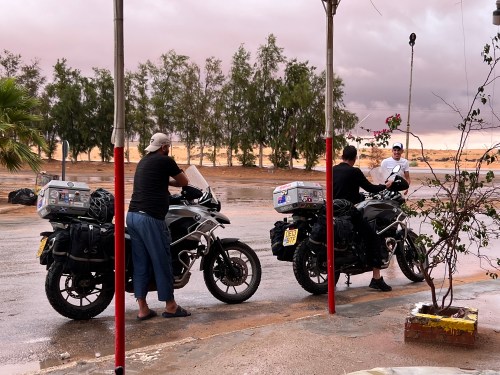
It has been raining in the night and the dust on the bikes has been spatter patterned by the rain. We have 360km to cover today, part of an 800km ride to Batna, with wind and rain forecast, the latter infrequent in this part of the world. The temperature has dropped by some 15 degrees Celsius making for a cool start.
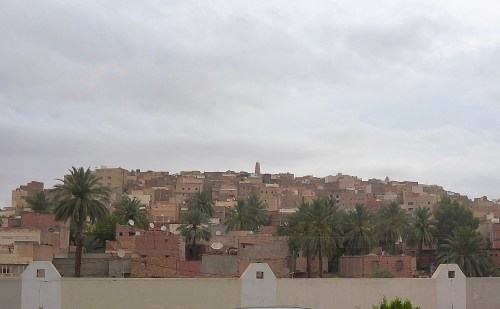
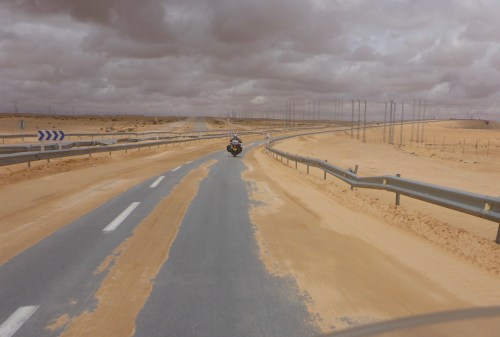
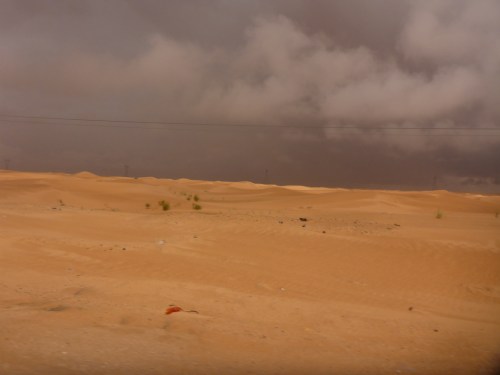
We ride up the hill southwards with our last look back at the “Pentapolis” as the five cities are called. Past the first police checkpoint, the red and white barriers you saw on the dual highway in the last video are actually bolted into the road! The wind has whipped the sand across the highway in places and we see our first “sand plow”. Looks just like a snowplow. This and other front loaders have the job of removing dunes off the highway where they moved to the road in the overnight storm. Until now we had only seen the rocky side of the Sahara, now we are seeing the more “traditional” view of the landscape. I should note that if anyone reading this blog is expecting those amazing photos of motorcyclists crossing huge dunes and rocky outcrops you are reading the wrong blog. The 2slowspeeds are tarmac bunnies, venturing onto hard dirt from time to time but happy to leave the tough stuff to those better suited to that pursuit.
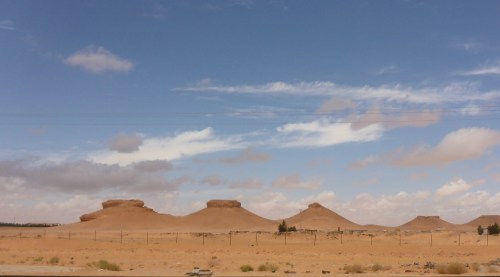
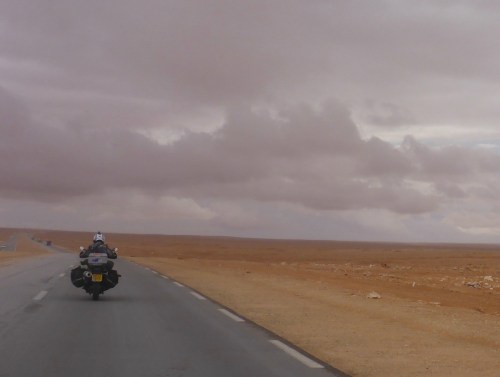
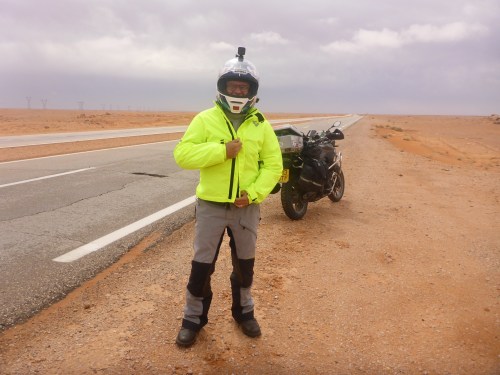
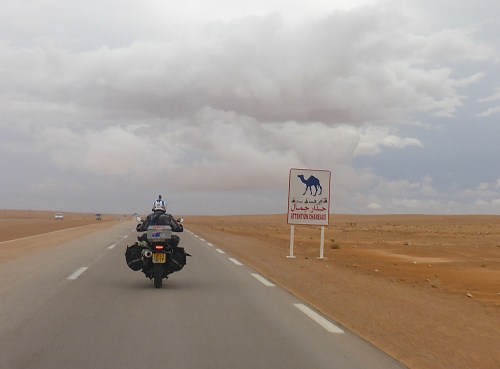




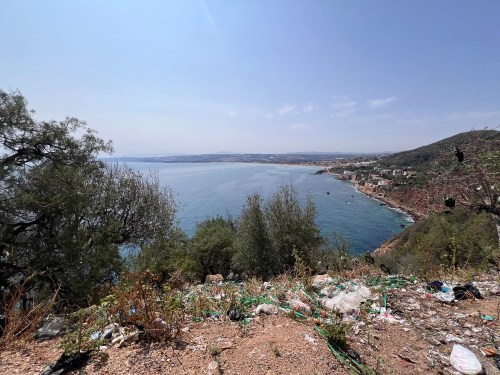
Littering! This is a topic that we have been wrestling with since our first day in Algeria. It is everywhere, sides of the roads, in towns, over hillsides and even out in the Sahara. We were initially overwhelmed by the sheer volume; plastic bags, bottles, cans, garbage bags everywhere. It impacts the visual landscape in such a manner that one cannot ignore it. At Tipaza the small beach was littered with waste, with more just floating in the water, washed in from elsewhere.

Why? That is what we asked ourselves but wanted more information before we made comment. Domestic waste volumes have grown significantly over the last twenty years and apparently waste processing has not kept up. Rubbish bins appear to be non-existent and if the people have no way to dispose of rubbish the inevitable happens and it becomes the norm to just throw it away, which is what has happened here. We have asked some of the people we have met their views which range from a shrug of the shoulders to discussions around people feeling entitled.

What to do? I will leave that to those wiser and more knowledgeable than myself. We see anti littering roadside signs, some young people collecting rubbish, some cleaner areas including the new town of Tafilelt where you get fined if you litter. The green shoots are there, they just need nurturing.
The traffic dance we described in a previous blog has, in our minds become a little clearer. We are starting to understand the steps and hopefully fit in better with the local drivers. In some ways I think the driving patterns here show similarities to how I envision driverless vehicles will operate. Not so much inflexible the traffic rules and signs we have today, but a real time adaption to circumstance. Those developing self driving vehicle software could look here and in Vietnam to see how drivers effectively work together to keep traffic moving more efficiently.
As a footnote however all the damaged armco barriers on the main roads and a car yard full of rolled vehicles means that country driving should not be used as a self driving model.
We may have mentioned road humps in towns and villages previously, but when you get back to back towns and villages on a road, you get literally dozens and dozens of the humps. Is this where suspension manufacturers come for field testing? Seems like you are endlessly changing gear and although it does enable us to get past trucks and cars with ease, a few less would be appreciated. We now check roads for the number of towns and villages before making a route decision.
I have been very impressed by the electricity transmission and distribution network. Wherever we go multiple power-lines stride alongside the roads connected large gas fired generation with impressive substations. There seems to be a high level of redundancy. We have seen little evidence of commercial solar or wind power, the latter would probably suffer from damage caused by the fine Sahara sand. Roof top solar has not really been in-evidence either.
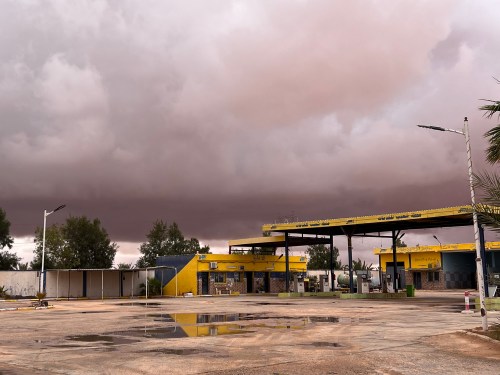
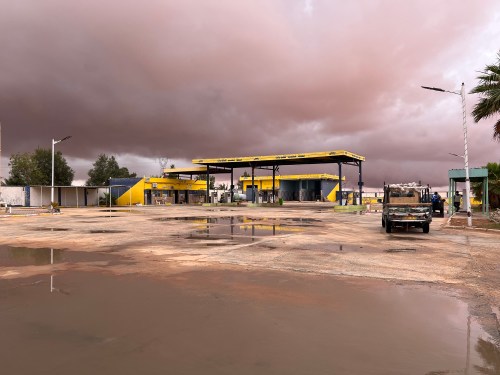
With the forecast wet weather we had decided the longer route via Ouargla with more traffic if we had a problem. At our lunch stop outside Ouargla a police patrol wishes to photograph us next to their vehicle. We cannot photograph them, but we seem to have a good relationship with the police. They even waved at the next checkpoint where we were stopped for some 25 minutes while our documents were checked, probably with a cup of coffee by the officer involved.
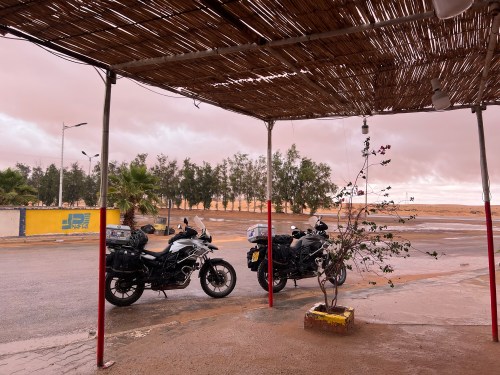
We did get the forecast rain. The hotel manager in Touggourt tells us that it normally only rains once or twice a year. We got the 3rd day.
Touggourt overnight and possibly someone checking out our bikes for nefarious purposes. We find evidence, probably from a cat burglar, so we will need to remain vigilant.
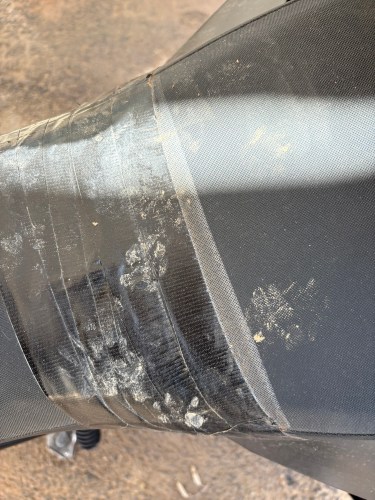
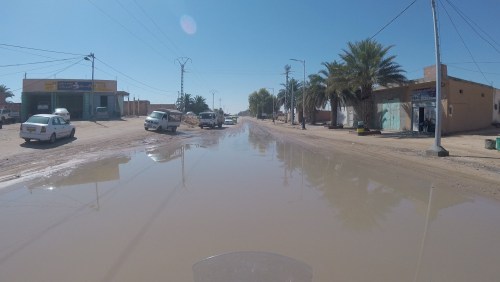
We decide to head north via El Oued and our decision is justified by beautiful sand dunes and palms grouped like oases. Some challenges today after yesterday’s heavy wind and rain with either vast puddles of water or sand across the road. At one point we just rode straight through unlike the locals. Further down the road, men are using a submersible pump to drain the “puddle”. I have been warned.


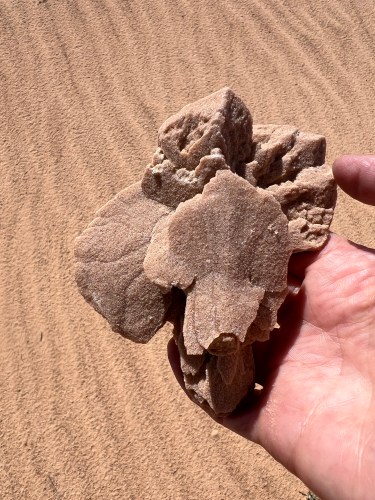
Up past the salt flats and as we get closer to Biskra we start to see the southern side of the Atlas mountains come into view. After so many days of relatively flat landscapes we enjoy the change.


As we leave Biskra, in the morning rush hour, Anne’s day almost starts with a bang, sandwiched between two cars coming from opposite directions on a large roundabout and only just managing to stay upright and avoid both vehicles. I saw how close it was, and while the drivers apologised for their errors, it was about as close as you want to be as a rider. Anne was badly shaken but chose to ride on. Anne is a tough one.
We had decided to take another Michelin map green scenic route, a little less sure after our first attempt, but the N31 is everything you could wish a motorcycling road to be. Amazing vistas, sweeping bends, little traffic and a tentative UNESCO site at Ghoufi to stop at and enjoy views of Ghoufi canyon and dwellings built by Nemidian Amazighs 2,500 years ago.
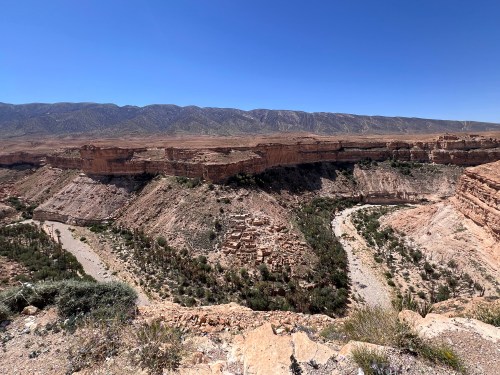

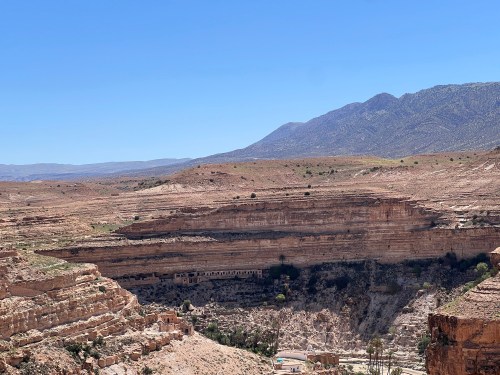
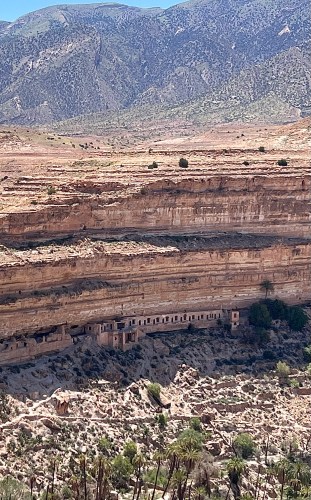
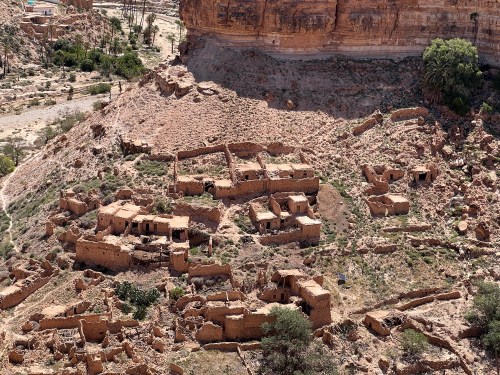
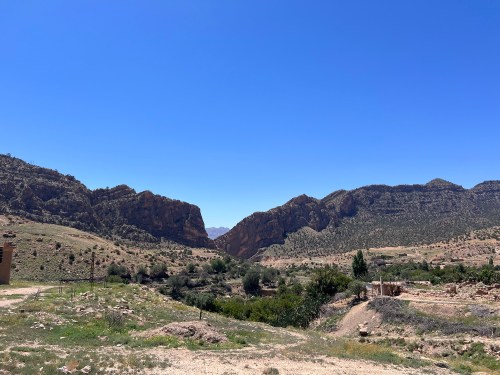
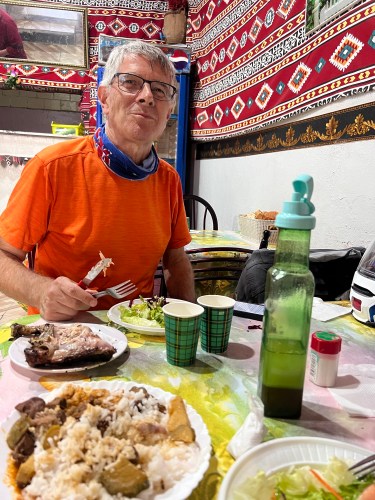
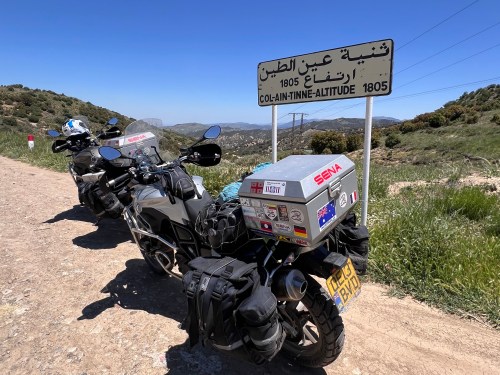
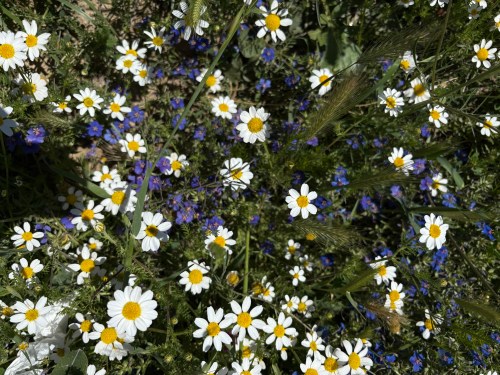
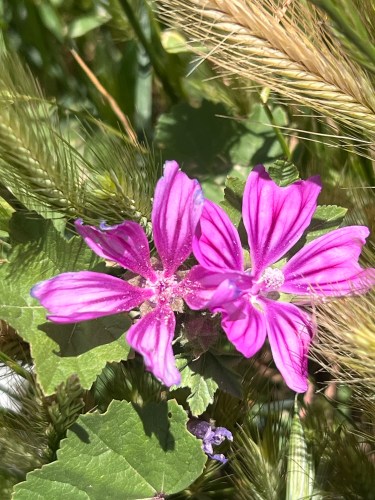
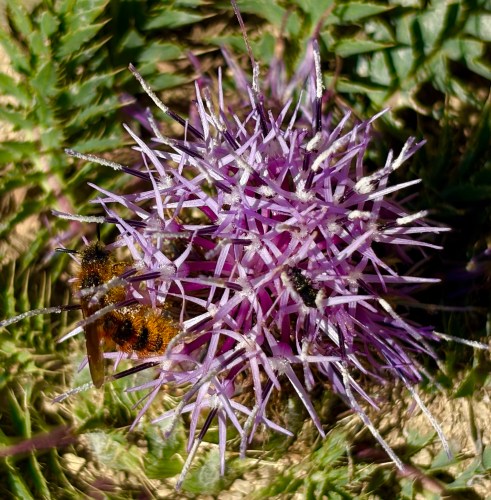
Onward up the valley, getting greener as we go. A pleasant lunch in Arris, with those interminable humps. We crossed a pass at 1805 m / 5,921 ft as the temperature drops below 20 degrees we gently descend towards Batna where will spend a couple of nights to go and see the Roman ruins at Timgad.
A last little challenge for the day after a wonderful ride.
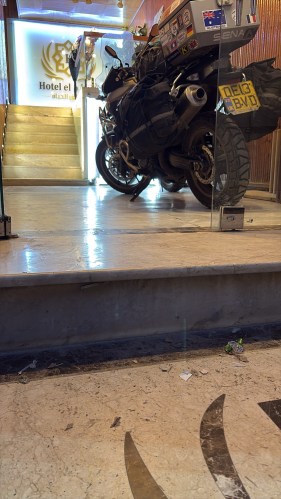
– Anthony & Anne
 2slowspeeds