Bandar Abbas

With yesterday’s long ride, we have the opportunity to depart earlier for Dubai. We have been advised to go to Shahid Rajaie Port Complex for the shipping and carnet processing. A taxi swiftly takes us to the port some 25 km from the city past long lines of trucks. The port is extensive, the largest in Iran, we have no idea where to go. Our taxi driver tries, initially in vain, to find where we should go. We finally end up in a large customs hall, after filling in a building entry application form on paper as the dozen of so electronic gates are unused, probably broken. People walk in and out, round each end past the security guards. We enter a large noisy hall filled with people. Briefcases, containing volumes of paperwork, are either in hand or perched on the counter that runs around the room, no visible signs of identification and mostly black. Some even have filing draws under the countertops that occupy the centre of the room to save taking paperwork backwards and forwards to the office.

We are lucky enough to meet Raza, an English speaking customs broker, who kindly offers to take us through the process on obtaining the carnet sign off. A charming gentleman, who we quickly form an affinity with. Not only does he help us here, but offers to take us to town to purchase the ferry tickets. We invite him to join us for lunch at our hotel. He does and then arranges for him and his wife to take us out for a tour of Bandar Abbas that evening. We are so lucky with the people we meet.

Reza with a friend, Banda Abbas, iran

Reza with a friend, Banda Abbas, iran


We meet Raza and his wife at 7pm and have an interesting tour of both the new and old,city, passing the fish market we plan to visit the next day. Tea and cake round off a great evening.

Reza has arranged an English speaking taxi driver, who turns out to be a retired Iranian navy captain, to take us to the shipping office to get our vehicle tickets. When we tell people we are retired and not working, they laugh. In Iran when you retire it just means you change jobs. Pensions are either small or not paid, so for the majority of people, retirement never happens.

Raza joins us as we purchase the vehicle tickets, or in fact get two copies of a letter in Farsi which says what?…. Raza takes us to the legal fish market, which of course has an illegal fish market operating alongside. We have seen this before in Tehran, legal and illegal operating side by side.

Fresh fish at Banda Abbas fish market, Iran

Fresh fish at Banda Abbas fish market, Iran

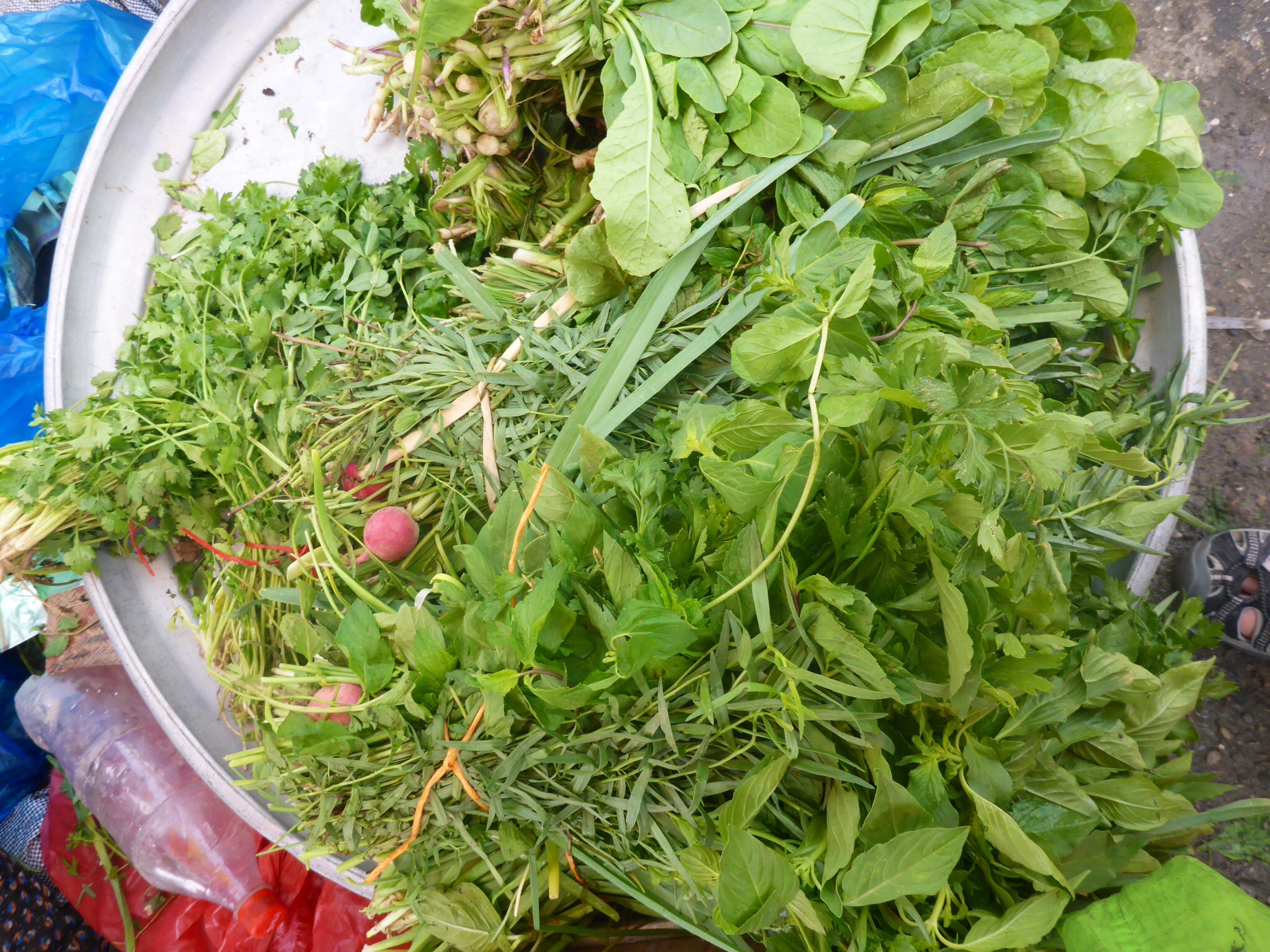
Iranian 'vegetables' consist of parsley, mint, lots of it, basil and other herbs with the odd raddish

Iranian ‘vegetables’ consist of parsley, mint, lots of it, basil and other herbs with the odd raddish

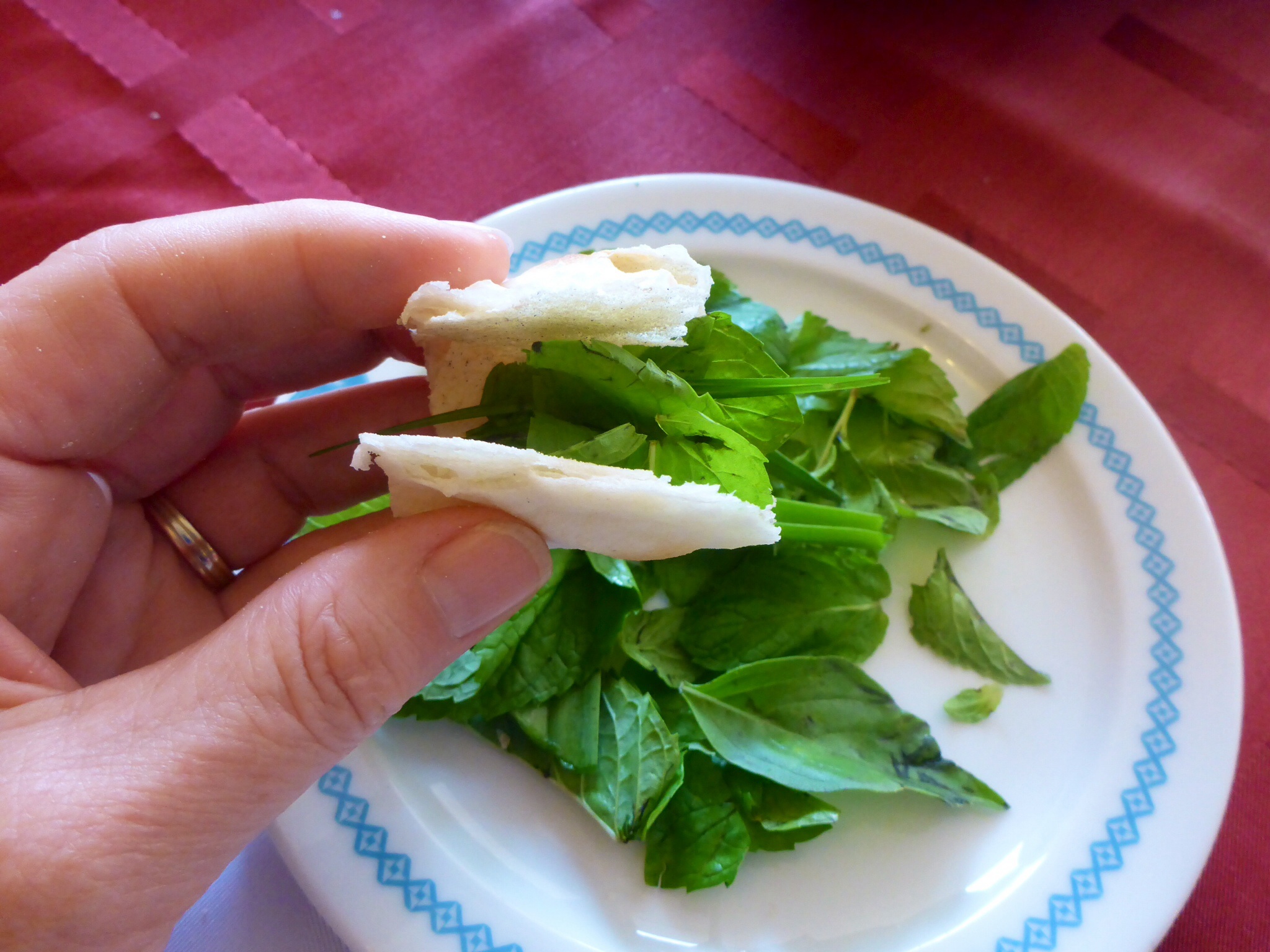
How to eat Iranian 'vegetables'

How to eat Iranian ‘vegetables’

Back to our hotel to avoid the heat of the day, and pack for the day and then a stroll up the new road to the beach, we go past dozens of aluminium boats that once could have just been taken straight to the beach, the new sea wall and four lane highway takes care of that. We walk further to the beach which is filled with people, cars and boats. Locals looking to get fish fresh from the boats?

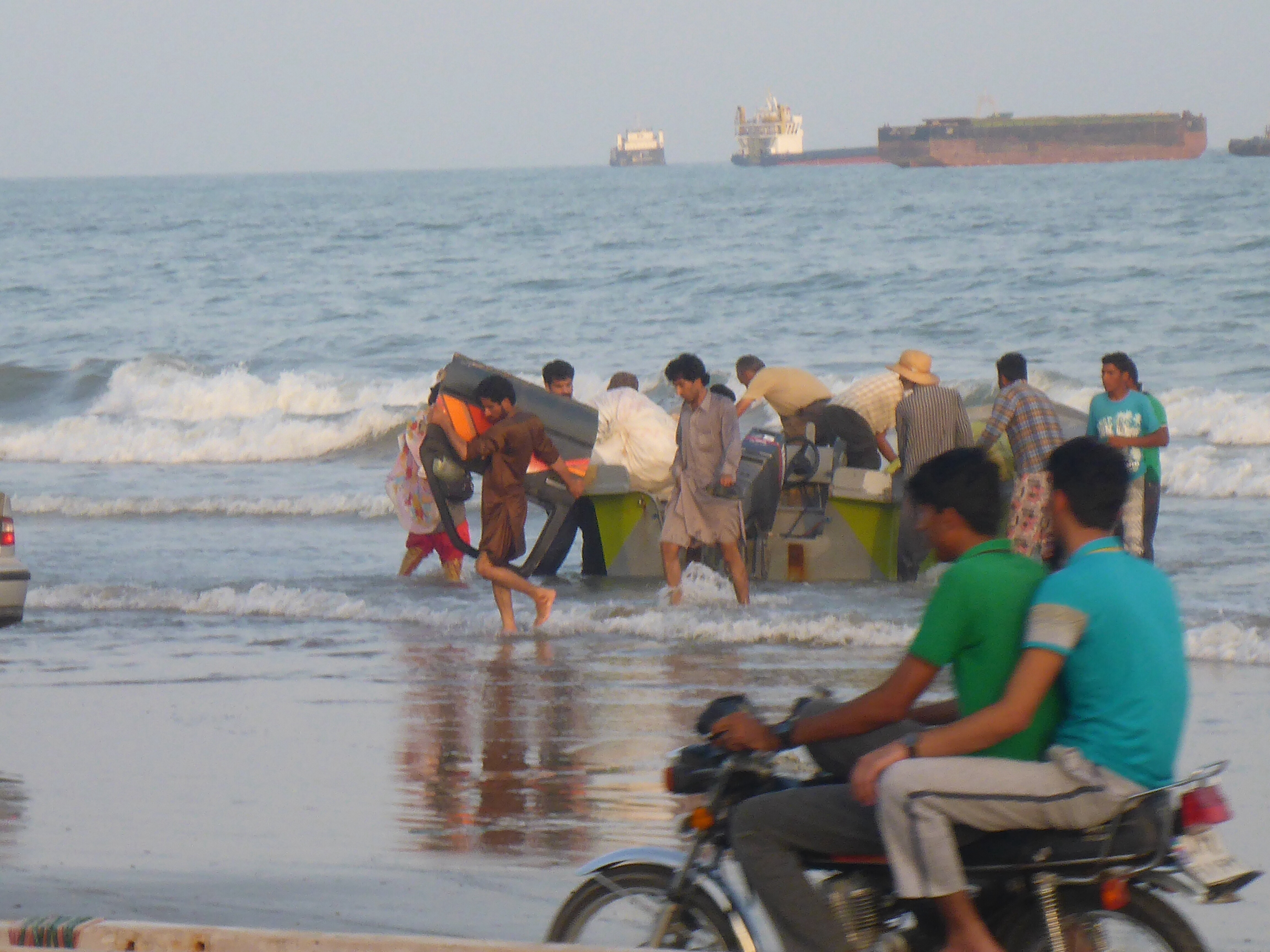
No not exactly. Rather people coming to load up their cars with smuggled goods! All these so called ‘fishing boats’ travel out to sea to collect goods from ships and bring them back to the beach for onward transportation for sale. We saw clothing, car bonnets and doors, people.

Unloading new car doors, Banda Abbas, Iran

Unloading new car doors, Banda Abbas, Iran


All move with efficiency off the boat, piled high into the backs of ordinary cars, hatchbacks are better as larger packages can be fitted. These cars can be seen around town and between cities, packed solid with goods. What do the authorities do about this? Nothing, we saw the police wander past taking no interest in the proceedings. As one older man, the beach master we think, said to us, “we are the Mafia”.
The very busy, friendly and open 'beachmaster', Banda Abbas, iran

The very busy, friendly and open ‘beachmaster’, Banda Abbas, iran

As the sun started to go down and we continued to video and photograph, a couple of cars with half a dozen young men pulled up, the atmosphere changed and while friendly and wanting us to join them in the cars we both knew it was time to leave. We did so and went safely back to our hotel before dusk. The sixth sense still working well.

– Anthony

Onwards to Kerman, or wherever…..

As we walk to our bikes for any early start, a cat scampers away, we see that my seat and tank are marked with paw marks: was the cat looking for a good night’s sleep, or, as we hear the sound of chickens from behind the high gate in front of which the bike was parked, a more sinister and likely reason comes to mind. Breakfast……

After the usual photographs for the hotel staff, we are off in the cool of the early morning. The route is straightforward for a change and in 15 minutes we are on the Persian Gulf highway heading for Kerman.

Heading out of Yazd, Iran

Heading out of Yazd, Iran

Along the Persian Gulf Highway

Along the Persian Gulf Highway

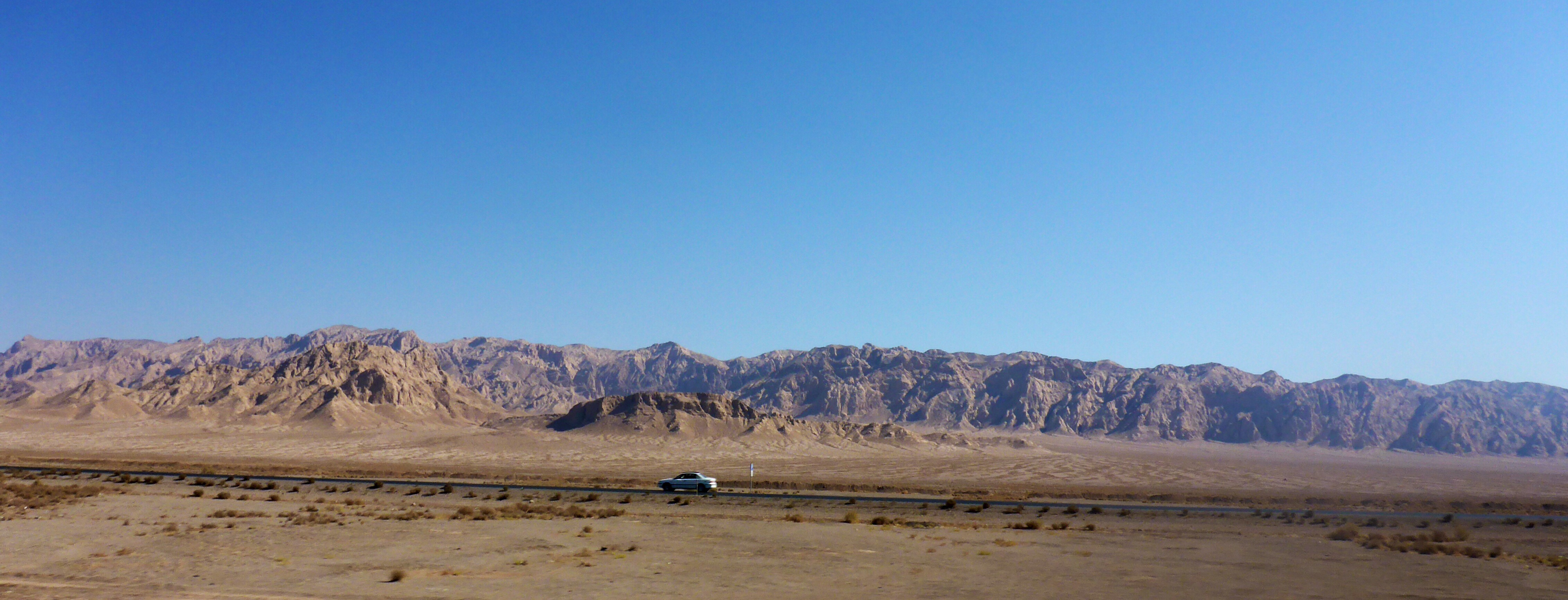
The road is dual highway with bypasses around each Last mountains before the Banda Abbas coast, Iran. We are able to maintain a higher average speed than normal and are making good progress towards Kerman.

Highway from Yazd to Kerman, Iran

Highway from Yazd to Kerman, Iran

We start to notice some faded animal signs along the route, each just before a parking area. Closer inspection reveals them to be warnings not to stay overnight because of the danger of cheetahs. Cheetahs in Iran??? A little research that night shows that there is an asiatic cheetah that is genetically different from the African one, having separated some 30,000 to 60,000 years ago. Sadly it is estimated that there are only between 40 and 70 left in the wild and few in captivity. I had only though that cheetahs existed in Africa. Let’s be positive and believe that the remaining few can survive and flourish, but sadly the faded signs will probably be monuments for their eventual demise and the inability of man and animals to successfully coexist.

Asiatic cheetah warning sign along the Persian Gulf Highway, Iran

Asiatic cheetah warning sign along the Persian Gulf Highway, Iran

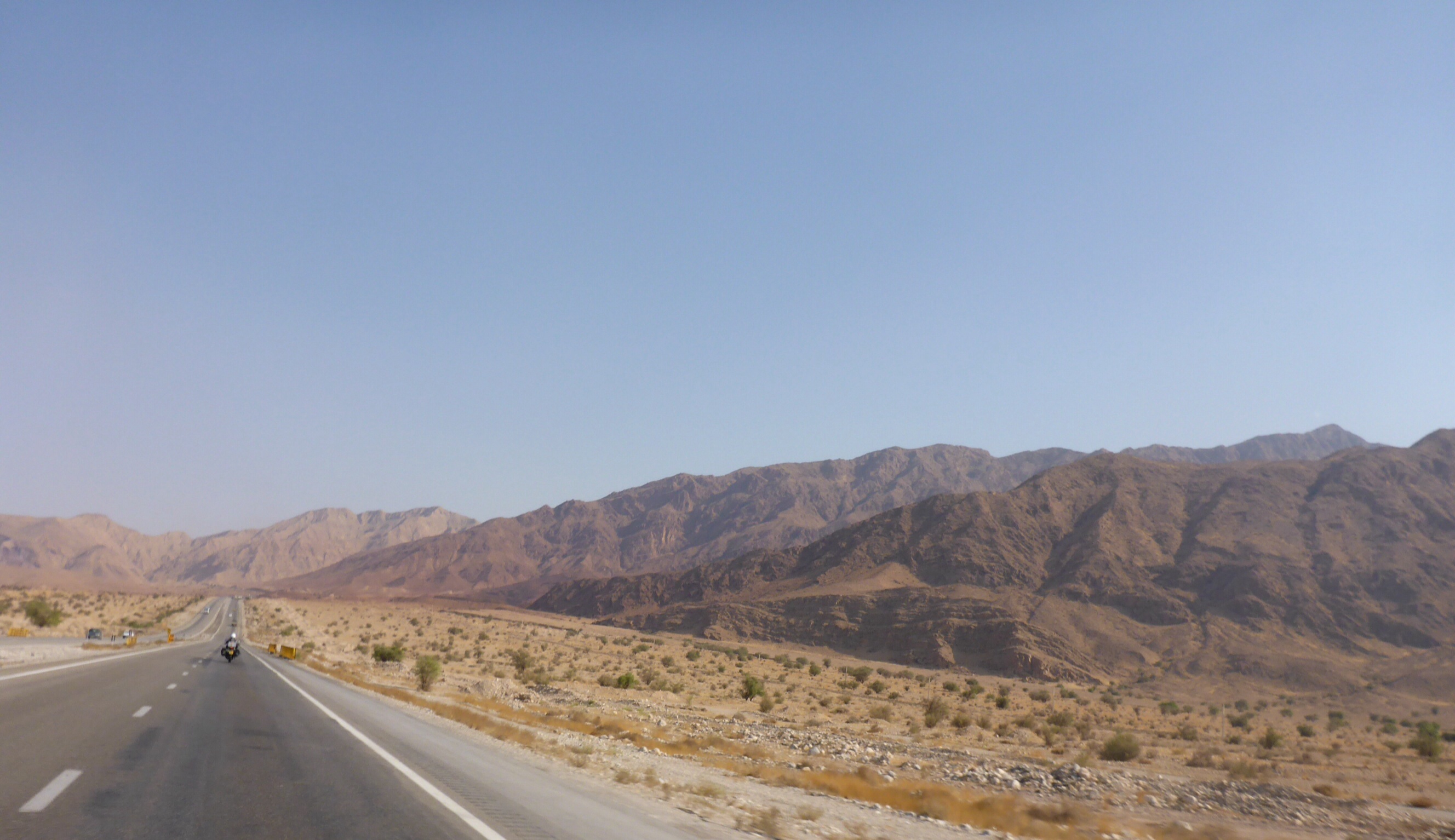
We are making good progress and while initially following the signs to Kerman, we now see a fork in the highway with Bandar Abbas, our ultimate destination indicated, so we follow that. We quickly become aware that we are not travelling east anymore but south? A check of our map reveals that the small 2nd class road is now a four lane highway taking some 100 kms off our journey and bypassing Kerman. Turn back or continue? The lure of the mountains ahead call us onward and we are not disappointed: gentle snaking turns, wind up between jagged peaks as we climb into cooler air and great scenery. Perfect motorcycling road with two lanes in each direction. We climb and descend and find ourselves out of the desert environs, with more cultivation and at a higher elevation.

(Anthony’s is too polite to mention my Shewee mishap. Here we are, on the side of a desert road with not a single tree or anywhere to hide behind away from the sight of passing motorists on this 4 lane highway, we stand side by side. But of course, I have my scarf on, so what is a woman doing standing right beside a man peeing. How naughty of me. This puts me into a fit of giggles. And in my rush and giggles, my Shewee is not positioned correctly… The feeling that I have ‘missed’ makes me laugh more… which is only making things worse…)

Half a dozen double parked trucks at the side of the road, the sign we have found to be a good place to have lunch. We have found worldwide that if the food is good, truck drivers will return. It is how we choose our lunchtime stops – no trucks no stopping for us. Kebabs are sizzling over a simple charcoal tray outside as we enter the cafe. Only truck drivers and us. We are made welcome and join four of them at a table. Only one menu item, chicken kebab with bread, yogurt and raw onion. Makes choosing simple. The final result is a long kebab, about the size of a small spear with huge chicken portions. One driver has about a dozen chicken legs on his. Really good value at $3 each. The cafe interior would not look out of place in the 1960’s, plastic tablecloths, pictures of country houses on the wall and a large flat screen tv showing about a dozen excellent quality close circuit video camera feeds from in and around the cafe. No idea why this is or what they use it for.

Roadside truck stop lunch, halfway between Yazd and Banda Abbas, Iran

Roadside truck stop lunch, halfway between Yazd and Banda Abbas, Iran


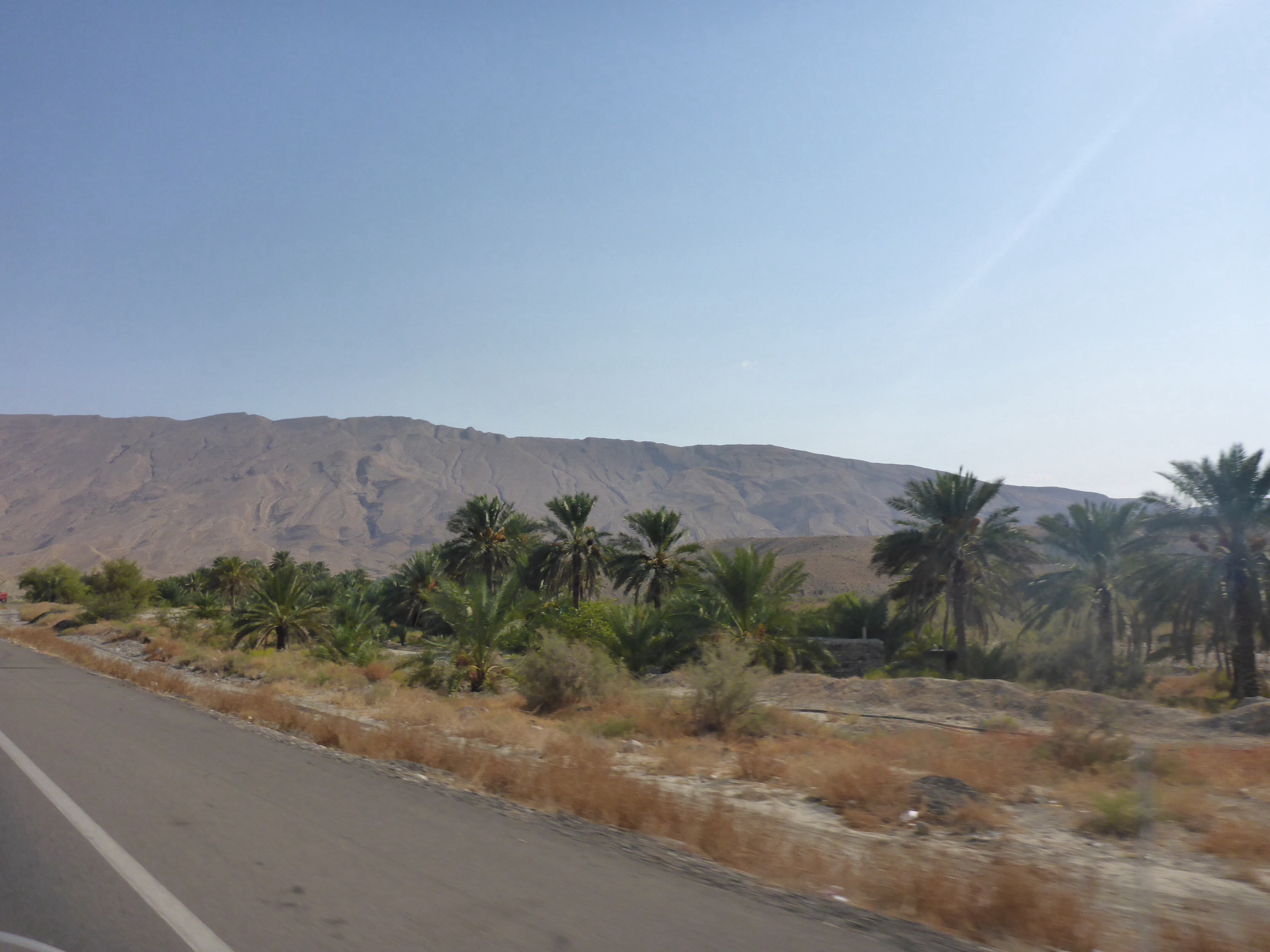
By 1pm, we have covered over 340 kms, which for us is normally a day’s travel, and after the leisurely lunch, it is still only 2pm. We are told Bandar Abbas is about 300km away. We decide that we will push on and look for a suitable campsite, or if not, carry on as far as we feel possible. As we continue south in the afternoon, we see no place that looks to entice us from the highway. The temperature is rising, a truck driver had told us Bander Abbas was up to 50 degrees Celsius last week. We climb up through the mountains again and we start to see water in, what up to now, have been dry river beds. Palm trees have started to appear and the feel of the landscape is changing.
200kms north of the south coast, Iran

200kms north of the south coast, Iran

Couldn't resist this corny shot

Couldn’t resist this corny shot


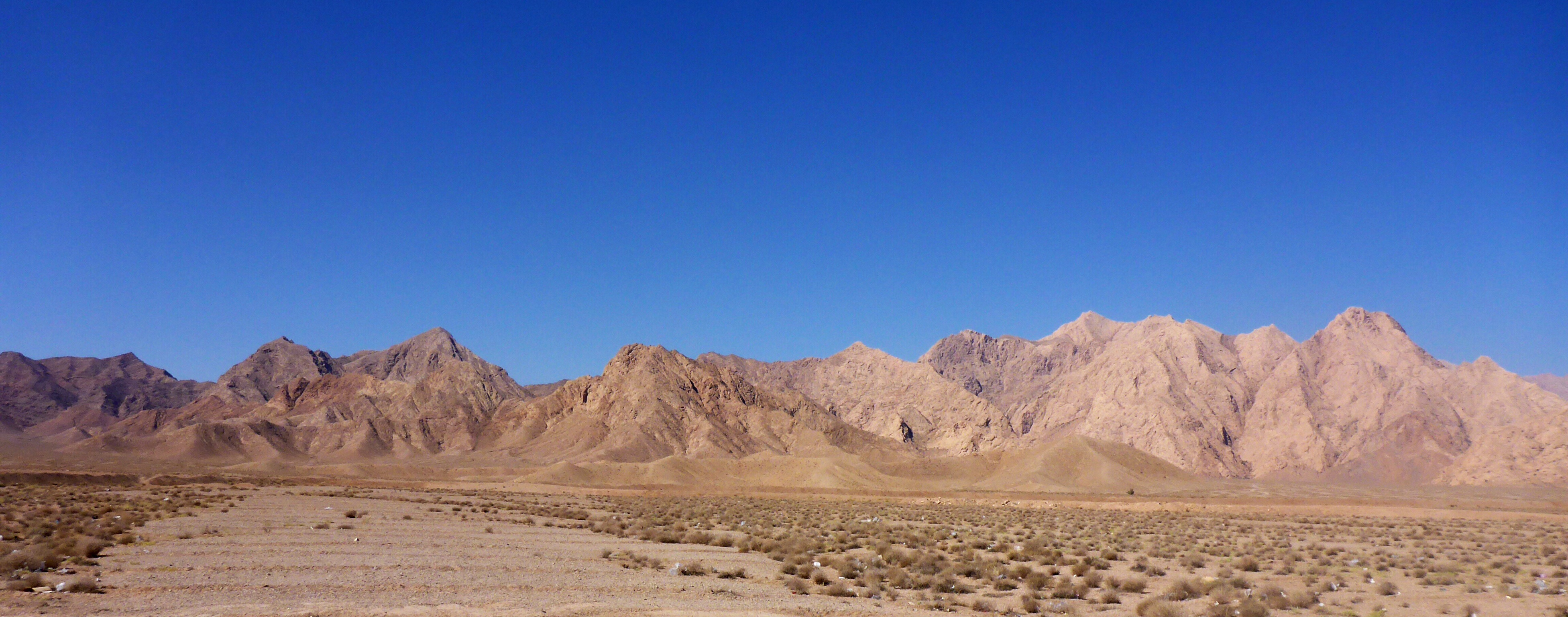
Ever changing mountains as we head towards Banda Abbas, Iran

Ever changing mountains as we head towards Banda Abbas, Iran


No suitable campsite forums and we are under a 100km away from Bandar Abbas.

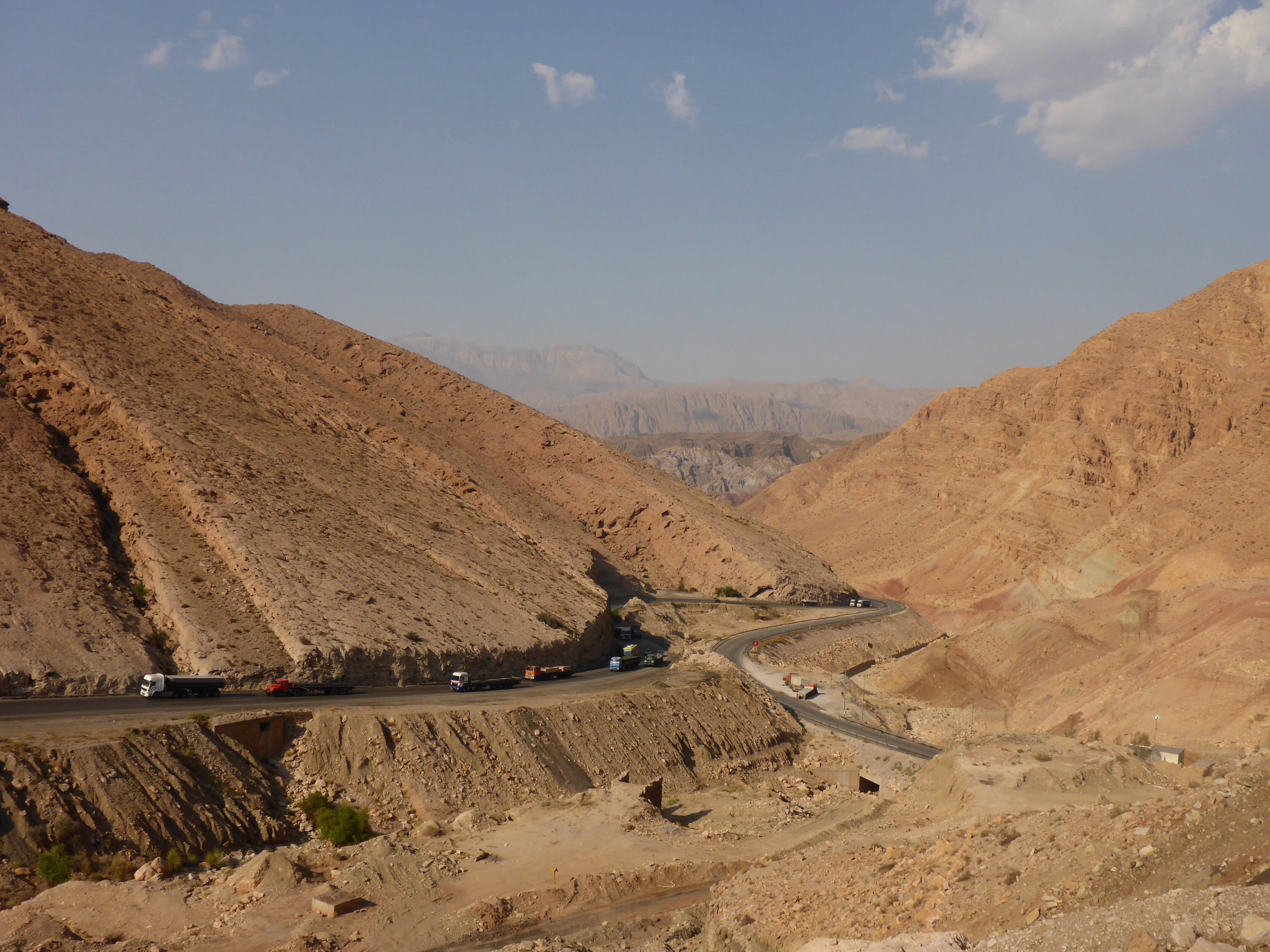
Looking back at the last climb before riding through a tunnel

Looking back at the last climb before riding through a tunnel


Disconcerting swap of lane direction as we come out of a tunnel, Iran

Disconcerting swap of lane direction as we come out of a tunnel, Iran


We decide to go all the way through. This will be the furthest we have ridden in one day, but the temperature has now climbed to high 30’s.

A rest stop, a chat with a police patrol in a land cruiser and the obligatory photos, then we are off again on the lat 30 km, following a small white car which offered to guide us into the city. Using the GPS we head for the waterfront where the hotel Anne has found is situated. Land reclamation has provided a new broad waterfront avenue which is not on my map. Our hotel is found, we navigate a couple of side streets to the entrance, park the bikes and stagger in and while we are being checked in, we sit in a couple of comfortable chairs sipping a complimentary glass of pomegranate juice reflecting that we have just ridden 640km in 10 hours, the furthest we have ridden in a day ever! What will Bander Abbas hold for us tomorrow?

– Anthony

Yazd

Our best city GPS ahead of Anthony - we're just 1' away from the hotel now

Our best city GPS ahead of Anthony – we’re just 1′ away from the hotel now

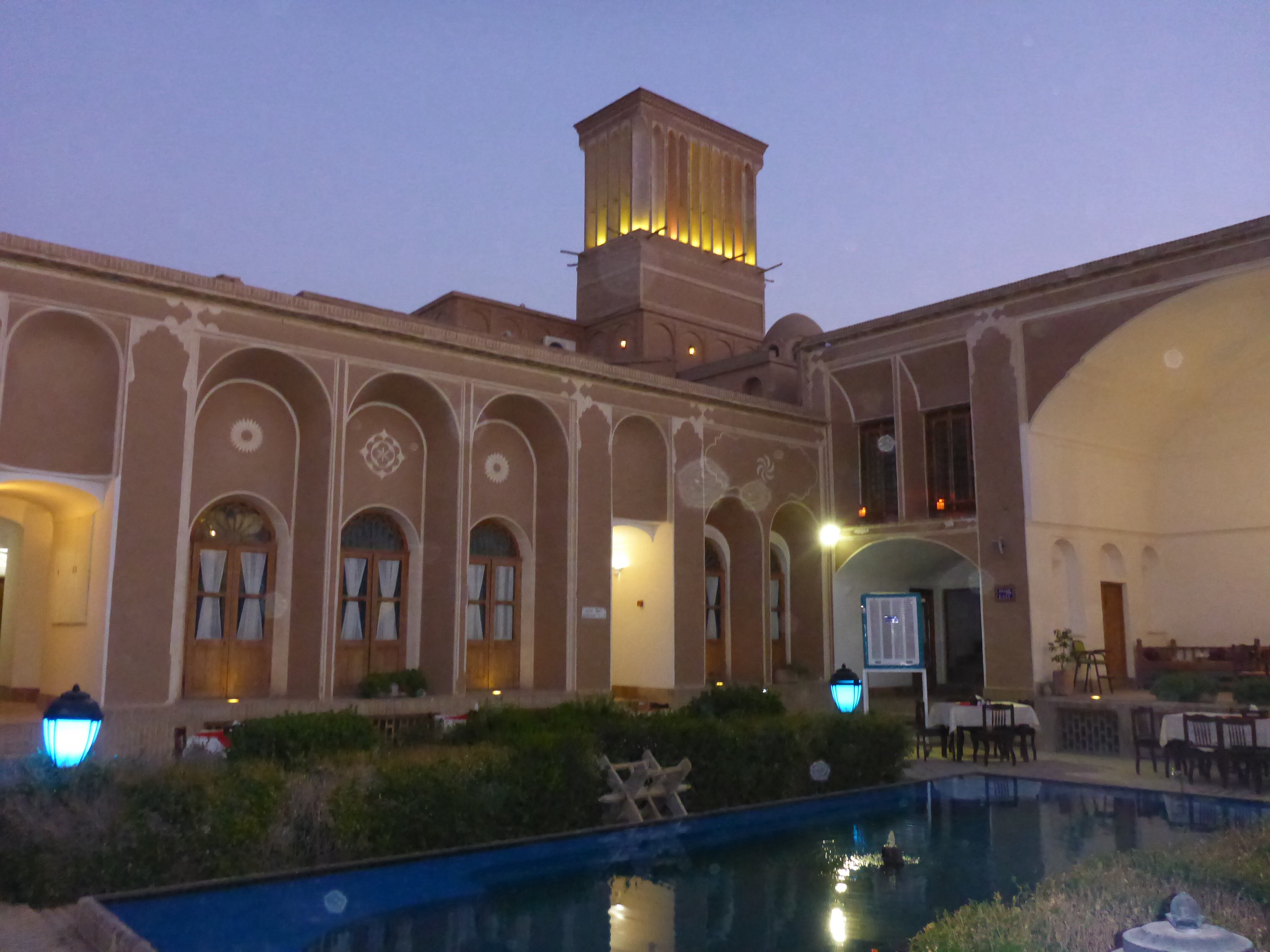
We set off from our beautiful hotel, which was formally a 180 year old house with three courtyards and endless rooms off them, to see the sights of Yazd.
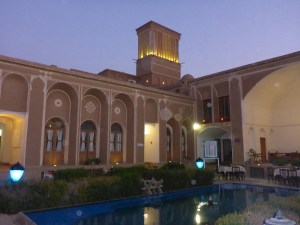
Our hotel in Yazd - the Laleh

Our hotel in Yazd – the Laleh

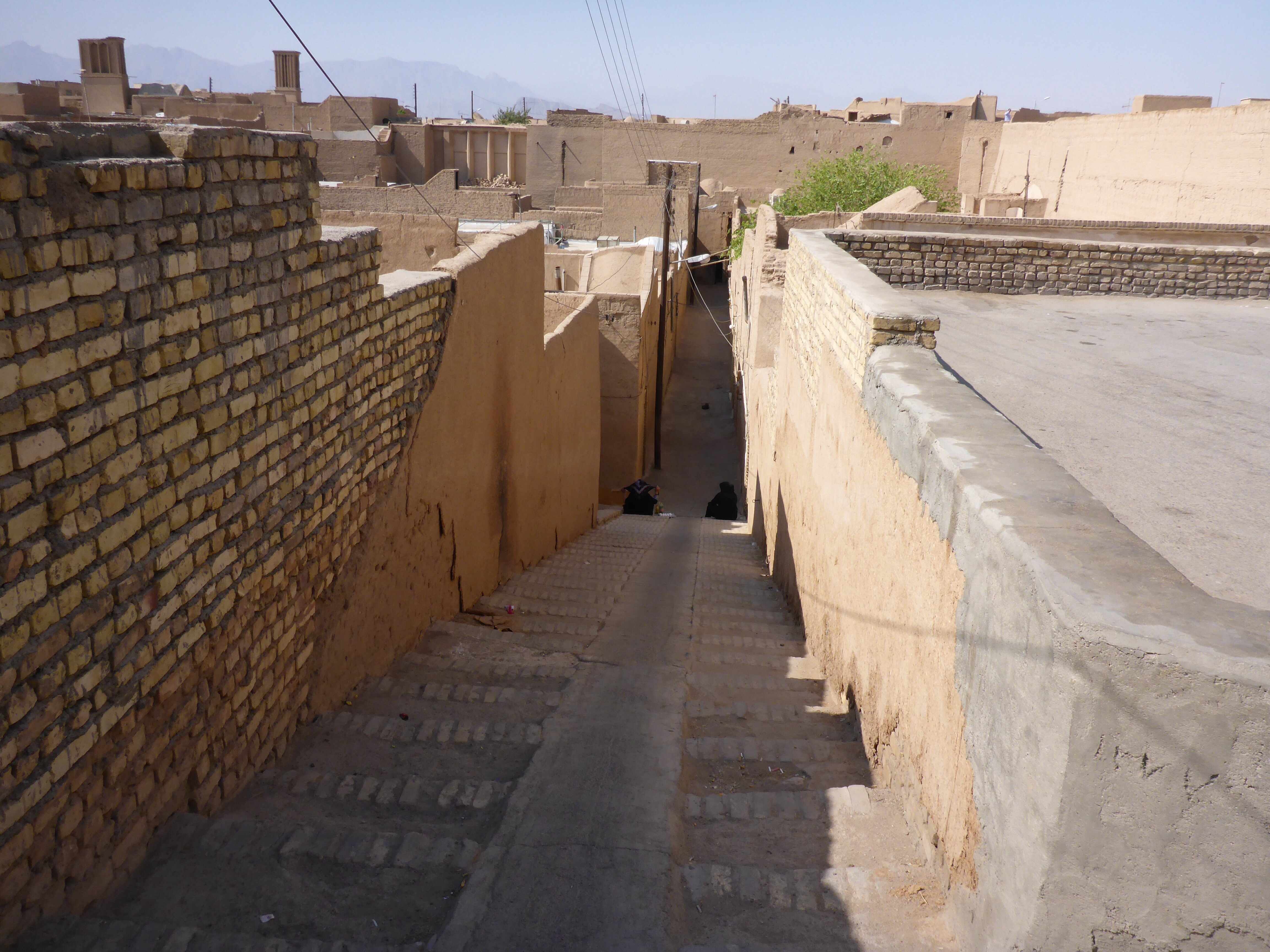
Rather than take the main roads which form large rectangular blocks, we will navigate the smaller lane ways towards the centre of the old city. We start confidently, but are soon surrounded by collapsed and derelict mud brick buildings. More interestingly, they are on multiple levels, abandoned courtyards below and ruined buildings above. Given the flat nature of the terrain, there must have been significant excavation to create these courtyards. Could this have happened at the same time as the water storage facilities were dug? The large size of the houses, and the upkeep required may have led to their abandonment over time. An additional impediment to keeping these buildings would be the installation of modern services such as sewerage, piped water and electricity.
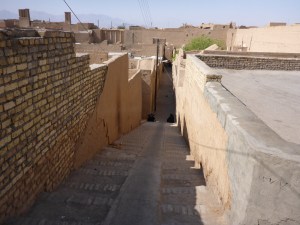
Backstreets on our way to Yazd city centre

Backstreets on our way to Yazd city centre

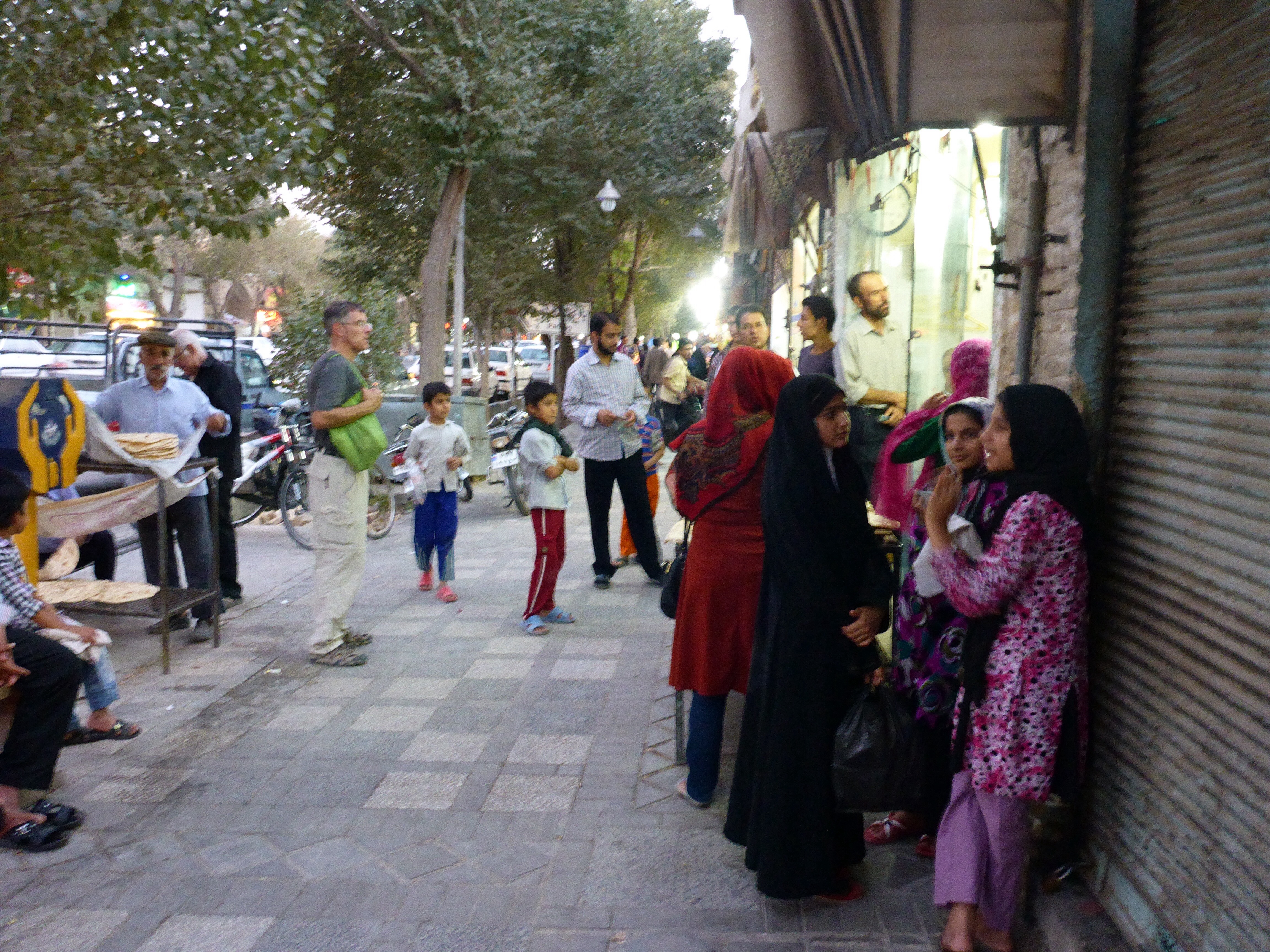
Back on track, we emerge into the busy centre of Yazd. Here, many more women are dressed all in black, unlike in Tehran and Esfahan. Are the smaller cities more conservative or is it due to the fact we are moving towards the Baluchi region of Iran? As we set off for the Mosques on Anne’s itinerary, we see for the first time the local bread making process in action. The video, posted below, shows how the pebble marked effect is created in a two step process. In the first step, the dough is hand thrown onto a round cushion like object that has raised knobs which would have been pebbles in older times, then the resulting pizza base like bread is tipped off the cushion onto a circular metal plate that is rotating the bread to be cooked both into and out of the oven. As each piece is finished, it is quality checked and placed on a wooden rack, but they are gone in a flash. People buy up to 20 at a time for meals at home, so the bakery production line of five people runs flat out just to keep up with demand. We are offered a a piece, Anne suggests we take a reject, because of a small hole in one part. It’s delicious, bread that was baked in the last 30 seconds.. The cheerful banter with each other and us, seeing the process in front of my eyes, these are the type of experiences I enjoy while travelling.

Queue outside our favourite bread shop, Yazd, Iran

Queue outside our favourite bread shop, Yazd, Iran

In the bazaar, we find the usual types of shops seen elsewhere, but we note very little foodstuffs sold in the bazaars we have visited previously, while there are many varieties of clothing, spices, jewellery and hardware all mixed up.

The food tends to be on the streets here or in specific areas of the bazaar. This does not always apply to spice shops whose presence we detect as the smell of delicious spices. While most spices are sold separately there is always a large bowl that contains layered spices, 16 in all that is used in Chicken dishes. I must say that the best food we have tasted in each city has predominately been the home cooking of our friends and their families.
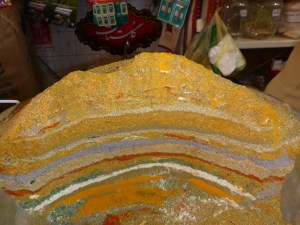
16 spices for chicken, Yazd, Iran

16 spices for chicken, Yazd, Iran

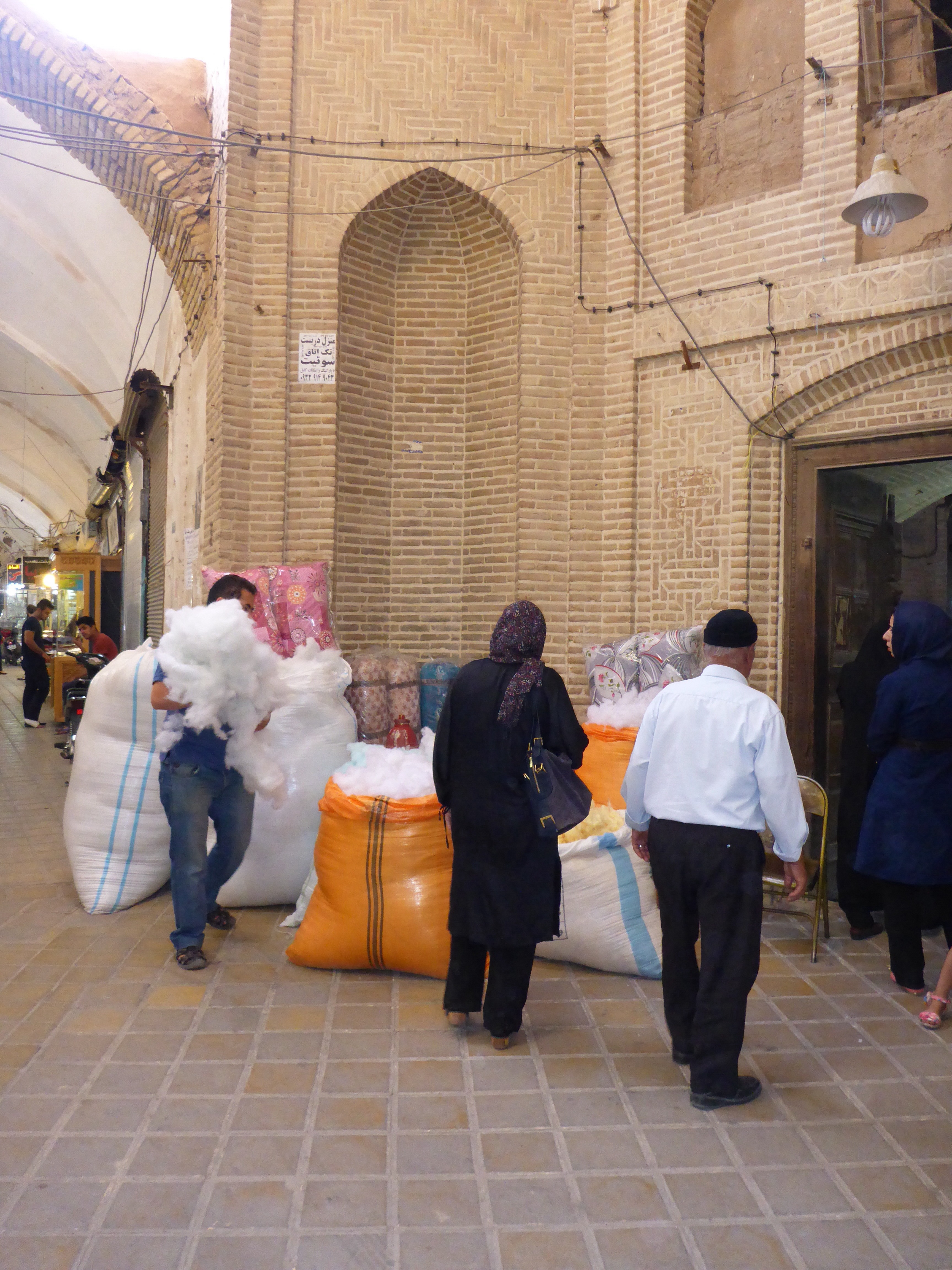
We encounter a new type of shop that just provides filling for pillows and cushions. You bring the inner linings and choose the quality softness and volume you want and you pay by the weight. We have noticed so many young children, but have not seen any pregnant women. Is this because loose outer clothing hides this from us, or do they not venture out in the later stages of pregnancy?
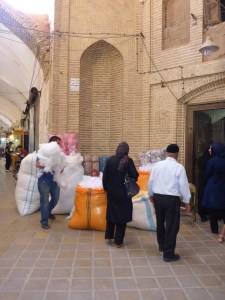
Select your preferred pillow stuffing, Yazd bazar, Iran
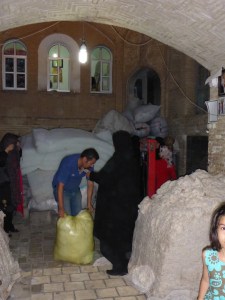
Select your preferred pillow stuffing, Yazd bazar, Iran

Then weigh your pillow stuffing selection, Yazd bazar, Iran

Then weigh your pillow stuffing selection, Yazd bazar, Iran


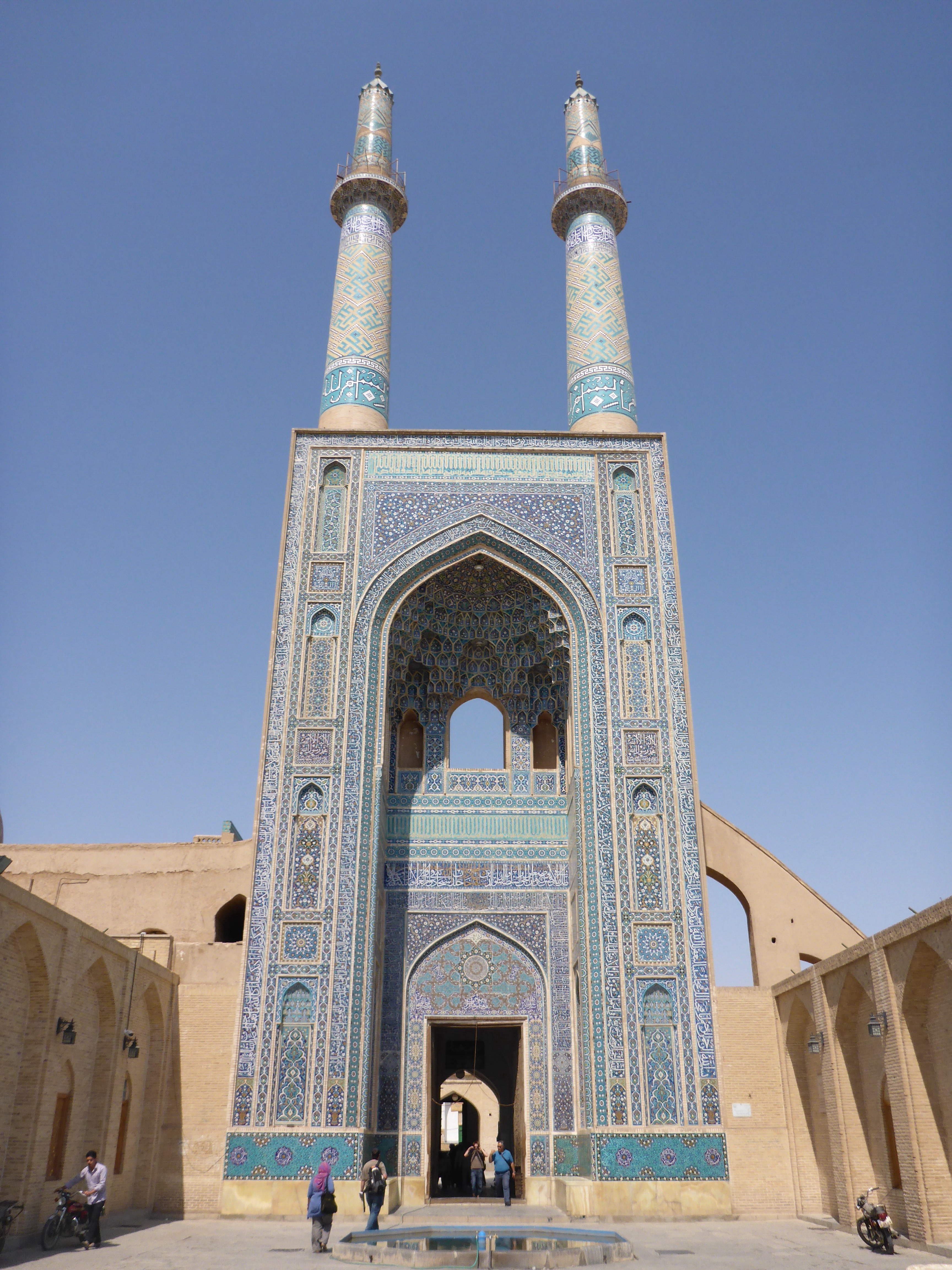
Anne is intent on finding and photographing the highest minarets and wind towers in Yazd. The only problem is that they all seem similar to the pictures we have seen and all about the same height.

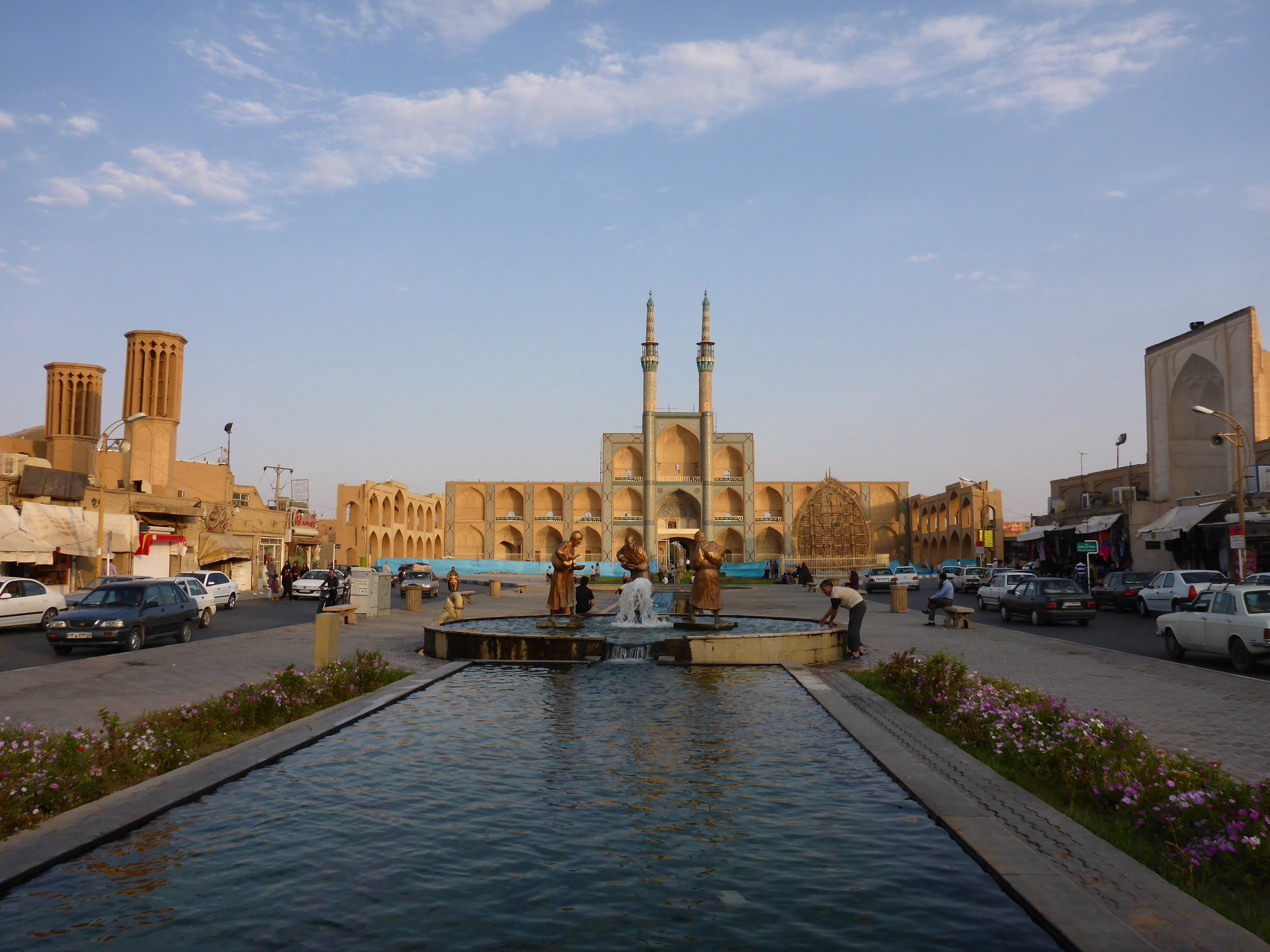
Amir Chakhmaq Complex, Yazd, Iran

Amir Chakhmaq Complex, Yazd, Iran

Jameh mosque, with the tallest minarets in Iran - Yazd, Iran

Jameh mosque, with the tallest minarets in Iran – Yazd, Iran

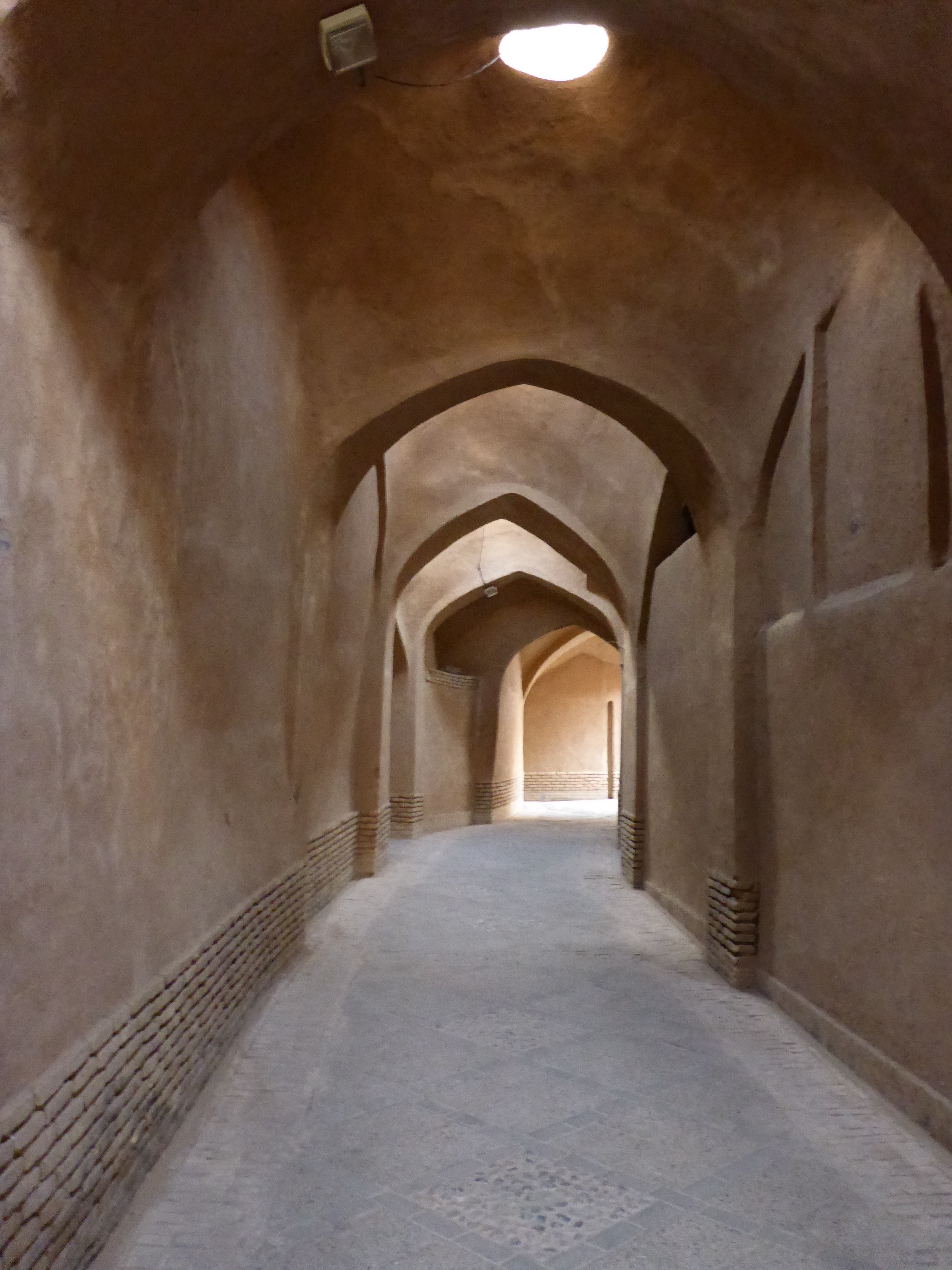
As we scour the lanes and alleyways moving from dark covered to light uncovered sections, always surrounded by dried mud brick walls, the city sounds fade to be replaced by silence and the occasional sound of a motorcycle navigating its way towards us – or is it away from us? It reminds me if those movies where the director uses the fading light, narrow lane ways and the sound of footsteps to show the hero/heroine is being followed, with of course the appropriate music.

Covered winding street in the old town, Yazd, Iran

Covered winding street in the old town, Yazd, Iran

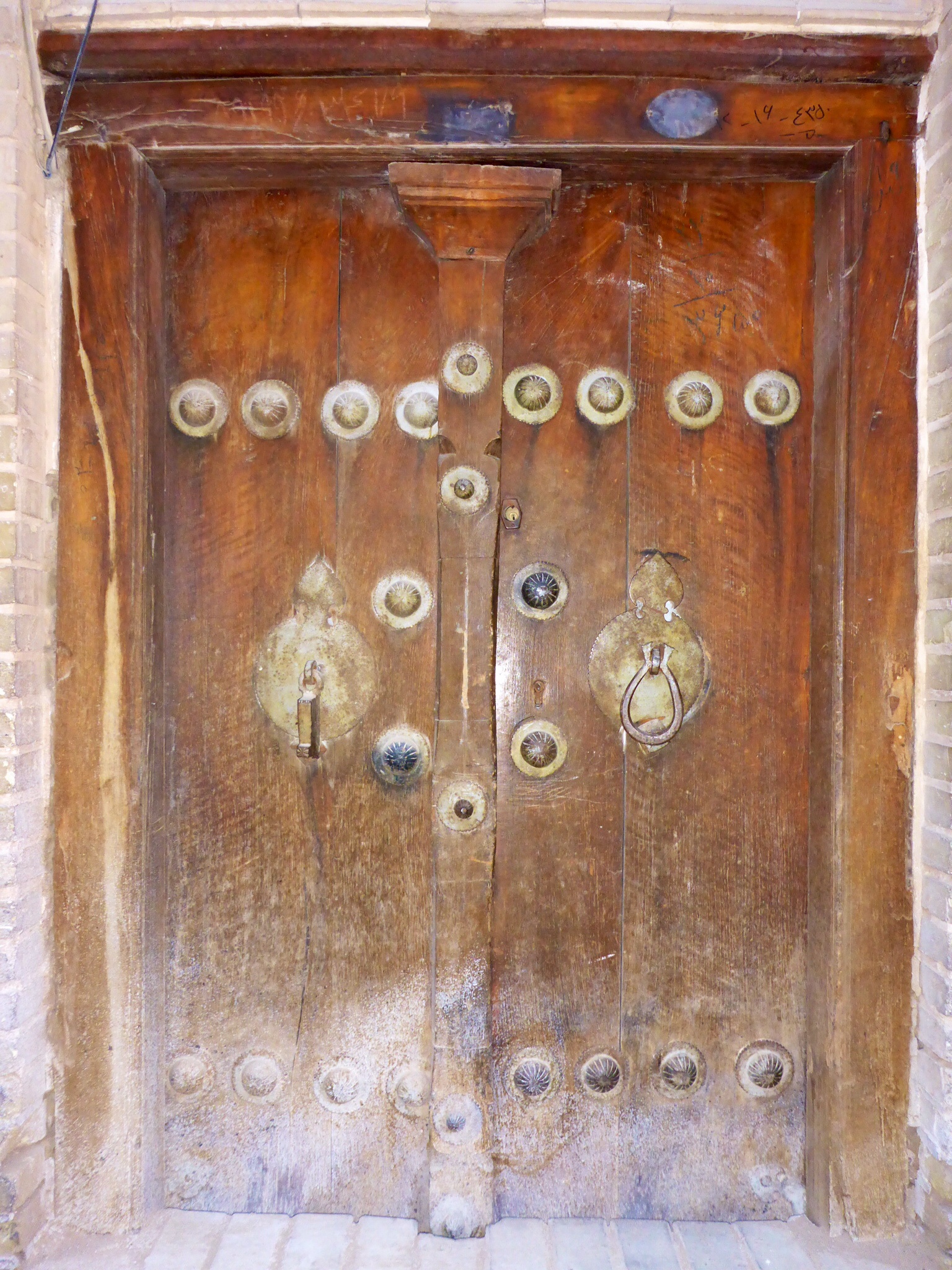
In the old town, we come across many traditional doors. They have 2 door knockers. One is long and narrow, the other round. They make different sounds and are designed to tell the inhabitants whether a male or female is at the door so that the right person opens it. You can guess which is the male or female knocker…

Traditional door with male and female knockers, Iran

Traditional door with male and female knockers, Iran

We meet in the fading light another German speaker, running an antiques shop after his lifetime in Germany. Anne’s German comes into play again, although he does speak good English. He advises that while the city is generally safe, wondering the unlit lane-ways at night for tourists has led to incidents. Good advice which we heed.

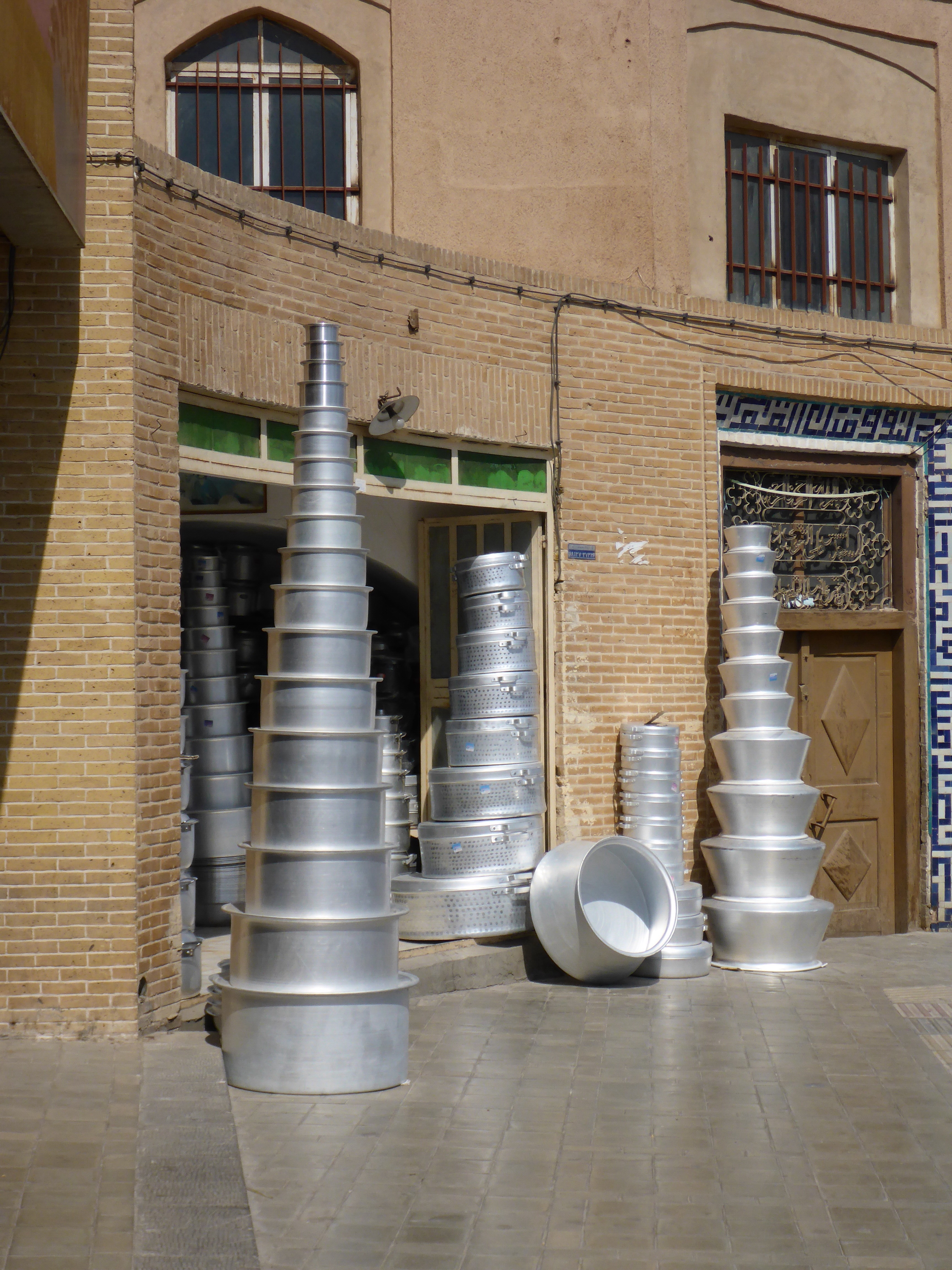
We found this great fresh baked cake and biscuit shop. We can buy four single cakes or biscuits for about 30 cents. We have been back twice in one day and our waistlines will grow if we stay here too long. Almost across the road is this great store selling pots and pans. Anyone who has a wedding gift to buy could do no worse than get the 10ft high matching pot and pan set. Might need an adjustment to the kitchen cupboard, but a great gift that covers all numbers of visitors for lunch, dinner or any occasion.

Household pots, Yazd, iran

Household pots, Yazd, iran

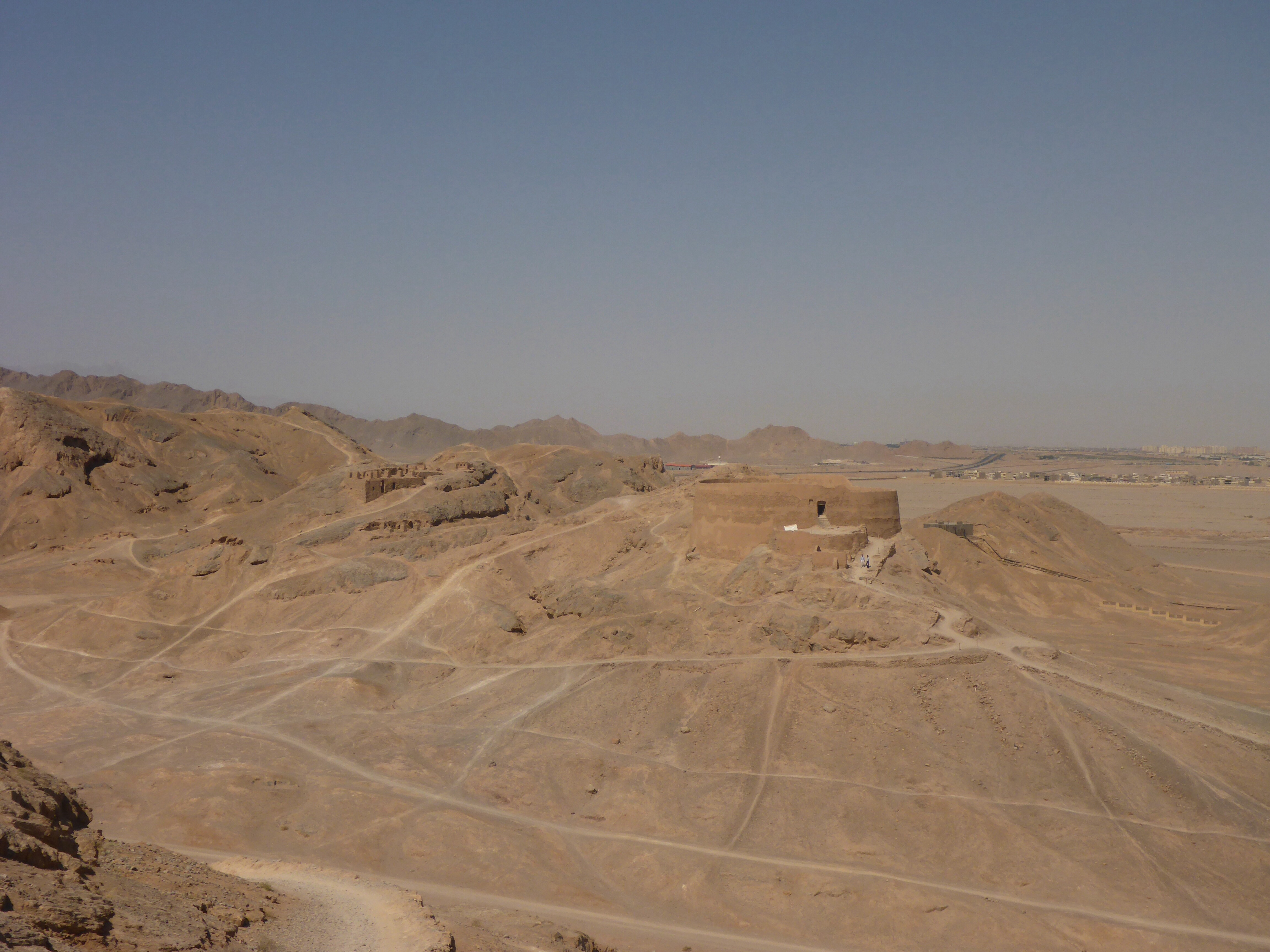
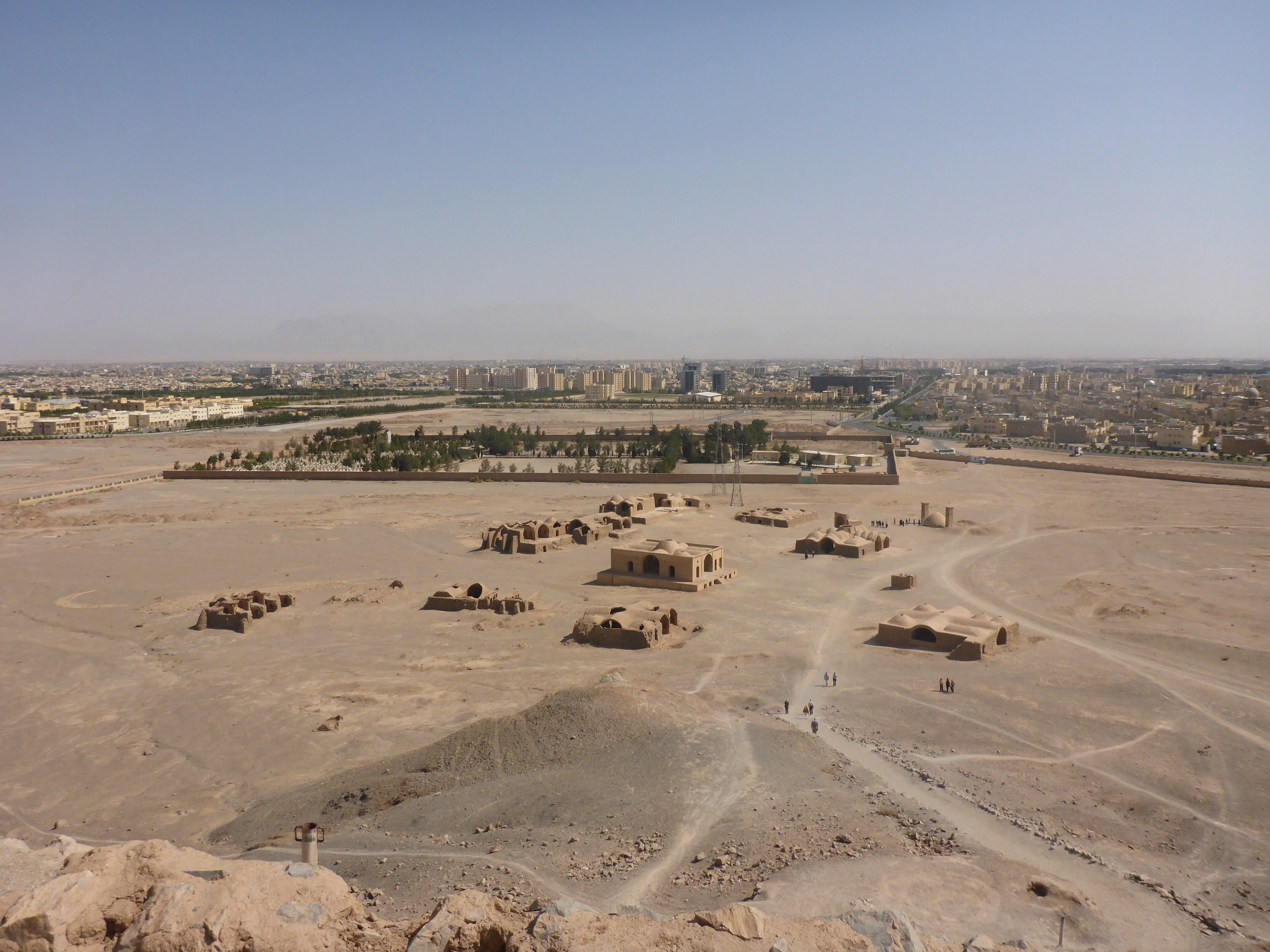
Our second day started with a visit to the Zoroastrian ‘Towers of Silence’ where bodies were placed after death, not before, to have the bones picked clean by vultures. This practice was stopped some 70 years ago, so no vultures circle overhead while you climb to the top of the towers in the hot sun. We did see black and white pigeon at the top of the male tower, a vulture reincarnated perhaps? While the city of Yazd has encroached towards the towers, they are still surrounded by a dry desolate environment, with no sounds of birds or other wildlife, just the breeze blowing around us as we sat in a contemplative mood at the top of the men’s tower, which of course is higher than the woman’s tower, but has a gentler ascent. Anne wants all of you to know she walked up both towers, me just the tallest and easiest one.

Zoroastrian Towers of Silence, Yazd, Iran
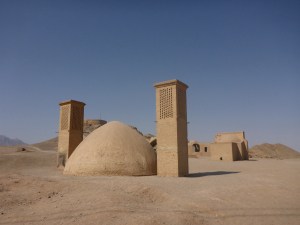
Zoroastrian Towers of Silence, Yazd, Iran

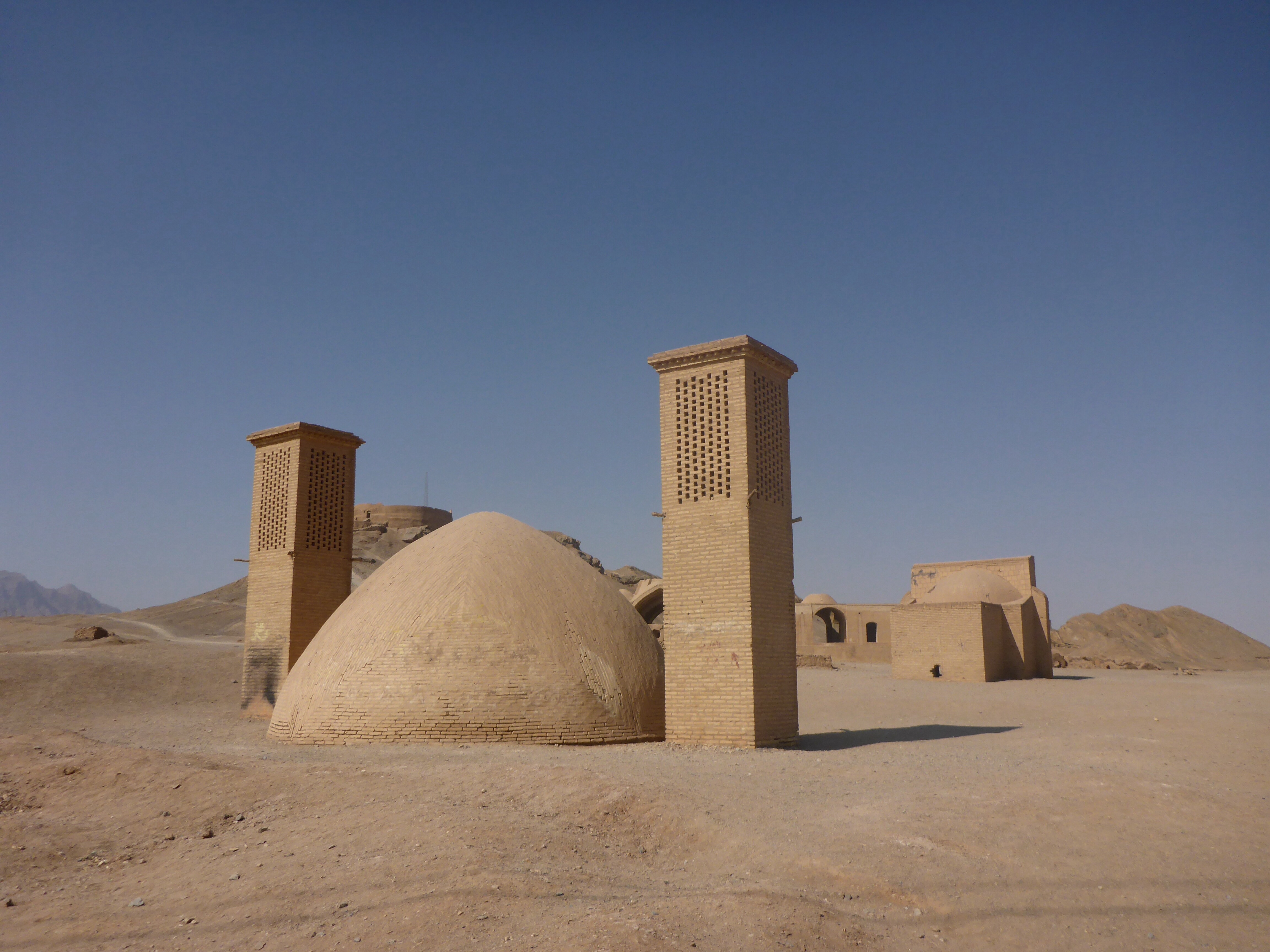
Wind towers above a water reservoir near the Towers of Silence, Yazd, Iran

Wind towers above a water reservoir near the Towers of Silence, Yazd, Iran

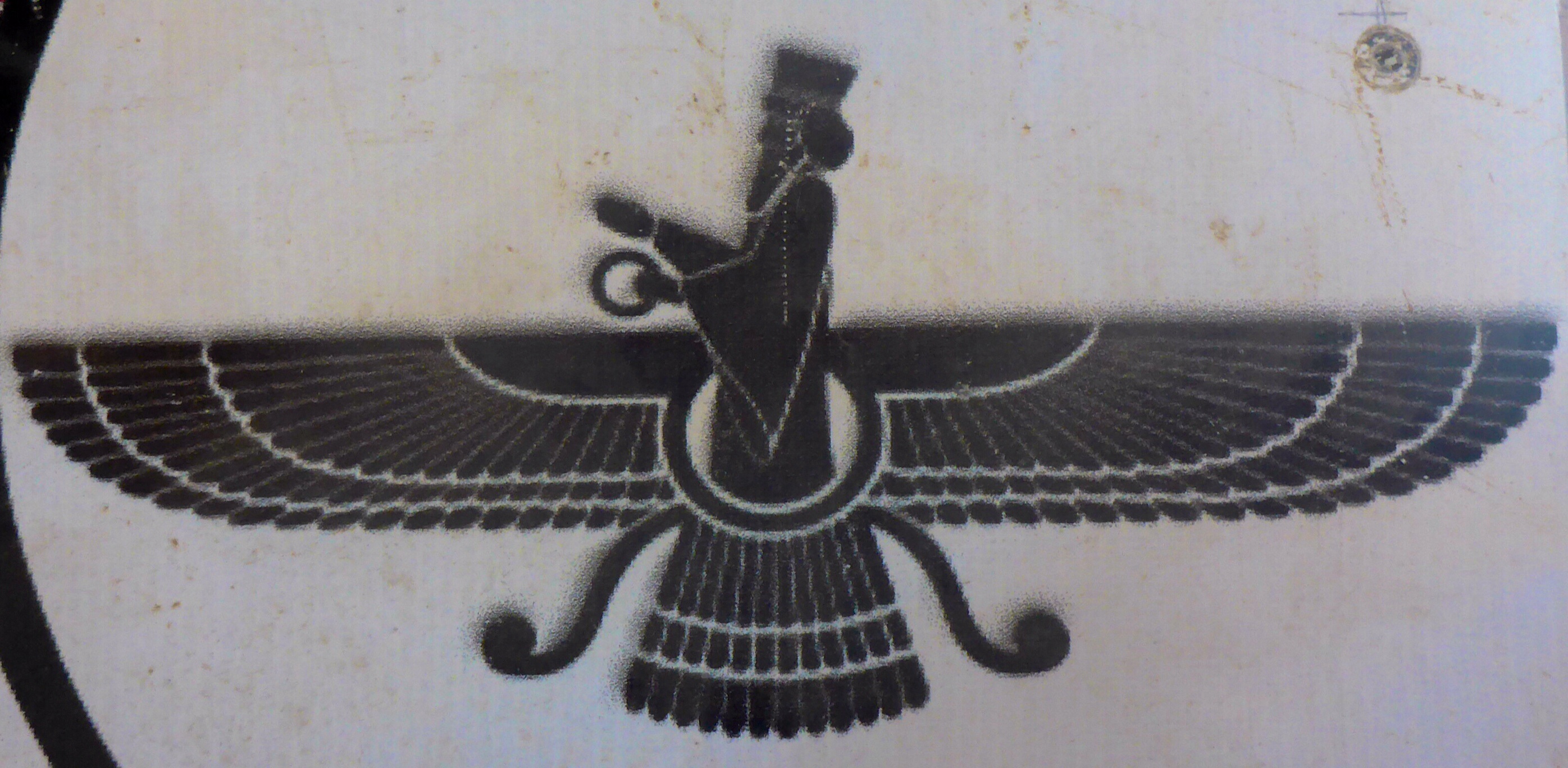
Zoroastrian symbol
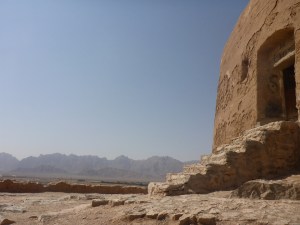
Zoroastrian symbol

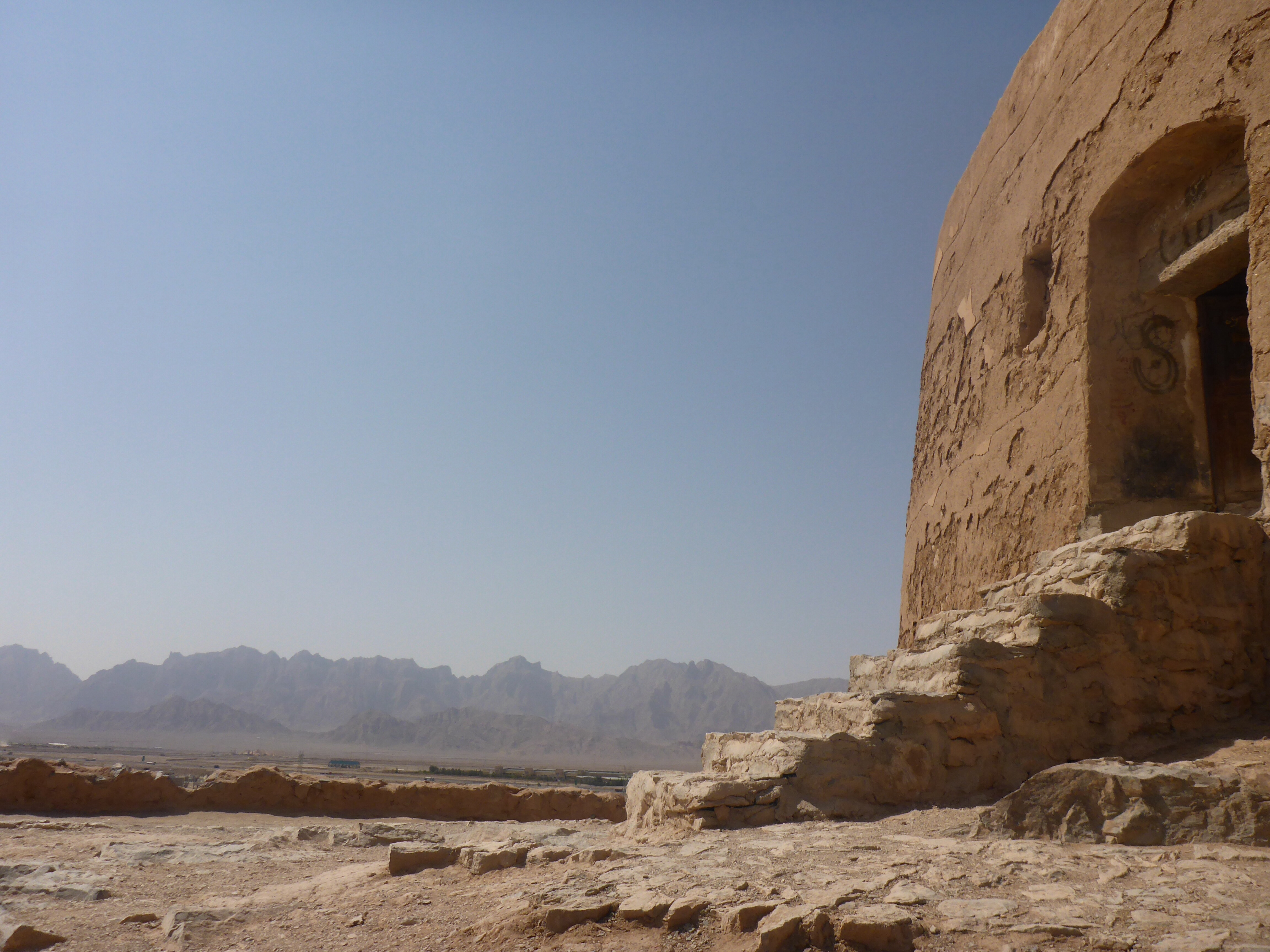
Steps into the female Tower of Silence, Yazd, Iran
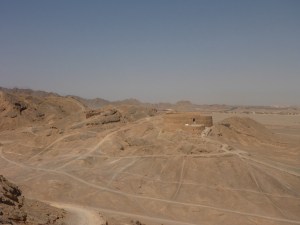
Steps into the female Tower of Silence, Yazd, Iran

View from the male Tower of Silence toward the female one, Yazd, Iran

View from the male Tower of Silence toward the female one, Yazd, Iran

View from the Towers of Silence, towards Yazd, Iran

View from the Towers of Silence, towards Yazd, Iran

This was also the day that blog writing returned with a vengeance. We had both been suffering from writer’s block, which we have heard happens to writers but not experienced ourselves. So many great people and experiences in the last 10 days that I think it was all to much for our minds to organise and document coherently for the blog. This afternoon we both found that the words just flowed, hopefully readable to all of you who follow us. We were able to make up ground, we had become concerned if we leave writing for too long that we forget details and sequences. An afternoon well spent, along with a couple of naps for me in the process.

We met a charming Brazilian couple staying at our hotel. They are not only visiting Iran, but Lebanon and Jordan. Jordan we have wished to visit over the years, but the opportunity has never eventuated. The variety of countries represented we meet while travelling is ever growing, interestingly earlier this year during the peak season in Yazd, 60% of the hotel guests were Italian, rather than the usual Chinese, Koreans and Japanese. I wonder what drives the interest in Iran from different cultures from year to year?

A visit to the water museum was fascinating and informative, but left us with more questions than when we went in. The clever use of hand built underground canals or ‘qanats’ as they are called here would take water from the foothills into towns where storage reservoirs were constructed underground with flights of steps leading down to where water can be collected. Larger houses may have had direct access to water from a qanat. This to would have entailed excavation work and due to the coolness of both water and earth, food storage areas were also built. Wind towers dot the city landscape, used to remove hot air from the vicinity of the water. A complete planned water delivery system. The nature of construction was difficult and dangerous and the workers chose to wear white to work so if they were killed, and probably entombed, they would be buried in a white shroud. Today in the larger cities, this supply system has been replaced by piped water, but the domed brick storage tanks and wind towers dot the city landscape, a testament to an ingenious and clever way to manage water supply just using gravity feed in a harsh environment where every drop of water counts.

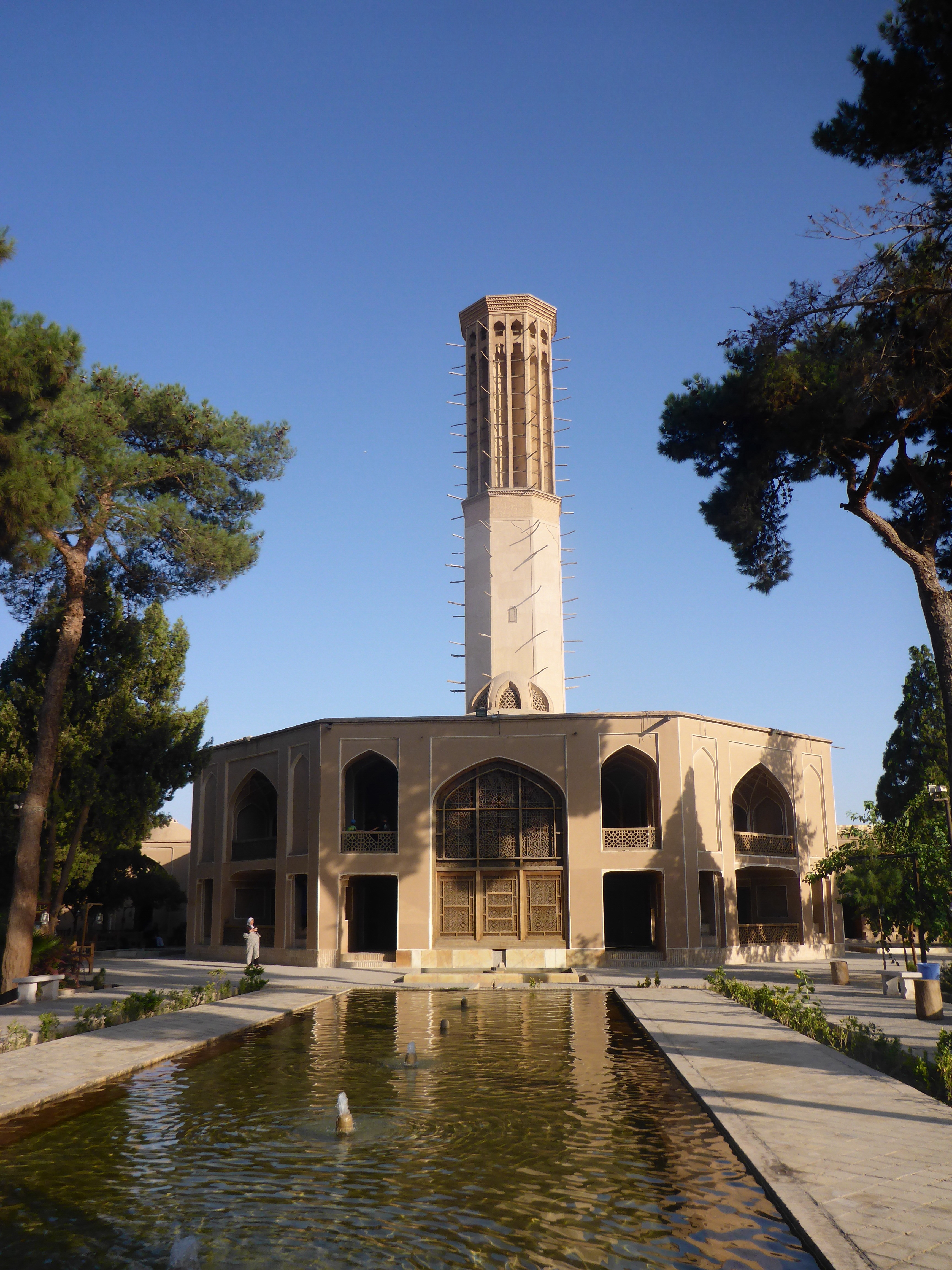
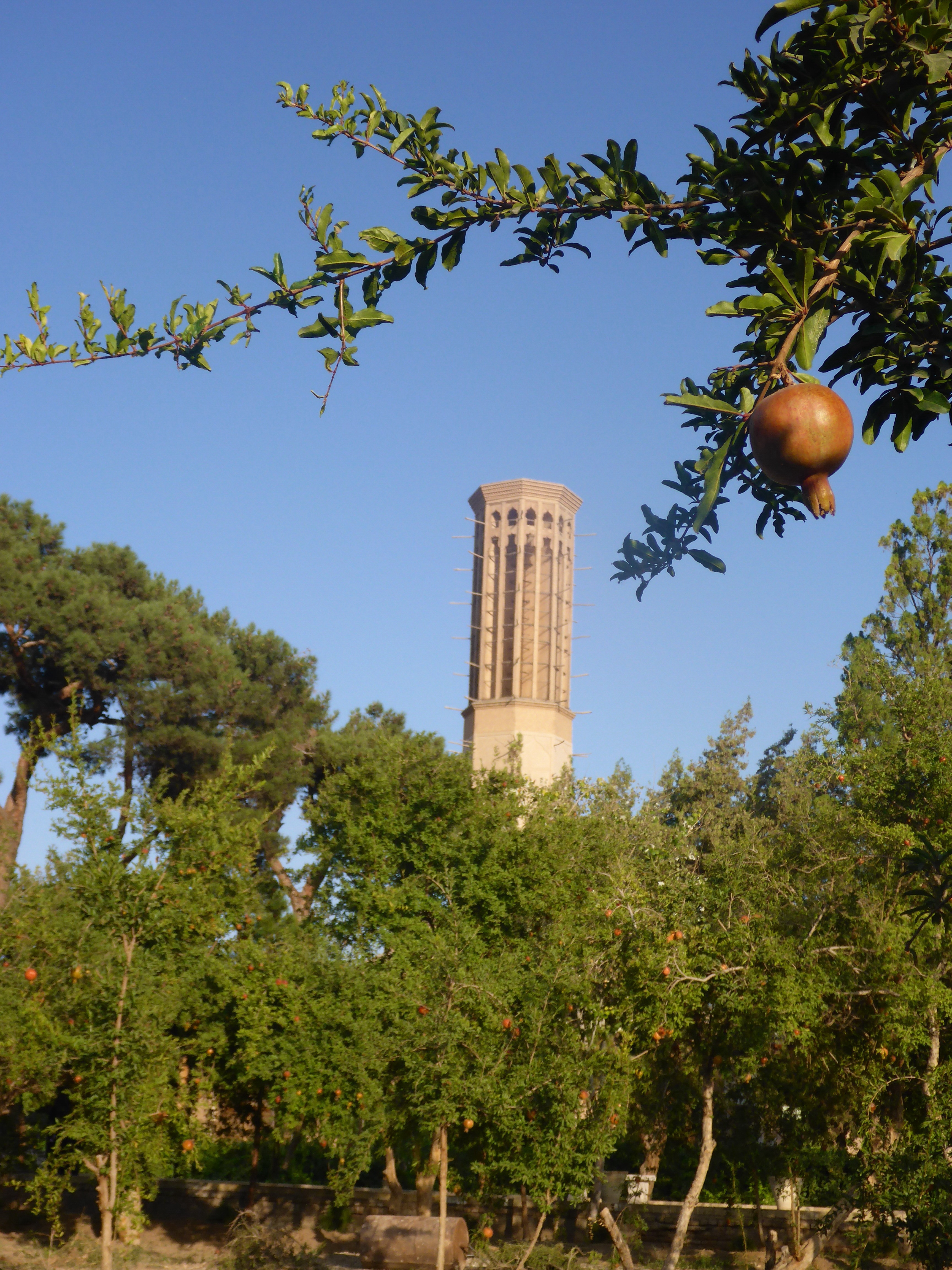
We round off our stay with an late afternoon visit to the Bagh-e Dolat Abad gardens containing the tallest Badgir or wind tower in Iran. Like many of the sights in Iran, it is down a couple of back streets and through a nondescript archway in a mud brick wall, postmarked with the scrapes of passing trucks and cars. Inside are acres of gardens filled with buildings and the imposing bagdir or wind tower, some 60 meters high. We are able to enter the building at the base of the wind tower and look up inside the construction to see the way it has been built looking like the segments of an orange. The bagdirs are designed to catch slight breezes from up to eight directions and direct them down over a pond of water creating an evaporative cooling system. We have been singularly impressed with the care and maintenance that has been given to all the gardens we have seen except this one. Weeds cover a good portion of the landscape and creepers have overwhelmed trees in other areas. Any disappointment was swept away by the views of the tower from among the pomegranate trees.
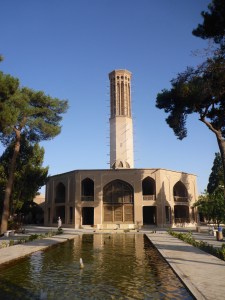
Dolat Abad with Iran's  tallest Bagdir, Yazd, iran

Dolat Abad with Iran’s tallest Bagdir, Yazd, iran
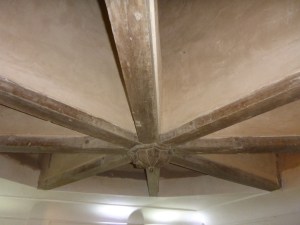
Under Dolat Abad's bagdir (wind tower), Yazd, Iran

Under Dolat Abad’s bagdir (wind tower), Yazd, Iran

Looking up one of the 'segments' of Dolat Abad's bagdir, Yazd, Iran

Looking up one of the ‘segments’ of Dolat Abad’s bagdir, Yazd, Iran
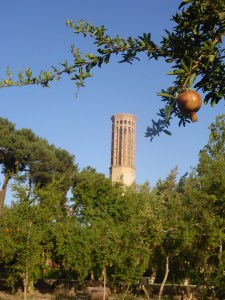
A pomegranate orchard surrounds Dolat Abad, Yazd, Iran

A pomegranate orchard surrounds Dolat Abad, Yazd, Iran

No taxis were to be seen for our return to the hotel. A gentlemen of uncertain age, with a car of even more uncertain age and adorned with many dents and scrapes stopped for us. He could not speak English and did not know where the hotel was. Through sign language, we indicated we could direct him. The journey was interesting as I contemplated from time to time what I would look like after impacting the windscreen, seat belts being an optional extra, but with the good graces of the other drivers we arrived in one piece looking forward to being back on the bikes tomorrow.

Dinner, packing and off to Kerman.

– Anthony
Driving in Iran

Driving in Iran and Tehran especially can be quite nerve racking, even for us with our varied riding and driving experience. The style and pace of traffic and pedestrian movement can be overwhelming and difficult to follow. We have however not noted a single incidence of road rage in-spite of actions that would drive western drivers to distraction. We see on a constant basis, actions and reactions that require intense concentration at all times, but sadly none of us are capable of sustaining that level of concentration and accidents happen here all to frequently. We have heard the phrase “people go out to have accidents” is used by staff in Iranian hospitals. The following are observations. They are not designed criticisms of the type of driving, we have enough of our own traffic problems, but a reflection on the driving style and the higher level of risk that it presents to road users.

Iranian driving observations

We start to see the Iranian driving we have heard about -drive close alongside, hold conversations, take photos, drive closely behind, pull out, overtake at speed, then cut in front and stop. The faster they overtake, the more likely they will stop sooner.

Taking a leaf from the credits at the end of movies: “The road markings depicted in Iran are fictitious. Any similarity or suggestive purpose to road markings in other countries is merely coincidental.”

Pulling out into traffic is a measured thought out process to give those already on the road enough time to adjust for their presence which is coming eventually. They do not wait for a gap as we would.

We think that you give way to traffic on the roundabout if you have an even numbered number plate and give way to traffic coming onto the roundabout if you have an odd numbered number plate, or visa versa, we cannot work it out after 2 weeks here!

Pulling over takes no care or thought for those behind you, normally the faster a car passes you the quicker it will pull over without warning and stop as quickly as it can, thought and action are one and the same.

More conscientious drivers will stop in the middle of the road, or roundabouts, to take or make calls.

Wearing gloves on motorbikes makes it impossible to text or surf the net while riding, so do not wear gloves.

Wearing helmets limits the ability to make and receive calls and smoke, so don’t wear a helmet.

Men occasionally wear helmets, their female passengers never do.

Motorbikes are mostly 125cc, but they still race past us in towns, usually with one or more passengers.

Additional Tehran motoring observations:

Toughest traffic to ride in: vehicles move quickly, see a space, fill a space. We have not ridden in a more challenging city environment. You cannot watch all directions at the same time and rely on others’ road skills or lack of, as the case may be.

Seems to resemble down hill skiing in the manner that those behind must look out for those in front, so be in front!

One way streets have a special invisible lane for motorbikes going in the opposite direction: dodge the on-coming traffic and you are ok. Very useful to avoid the one way systems – we have used it successfully.

If you find you have gone the wrong way, put the hazard lights on, just reverse and then do a u-turn, even in one way streets!

For motorbikes and mopeds, it is quicker to go the opposite direction around the roundabout if you are going to the third or fourth exit (only seen a couple of times).

Groups of pedestrians can be found walking in the road and even around, not across roundabouts and streets without any regard for traffic.

Can confirm the reason motorbikes and mopeds ride so close to the vehicle in front is to see that vehicle’s speedometer as their instruments and lights are covered by the helmet.

Vehicle lights are optional at night.

Bus lanes are great for motorbikes even if they are travelling in the wrong direction, they just get out of the way when a bus comes.

Traffic lights must be used for colourful decorations as they don’t have the same significance as we know them to have. We regularly see traffic going through very red lights with no one caring but simply adjusting their speed or direction to avoid any collision.

Traffic lights have countdown timers, but several go down to 3 seconds and stay on 3 for an unknown number of seconds, and others go from 17 seconds to 1 second in 1 second.

Having said all this, do not be put off, it is an amazing experience to see how people can operate without road rage and with a level of cooperation we do not see in the western world. You will get used to the traffic and the perceived chaos.

– Anthony & Anne