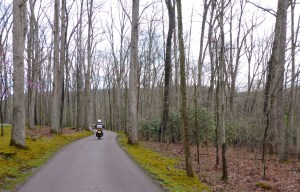
It is 2.5 degrees celcius (36 Fahrenheit) with clear blue skies, early Sunday morning and we are heading to the outskirts of Bremen on Streak and Storm. Slow moving shapes on the side of the road come to life through the cold morning mist as we approach them – people walking in their Sunday best, ladies’ capes blowing in the wind, a few horse and buggies clip-clopping gently along the lane, all waiving at us as we ride by. As we approach our destination, the road is nearly blocked with people: some pulling beautiful woodden open low carts with several children in each, others getting out of buggies. We see several men standing in a line in the front garden, all dressed in black with wide brimmed black hats. Streak and Storm very slowly ride past and turn up the gravel path to the shed awaiting them for the day. Brian and Neil are already there, awaiting our arrival. It is just after 8am and Sunday service starts at 9am. By the time we walk out of the barn, there is a long procession of horse and buggies arriving. Everyone is in their Sunday best. What a sight… We nod to the people arriving and parking their buggies as we walk by in our goretex trousers and motorcycle boots. The day that ensued was simply magical…

Start of a magical day
Going back a few days in time…..
What are we doing here? Some of you may recall that the highlight of our 3 months in the US back in 2015 was meeting David in Nappanee, as described in “An insight into Amish life” https://2slowspeeds.com/2015/08/17/an-insight-into-amish-life/ , and being invited back to his home to meet some of his family and learning more about each other’s culture and life. Since then, apart from the annual Christmas letter exchange, I have stayed in touch with Brian, David’s son-in-law, via email. Email?! Yes, luckily, Brian works for a manufacturing company and his job requires him to use computers etc. so we have been communicating while he is at work. Apart from our departure date from Vancouver in June, our meeting with David, Brian and their families on the 20th April was the only thing we had scheduled on our US/Canada leg of this trip.
Seeing David and Linda again was wonderful and, as so often happens, it felt normal to be seeing our Amish friends again. Brian and Edna and their five children, Amy, Eric, Lydia, Lucas and Amanda, arrived by horse and buggy shortly after we arrived. Dinner is nearly ready but Brian offers to take us for a short buggy ride. You will have seen Anthony’s video. The horse and buggy has one feature we wish we had with Streak and Storm: reverse!! Yes, we did a 3 point turn with the horse and buggy on that little narrow lane to turn back and go home. Well, I can see many more advantages of horse and buggy over Streak and Storm really but that’s another story.

A gentle ride with Brian and Dreamer

Sorry Streak, we have a new steed
We are greated with a huge dinner of barbecued chicken, fresh vegetables, fried potatoes and salads followed by 2 different home made of course, pies. It was such a lively and fun evening. After dinner, David takes us see the large 16 ft trailer that’s sitting in their front yard – what could that be for?! The trailer hold benches of different lengths of 6 to 12 feet long and boxes of hymn books for their bi-weekly church services, and because church is followed by lunch, boxes with all the cuttlery, glasses and table cloths. David and Edna are hosting this Sunday’s service. The Amish hold their church services in their homes and take turns following an annual, but flexible, roster. As an Amish church district is made up of roughly 25 to 35 families on average (at which point a district is split into 2), and families attend different districts’ service on their ‘off’ Sunday, you are never sure how many people will attend the service!!! And of course families have between 5 to 7 children on average each so that makes for huge numbers at any church service. This massive trailer belongs to the church district and is moved between host families by 2 draft horses.
David leads us to the basement of his home where the service will be held: they have different length benches so that they can easily fit in different shapped basements or barns and we are shown how the benches which serve as pews cleverly transform into tables for the lunch after the service: the legs of two benches are sloted into a wooden stand at each end which raises the bench into the table top and one sits on a church bench, so 4 benches turn into one wide and long table and bench seating. David hands me a copy of the Ausbund hymnbook, the oldest songbook in the world still in continuous use, which was first printed in1564 and used in all Amish churches today. It contains centuries-old songs originating with Anabaptist captives held at the Oberhaus castle prison in Passau, located in present-day southeastern Germany. He shows me page 770 and explains that this is always the second hymn sung in every Amish worship service, hymn # 131 “Das Loblied” or “hymn of praise”. The thought of every Amish service singing the same song at the same time gives me goosebumps. I can’t hide the impact that has on me. David asks me if I/we’d like to attend the service on Sunday. What an incredible priviledge to be invited. Of course I would love to!! At the same time, in another part of the basement, Brian asks Anthony if he/we’d like to attend. Funnily but not surprisingly, we both respond exactly the same way: we would love to but need to run it by the other first. How could we miss up such a kind opportunity to witness an important part of Amish culture. We are warned that the service lasts 3 hours and each hymn takes 20 minutes each. The hymn #131 comprises just four seven-line stanzas only – I am getting an idea of how slowly hymns are sung!!
We get back to our hotel, narrowingly missing the fox that ran between our bikes and look at accommodation options for the next 3 nights. For some reason all hotels in the area are 80% booked, including the one we’re staying at but we find one in Warsaw, not far away. That is the beauty of travelling with no fixed plan: a 2 night stay suddenly ends up being 5. Interestingly, we find out that Warsaw is the prosthesis capital of the world. Any of you with a new hip or knee, it most likely comes from Warsaw.

Heading back to our motel in Plymouth
For anyone visiting the area, the Menno-Hof centre, in Shipshewana gives an excellent insight into the history of the Amish and Mennonites. They’ve certainly had a turbulent history. Plan on 2.5 to 3 hours for a visit.

Car park in Shipshewana

Menno-Hof centre in Shipshewana
Knowing we had nothing planned between now and Sunday, Brian kindly invites us to visit him at work if we’d like a tour of the plant. Of course! He works for a company that designs and manufactures aluminium outdoor cabinets. As soon as we enter his office, we are both instantly struck by how incongruous it all seems: all this technology, computers, CAD design, mobile phone yet Brian cycles a little over 6 miles to work, starts at 6am so that he can leave early afternoon, cycle the 6 miles back home and still have the afternoon and evening with his family, living his traditional Amish life. Such life balance. I truly admire this honesty in lifestyle.

Brian’s office
The 2 hour tour of the plant is fascinating – Brian knows every step of the process and knows everyone in the plant. It is funny how only a few days earlier we visited the Honda plant and here we are now in a different plant, on a smaller scale but no less impressive, in a different way. I was particularly intrigued by the powder coating process: the powder is sprayed using an electrostatic gun which imparts a positive electric charge to the powder, which is then sprayed towards a grounded object by the powerful electrostatic charge. The sprayed part is then heated, and the powder melts into a uniform film, and is then cooled to form a hard coating. As we are about to leave, a colleague asks Brian if they can have a meeting once he’s free of his visitors. No, it can wait until Monday morning as it is 2pm, time for Brian to leave work and return to his family. Once again, an example of how important family is. I love that! We will see Brian next on Sunday morning around 8am…

Challenger Designs plant, Nappanee
Returning to the present…….
After leaving Streak and Storm in the barn Sunday morning, Brian leads us to the house. Brian takes Anthony under his wing and stays outside with the men and his wife Edna comes to greet me and leads me inside the house which is already full of women. Women greet each other with a handshake and a kiss. And so do the men. The atmosphere, as people arrive and the room fills, is calm and quiet. Everyone and even kids just whisper. I cannot help but think back to kids that stayed at our hotel and were so noisy, screaming and runing and slamming doors, with their parents either oblivious to the noise or beyond caring….
Just before the service, Brian thoughtfully leads us to the back of the room where the service will be held so that we don’t feel like everyone is staring at us. As people arrive, he quietly explains to Anthony how and why people are seated in the room the way they are.
The three-hour service is spoken entirely in Pennsylvania Dutch and German. It begins with the congregation singing 2 hymns very slowly in German. A male song leader starts the first syllable of each line and then the rest of the congregation joins in, chanting very slow, drawn-out notes, with the last syllable the only short one, ready for the song leader to start his next first note. “Das Loblied”, the 2nd hymn lasted 25′. I was able to join in the chanting after a while as I could read and understand the German but sadly I didn’t understand the hour long sermons – the language and accent too difficult for me although I was surprised at how many English words and expressions were mixed in.
The last part of the service was “business”. This was another fascinating aspect of Amish life. Instead of national health services or medical insurance, they rely on each other to cover medical expenses of members of their church district. Everyone contributes based on their income. A true community.
As soon as the service is over, there is a hive of activity and suddenly, pews converted to tables, tables are layed and lunch is served: coffee, sliced homemade bread, lunchmeat, Amish peanut butter spread with marshmallow cream mixed in, cheese spread, and pickles. And because there are so many people, there are several sittings. Three of Linda’s sisters take me under their wing for lunch. After lunch, the ladies sat in circles in the kitchen and lounge while the men sat outside in one large circle, chatting for a few hours. David introduced Anthony to his son-in-law, then another son-in-law, then another, until it appeared everyone was in on the joke and introduced himself as one of David’s son-in-law. Suddenly, we had spent 7 hours with them all. Time for us to leave.
We cannot thank David, Linda, Brian and Edna enough for their kindness, generosity and trust. It was an incredible priviledge to be able to attend a Sunday service with them. A true connection and friendship has been formed and we are extremely grateful for our friends’ warmth and openess with us. I feel we were more than mere witnesses to their culture. I feel like part of me has been left behind. We are sorry we don’t have any photos of our amazing experience to show you but respecting their culture and beliefs was paramount to us and the images of that Sunday and our time with our friends will never leave us.
– Anne