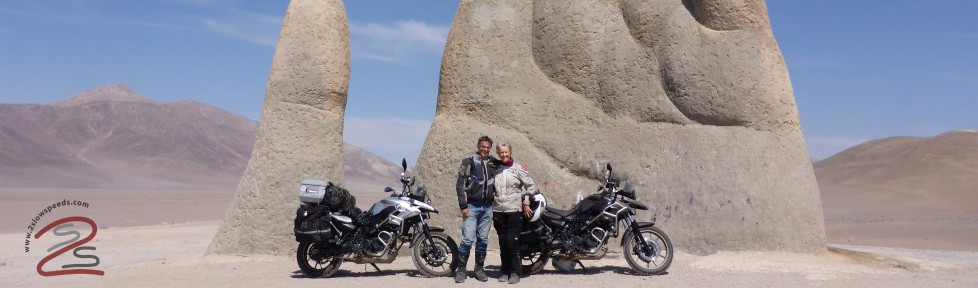
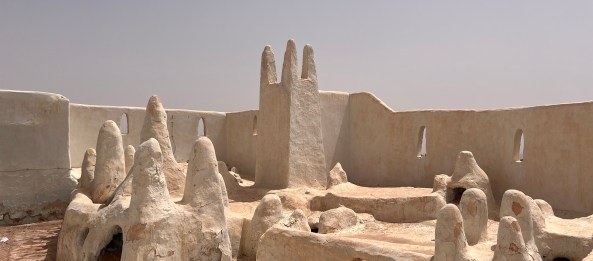
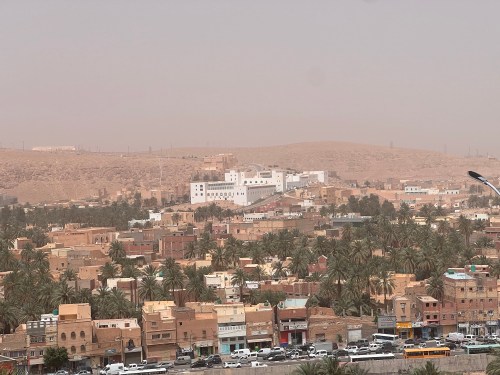
From the initial spectacular view of Ghardaia, we descend into the new Ghardaia, ride through the usual chaotic traffic, through roundabouts and over the endless humps and get stopped for only the second time in Algeria but second time today. Same questions as last time, “where did we come from”, “where are we going”, “where are staying” and “where to after here”. A phone call is made with all this information relayed to someone at the other of the phone and we are welcomed to Ghardaia with a smile.
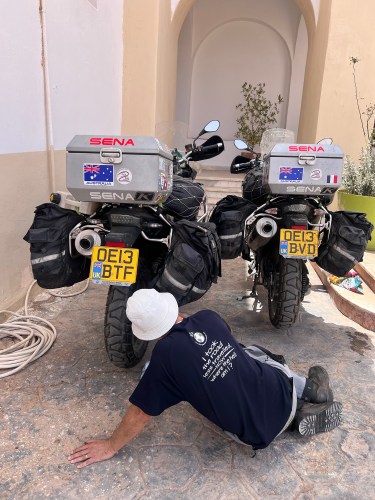
A wrong turn in the guts of old Ghardaia sends up a narrow lane, hairpin bend up another steeper lane to find out we’ve arrived at the back of the hotel. A quick U turn and we head back down, nearly into a reversing car on the sharp bend. Anthony swerves to avoid the car and we encounter our first unhappy driver shouting “il en enfoiré c’lui la” at me!! (He’s crazy that one!). Finally at our hotel having reversed our bikes off the road, I am totally exhausted and out of breath. This 37 degree heat and exercise is reminding me of my age these days!!
So why have I been so keen to ride through this vast expanse for the last couple of days to visit Ghardaia? Well its history, geography and house construction had fascinated me from what I had read.
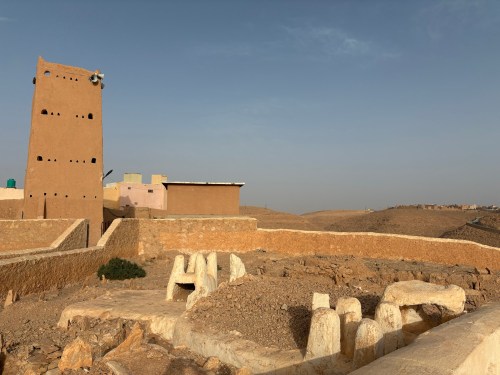
A bit of background first. Ghardaia, a hill top village that lies within the M’zab Valley about 600kms south of Algiers and is part of what is known as a Pentapolis, comprised of five walled villages, together with Melika, Beni-Isguen, Bounoura, and El Attuf. It dates back to the 11th century and was founded by the Mozabites, an Ibadi sect of the Berber Muslims. And unsurprisingly, it was declared a UNESCO World Heritage Site in 1982. All five are similar hilltop mini citadels, each with its own rampart, mosque, watch tower, cemetery. Ghardaïa and Melika are the only ones of the five that housed not only Ibadites Berbers, but also Malekits Arabs and a Jewish community until the Algerian Independence.

I cannot wait to see and experience this region!
The hotel we’re staying up was recommended to us by several people and I knew was designed by French architect Fernand Pouillon which sounded interesting. We find out over the next couple of days that it was once a prestigious hotel designed and built in 1970 over the remants of an old fort occupied by the colonial army. It was restored after being closed for 27 years as part of the 67th anniversary of the “Glorieuse Révolution du 1er Novembre 1954”. We also find out that it is now a state owned hotel. Think Faulty Towers service and you get an idea of what this place is like. The proudly placed large Visa sign on the reception counter is for show – cash only here. Menu prices are wrong, the proper prices (and you guessed it, more expensive) are in the computer.
The one thing going for the M’zab hotel is the most stunning view you get over the valley, super comfortable beds and interesting Fernand Pouillon architecture. When I saw our hotel from the other side of the valley the next day though, I was shocked and even embarassed to be staying there. While all the buildings around the M’zab valley have a gentle sand colour, this hotel is huge, white (with sand stained water marks down the walls instead of its original traditional colour that blended into the mountain) and looks so out of place. Even the palm trees have been replaced with stainless steel poles (meant to be flag poles but have no flags). What disappointing “restoration”. Enough on that.
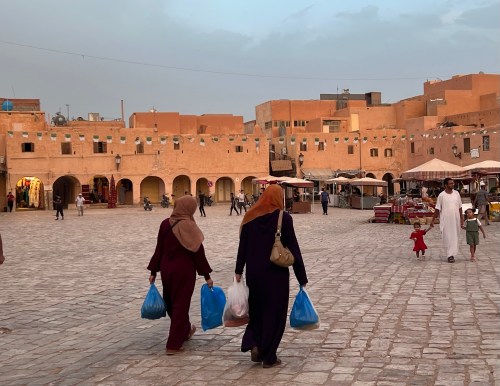
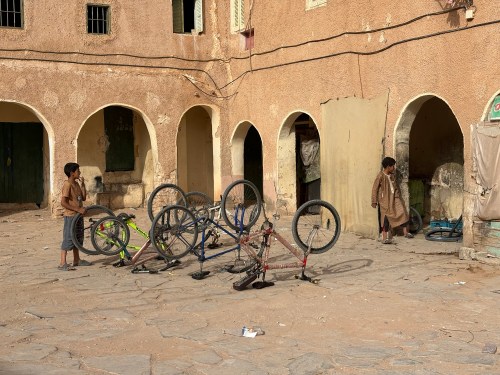
After a shower and a rest, we head down to the old market square. What a delight. We are welcomed by so many stall holders in the souq as we wander through the narrow lanes. Bienvenue! How refreshing to be in such a place and not be accosted to buy something. The beauty and advantage of little tourism to date. In fact we do not see a single tourist.

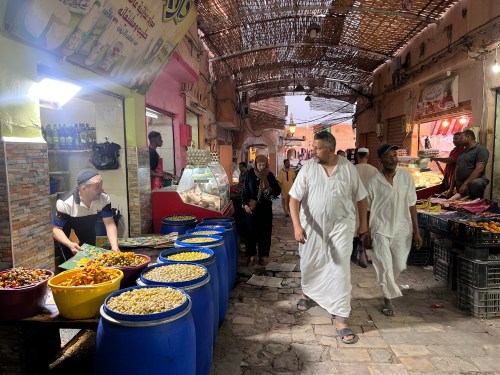

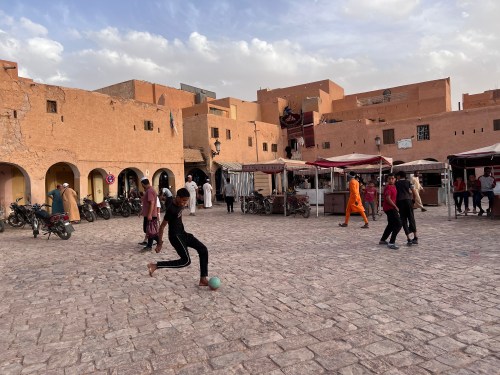
Rachid stopped us in the souq – he is a lecturer here and was shopping. Welcomed us to Ghardaia as all Algerians we cross do, chatted about his job and interest in renewable energy then took us to a drinks shop and bought us 2 cups of a local drink: Takerwait, a traditional Algerian beverage from the M’zab Valley, is made from a blend of natural ingredients, primarily dates, citrus fruits (like lemons), and a variety of herbs and spices. Specifically, it often includes myrtle flowers, marigold, and other aromatic plants. The infusion is typically sweetened with sugar and known for its slightly bitter and spicy flavor. It was very tasty.

After parting company, we continue wandering through the souq and Rachid comes back to us as he wants to introduce us to someone in the souq, even though he is in a rush to get elsewhere he tells us. We have no idea where we’re going but know it could be interesting.
There in this little store we’ve been taken to, we meet Hamid and Idriz in the souq who both spoke great English. After chatting for a while, I asked Hamid if he would be willing and available to be our guide. While I had already organised one for tomorrow morning, he only spoke some broken French. After some phone calls and messaging, juggling our day tomorrow, we now had Hamid picking us up at 9:30am and Hafid at 16:00. This is getting very exciting. Hamid will not take payment as it is his pleasure to take us around. Such kindness again.
Thursday morning and we’re excited to meet up with Hamid and discover a bit of this region with him.


Hamid was born in Ghardaia and knows the area well. He picks us up on the dot as planned. He is an engineer who has worked in various countries and speaks excellent English. It is nice for Anthony who has missed out on most of the conversations – even though I translate for him along the way, sometimes, it breaks the flow of conversation too much and he really missed out.
I was keen to see Melika so after being taken to get a bird’s eye view of the entire valley, we head to Melika next. The views are hazy all day today because of the wind and sand.

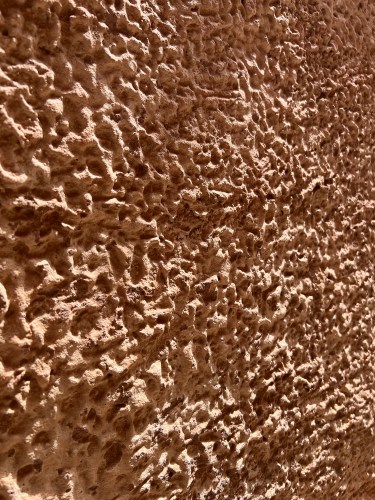
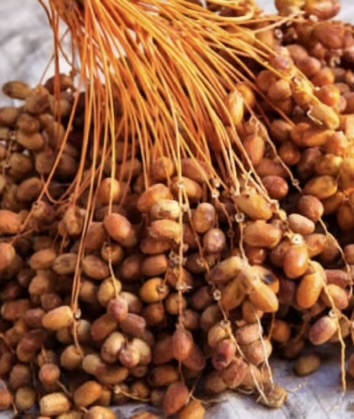
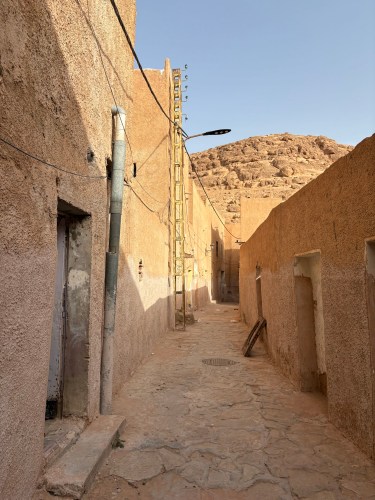
Hamid points out various cultural, environment and defensive designs adapted throughout the pentapolis. For privacy, front doors don’t face each other. All buildings are the same height so that one does not look over and into a neighbour’s house and roughly the same size. I had read that the wall coating is designed to create as much shade as possible thus reducing house temperatures by up to 20 percent. The walls are covered in little bumps created by first painting the walls with wet clay then thrashing them with the empty date branches. Streets are curved so that winds and sand storms can’t funnel down a street as they would do if straight. The dead ends are to confuse intruders or invaders. And there are no cars within those ancient walled cities. It is not difficult to see why these ancient cities should be a source of inspiration for urban planners today.

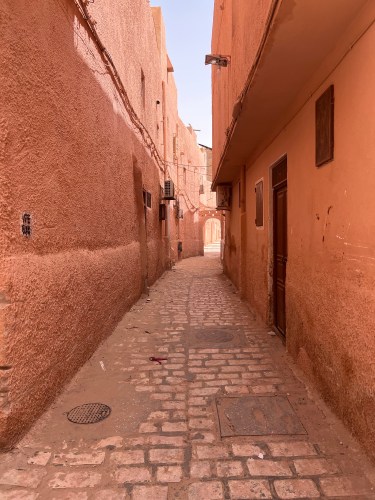
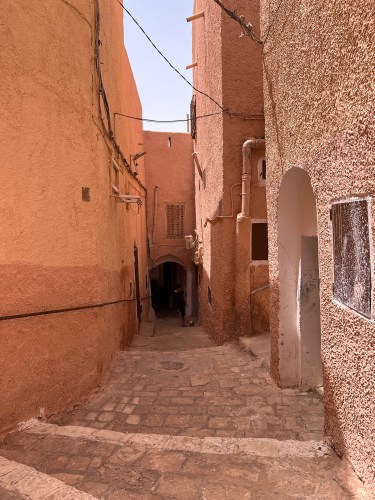

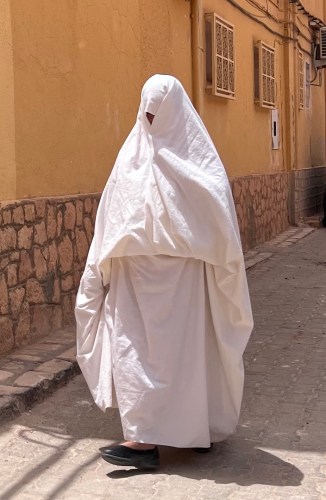
As we walk around Melika, I know not to take photos of people but really wish I could. Especially of the Mozabite women who wear a white shroud totally covering them but for one eye if they are married. I eventually mention this to Hamid who tells me that so long as it is taken from a distance, that was ok which is what I did. Here are a couple of cropped photos.
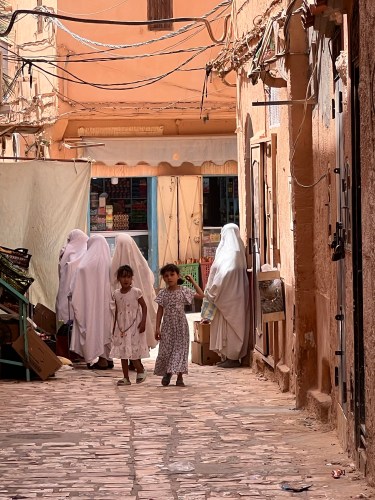
After an hour’s walk, we return to the square where there were a couple of shops for some cold drinks. Anthony counted the money and hands the coins to the store owner. He noticed Anthony put the coins into his right hand before handing them to him and thanks him. He appreciated Anthony’s cultural awareness of not using his left hand.

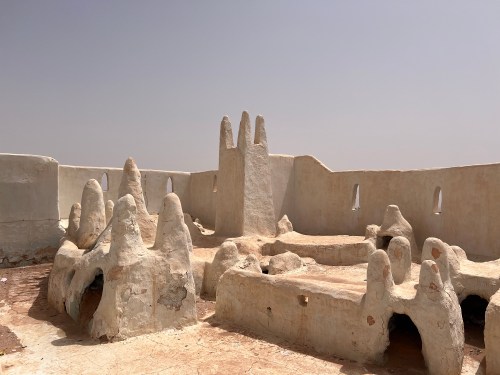
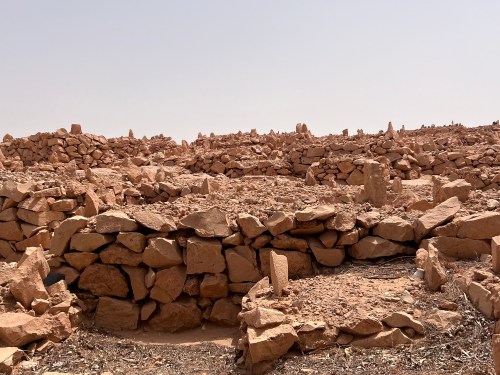
Our conversation throughout the day with Hamid is fluid going to so many topics, from energy to ancient civilisations, to travel, to life dreams, to today’s generation of entitlement, to his preference to eat fresh organic foods, to Algerian life including finding out why so many buildings in Algeria are unfinished. Algerians like to invest in bricks and mortar. It doesn’t matter that the house is unfinished – they have placed their investment in something tangible. They leave the exposed concrete rebar so that their children can expand onto their parents’ house.
At 4pm Hafid picks us up and first takes to an ossis outside Beni Isguen to see a centuries old dam wall that was ingeniously constructed to protect the city from violently flooding Ben Isguen.
Beni-Isguen, built in the fourteenth century, is surrounded by a great wall of 1525m in length and 3m in height with a thickness of up to 1m at the base and 20 cm at the top. It is the most sacred Berber Islamic town. It prohibits all non-M’zabites from various sections of the town, and all foreigners from spending the night within its walls.
We see our first tourists in a week here – so many! Must have seen a dozen!! I knew we could only visit this city with an official guide. While Hafid is an official guide, we are given another Ben Isfuen guide to take us around. Very kindly, they have provided us with Taha, a 19 year guide who spoke excellent English. First, we must read a huge sign which clearly states that we must not take photos of anyone. At one point during our visit, I wanted to take a photo of the market square pointing away from people. But in the distance, there was a child walking away. I had to wait to take the photo.
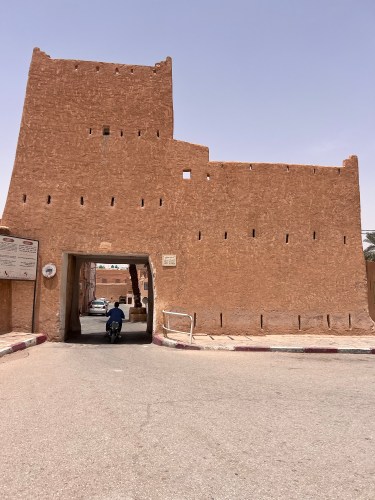

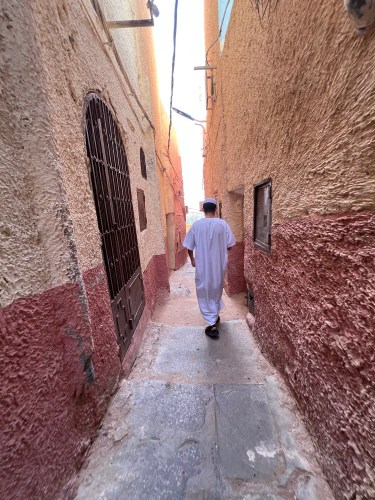
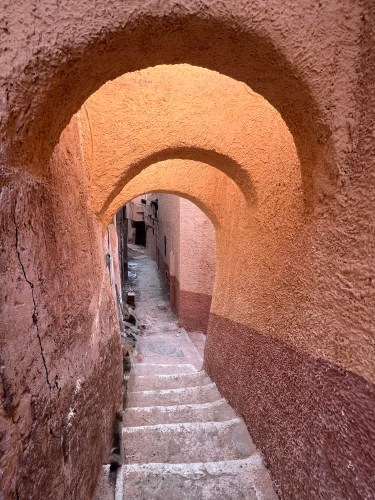
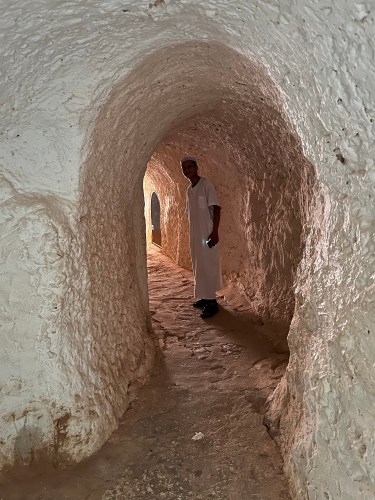
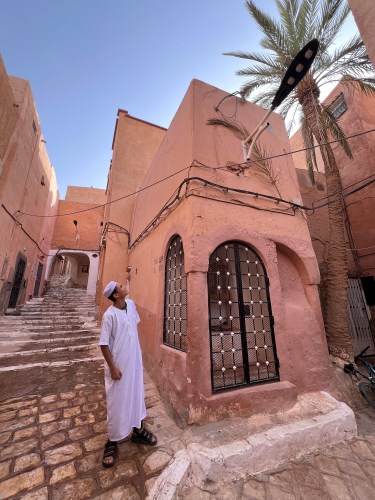
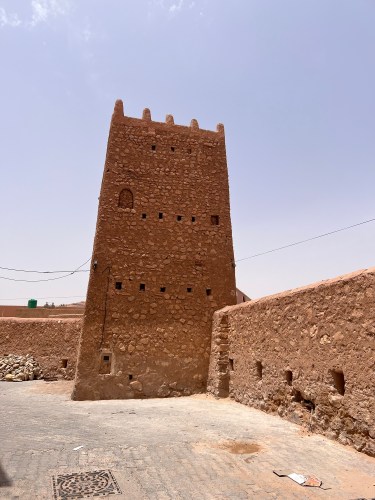
The next day, Friday, is prayer and family day. We are perfectly located to hear the Adhan, the call to prayer moving like a wave from minaret to minaret across the Valley around us. I first heard it from a roof top in Jeddah 20 years ago and I found it quite moving. For us it is a blogging and bike maintenance morning. Tins of tuna and sardines and corn crackers on the balcony for lunch then 4.5 hours with our guide Hafid for more discovery.
We head to Metlili 40kms away from Ghardaia then onto Sebseb, a spot on the edge of the Sahara sand dunes for sunset. How lovely to see so many families out together and just quietly sitting there waiting for that magical sunset. Anthony and I head out away from the “crowd” for a little moment alone. How special to be here!!! We have only been here 2 days, have seen and learned so much over the last two days – our brains are full. Makes us realise we need to change our way of life when we get home and not fritter our precious time away.


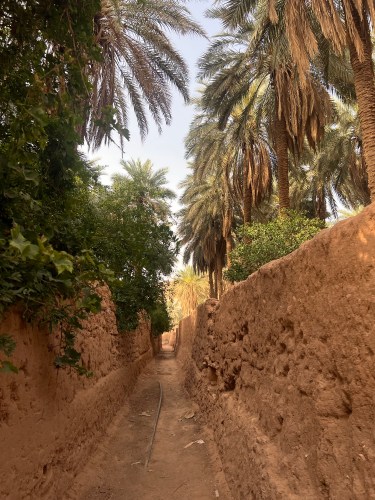

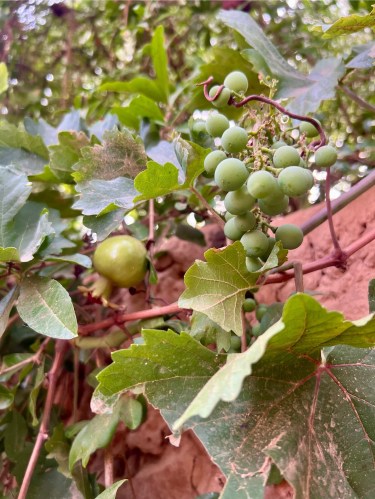

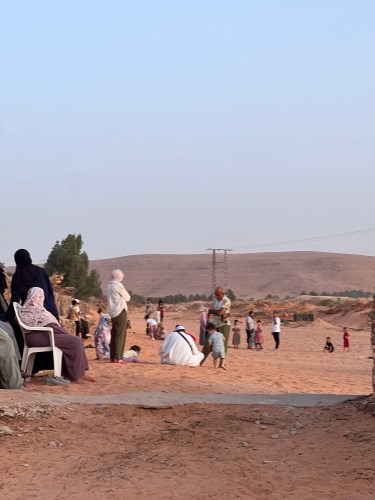
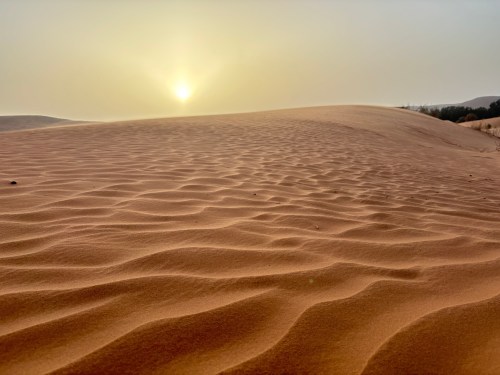
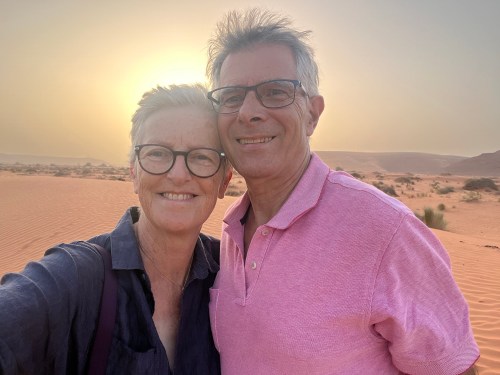
As we were driving back in the dark, I noticed what looked like thick low cloud or a mountain range in the distance which I knew wasn’t there. I point it out to Anthony as it seems so strange. 5’ later the most violent wind picks up whirling sand all over the place. I thought our sandy wind a couple of days ago was bad – this is heaps worse with visibility near disappearing for a time and impressive buffeting of the car. At least Hafid did momentarily slow down – not a comfortable ride with no seat belt, at 110kms in the dark up and down mountains. Thank goodness for the smaller places as we get back closer to Ghardia and have to slow down for the hundreds of speed humps.
We have had 3 different guides over the past two days and they each gave us a different perspective and slant on their city and its history. What a magical experience.
Once again, we leave a place having met some very kind people and made some wonderful connections. We hope we met Hamid again somewhere sometime. We also hope that tourism doesn’t change Ghardaia and its people too much and are grateful to have been there now.
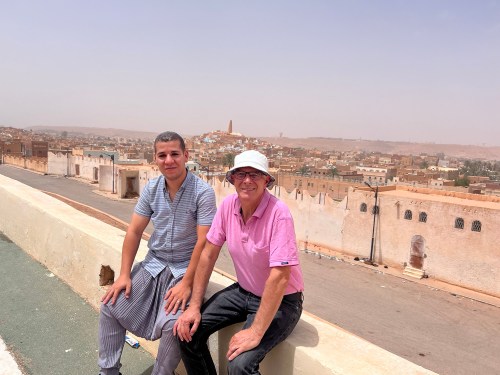
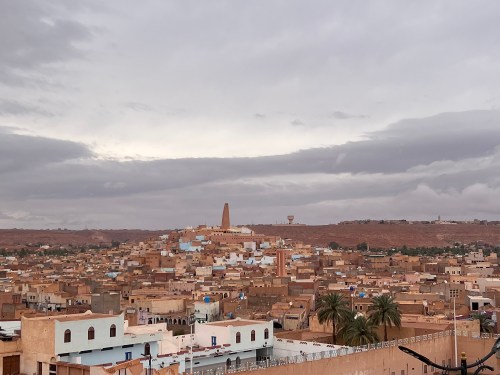
The wind howled all last night, sand blown into our room and it rained heavily. We get a different clear view of the valley.

What will today’s ride be like? We have 360kms to cover today to get to Touggourt – yes this is pretty much as far south as we’re going on this trip. Time to head off and find out what awaits us next.
– Anne
 2slowspeeds