Doha, a city less than on tenth the size of Ho Chi Minh City where we have just come from is a perfect mid point stop over to London. But it is much more than a convenient stop over point to avoid jetlag before we get to our family in the UK.
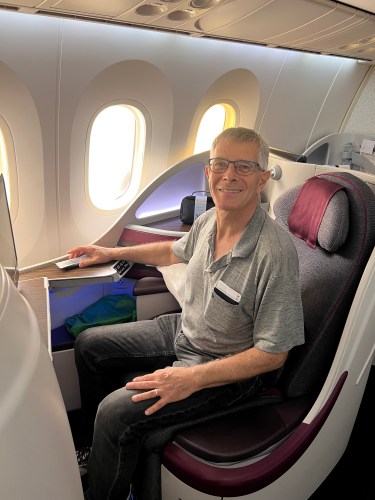
First, our journey over to Doha. With Anthony’s judicious use of points, and my Virgin status thanks to my flying up to Cairns for the past 19 months, we are sitting at the pointy end of this HCMC-Doha Qatar flight. The food menu, the selection of wines and the service are all impressive. We both particularly enjoyed the French 2016 Chateau Cantermerle red. What a contrast arriving in Doha to our Ho Chi Minh experience. No queuing for 2 hours to get through immigration but a swift pass through a private lounge and we’re out in the taxi just 30’ after landing!!
Doha has metamorphasised since I was first there in 2005! There was one international hotel back then – the Sheraton, with its funky design. The Sheraton was widely recognized as a symbol of the Doha Corniche’s development. It also catalyzed the creation of a new central business district called Al Dafna built on dredged land in the 1980s. It is still there, but totally surrounded now by much taller modern buildings and apparently refurbished inside.
We get to our hotel which I picked for its location close to a number of cultural museums I have been looking forward to visiting. We get the usual super friendly Arabic welcome and an added surprise – we have been upgraded to a studio for the next three nights! The bathroom is 3 times the size of ours at home!! Very nice!

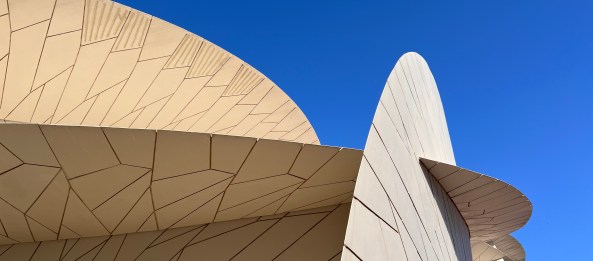
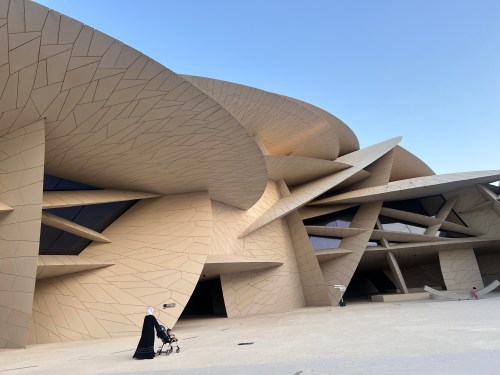
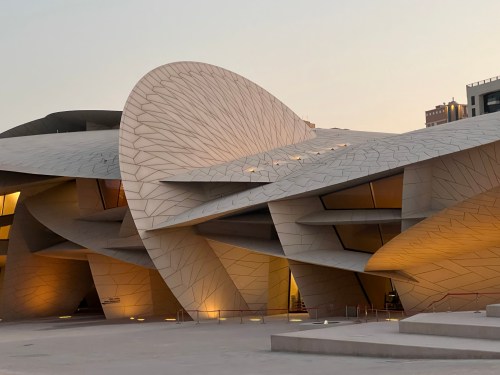
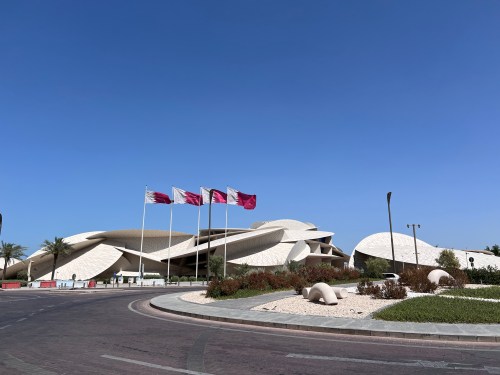
I cannot wait to discover the National Museum of Qatar close by, affectionately known as the Desert Rose for obvious reasons when you see it. In the words of the architect Jean Nouvel:
“The National Museum of Qatar is dedicated to the history of Qatar. Symbolically, its architecture evokes the desert, its silent and eternal dimension, but also the spirit of modernity and daring that have come along and shaken up what seemed unshakeable. So, it’s the contradictions in that history that I’ve sought to evoke here. I wanted to create a structure that evoked the local geography and, in keeping with the tradition of the place, to ensure that it offers maximum protection from the sun.”
The sun is going to be setting in an hour so no time to linger in our luxury appartment right now and perfect to admire Jean Nouvel’s creation in changing light. It is closed today but we’ll be visiting it tomorrow. We’ll just enjoy the outside architectuee for now.


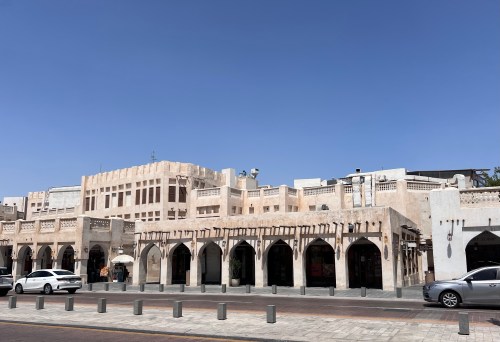
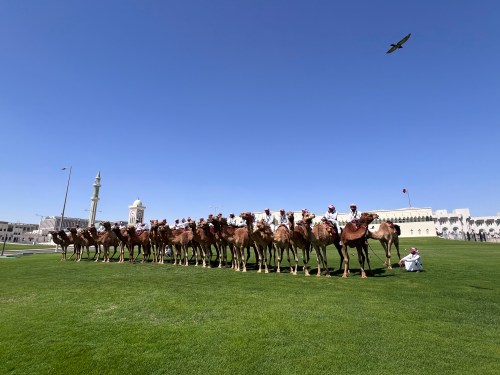
After a leisurely breakfast and a washing load (the apartment has a washer/dryer!) we decide to walk to the Falcon Souq (market). There are very few pedestrians out as it is hot already!! We wend our way to the souq, through the Souq Wakif Park first, and after first stopping for an unexpected sight. The Palace Guard is out, lined up outside Amiri Diwan, which is the administrative office of the Ruler of Qatar. The Amiri Diwan is the seat of rule of the State of Qatar. It is the sovereign body and the administrative office of HH The Amir. It acts as a nexus between His Highness and all governmental and non-governmental bodies internally and externally. The Palace Guard used to ride the most special and majestic camels, patrolling the area in order to protect their Emir (ruler). Today, they are all lined up, happy enough for us and the 3 other visitors around to take photos. The guards eventually dismount, the guard nearest me and his camel exchange a kiss, and the whole group eventually leave the park and make their way back to the royal stables, a man diligently following behind, sweeping the road of any camel “gift”.
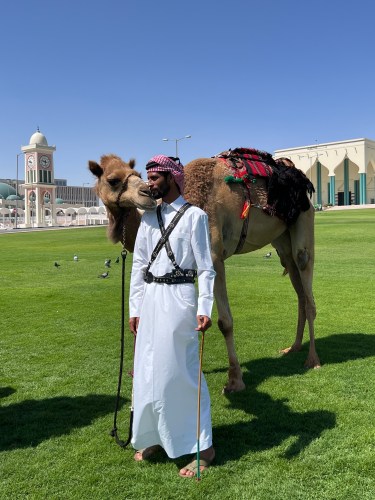

After this unexpected spectacle, we continue our way to the Falcon hospital and falcon souq. We know we are in the right area when we come across two men each holding their falcons. We approach each one and they kindly accept we ask questions about their birds and ask whether we can take photos. They have just come from the falcon hospital, one Qatari actually holding syringes of medication for his 15 year old falcon.

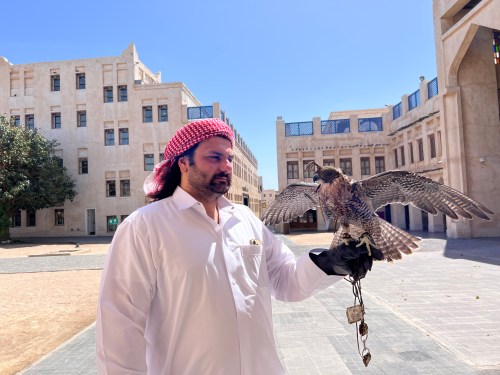
The falcon is the national bird of Qatar. With almost 8 times better vision than the sharpest of human eyesight, falcons silently swoop down as soon as they’ve spotted their prey. The qualities of this wild bird launched the tradition of hunting fresh meat to augment the nutrition of desert nomads, over 5000 years ago in Iran and was spread across the Middle Eastern countries over centuries. The bond created between the bird and its trainer always results in a great hunting partnership. This solitary bird educates patience, endurance, self-reliance, and valour among other things to its falconers. associated with wealth and nobility, for owning a healthy falcon is an affluent and time-consuming proposition. These formidable hunters generally have a lifespan of 12-15 years.
The Peregrine falcon is the fastest recorded animal in the world with a flight speed of up to 389km/242 miles per hour.
We make our way to the falcon hospital next – the reception has one falcon waiting its turn, perched on one of the many perches. Behind reception is an xray on some poorly falcon being examined.
There is small museum which visit and try and learn as much as we can. Walking around the reception area, we notice the pharmacy area and and automatic falcon medication vending machine.


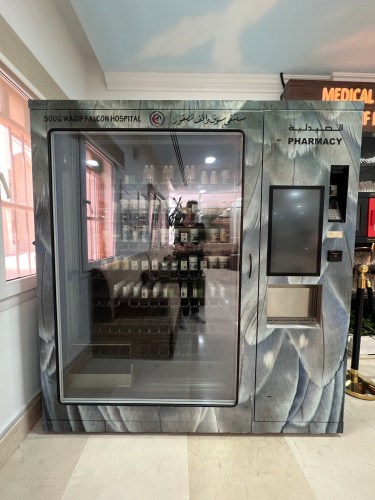
One of the receptionists notice our keen interest and asks if we’d like to visit the hospital and takes us around. It is the low season so there are no falcon being operated on right now but he takes around all the rooms, explains the history and physical capabilities of these magnificient birds and explains how they replace feathers. Fascinating.

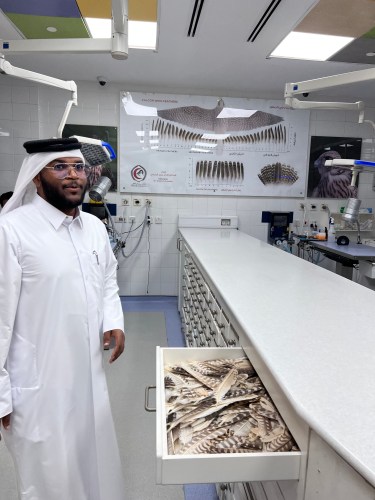
This falcon hospital is run by the government, which tends and cures injured falcons. There are also more expensive private falcon hospitals. It is like our medical health, pay more if you want your bird seen to sooner.
After our wonderful private tour, we head off to the souq. I am not sure how many stores there are in the area but easily a couple of dozen stores dedicated to falconery parafanalia, falconery camping equipment and even falcon sales. As it is the off season, the sale is on and you can buy an older falcon for just a few thousand dollars. The new season with younger fresher birds starts up again in August. It was interesting to hear that most birds come from Germany, a cooler and better climate for breeding. We are told some birds easily reach US$275000.
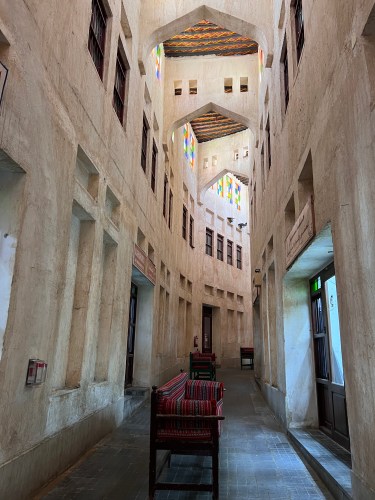
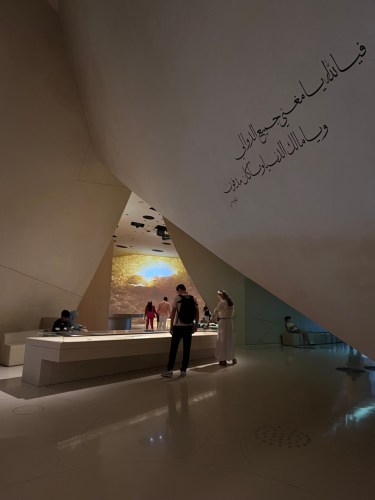
After returning to our hotel for a rest, we head out again around 5pm to visit the National museum. The inside architecture does not disappoint.

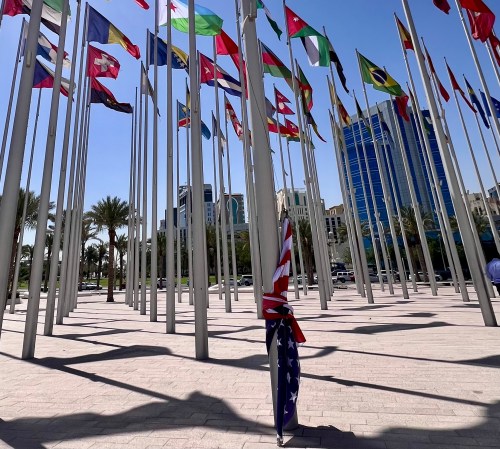
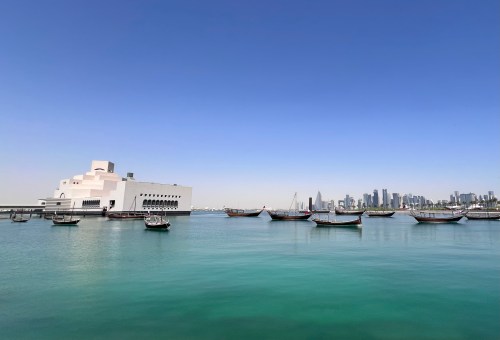
On our 2nd day, we head to the Islamic Art Museum, via the flag plaza. Interesting to notice someone obviously removed the US flag and tied it up close to the ground…. No doubt a reaction to the recent political events…
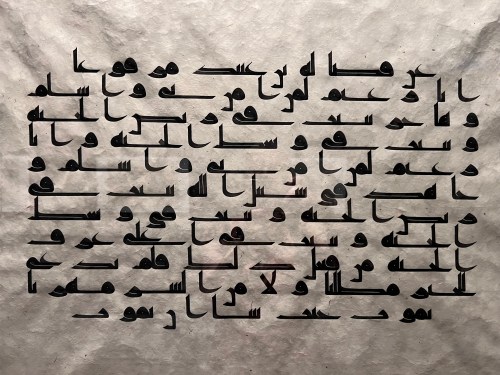
We are lucky that the Islamic Art museum is currently showing the results of the Al-Ragim International Calligraphy Competition, an international event organized by the Qatar Ministry of Endowments (Awqaf) and Islamic Affairs, in collaboration with the Museum of Islamic Art. The competition was designed to feature five distinct Arabic calligraphy scripts: Thumuth, Naskh, Nastaliq, Kufic and Diwani, each one with a jeli, or larger and decorative version.
The Thuluth script, developed in the 10th century, is celebrated for its graceful, flowing form with curved and oblique lines, earning it the title “mother of all scripts.” Its name, meaning “one-third” in Arabic, refers to the slanted proportion of each letter. This scripts versatility enabled calligraphers to craft intricate compositions, particularly in Jali Thuluth, which was widely used in architectural inscriptions.
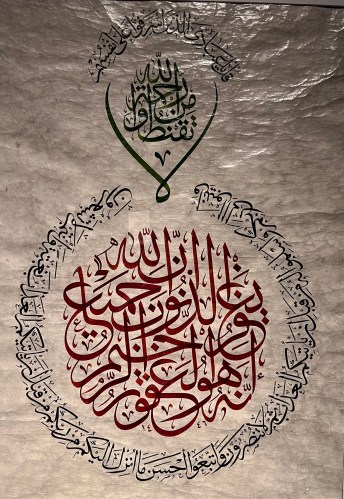
The Naskh script, developed in the 10th century, is renowned for its legibility and balanced proportions. Its clarity made it ideal for transcribing the Qur’an and various manuscripts.
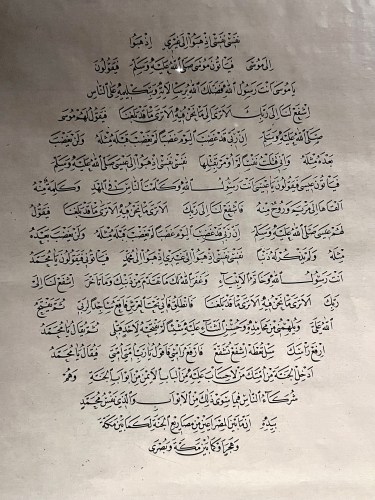
The Nastaliq script, developed in the late 14th century, is attributed to Mir ‘Ali Tabrizi (active circa 1370-1410). He refined existing scripts to create a fluid and elegant style, becoming the standard for Persian calligraphy. As Persian became the official court language of the Persianate world, Nastalia flourished as the primary script for chancery documents as well as poetry, embodying the beauty of Persian literature.

The Kufic script, one of the earliest forms of Arabic calligraphy, emerged in the 8th century, deriving its name from the city of Kufa in Iraq. Characterized by its angular, geometric letterforms with straight lines and sharp angles, as well as the absence of diacritical marks, it was extensively used for transcribing Quranic manuscripts and adorning architectural monuments. Over time, Kufic evolved into various styles, including foliated, knotted, and square Kufic, each distinguished by unique decorative elements. The oldest known inscription in an Islamic monument, using this script, adorns the interior of the Dome of the Rock in Jerusalem, dating to 691-692.
The Diwani script, developed during the early Ottoman period, was used for official state documents and valued for its intricate features and confidentiality. It reached its peak under Sultan Süleyman the Magnificent (r. 1520-1566). In the 16th century, the embellished Diwani Jali variant emerged, known for its dense, ornate style, making it difficult to read and preventing forgery. Only specialized calligraphers could decipher it.


I wonder which is your fabourite.
I was particularly taken by the Diwani script.
What a fabulous and informative exhibition.
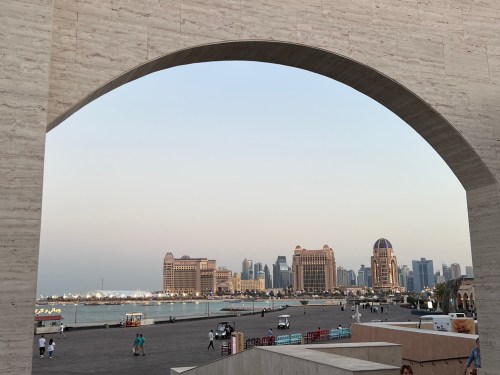
In the evening, we head to the Katara Cultural village. Maybe we did not give it the time it deserves, but I felt it was one huge fantasy luxury area. Not our thing but it was impressive to be able to sit outside for a well deserved drink in the high 30 degrees and feeling cool from the outside airconditioning coming through vents in the ground!!
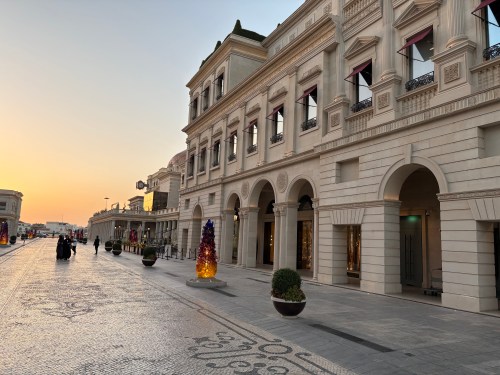
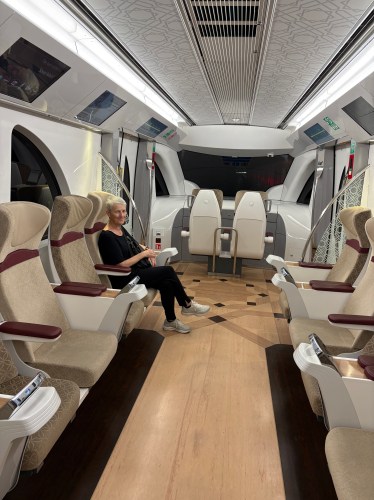
We took the metro there and back and accidentally ended up in the gold class section – once in, we couldn’t get out and move to the normal class!!

As you can tell, we had a fabulous time in Doha. These hops since Brisbane have been great to slowly deal with jetlag. Now for one last flight before we get to see family!!
– Anne
 2slowspeeds
More adventures,photos and stories to archive in the memory bank Anne…..well done !
LikeLike
Great blog!!! I have passed through when connecting to Europe will now look to stop over and have a peak around as it looks interesting.
All the best John M
LikeLike
slick! World’s First Carbon-Neutral Country Achieves Goal 2025 ornate
LikeLike